


Finding a negative Ripoff Report can feel like a punch to the gut. It’s frustrating, and given the site's policies, it can seem like there’s nothing you can do. But that’s not true. While getting a report deleted outright is nearly impossible, you have solid, actionable options to make it irrelevant.
The game plan boils down to three core approaches: using their internal VIP Arbitration Program, taking legal action against the person who wrote the report, or launching a targeted SEO campaign to bury it. Think of this as your playbook for taking back control.
Confronting The Ripoff Report Challenge
Let's be clear: Ripoff Report is built to be a fortress. Thanks to Section 230 of the Communications Decency Act, the site itself is generally not liable for what users post. This is why they stand by their "no removal" policy, leaving many business owners feeling trapped.
But a negative listing isn't a life sentence for your brand. You just need to shift your focus from "removal" to "mitigation." The real goal is to neutralize the report's impact, either by getting an official update posted on the page or by pushing it so far down in Google search results that no one will ever find it.
This flowchart maps out the decision-making process, showing you the different paths you can take to get a Ripoff Report out of the public eye.
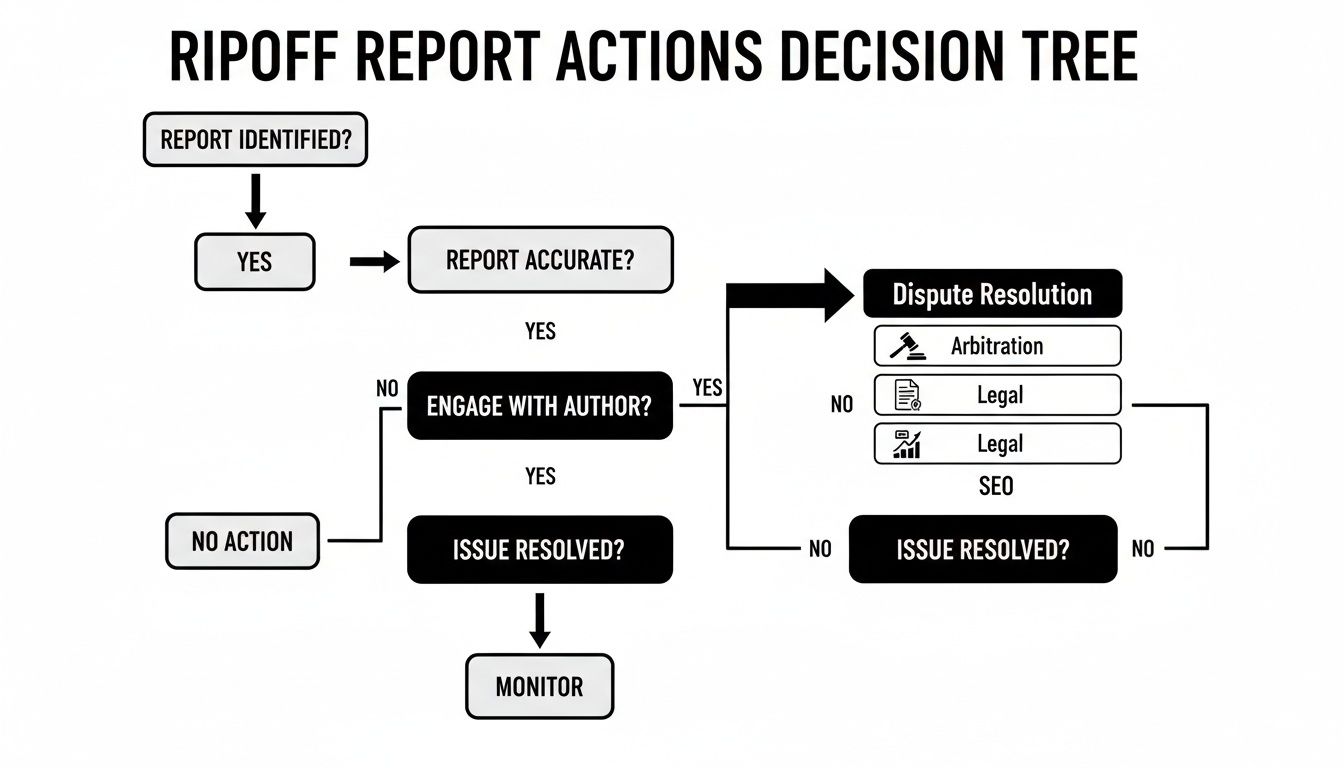
As you can see, your options split into three main directions: working within the Ripoff Report system, pursuing legal options against the author, or using SEO to suppress the negative content.
Your Strategic Pathways Forward
The damage from false or malicious online content is staggering. Fake online reviews are responsible for over $152 billion in losses for businesses worldwide each year, a number that's only climbing. This is the environment we're operating in.
Because of this, you need a structured game plan. The right strategy for you will hinge on the details of your situation, your budget, and how quickly you need results.
Here’s a quick overview of the main strategies you can deploy.
| Ripoff Report Mitigation Strategy Overview | |||
|---|---|---|---|
| Strategy | Primary Goal | Key Action | Success Factor |
| Platform-Based Resolution (VIP Arbitration) | Get an official update/retraction posted on the report itself. | Pay for and engage in Ripoff Report's arbitration program. | Willingness to pay the high fees and having strong evidence to prove the report is false. |
| Legal Action (Defamation Lawsuit) | Obtain a court order to force search engines to de-index the URL. | Sue the original author of the report for defamation. | A strong legal case, the ability to identify the author, and a favorable court ruling. |
| SEO Suppression | Push the negative report off the first page of Google search results. | Create and promote a network of positive, high-ranking content. | A consistent, long-term investment in content creation, link building, and digital PR. |
Each of these paths demands a different set of resources and expertise. Knowing how these approaches fit into broader online reputation management strategies can give you a better perspective on the long-term effort required. Now, let's dive into the specifics of how to execute each one.
Building Your Case with Evidence
When you first discover a negative Ripoff Report about your business, the natural reaction is a mix of anger and frustration. It feels personal. But letting emotion drive your response is the single biggest mistake you can make. The first step isn't to fire back—it's to methodically build an airtight case.
Think of it this way: you need to create a dossier of evidence so strong that it completely dismantles the report's claims. This isn't just for a potential lawsuit; it's the foundation for every single option you have, from arbitration to a public rebuttal.
Start by printing out the report and going through it line by line with a highlighter. Pinpoint every single statement that is demonstrably false, misleading, or a flat-out lie. This takes the rambling, emotional complaint and breaks it down into a series of specific, manageable points you can directly refute.
Assembling Your Proof
With your list of false claims in hand, it's time to play detective and gather the hard proof to contradict each one. You're not just saying, "That's not true." You're proving it with documentation that leaves no room for doubt.
Your evidence file needs to be organized and utterly convincing. Here’s what you should be collecting:
- Dated Screenshots: Grab a full-page screenshot of the Ripoff Report. Make sure the URL and the date you took it are visible. This locks in the original text in case the author tries to edit it later.
- Communication Logs: Pull together every email, text message, and social media DM you have with this person. Often, their own words will contradict their public complaint or show that you were trying in good faith to solve the problem.
- Transaction Records: This is non-negotiable. Find the invoices, payment confirmations, and receipts that show the real financial story. This is your silver bullet against claims about pricing or non-payment.
- Proof of Work: If the report is about your service, gather the project plans, signed contracts, photos of the finished work, or delivery confirmations. Anything that proves you held up your end of the bargain is gold.
Without this evidence, you're stuck in a "he said, she said" battle you can't win. With it, you control the narrative with facts.
Organizing Evidence for Maximum Impact
A jumbled mess of files won’t do you any good. You need to organize your evidence so that anyone—an arbitrator, a lawyer, or even a potential customer reading your rebuttal—can immediately understand your side of the story.
Create a main folder for the case on your computer, then use subfolders for each category of proof. For instance, if someone claims you never delivered their product, you should have a folder containing the purchase order, the payment receipt, the shipping confirmation email with the tracking number, and a screenshot from the carrier’s website showing it was delivered.
Pro Tip: Your evidence needs to tell a clear, chronological story. The goal is to make the original report look ridiculous when confronted with the sheer weight of your factual documentation.
I always recommend creating a simple summary document. In one column, list each false claim from the report. In the next column, link directly to the specific file in your evidence folder that proves it's false. This becomes your playbook for every move you make.
This level of preparation isn't just for legal battles. It allows you to write a public rebuttal that is calm, factual, and incredibly persuasive. Instead of an emotional rant, you can confidently state the facts, knowing you have the proof to back up every word. A well-built case is the only real weapon you have in this fight.
Working Within Ripoff Report's System
Before you explore legal avenues or SEO strategies, it’s smart to understand the resolution paths offered directly by Ripoff Report. These aren't your typical "report a post" buttons. Instead, they are formal, paid programs designed to add official context—but not removal—to a damaging report.
This route isn't for everyone. It means engaging directly with the platform hosting the negative content and involves a significant financial investment. But for businesses that have rock-solid evidence and the budget, it can be a way to officially discredit a false report right on the page itself.

The VIP Arbitration Program
The VIP Arbitration Program is Ripoff Report's main paid channel for challenging a report's accuracy. Think of it as a private, binding mini-trial. Your goal is to prove to a neutral, third-party arbitrator that the statements made against you are factually false.
This is where all the evidence you’ve gathered—contracts, emails, payment records—comes into play. You submit your case, and the person who wrote the report is invited to defend their claims. Even if they don’t show up, the process moves forward.
Here’s a rough breakdown of what to expect:
- Initiation: You'll pay a significant upfront fee to get the ball rolling, often starting in the thousands of dollars.
- Evidence Submission: You and the original author (if they participate) submit all your documentation and arguments.
- Arbitrator Review: The independent arbitrator sifts through everything to determine the facts of the matter.
- The Decision: A binding decision is issued.
Key Point: Winning the arbitration does not get the report deleted. What it does is force Ripoff Report to post a prominent headline and update at the very top of the report, stating that the claims were found to be false by a neutral arbitrator.
This official update can be a powerful tool. Anyone who lands on that page will immediately see the arbitrator's findings, which can completely neutralize the original complaint's impact.
The Corporate Advocacy Program (CAP)
Another option is the Corporate Advocacy Program (CAP). This program is less about disputing facts and more about demonstrating your company's commitment to customer satisfaction. It’s essentially a paid reputation management service offered by Ripoff Report itself.
Joining CAP allows you to post official, verified responses and resolutions to complaints. It's designed to show that you're proactive about addressing customer issues. The downside? It’s a subscription-based service, and many businesses balk at the idea of paying the very platform hosting the negative content.
Deciding between these programs requires careful thought. For a more detailed look at the pros and cons, our comprehensive guide offers deeper insights. You can learn more about the nuances of Ripoff Report removal and decide if it's the right path for you.
Writing a Rebuttal That Actually Works
Whether you pay for a program or not, your first move should always be to post a public rebuttal. It's free, it's immediate, and it's your first chance to reclaim the narrative. How you write this response is absolutely critical.
You need to come across as professional, calm, and in control. Don't get emotional or launch personal attacks—that just makes you look guilty. Stick to the facts.
A simple but effective framework for your rebuttal:
- Acknowledge Calmly: Start by acknowledging the post without admitting any wrongdoing. For example: "We are writing in response to the concerns raised in this post."
- Present Key Facts: Counter the main allegations with your evidence, but keep it concise. For instance: "Our records show the project was completed and signed off on by the client on [Date]."
- Move the Conversation Offline: Offer a direct line of contact. This shows you're reasonable and willing to resolve things, which looks great to potential customers. Try something like: "We invite the original poster to contact our office directly at [Email Address] to discuss their concerns."
The internet is swimming with fake reviews, making your level-headed response even more important. Data from 2021 revealed that of 2.7 million fake reviews pulled from major sites, an astonishing 46% were actually five-star reviews. This trend, highlighted by Statista's research on review manipulation, proves that online content is often used to unfairly harm and artificially boost reputations.
A well-written rebuttal cuts through that noise, providing an immediate counter-narrative while you plan your next move.
Pursuing Legal Action for Defamation
When you've tried everything else—rebuttals, arbitration, direct appeals—and that damaging report is still sitting there, legal action can feel like the nuclear option. It's a serious step, but sometimes it's the only one that truly works.
The biggest mistake I see businesses make is trying to sue Ripoff Report directly. It's an understandable impulse, but it's almost always a dead end thanks to Section 230 of the Communications Decency Act, which shields platforms from liability for user-generated content.
The right move, and the one that actually gets results, is to file a lawsuit against the person who wrote the report. The real goal here isn't a big payday; it's getting a court order that officially declares the post as defamatory. That court order is your golden ticket—it's what finally gets Google to listen.

What It Takes to Prove Libel
Suing for defamation isn't about being upset; it's about proving a specific type of legal harm called libel (which is written defamation). You can't just walk into court and say a post is mean. You and your attorney have to build a case that checks several specific boxes.
Here’s what your legal team must prove about the statements in the report:
- They are false. This is the big one. You need to show, with evidence, that the core accusations are factually incorrect. All those emails, contracts, and records you gathered earlier? This is where they become the foundation of your case.
- They were published. A post on a public website like Ripoff Report easily meets this standard.
- They caused damage. You have to show real, tangible harm. Did you lose a major client right after they found the report? Can you show a dip in sales that lines up with the post's publication? This is about connecting the dots between the lies and your losses.
- They were unprivileged. This just means the statements weren't made in a protected setting, like testimony in a courtroom.
It’s a high bar, no question. But with the right evidence, it’s absolutely possible to win and flip the script from defense to offense.
The Real Power of a Court Order
The ultimate prize in this fight is that signed court order. Once a judge has legally branded the content as defamatory, everything changes. You now have a weapon that search engines and even Ripoff Report have to respect.
Armed with a court order, you can submit a formal removal request to Google. Google is generally hands-off with disputes, but they have a clear process for complying with legal rulings. When they receive a valid order, they will de-index the URL. This means the Ripoff Report page vanishes from search results for your name or business. For all intents and purposes, it's gone.
A court order transforms your request from a complaint into a legal mandate. It’s the difference between asking a search engine to take something down and compelling them to do so based on a judicial ruling.
Even Ripoff Report itself, known for its rigid "no removal" policy, tends to cooperate when faced with a court's decision. They won't delete the post, but they often redact the defamatory statements or add an update at the top explaining the court's findings, effectively neutering the original claims.
Don't Overlook Other Legal Angles, Like a DMCA Takedown
While defamation is the main event, it’s not your only option. In some very specific situations, you might have a faster, cheaper path available through copyright law.
The Digital Millennium Copyright Act (DMCA) is a powerful tool if the report uses your intellectual property without permission. Did the author steal a photo from your website? Did they lift your company logo or copy and paste huge chunks of your marketing text? If so, you can file a DMCA takedown notice.
This strategy doesn't target the lies themselves but rather the stolen material. However, if that copyrighted image or text is a key part of the report, removing it can leave the post looking broken, incoherent, and far less credible. It's a surgical strike, but when the conditions are right, it can be a surprisingly effective way to cripple a damaging report without the time and expense of a full-blown lawsuit.
Using SEO Suppression To Control Your Search Results
When getting a Ripoff Report removed directly just isn't in the cards, you have to change the game. This is where SEO suppression comes in. It's the strategy of burying that negative listing by creating a wave of positive, high-authority content that Google will rank higher.
The goal is pretty straightforward: when someone Googles your name or your business, you want them to see a first page filled with professional websites and profiles that you control. This pushes the Ripoff Report down to page two, three, or even further—where almost no one ever looks.
This isn't a quick trick; it’s a methodical campaign to build a strong, positive online presence that defines your reputation. You’re not just throwing content out there; you're strategically telling your story on platforms Google already trusts.
Building Your Network Of Positive Digital Assets
The heart of any suppression campaign is creating and optimizing a range of online properties. Think of each one as a piece of digital real estate you own on Google’s first page. And just like real estate, some properties are more valuable than others.
You should start with the assets that have built-in authority and are directly tied to your brand. These are the cornerstones of your defense.
- Your Official Website: This is non-negotiable and your single most important asset. It needs to be fully optimized for your brand name, featuring a solid "About Us" page, clear service descriptions, and ideally, an active blog.
- Social Media Profiles: Get on all the major platforms—LinkedIn, Facebook, X (formerly Twitter), Instagram—and fill out your profiles completely. These platforms have immense domain authority and tend to rank very well for name searches with minimal effort.
- Business Directories: Set up detailed, complete listings on heavy-hitters like Google Business Profile, Yelp, and any directories specific to your industry. A well-managed profile, especially one with positive reviews, carries a lot of weight.
To push down a negative link, your own positive pages need to be strong enough to rank above it. If that’s a challenge, figuring out why your website isn't ranking and how to fix it is the first problem you need to solve. Once your core properties are in good shape, you can start expanding.
Amplifying Your Reach With High-Authority Content
Once your foundation is solid, the next step is to create a steady stream of positive content on other people's websites. This tactic works by borrowing the authority of established platforms to create more positive search results for your name.
Press releases are a classic for a reason. Announce a new project, a company milestone, or a charity sponsorship. This can get picked up by dozens of small news outlets, each creating a new positive mention. Another great tactic is writing guest posts for respected blogs in your field. This not only positions you as an authority but also creates a powerful, positive search result that you control.
Expert Insight: The biggest mistake I see is people putting all their eggs in one basket. A successful suppression campaign needs diversity. A healthy mix of social profiles, press releases, guest articles, and directory listings looks far more natural to Google and builds a much stronger defense.
This is a long-term play. For a deeper dive, our guide on how to suppress negative search results covers more advanced strategies for building out your positive online footprint.
To help you prioritize, here’s a look at the most effective digital assets for an SEO suppression campaign.
High-Impact Assets for SEO Suppression
This table breaks down the types of online properties you should focus on creating, ranked by how effective they typically are at influencing search results.
| Asset Type | Why It Works | Optimization Tip |
|---|---|---|
| Official Website/Blog | Highest authority and control. This is your digital home base. | Optimize the homepage and "About Us" page titles and content for your exact brand name. |
| LinkedIn Profile | Extremely high domain authority; often ranks in the top 5 for personal names. | Fully complete your profile, use a professional headshot, and make your headline keyword-rich. |
| Google Business Profile | Dominates local search and appears in the main search results with maps and reviews. | Fill out every single section, add high-quality photos, and actively encourage customer reviews. |
| Other Social Media | Facebook, X, Instagram, etc., have massive authority and rank easily for brand names. | Claim your name/brand on all major platforms. Keep them active, even with minimal posting. |
| Guest Posts | "Borrows" the authority of an established, relevant website in your industry. | Target high-authority blogs and write genuinely useful content. Ensure your name is in the author bio. |
| Press Releases | Distributes your news across dozens of syndicated news sites, creating multiple positive mentions. | Focus on newsworthy announcements (events, awards, new hires) for the best pickup. |
| Video Platforms (YouTube) | YouTube is the world's second-largest search engine; videos can rank on Google's main page. | Create a branded channel and upload a simple "About Us" or introductory video. |
| Industry Directories | High-authority, niche-specific sites that Google trusts for business information. | Find the top 3-5 directories for your specific field and create detailed, consistent listings. |
Creating a diverse mix of these assets is the key to building a resilient and positive first page of search results.
The Critical Role Of Content Quality And Consistency
Look, it’s not enough to just create these profiles and walk away. An empty Twitter profile or a blog with one post from 2021 isn't going to outrank a powerful site like Ripoff Report. Google rewards fresh, relevant, and active content.
Your efforts are a direct countermeasure to the kind of damaging, often fake, content that can pop up online. The scale of this problem is huge. In 2023, Trustpilot alone removed a staggering 3.3 million fake reviews. A full 82% of these were caught by automated systems that flagged them as suspicious. This shows just how easily a reputation can be attacked with fraudulent content, which is precisely why you need to build your own network of authentic, positive assets.
An SEO suppression campaign is a marathon, not a sprint. It can take anywhere from 3 to 12 months to see a real shift in your search results, depending on how authoritative the negative link is. But the investment pays off by giving you a lasting defense that puts you back in control of your own story.
Common Questions About Ripoff Report Removal
Finding your business on Ripoff Report can be a gut-wrenching experience, and it's completely normal to feel overwhelmed and unsure of what to do next. This isn't a simple problem with an easy fix, but understanding how the platform operates is the first, most crucial step toward taking back control of your reputation. We've compiled the questions we hear most often from business owners in this exact situation and answered them with practical, no-nonsense advice.

Can I Sue Ripoff Report to Have a Post Removed?
To put it bluntly, almost never. Ripoff Report is protected by a powerful piece of federal legislation called Section 230 of the Communications Decency Act. This law effectively treats sites like Ripoff Report as a public bulletin board, not the publisher of the content.
This legal shield means any lawsuit aimed directly at the platform itself is almost guaranteed to be dismissed. The correct legal path, if you choose to take it, is to go after the person who actually wrote the defamatory post. If you sue the original author and secure a court order declaring the statements false, you have a potent legal tool. While Ripoff Report isn't forced to comply, they may agree to redact the report or add an update reflecting the court's judgment.
How Much Does the VIP Arbitration Program Cost?
Be prepared for a significant financial investment. Ripoff Report’s VIP Arbitration Program isn't cheap, and while the final cost depends on the specifics of your case, the initial fees alone run into thousands of dollars. It’s a formal, binding process where you make your case to a neutral arbitrator.
The entire goal is to prove, with concrete evidence, that the statements made in the report are factually untrue. Here's the catch: even if you win, the report is not removed. Instead, Ripoff Report places a prominent update at the top of the page stating that the claims were found to be false. You have to do a serious cost-benefit analysis, weighing the program's high price tag against the real-world financial damage the report is causing your business.
How Long Does SEO Suppression Take to Work?
Think marathon, not a sprint. There's no quick fix or magic button to bury a negative search result. A realistic timeline for seeing meaningful change can be anywhere from a few months to well over a year.
How fast you see results really depends on a few key things:
- Your Website's Authority: If your business already has a strong, established online footprint, you’ll see results much faster.
- The Report's Authority: A Ripoff Report that’s been sitting online for years, collecting backlinks, is a lot tougher to dislodge from the first page.
- Consistency of Effort: This isn’t a one-and-done task. Suppression demands a sustained, ongoing campaign of creating and promoting positive content.
You might start to see some positive movement in the search rankings within 3-6 months. But pushing a stubborn Ripoff Report off the first page of Google for good often requires a dedicated effort lasting 6-12 months, sometimes even longer.
The key to successful suppression is diversifying your positive assets. Relying solely on one or two social media profiles is not enough. You need a mix of high-authority content—from guest posts and press releases to optimized business directories—to build a digital fortress around your brand.
What Is the Best First Step I Should Take?
Your most powerful and immediate move is completely free and totally in your control: post a rebuttal. Head to the Ripoff Report page and write a calm, professional, and factual response. This is your chance to immediately present your side of the story to any potential customer who finds the report.
Avoid getting emotional. Don't engage in personal attacks or get defensive. Just stick to the facts, address the core inaccuracies, and demonstrate that you're a reasonable professional who is willing to find a resolution. This simple act can mitigate a surprising amount of damage while you figure out your long-term strategy for dealing with the report's visibility.