


Let's be blunt: getting a Ripoff Report removed is nearly impossible. The platform simply doesn't delete posts. So, if you're facing this problem, you need to stop thinking about removal and start focusing on what actually works: getting the report legally de-indexed from search engines or burying it with strategic SEO.
Why Ripoff Reports Do So Much Damage
When a negative Ripoff Report pops up in search results, it feels like a permanent mark against your name or business. The site is designed to make these unverified complaints stick around and show up prominently, which is a massive headache for anyone targeted.
The platform's entire history is built on a controversial 'no removal' policy. Since it launched back in 1998, this stance has led to endless legal fights. Yet, even when a report is proven to be completely false, getting it taken down directly is a non-starter.
Today, the site hosts over 2 million unverified complaints. Think about that. Anyone—a competitor, an angry customer, a disgruntled ex-employee—can post defamatory content with zero fact-checking, and it stays online forever.
The Search Engine Problem
Ripoff Report has built up incredible domain authority over the years, which means Google and other search engines see it as a credible source. The result? A negative report can shoot to the top of the first page for your name, becoming the first impression for potential clients, partners, and employers.
That high visibility isn't just an annoyance; it's a direct threat to your bottom line.
A single negative search result can scare away a huge chunk of your potential customers. The visibility of a Ripoff Report is a direct attack on your credibility and revenue.
Understanding Your Real Options
Since you can't just ask them to delete it, you have to change your strategy. Ripoff Report is shielded from liability for what its users post by Section 230 of the Communications Decency Act. Suing them directly is a waste of time and money.
This leaves you with two realistic paths forward:
- Legal De-indexing: The goal here is to get a court order that officially declares the report's content as defamatory. With that court order in hand, you can then go to search engines like Google and compel them to remove the URL from their search results. The report technically still exists, but if no one can find it, the damage is neutralized.
- SEO Suppression: This is the digital equivalent of "outshining" the negative. The strategy is to create and promote a large volume of positive, high-quality content that ranks higher than the Ripoff Report. By pushing it down to the second or third page of search results, you effectively make it invisible to over 90% of searchers.
To give you a clearer picture of your options, here's a quick breakdown of how these strategies stack up.
Comparing Ripoff Report Removal Strategies
| Strategy | Likelihood of Success | Estimated Timeline | Primary Goal |
|---|---|---|---|
| Legal De-indexing | High (with a court order) | 6-12 months | Make the report undiscoverable via search engines. |
| SEO Suppression | High (with consistent effort) | 4-12+ months | Bury the report under positive content. |
| Direct Removal | Extremely Low (almost 0%) | Indefinite | Remove the report from the Ripoff Report website. |
As you can see, focusing your energy on de-indexing or suppression is a far more productive and realistic approach than chasing the impossible goal of direct removal.
Dealing with a Ripoff Report is just one piece of a much larger puzzle. Protecting your reputation requires a holistic approach that often involves proactive social media management. For a deeper dive into this, check out this excellent guide on Reputation Management with Social Media: A B2B SaaS Guide. In the next sections, we'll walk through exactly how to execute both the de-indexing and suppression strategies.
What About Rebuttals and Advocacy Programs?
When a negative report pops up, the gut reaction is usually one of two extremes: bury your head in the sand or come out swinging. In my experience, a more strategic, measured response almost always wins the day. Your first line of defense is to engage directly on the platform by posting a professional, factual rebuttal.
This isn't about getting into a messy online argument. The goal is to set the record straight for any potential customer who stumbles upon the report. A well-crafted response can showcase your professionalism and provide the context that the original complaint conveniently left out.
The trick is to keep it objective and fact-based. Ditch the emotional language and personal attacks—that just makes you look guilty. Stick to the facts and present them as clearly as you can.
How to Write a Rebuttal That Actually Works
A powerful rebuttal is all about credibility. You’re not just saying "nuh-uh"; you're systematically taking apart the original complaint with proof.
To make your response hit home, be sure to include these elements:
- Hard Evidence: If the complaint throws around specific dates or transaction details, counter with your own documentation. This could be anything from receipts and signed contracts to timestamped emails that tell a different story.
- Proof from Others: Don't be shy about linking to your positive reviews on reputable sites like Google, Yelp, or wherever your customers hang out. You can also point to testimonials or case studies on your own website.
- A Cool, Professional Vibe: Address their points logically. Acknowledge the complaint (without admitting fault if it's baseless), and then calmly dismantle the inaccuracies with the evidence you’ve gathered.
Imagine you're presenting your case to a jury. Your real audience isn't the person who wrote the report; it's every future client who finds it.
A Closer Look at the Corporate Advocacy Program
Ripoff Report heavily promotes a paid service called the Corporate Advocacy Program. On the surface, it looks like a direct path to fixing your problem, but you need to know what you’re really paying for before you even think about signing up.
Let's be crystal clear: this program does not remove the original report. What it does is let you post a long rebuttal that appears at the top, add some positive updates, and have Ripoff Report conduct a so-called "investigation." The damaging, negative content stays right where it is, just pushed down the page a bit.
The biggest problem with the Advocacy Program is that you're paying a huge fee for what amounts to a glorified comment. The defamatory report is never actually deleted, which means your problem isn't really solved.
And the cost is a huge factor. The program isn't cheap, often starting at $5,500 and can easily climb into six-figure territory for more complicated situations. Ripoff Report keeps this program going—with its price tag of anywhere from $5,500 to over $100,000—because it lets them sell a "solution" while maintaining their "consumer protection" stance.
This has forced many businesses to change their strategy, moving away from direct removal and toward SEO suppression campaigns that give them back control over their search results. You can find out more about this important shift in reputation management strategies.
For the vast majority of businesses, the ROI on this program just isn't there. Shelling out thousands of dollars just to add a headline to a defamatory post that still shows up in search results is rarely a smart move. That money is almost always better spent on getting a court order for de-indexing or funding a solid SEO suppression campaign—strategies that offer a much more permanent fix.
The Legal Path To De-Indexing From Google
When you’ve tried everything else—rebuttals, advocacy programs—and the damaging report still lingers, it’s time to consider the most definitive strategy available: the legal route. This isn't about picking a fight with Ripoff Report directly. Instead, it’s a surgical legal strike designed to get the harmful URL wiped from Google's search results for good.
The entire process boils down to one critical goal: securing a court order that officially declares the report's content false and defamatory. Think of this legal document as your golden ticket. It's the proof Google needs to justify removing the link from its index.
Finding The Right Legal Partner
Your first move is to find an attorney, but you can't just hire any lawyer. You absolutely need a specialist in internet defamation, online libel, and the infamous Section 230 of the Communications Decency Act. These lawyers live and breathe this stuff. They understand the unique legal landscape of online content and know exactly how to frame a lawsuit to get the result you need.
A common mistake is trying to sue Ripoff Report itself—that's a dead end that will only drain your bank account. A savvy attorney will instead target the person who actually wrote the defamatory post. The objective isn't a big payout; it's to get a judge to issue an order stating the content is false. That's the only thing that matters to Google.
The Lawsuit Process Explained
The legal process might sound daunting, but a good lawyer handles the complex parts. It generally breaks down like this:
- Pinpointing the Author: If you know who posted it, you're a step ahead. If not, your attorney can file a "John Doe" lawsuit. This allows them to subpoena records from Ripoff Report or internet service providers to unmask an anonymous poster.
- Filing the Complaint: Next, they'll file a formal complaint in court. This document lays out the defamatory statements and details the real-world harm they’ve caused to your reputation or business.
- Securing the Court Order: Here’s the key part. In many of these cases, the original author never shows up to court to defend their post. This often results in a default judgment in your favor, which includes that crucial judicial order declaring the content defamatory.
This legal declaration is the linchpin of the whole strategy. It shifts the situation from your word against theirs to a legally confirmed fact, giving you the leverage to force Google’s hand.
Once you have that court order, the hardest part is over. The battle shifts from the courtroom to Google's legal submission portal.
This diagram illustrates the two main actions you can take directly on the Ripoff Report website—a basic rebuttal or their paid advocacy program.
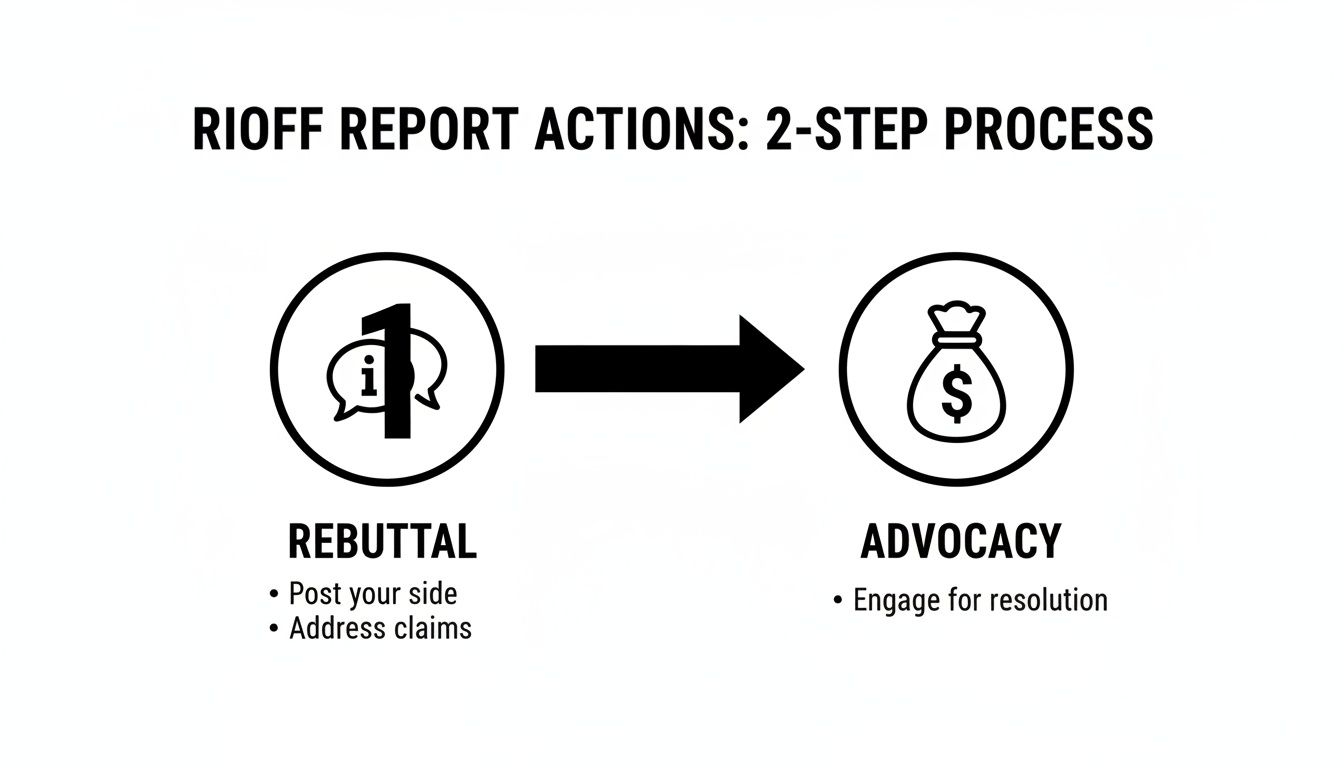
While these options give you a voice on the platform, they simply can't deliver the permanent, invisible solution that de-indexing from Google provides.
Submitting Your Court Order To Google
With the court order in your possession, the final step is to submit it to Google. They have a specific online portal for legal removal requests. You'll need to provide the exact URL of the Ripoff Report page and upload a digital copy of your court order.
Google's legal team then reviews your submission. They're checking to make sure it's a valid order from a legitimate court that explicitly finds the statements at that URL to be unlawful. Once they verify it, they’ll de-index the page. It won't just be pushed down in the rankings; it will vanish from their search results entirely. You can explore the mechanics of this in more detail in our guide on how to remove links in Google search.
The results of a successful de-indexing can be dramatic and almost immediate. I once worked with a local consulting firm that was ambushed by a false report from a disgruntled contractor. Their lead generation flatlined overnight as the report rocketed to the top of Google for their brand name.
After they hired a defamation lawyer and got the court order, we submitted it to Google. In less than three weeks, the link was gone. A month later, their lead flow had not only returned to normal but had actually jumped by 22% compared to before the incident.
This real-world example shows just how tightly your search results are tied to your bottom line. It's no surprise the reputation management industry is booming when platforms like Ripoff Report can cause so much damage. Data shows that 55% of consumers will walk away after finding just one negative result. A successful de-indexing isn't just a defensive move; it's a powerful investment in your business's future.
How To Suppress Negative Links With SEO

When getting a Ripoff Report legally de-indexed just isn't in the cards, your best move is to fight fire with fire—or in this case, fight content with better content. This is where SEO suppression comes in.
Think of it less as an attack and more as a digital PR campaign. The goal isn't to delete the report; it's to bury it. You'll create a flood of positive, high-quality content that systematically pushes that negative link down and off the all-important first page of Google's search results.
This “reverse SEO” strategy works because, let's be honest, almost no one looks past page one. In fact, over 90% of searchers never click to the second page. If you can push the Ripoff Report to page two or three, it might as well be invisible to the vast majority of people looking you up.
The trick to a successful suppression campaign is a consistent, multi-pronged effort. It’s a strategic game of creating new digital assets while simultaneously beefing up the ones you already control.
Building Your Digital Fortress
First things first: take stock of what you already own online. You probably have a handful of web properties that, with a little work, can be optimized to outrank that pesky Ripoff Report. These are the foundations of your counter-offensive.
Your most valuable assets will almost always be:
- Your Main Website: This is your digital home base and your most powerful tool. Make sure it's fully optimized for both your personal and business names. Start publishing high-value blog posts, detailed case studies, and fleshed-out "About Us" pages that naturally use those keywords.
- Professional Profiles: Google sees a platform like LinkedIn as a major authority. Get that profile to 100% complete, use a professional headshot, and start sharing updates or articles. Other sites like Crunchbase or niche industry directories also pack a serious punch.
- Social Media Accounts: Don't underestimate the power of social media in search results. Profiles on X (formerly Twitter), Facebook, and Instagram can rank surprisingly high for name searches. Keep your usernames consistent, optimize your bios, and post regularly to signal to Google that these profiles are active and relevant.
Shining up these existing properties gives you a solid base to work from. But to truly dominate the first page and secure your reputation, you'll need to expand your digital footprint with new, authoritative content.
SEO suppression is a long-term strategy, not a quick fix. Success depends on creating a portfolio of positive content that is more relevant and authoritative to Google than the single negative report.
This isn't a one-and-done task. It means consistently publishing new material that reinforces the positive story you want to tell.
Creating New High-Authority Assets
With your foundational profiles optimized, it's time to go on the offensive. The idea is to build a diverse network of web pages from various trusted sources that all paint a positive, credible picture of you or your business. This is a core professional tactic used by experts to remove negative search results from the public eye.
Here are some of the most effective assets you can start creating:
- Launch a Personal or Business Blog: If your website is just a static brochure, you're missing a huge opportunity. Start a blog. Write articles that showcase your expertise and specifically target the keywords that trigger the Ripoff Report. For example, if the report ranks for "John Doe Contractor," you should be writing posts like "John Doe Contractor's Guide to Kitchen Remodels."
- Publish Press Releases: Did your company win an award, launch a new product, or hire a key executive? These are perfect excuses for a press release. Using a service like PR Newswire can get your news out to hundreds of media outlets, generating powerful backlinks and positive mentions that show up in search results.
- Contribute Guest Articles: Writing for other well-respected websites in your industry is a fantastic way to build your authority and create another positive search result. Platforms like Medium or niche industry blogs are often looking for expert contributors. Every article published under your name becomes another asset working in your favor.
To help you get started, here's a quick checklist of the most impactful assets to create and optimize.
Positive Content Asset Checklist For SEO Suppression
This table breaks down the types of content you should focus on, how to optimize them, and their general impact on pushing down negative results.
| Asset Type | Key Optimization Tactic | Estimated Impact |
|---|---|---|
| LinkedIn Profile | Fully complete all sections; regularly post professional updates and articles. | High |
| Personal/Business Blog | Consistently publish keyword-targeted posts showcasing expertise. | High |
| Guest Articles | Contribute to high-authority sites like Medium or industry journals. | Medium-High |
| Press Releases | Announce positive company news and distribute through a wire service. | Medium |
| Social Media Profiles | Maintain active, optimized profiles on X, Facebook, and Instagram. | Medium |
Focusing on the high-impact items first will give you the most bang for your buck, but a truly successful campaign uses a mix of all these asset types.
Setting Realistic Expectations
I'll be direct: an SEO suppression campaign is a marathon, not a sprint. It demands patience and, more importantly, consistent effort over a long period. You're fundamentally trying to reshape how Google perceives your entire online identity, and that's a big ship to turn.
In most cases, you can expect to see some positive movement within 3 to 6 months. However, for a deeply entrenched link like a Ripoff Report, fully suppressing it can easily take up to 12 months or even longer. The exact timeline really depends on the authority of that negative link and how competitive your target keywords are. This is an ongoing investment in your reputation, not a one-time project.
DIY vs. Professional Services: Which Path to Take?
Deciding whether to tackle a Ripoff Report yourself or hire a professional is a huge decision. There's no single right answer—it really comes down to your unique situation, how much time and money you can commit, and just how bad the damage is.
A do-it-yourself approach, especially for SEO suppression, is absolutely on the table. If you've got a decent grasp of digital marketing, can carve out the time for a long-haul project, and have the patience of a saint, you can definitely make a dent. Going it alone gives you total control and saves you a ton on professional fees.
But let's be realistic: the DIY path isn't for everyone. If that report is getting a lot of attention, sitting right there on the first page of Google, or actively costing you money, the stakes are way too high to mess around. This is when calling in a professional shifts from being a luxury to a flat-out necessity.
When to Call In The Experts
Some scenarios are just too complex or high-stakes to handle on your own. You should seriously think about hiring a reputation management service if you're facing one of these situations:
- You're Strapped for Time: SEO suppression isn't a weekend project. It demands consistent work, week in and week out, for months. If you're busy running your business, you probably don't have the 10-15 hours per week required to do it right.
- You Need a Court Order: The legal route is a minefield. Navigating defamation law and court filings is incredibly complicated, and one wrong move can sink your case. For this, an experienced internet law attorney isn't just a good idea—it's essential.
- The Report is Front and Center: Is the negative link sitting at the #1 or #2 spot for your brand name? A slow-and-steady DIY campaign might not be aggressive enough to stop the bleeding. Professionals have the firepower to launch a broad, intensive campaign right out of the gate.
As you weigh your options, it's helpful to see what kind of technology the pros use. You can compare online reputation management tools to get a feel for the software that drives these campaigns.
How To Vet A Reputation Management Agency
The reputation management industry has its share of shady operators who make big promises they can't keep. To avoid getting burned, you need to do your homework and ask some tough questions before you sign anything.
Here's what you should ask any potential agency:
- Walk me through your strategy. Don't accept vague answers. They should be able to clearly explain their process for suppression or legal action.
- Show me some real-world examples. Ask for anonymized case studies from clients who were in a similar boat.
- How will you track and report progress? A good firm will provide clear, regular updates on keyword rankings and the visibility of the negative content.
- What's your pricing structure? Get a complete breakdown of all costs. Is it a monthly retainer? A one-time project fee? Are there any hidden charges?
- Give me a realistic timeline. A trustworthy company will set realistic expectations, usually in the 6-12 month range, not promise overnight miracles.
Be wary of anyone who "guarantees" removal. This is the biggest red flag in the industry. No reputable company can guarantee that a Ripoff Report will be removed or de-indexed. Promises like that almost always end in frustration and wasted money.
Choosing between a DIY effort and professional help is the first critical step in taking back control of your online reputation. A clear-eyed look at your resources, the severity of the problem, and a thorough vetting process will put you on the right path to success.
Answering Your Top Questions About Ripoff Report
When you’re staring down a negative Ripoff Report, a million questions start racing through your mind. It’s a stressful situation, and the path forward can seem murky. Let’s cut through the noise and get straight to the answers you need.
What's the Real Cost of Ripoff Report Removal?
This is usually the first question people ask, and the honest answer is: it depends entirely on your strategy. There’s no single price tag, and the investment level is directly tied to the outcome you can expect.
Here’s a practical breakdown of what you’re looking at financially:
- Writing a Rebuttal: This costs you nothing but your time. It's free to post a response directly on the site. Just be aware that while you get your side of the story out, it rarely fixes the root issue—the negative report is still the first thing people see.
- Ripoff Report's Advocacy Program: Be prepared for a serious investment here. The cost often starts at several thousand dollars and can go much, much higher. You’re essentially paying for a highlighted response from the platform, not a removal.
- Court-Ordered De-Indexing: This is a legal route, so attorney fees are the main cost. Depending on how complex your case is, you can expect to invest anywhere from $5,000 to $25,000 or more to get that crucial court order.
- Professional SEO Suppression: Think of this as an ongoing campaign. Most reputation management firms work on a monthly retainer, which can run from $1,000 to $5,000 per month. The price reflects the sustained effort needed to build a positive online presence that outranks the negative report.
Can I Just Sue Ripoff Report and Be Done With It?
It’s a tempting thought, but the answer is a hard no. Trying to sue the platform directly is a common mistake and, frankly, a waste of time and money.
The reason is a powerful piece of U.S. legislation called Section 230 of the Communications Decency Act (CDA). This law shields online platforms from liability for content posted by their users. In the eyes of the law, Ripoff Report is just the bulletin board, not the person who pinned the defamatory note to it.
This is a crucial distinction. Your legal action has to be against the author of the post, not the website hosting it. The objective isn't to punish Ripoff Report; it's to obtain a legal judgment stating the content is false. That court order is the tool you then use to get the link removed from Google's search results.
Don’t fall into the trap of going after the platform. It's a legal dead end.
How Long Until I Start Seeing Results?
Reputation repair is a marathon, not a sprint. Anyone promising an instant fix isn't being straight with you. The timeline depends completely on the method you choose.
Let's set some realistic expectations:
- Rebuttals: You'll see your rebuttal online almost immediately after you post it. The impact, however, is minimal and won't make the original report go away.
- SEO Suppression: This is a slow and steady build. You might start noticing some positive shifts in the search results within 3-6 months, but pushing a stubborn Ripoff Report off the first page completely can easily take up to 12 months or even longer.
- Legal De-Indexing: From the moment you hire a lawyer to the day the link vanishes from Google, you're typically looking at a 4 to 8-month process. This accounts for filing the lawsuit, getting the court order, and submitting it to Google for their review and action.
Is the Report Ever Really Gone for Good?
This is where we have to be very clear: in nearly every case, the report itself will continue to exist on Ripoff Report's website forever. Their foundational policy is "no removals," and they are notoriously rigid about it.
So, what’s the point? The goal isn't deletion—it's invisibility.
Both de-indexing and suppression work to remove the report from search engines like Google, which is where over 95% of people would have found it in the first place. If a potential client, employer, or even a new date can't find it when they search your name, its power to harm you is effectively gone.
The report may technically still be out there, but you’ve taken away its ability to damage your reputation.