


Finding something negative about your brand online can feel like a punch to the gut. The instinct is to either fight back immediately or just shut down. But the best first move isn't emotional—it's strategic. Before you can even think about how to suppress negative search results, you have to get a clear-eyed view of the damage. This initial diagnosis is everything; it’s the foundation for any successful reputation campaign.
Your Initial Reputation Damage Assessment
So, you’ve found it. That nasty article, scathing review, or viral social media post. Your heart sinks. It's a universal feeling for any business owner or marketer. Instead of reacting, take a breath and shift into assessment mode. This is where you get your bearings and figure out exactly what you're dealing with.
Let's be clear: not all negative content is a five-alarm fire. A defamatory post on a major news site is a whole different beast than an anonymous grumble on a tiny forum. Your first job is triage. You need to figure out the severity and the reach of the content that's hurting you.
Think of it as a three-phase process: Discover, Evaluate, and then Act. This framework keeps you focused and prevents you from wasting time and resources on things that don't really matter.
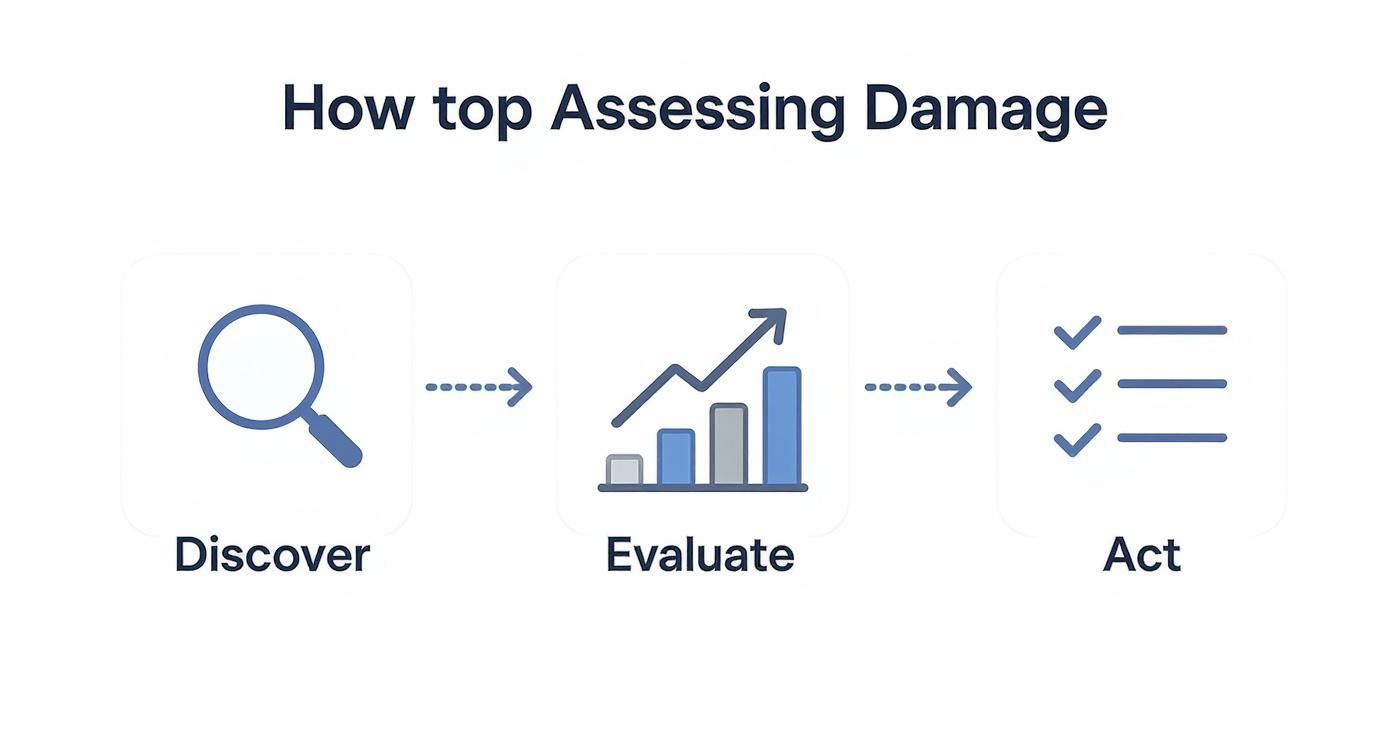
Following a methodical path like this brings clarity. It stops you from spinning your wheels on low-impact issues and helps you zero in on the real threats.
Cataloging Your Digital Footprint
Time to get your hands dirty with a full audit. Don't just glance at the first page of Google. Dig deeper. Search for your brand name, the names of your key executives, and your main products. You need to be looking at least three pages deep into the search results for each one.
Open up a simple spreadsheet and start logging what you find. For every negative link, you’ll want to capture:
- URL: The exact link to the page.
- Ranking Position: Where does it show up, and for which search term?
- Content Type: Is it a news story, a blog post, a review, a forum thread, or something on social media?
- Sentiment: Is the tone aggressively hostile, just mildly critical, or maybe neutral but unflattering?
This document is now your map of the battlefield. The problem is no longer a vague, scary "thing" out there; it's a specific list of URLs that need attention. This audit might also turn up personal details on data broker sites—a separate but related headache. If that happens, it’s worth looking into how to get your information removed from people search sites.
Gauging The True Impact
With your inventory in hand, it's time to analyze the actual business risk. This is where you prioritize.
Is the negative result sitting on the first page for your most important keywords, like your brand name? This is critical, because over 75% of people never bother clicking past the first page of search results.
A negative article lurking on page four for an obscure search term is an annoyance, not a crisis. But a one-star review popping up in the top three results for your brand name? That’s an emergency.
You also have to consider the source. A hit piece from a respected industry journal carries a lot more weight than a rant on some forgotten personal blog. How credible does the content seem? Is it a well-argued critique with valid points, or just an emotional, baseless attack? The more believable it sounds, the more it can erode trust in your brand. This honest assessment will tell you whether you need a few positive blog posts or a full-blown campaign to suppress negative search results.
Strategies for Direct Content Removal
Before you dive into a long-term campaign to bury negative search results, always try the direct approach first. Getting the damaging content taken down at the source is the cleanest, most permanent solution. If you succeed, the problem vanishes from Google—and everywhere else—for good.
Think of it this way: suppression is a long game of winning a popularity contest online. Removal is about getting the problematic content disqualified from the game entirely. It's faster and more decisive, but it only works if the content clearly breaks a specific rule.

Navigating Review Platform Takedowns
For most businesses, the front line of reputation management is dealing with negative reviews. Platforms like Google, Yelp, and Trustpilot all have content policies, but simply disagreeing with a reviewer's opinion is never enough to get a review removed. Your request has to prove a clear violation.
You need to become a student of their terms of service. Don't waste time arguing the facts of the review; instead, hunt for a clear-cut policy breach. I've had the most success by focusing on these violations:
- Conflicts of Interest: The review comes from a direct competitor, a bitter ex-employee, or someone who provably was never a customer.
- Hate Speech or Harassment: The content is abusive, uses slurs, or personally attacks an individual.
- Off-Topic Rants: The review veers into politics, social commentary, or other issues that have nothing to do with their actual customer experience.
- Impersonation: The reviewer is clearly pretending to be someone else.
When you flag a review, be surgically precise. "This review is fake" gets you nowhere. A much stronger approach is, "This review violates your conflict of interest policy. The user's profile shows they are an employee at [Competitor Name], and their comments target our proprietary processes." Evidence is your best friend.
Addressing Inaccurate Business Listings
Bad information on business directories can be just as damaging as a one-star review. A wrong phone number, an old address, or an outdated service list sends potential customers to your competitors and chips away at their trust.
Thankfully, this is often the easiest problem to solve. Most platforms, from Google Business Profile to smaller industry directories, let you suggest edits. The real power move, though, is to claim your business listing. Once you own the profile, you have direct control to correct inaccuracies and ensure your brand’s information is consistent everywhere it appears online.
Social Media and Forum Content Moderation
Getting content pulled from platforms like Facebook, X (formerly Twitter), or Reddit follows the same playbook: find the rule violation. Each platform has its own community guidelines, and your takedown request lives or dies based on how well you can prove a breach.
The secret to content removal isn't about arguing your side of the story. It's about showing a platform administrator that a user has broken their rules. Frame every request through the lens of their policy, not your own sense of what's fair.
Zero in on content that crosses a clear line. Things like doxxing (publishing private info like a home address), copyright infringement, credible threats, or targeted harassment are usually straightforward violations. Someone posting "Your product is terrible" is just sharing an opinion. Someone posting an employee's personal phone number is harassment. That's the difference.
When negative content starts to spread quickly, you need a plan. Knowing whether to pursue removal or pivot to suppression is key. For a complete crisis playbook, check out this guide on how to handle a negative review or incident going viral.
Just look at Google's own policies for prohibited content. They lay it all out for you.
Having clear categories like "Spam and fake content" or "Restricted content" gives you the exact language you need. If a negative post falls into one of these buckets, you have a solid foundation for your removal request before you even click "report."
When you can't get negative content removed, you have to change the battlefield. The fight moves from deletion to domination on Google's first page. The only way to win is to suppress negative search results by building a fortress of positive, authoritative digital assets that you control, pushing the bad stuff to the obscurity of page two and beyond.
This isn't about just tossing up a few blog posts and hoping for the best. It's a strategic campaign to seize prime search engine real estate. Think of every positive piece of content as a soldier in your army, occupying valuable territory and making it impossible for the enemy—the negative content—to hold its ground.

Laying the Foundation with Owned Properties
Your fortress starts with the digital properties you own outright—the websites and profiles where you call the shots. These are your heavy hitters because you have absolute authority over the content, the messaging, and all the behind-the-scenes optimization.
First, get the essentials locked down. If you don’t have a professional website for yourself or your business, that’s your first move. This site becomes the central hub for your online identity. The domain name should be your name or brand name if possible, which makes it a hyper-relevant result for anyone searching for you.
Next, you need to expand your footprint by claiming and, more importantly, fully building out your social media profiles. Don't just create an account and walk away.
- LinkedIn: This is a powerhouse. Fill out every single section: summary, work history, skills, endorsements, the works. Get active in relevant groups and, if you can, publish thoughtful articles directly on the platform.
- X (formerly Twitter): A professional bio and a high-quality headshot are non-negotiable. More than that, you need to be active, sharing content that’s relevant to what you do. Google sees that engagement and it signals that the profile matters.
- Other Relevant Platforms: Depending on your field, this could mean a professional Facebook page, an active Instagram profile, or a well-maintained YouTube channel.
These owned properties are the bedrock of your defense. They are the first assets you'll optimize and the primary channels for publishing all the new, positive content you're about to create.
Creating High-Value Content Google Loves
With your foundational properties in place, it’s time to start producing content that is specifically designed to rank. The mission is to create assets that Google's algorithm sees as more credible and authoritative than the negative link you're fighting. In today's search environment, that means aligning with Google's E-E-A-T framework: Experience, Expertise, Authoritativeness, and Trustworthiness.
Your goal is to publish such a high volume of credible, positive information that the negative item becomes a statistical blip. Google's algorithm wants to show the most relevant, authoritative results. Your job is to prove the negative content is neither.
This requires moving beyond just writing articles. A multi-format content strategy is far more effective:
- Expert Articles: Go deep. Write long-form articles for your own website or blog that showcase your expertise and offer real value.
- Guest Appearances: Get your name and expertise out there by doing interviews on industry podcasts or contributing guest posts to respected publications in your niche. This creates powerful associations.
- Video Content: A YouTube channel can be a massive asset. Think tutorials, industry commentary, or interviews. Well-produced videos often rank very well on their own.
The game plan to suppress negative search results has changed a lot, especially with AI influencing search. It's now all about promoting positive content that simply outmuscles the negative pages. Reputation management firms do this by creating a steady stream of high-quality articles, interviews, and videos on trusted platforms, all optimized with advanced SEO to hit every mark on Google’s E-E-A-T checklist. You can dive deeper into these proven SEO strategies for online reputation.
Amplifying Your Assets with On-Page SEO
Creating great content is just step one. You have to actively signal its importance to search engines, and that’s where on-page SEO comes in. This means optimizing every single piece of content to give it the best possible shot at ranking.
One of the most powerful techniques here is implementing schema markup (also known as structured data). This is a bit of code you add to your website that helps search engines understand your content on a deeper level. For instance, using "Person" schema on your personal site explicitly tells Google about your profession, where you work, and which social media profiles belong to you.
A smart internal linking strategy is also absolutely crucial. From your new blog posts and web pages, you should be linking out to your other positive assets—your LinkedIn profile, your guest articles, your YouTube channel. This weaves a web of positive content, sharing authority between all your properties and showing Google they're all part of a single, unified online presence. Every link is a vote of confidence, making your entire fortress stronger.
Using Advanced SEO to Suppress Negative Content
So you’ve created a library of positive content. That’s a great first step, but it’s only half the battle. If all that great material is buried on page five of Google, it's not helping you. The real work starts now, using advanced Search Engine Optimization (SEO) to give your positive assets the muscle they need to climb the search rankings and push the negative stuff down.
This is where you pivot from simply making content to strategically promoting it. The goal is to send a clear message to Google: your positive websites, articles, and profiles are far more credible, trustworthy, and relevant than the negative results you're trying to bury. This effort really boils down to two critical components: earning high-quality backlinks and getting your technical SEO right.
Mastering Strategic Link-Building
Think of backlinks as votes of confidence from other websites. When a reputable site links to your content, it’s basically vouching for you, telling Google, "Hey, this page is important." The more high-quality "votes" you collect, the more authority your positive assets gain, making it much easier for them to outrank negative content.
But let's be clear: not all links are created equal. A single link from a respected industry publication can be worth more than a hundred links from sketchy, low-quality directories. You absolutely have to focus on quality over quantity.
Here are a few proven ways to earn powerful backlinks:
- Guest Posting: Find authoritative blogs and online publications in your field that accept guest articles. Pitch them a well-researched idea that genuinely helps their readers. Inside your article, you can naturally link back to your main website or another key positive asset.
- Securing Media Mentions: Position yourself as the go-to expert for journalists. When you get quoted in a news story or industry feature, it almost always comes with a powerful backlink to your site.
- Podcast Interviews: Being a guest on relevant podcasts is a fantastic way to build both authority and links. Most podcasts include links to their guest's website and social media profiles in the show notes.
The secret to successful link-building is making it a value exchange. Don't just ask for a link. Offer something valuable in return—expert content, unique data, or a compelling story. This approach builds real relationships and earns links that actually stick around.
A crucial, and often overlooked, piece of this is anchor text optimization. That’s the clickable text in a hyperlink. You need a natural and diverse anchor text profile to avoid looking manipulative to search engines. Aim for a healthy mix that includes your brand name, your personal name, and descriptive phrases.
Fine-Tuning Your Technical SEO Foundation
While link-building is about building authority from other sites, technical SEO is about making sure your own websites are perfectly optimized for Google and provide a great user experience. If your site is slow, clunky, or confusing, Google won't want to rank it highly, no matter how great your content is.
The biggest area to focus on right now is Core Web Vitals. These are metrics Google uses to measure a page's real-world user experience, looking at things like loading speed, interactivity, and visual stability. A site that offers a fast, smooth experience gets rewarded with better ranking potential. Improving these vitals often means optimizing your images, streamlining code, or upgrading your web hosting.
The search landscape is also changing fast. The rise of Google's AI-driven features, like AI Overviews, is a game-changer for suppression campaigns. These AI-generated summaries can push the traditional organic results further down the page, potentially cutting click-through rates by 20-40%. This shift makes it even more critical that your positive content is technically flawless and aligns with Google's quality standards, giving you the best shot at either being featured in an AI Overview or ranking highly just below it. You can discover more insights about how AI is changing search suppression strategies on optimizeup.com.
Beyond speed, you also have to ensure your site is mobile-friendly and secure (using HTTPS). These are table stakes for building trust with both users and search engines.
While removing the negative content directly is always the best-case scenario, it's not always an option. If you want to explore that route first, our guide on how to remove links in Google search can help. But when suppression is your only path forward, a rock-solid technical SEO foundation gives your positive content the fighting chance it needs to win.
To help you stay on track, we've put together a simple checklist for promoting your positive assets.
Positive Asset Promotion Checklist
This checklist outlines the key SEO and promotional tasks needed to boost the visibility and authority of your positive content. Following these steps consistently will help your assets climb the search rankings and suppress unwanted results.
| Task | Objective | Frequency |
|---|---|---|
| Publish New Positive Content | Continuously create fresh, relevant content (articles, case studies). | 1-2 times/month |
| Guest Post Outreach | Identify and pitch 5-10 relevant blogs for guest posting opportunities. | Monthly |
| Secure Media Mentions/Quotes | Respond to journalist queries on platforms like HARO or Qwoted. | Weekly |
| Podcast Guest Outreach | Research and pitch relevant podcasts for interview opportunities. | Monthly |
| Internal Linking Audit | Add links from new content to older, authoritative positive assets. | As new content is published |
| Monitor Core Web Vitals | Check Google Search Console for performance issues and fix them. | Monthly |
| Check Mobile-Friendliness | Ensure all positive assets render correctly on mobile devices. | Quarterly |
| Build Social Signals | Share all positive content across your relevant social media channels. | As new content is published |
By systematically working through this checklist, you create a powerful, ongoing promotion engine. This consistent effort is what sends the strongest signals to search engines, ensuring your positive reputation defines your digital footprint.
How to Monitor and Maintain Your Online Reputation
Getting negative results off the first page of Google is a massive win, but don’t spike the football just yet. Your online reputation isn't something you can fix and forget. It’s more like tending a garden; you have to keep watering the good stuff and pulling the weeds before they have a chance to take over.
This final, ongoing phase is all about building a system to keep a close watch on your digital footprint. It's about shifting from reactive damage control to proactive brand defense. The real goal is to build such a strong, positive online presence that any future negative content simply gets drowned out before anyone even sees it.
Setting Up Your Monitoring Dashboard
You can't defend against what you can't see. The first step is to automate your monitoring. Googling yourself every day is not a strategy—it's inefficient, and you'll inevitably miss things. You need tools that act as your eyes and ears online, alerting you the moment your brand is mentioned.
A few solid options can get you started, ranging from free to paid:
- Google Alerts: This is the bare-bones essential. Set up alerts for your name, your company's name, and maybe your top products. It’s a simple, free way to get an email when Google finds something new.
- Social Listening Tools: Platforms like Brand24 or Mention dig much deeper. They comb through social media, forums, and blogs in near real-time, giving you a much clearer picture of what people are actually saying about you.
Using these tools means you can spot a spark before it becomes a wildfire. A nasty blog comment or a critical tweet can be handled before it gains steam and starts to rank, saving you from a whole new suppression headache.
Key Metrics for Reputation Tracking
Once your alerts are running, you need to know what you’re looking for. Tracking the right KPIs tells you whether your defenses are holding strong.
Your primary focus should be the search engine results page (SERP) for your most critical keywords. The most important metric is the search position of known negative URLs. Is that nasty article still buried on page two, or is it starting to creep back up? At the same time, keep an eye on the rankings of your positive, owned assets—your website, LinkedIn profile, and positive blog posts. If they start slipping, it’s an early warning sign that your fortress has a crack in it.
The ultimate goal of any suppression campaign is to push unwanted content off the first page of search results. Why? Because that’s where virtually all the attention is.
User behavior data doesn't lie. The click-through rate (CTR) for the #1 result on Google can be over 30%. By the time you get to the bottom of page one, it’s already dropped to less than 2%.
Once a link gets pushed to the second page, its visibility essentially disappears, with CTRs hovering around a measly 1.05%. This is why page two is the promised land in reputation management—it renders negative content practically invisible to the average person.
Proactive Strategies for Long-Term Defense
Monitoring and tracking are your defense. But the best long-term strategy is a good offense. This means constantly building and reinforcing your positive online presence so it’s strong enough to withstand future hits.
If you're considering the best way to handle this, you might wonder if your business needs professional online reputation management services. If you’re keeping it in-house, the name of the game is consistency.
Keep publishing high-quality content on your blog. Don't stop looking for guest post opportunities and media mentions that earn you powerful backlinks. And never stop encouraging your happy customers to leave authentic, positive reviews. Each one of these actions adds another brick to your digital fortress, making it that much harder for any single negative item to break through.
Frequently Asked Questions
When you're trying to clean up your search results, a lot of questions pop up. It can feel like a complex, uphill battle. Let's tackle some of the most common things people ask when they're working to get their online reputation back on track.
How Long Does It Take to Suppress Negative Search Results?
This is the million-dollar question, and the honest answer is: it depends. The timeline really hinges on two things: how authoritative the negative source is and how competitive your search term is.
If you're dealing with a low-authority blog post or a comment on some obscure forum, you could see a real difference in 3 to 6 months with steady, focused work.
But if you're up against a damaging article from a major news organization or a highly respected industry site, you're in for a much longer fight. Pushing that kind of result off the first page can easily take 12 to 24 months of relentless effort. Success comes from patiently and strategically building an arsenal of positive content that Google eventually learns to trust more than the negative piece.
Should I Hire a Professional or Do It Myself?
The right call here comes down to your time, your budget, and just how bad the problem is. A DIY approach can work for minor issues, especially if you're comfortable with creating content and understand the basics of SEO. If the negative result isn't getting much traffic, you might be able to handle it on your own.
On the other hand, when you're facing deeply-rooted negative results on high-authority websites, bringing in a professional reputation management firm is almost always the right move. These agencies have the specialized know-how, established media contacts, and the sheer manpower to run the kind of advanced SEO campaigns that are nearly impossible to manage solo.
The real value of a professional service isn't just their technical skill; it's their ability to accelerate results. What might take you two years to achieve on your own, an experienced team can often accomplish in a fraction of the time.
Can I Just Permanently Delete the Negative Result?
Getting something completely wiped from the internet is the dream scenario, but honestly, it's pretty rare. True removal is only on the table in a few specific situations.
You've got a good shot at getting content taken down if:
- You're the one who published it and still have access to delete or edit it.
- It clearly violates a platform's rules, like outright harassment, hate speech, or doxxing.
- You have a solid legal reason, such as a clear copyright infringement or a court order for defamation.
For most situations—like an unfavorable news story or a negative opinion piece—suppression is the most practical and effective strategy. The goal isn't deletion anymore; it's about making the negative result invisible by burying it deep in the search results.
Will Responding to a Negative Review Make It Rank Higher?
Yes, it absolutely can. This is one of the most common pitfalls people fall into. When you engage with a negative review or an article, even to defend yourself, you're adding fresh content and activity to that page. To Google, these are signals that the page is active and relevant, which can accidentally give it a ranking boost.
Unless you feel a direct response is absolutely critical for customer service (say, on a platform like Yelp or Google Reviews), it's usually better to put your energy elsewhere. Instead of giving the negative link more oxygen, focus on creating and promoting the positive content that will eventually push it down and out of sight.