



When you're trying to get negative content removed from Google, you've really got two main options: go straight to the source and ask the website to take it down, or use Google's own tools to get the page de-indexed from search results. From my experience, the best results always start with a calm, clear-headed assessment and meticulous evidence gathering.
Your First Moves Against Negative Search Results
Finding something damaging about you or your business on Google feels like a punch to the gut. The natural instinct is to react immediately, maybe even emotionally. But trust me, firing off angry emails is the fastest way to make things worse. The most critical moments are these first ones, and they demand a strategic approach, not a panicked one. It's time to shift from reaction to action.
Before you can build a strategy, you have to know exactly what you're dealing with. Is it a fake review on a local listings site? A misleading news article from years ago? Someone using your photos without permission? Each of these situations requires a completely different playbook. What works for a defamatory post on a forum won't work for a copyright issue on a blog.
Document Everything Meticulously
Your first real task is to become a digital detective. Evidence is everything. It's the only thing that matters when you're making your case to a webmaster or Google's legal team. Without solid proof, your complaint is just an opinion.
Start by meticulously documenting every single piece of negative content you find.
- Take Full-Page Screenshots: Don't just grab the part of the screen you can see. Use a browser extension or your computer’s built-in tools to capture the entire webpage. Make sure the URL and the date are clearly visible.
- Archive the Live URL: Use a free tool like the Wayback Machine to save a permanent, time-stamped copy of the live page. This is your insurance policy in case the other party tries to edit the content later to weaken your claim.
- Keep a Detailed Log: I recommend a simple spreadsheet. For each piece of content, log the URL, the date you found it, the website or publisher's name, and a quick summary of why it's harmful or inaccurate.
This documentation is your foundation. It not only builds a powerful case for your removal request but also creates a historical record that can be crucial if you eventually need to take legal action.
This systematic collection of evidence is the bedrock of your entire removal effort.
Choose Your Battleground Wisely
With all your proof gathered, it's time to decide where to focus your energy. This is a critical decision point, and the path you take matters.
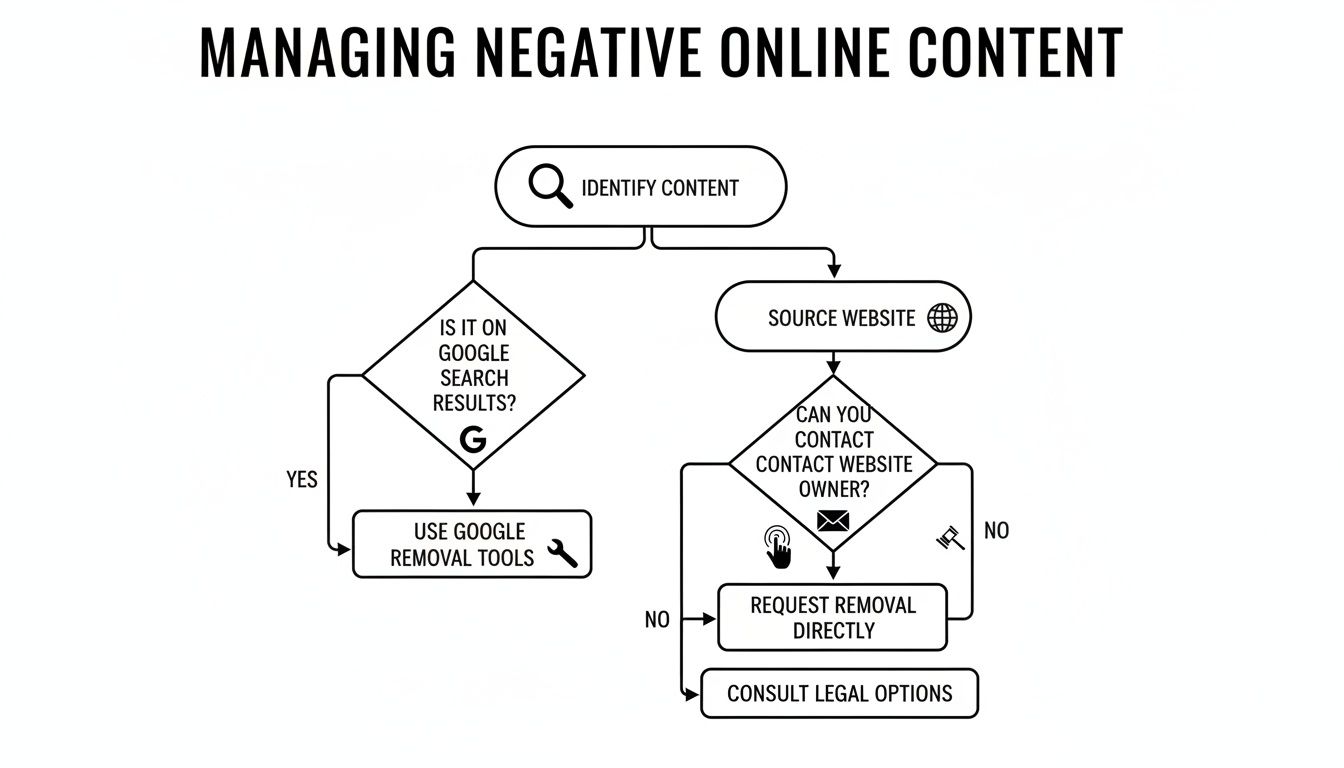
As you can see, your strategy really depends on whether you have a clear policy violation that Google will act on, or if it's a problem you need to solve directly with the website owner.
In almost every case, going to the source first is the best move. Getting the content completely deleted from the website is the only truly permanent solution. It's gone for good, and it can't be re-indexed by Google or pop up on Bing or DuckDuckGo.
On the other hand, going straight to Google is the right call when the content is a blatant violation of their specific policies—things like exposed personal information (doxing), non-consensual explicit imagery, or clear copyright infringement. Knowing which path to take right from the start will save you a ton of time and frustration.
Navigating Google’s Official Removal Tools
So, you’ve gathered your evidence. Now it’s time to take the fight directly to Google. The biggest mistake people make is thinking of Google as one giant, all-knowing entity. It’s not. It’s a massive company with different departments, each with its own rulebook and reporting system. To get anywhere, you have to frame your complaint in a way that fits perfectly into one of their specific removal categories.
Think of it like this: Google has a series of very narrow doorways, each labeled for a specific problem like "copyright violation" or "private information." If your request doesn't fit the exact shape of one of those doorways, the door stays shut. A simple negative opinion or a news story that’s true but embarrassing? Those requests almost always get rejected on the spot. Google’s job is to index the web, not to play judge and jury over personal disputes.
Policy Violations vs. Legal Claims: Know the Difference
I see this trip people up all the time. They mix up a policy violation with a legal claim, but in Google’s eyes, they are two completely different worlds. A policy violation is when content breaks Google’s own internal rules. A legal claim is when content breaks an actual law, like defamation or copyright infringement.
Here’s a real-world example: A disgruntled client leaves a fake, scathing review for a contractor, claiming, "This company is a scam and never finished the job." From the contractor's perspective, that’s defamation. But to get Google’s legal team to act on a defamation claim, you’ll almost certainly need a court order, which is a long and expensive process.
However, let’s say that same fake review also includes the contractor’s home address or a doctored, explicit photo. Now you’re talking. That’s a clear-cut policy violation for doxxing or harassment. Reporting it as a policy violation is a much faster and more direct path to removal.
Always look for the path of least resistance. A clear policy violation is your best friend—it’s the fastest and most straightforward route to getting content taken down.
Trying to report a bad review as a legal issue without a court order is a surefire way to get your request denied. The evidence you need and the forms you use are completely different for each path.
Using Google’s Legal Help Tool
Your command center for most removal requests is Google's Legal Help tool. It’s not a single form but a guided workflow that asks a series of questions to route you to the correct department.
You’ll need to be ready to specify:
- Which Google product is involved (e.g., Google Search, Google Maps, YouTube).
- What kind of problem you’re reporting (e.g., personal information, harassment, defamation).
- The exact URLs of the content you want gone.
Precision is key here. If you’re trying to remove a defamatory blog post, you need the specific URL of that post. If it’s an image that appears in Google Images, you need two things: the URL for the image search result and the URL of the webpage where the image is actually hosted.
Getting Rid of Outdated and Cached Content
Here’s a classic, frustrating scenario: you convince a website owner to remove some negative content, but when you search your name, it’s still there in Google’s results. What gives? You’re seeing a version of the page from Google’s cache—an old snapshot saved before the content was deleted.
For this specific issue, Google has the "Remove Outdated Content" tool. A crucial point: this tool is only for content that has already been removed or changed on the live website. It won’t work on live content.
The process is pretty straightforward. You submit the page URL, and Google’s system crawls the live page to verify the information is truly gone. Once it confirms the change, it schedules the cached version and the search snippet for removal. This usually happens within a day or two. For a more detailed walkthrough, our guide on how to remove links in Google Search covers every step.
The "Right to Be Forgotten" in Europe and Beyond
If you or your business has a connection to Europe (or a few other select regions), you have another powerful option: the "Right to be Forgotten" (RTBF). This legal right, established under GDPR, allows individuals to request the removal of search results that are inadequate, irrelevant, or no longer relevant.
An RTBF request is a different beast entirely. It’s not about policy violations or illegal content. For instance, an old, factually accurate news article about a minor business dispute from ten years ago might still be online. While true, it may no longer be relevant to the public interest. Under the RTBF framework, you can argue that its continued presence in search results violates your privacy.
To file this type of request, you have to demonstrate your connection to a relevant country and make a compelling case for why your right to privacy now outweighs the public's right to access that information.
Taking Down the Content at Its Source

While getting Google to hide a link is a great first step, it’s really just a band-aid. The problematic content is still out there on the original website, visible to anyone with a direct link or who uses a different search engine. The real win is getting it deleted from the source. Gone for good.
This is where things get a bit more personal. It's less about filling out forms and more about diplomacy, solid research, and knowing how to talk to people. Your success here often comes down to how well you can build your case and communicate it without escalating the situation.
Finding the Right Person to Contact
First thing’s first: you need to figure out who holds the keys. This isn’t always straightforward. On a small blog, you might get lucky and find the owner’s email on a "Contact Us" page. But most of the time, you have to play detective.
A WHOIS lookup can sometimes give you the domain owner's contact info, but privacy services often hide these details. If you hit a dead end there, your next move is to identify the hosting provider. A tool like whoishostingthis.com can tell you who hosts the site. From there, you can find their abuse department and file a complaint, which is especially effective if the content violates the host's terms of service.
For bigger, more established platforms, the process is usually more structured:
- Review Sites (Yelp, Trustpilot): Your only real path here is their built-in reporting system. Get to know their content guidelines inside and out, so you can point to the specific rule the review breaks.
- Social Media (Reddit, X): These platforms have dedicated moderation teams. Report the post or comment directly through the platform’s tools, and be very clear about how it violates their rules on things like harassment, misinformation, or privacy.
How to Craft an Effective Removal Request
Once you know who to email, what you say is everything. Firing off an angry, demanding message is a surefire way to get ignored—or worse, to have the author double down and make the problem bigger. You need to be professional, concise, and completely non-confrontational.
Your email should clearly cover three key points:
- Who you are and the exact content you're talking about (always include the direct URL).
- Why it needs to go, referencing specific inaccuracies, policy violations, or the harm it’s causing.
- What you want them to do, which is almost always the complete removal of the post or page.
Pro Tip: Whatever you do, don't threaten legal action in your first email unless you've already got a lawyer ready to act. An empty threat can shut down any chance of a simple, quiet resolution.
Going directly to the source is the only way you can truly remove negative content from Google search permanently.
Adjusting Your Approach for Different Platforms
You can’t use the same script for everyone. The owner of a personal blog might be swayed by a polite, personal appeal, whereas a massive review platform runs strictly on policy enforcement. This is where your homework on their rules pays off.
For instance, many review sites have clear policies against reviews from disgruntled former employees, content that is obvious hearsay, or rants that are completely off-topic. If you can frame your request as a clear policy violation, you’re much more likely to succeed.
And these platforms do act. In 2023 alone, Google took down over 115 million policy-violating reviews and zapped more than 20 million fake business profiles. This shows just how powerful a well-argued policy violation claim can be. For more stats on this, check out the insights on Asset Digital Communications' blog.
In the end, it doesn't matter if you're talking to a blogger, a forum mod, or a corporate legal team. Success comes from building a logical, evidence-based case. Calmly state your position and show them how removing the content aligns with their own standards.
Using Legal Channels for Content Takedowns
So, you've tried asking nicely, and you've tried Google's built-in tools, but the damaging content is still out there. What now? This is the point where you have to escalate things. Taking the legal route adds serious weight to your request and can force a website owner’s hand when nothing else has worked.
Don't worry, this doesn't automatically mean you're filing a massive lawsuit tomorrow. It’s about using specific legal notices to show you mean business and are ready to protect your reputation. A website owner who happily ignored your emails will think twice when they receive a formal letter that mentions specific laws they might be breaking.
The Power of a Cease and Desist Letter
The first real warning shot in a legal campaign is usually a Cease and Desist letter. It’s a formal document, ideally drafted by a lawyer, that spells out exactly what content is harmful, why it breaks the law (like defamation), and demands its immediate removal to head off legal action.
The magic of this letter is its official nature and the implied threat of a lawsuit. For many smaller website owners or individuals, the mere thought of a legal fight is terrifying. The potential cost and sheer hassle are often enough to get them to comply, even if they think they have a case. They just want the problem to go away.
A well-crafted Cease and Desist letter should:
- Identify the exact URLs and the specific statements causing harm.
- Clearly explain why those statements are false and damaging to you.
- Give them a hard deadline to remove the content.
It’s a strategic move that fundamentally changes the conversation. You're no longer asking; you're demanding.
Leveraging the Digital Millennium Copyright Act (DMCA)
When it comes to getting unwanted content out of Google's search results, the DMCA (Digital Millennium Copyright Act) is one of the most powerful tools in your arsenal. This is a federal law designed to protect your copyrighted material. If someone has stolen your original photos, videos, or even just copied and pasted your written work without permission, the DMCA is your best friend.
The process is surprisingly direct. You file a DMCA takedown notice with the website’s hosting company. Under the law, the host has to act quickly to remove the infringing content to avoid being held liable themselves. This is fantastic because it lets you sidestep the uncooperative website owner entirely.
You can also file a DMCA request directly with Google to get the infringing URL removed from search results. This is an extremely common and successful strategy. In fact, Google processed a staggering 5 billion takedown requests for URLs in a single year, which shows just how vital this tool has become. You can read more about these trends and the impact of automated DMCA requests on TorrentFreak.
Heads up: A DMCA notice is a sworn legal statement. Filing a bogus claim is perjury and can get you into serious trouble. Before you file, be 100% certain you own the copyright to the material you're reporting.
When to Send a Presuit Demand Letter
If a Cease and Desist is a warning shot, a presuit demand letter is the final warning before the battle begins. This is a much more aggressive step, reserved for clear and severe cases of defamation where the financial or reputational damage is substantial.
This letter formally lays out your legal claims, the proof you've gathered, and a specific demand for compensation for the damages you've suffered. It’s not a bluff. You only send a presuit demand when you are absolutely ready to file a lawsuit if the other side doesn't comply. It’s a high-stakes move that shows you have a strong case and you're not afraid to take it to court. Very often, this is the final push needed to resolve the issue without having to go through a long and expensive legal battle.
Repairing Your Reputation With SEO Suppression

Let's be realistic. Sometimes, no matter how strong your case is, certain negative content just isn't coming down. A factually accurate news article, a stubborn blogger who won’t budge, or a review that skirts the edge of a platform’s policy can feel like a permanent mark on your record.
When removal hits a dead end, your next move is suppression.
Suppression, also known as "reputation SEO," is all about burying the bad stuff with an avalanche of good stuff. The goal isn't to delete the negative link but to push it so far down Google's rankings—ideally to page two or beyond—that it becomes practically invisible. Since less than 1% of searchers ever click past the first page, this strategy can be just as effective as getting the content taken down.
This approach shifts you from playing defense over one bad link to playing offense by building a powerful, positive digital footprint. You're not just fixing a problem; you're building a digital fortress that makes you more resilient in the future.
The Foundations of Reputation SEO
To successfully push down a negative result, you have to understand what Google wants to see. It’s not about gaming the system with old-school tricks. It's about implementing smart Search Engine Optimization (SEO) strategies to create genuinely valuable content that search engines want to rank.
The core idea is simple: dominate the first page of Google with assets you either own or influence. These fall into a few key categories:
- Owned Properties: This is your home turf—your main website, company blog, and official social media profiles on LinkedIn, X, Facebook, and Instagram. You have total control here.
- Earned Media: Think of this as third-party validation. Positive press releases, news features, guest posts on respected blogs, and glowing reviews all help build a positive narrative.
- Controlled Profiles: You can create and optimize profiles on high-authority platforms like Crunchbase, Medium, or industry-specific directories. These often rank surprisingly fast for branded searches.
By optimizing these positive assets for the same search terms that pull up the negative content, you’re essentially creating direct competition. You’re telling Google, “Hey, look over here! This positive content is far more relevant and authoritative.”
Executing a Suppression Campaign
A good suppression campaign isn't a one-and-done task. It’s a sustained, multi-pronged effort that blends strategic content creation with a bit of technical SEO.
First, find your low-hanging fruit. Look for any positive content that's already ranking, even if it's on page two or three. In the industry, we call these "Positives Under Negatives" (PUNs). By improving their on-page SEO and building a few high-quality backlinks to them, you can often give them the nudge they need to leapfrog the negative result.
Next, you need a steady stream of new, high-quality content. This could be anything from:
- In-depth blog posts that establish your expertise.
- Case studies that showcase your clients' success.
- Press releases about company news or community involvement.
- High-quality videos for YouTube (which is owned by Google and often ranks very well).
The key here is quality over quantity. One well-promoted article on a major industry publication will do more for your reputation than a hundred generic blog posts. Focus on authority, not just volume.
For a deeper dive, our guide on how to https://levelfield.io/blog/suppress-negative-search-results provides a more detailed playbook for reclaiming control of your online narrative.
Comparing Content Removal and Suppression Strategies
Choosing between direct removal and SEO suppression depends entirely on your situation. This table breaks down the differences to help you decide which path makes the most sense.
| Strategy | Best For | Method | Outcome | Timeframe |
|---|---|---|---|---|
| Direct Removal | Policy violations, copyright infringement, illegal content, clear defamation. | Legal requests, platform policy reports, contacting webmasters. | The negative content is permanently deleted from the source and Google. | Weeks to months; can be quick or very slow depending on cooperation. |
| SEO Suppression | Factually accurate but negative articles, stubborn site owners, content that doesn't violate policies. | Creating and promoting positive content to outrank the negative link. | The negative content still exists but is pushed to page two or beyond, making it invisible to most searchers. | 3-12 months for significant, stable results; requires ongoing effort. |
Ultimately, removal is a precise surgical strike, while suppression is about building a powerful, long-term defense.
Technical Tools for Managing Your Content
Beyond creating new content, you have a few technical tools for assets you directly control. If an old, irrelevant page on your own website is causing issues, you can add a "noindex" tag. This is a simple snippet of code in the page's HTML that tells search engines like Google to completely ignore it.
Another essential tool is the disavow tool in Google Search Console. If you notice spammy, low-quality websites linking to you (sometimes as part of a negative SEO attack), you can upload a list of these domains and ask Google to ignore them. This protects your website's authority and keeps toxic backlinks from dragging you down.
When You Need to Call in the Professionals
Let’s be honest: you can often tackle a single negative search result on your own. But some situations are just too complex, aggressive, or legally thorny for a DIY approach. Knowing when to hand the reins over to a professional is a crucial call that will save you a world of time, money, and stress.
Trying to fight a large-scale reputation attack without experience can be like pouring gasoline on a fire. You can accidentally make things much, much worse.
Certain red flags should tell you it’s time to seek expert help. Are you facing a coordinated attack—a sudden flood of bad reviews, negative articles, and nasty social media posts all at once? That’s not a coincidence; you’re dealing with a determined adversary. The same goes for content involving tricky legal issues like defamation or libel, especially if it crosses state or international lines. Navigating that minefield requires a seasoned guide.
Finding Your Tipping Point
The decision to hire a firm usually boils down to two things: resources and risk. Do you really have the dozens of hours it takes to meticulously document evidence, hunt down webmasters, file endless reports, and constantly monitor for new attacks? For most business owners and professionals, the answer is a hard no. Every hour you spend fighting online battles is an hour you’re not spending on what you do best.
Here are a few scenarios where calling a professional is a no-brainer:
- Persistent Defamation: One person is relentlessly creating multiple websites, social media profiles, or forum threads just to harass you.
- High-Authority Negative Press: A damaging story from a major news outlet is stuck on the first page of Google for your name.
- Serious Legal Allegations: The content accuses you of fraud, criminal activity, or other career-ending claims.
- You've Hit a Wall: You’ve spent months trying every DIY method you can find, and nothing has worked.
A professional firm brings more than just manpower; they bring a strategic playbook developed from handling hundreds of cases just like yours. They know which tactics work, which don't, and can often anticipate an attacker's next move.
What to Expect From the Process
Working with a reputation management agency isn't a black box. It’s a structured, methodical process. It always starts with a confidential case assessment where they dig into the negative content, figure out how much traction it has, and identify the best strategies for removal or suppression. From there, they should give you a clear, actionable plan with realistic timelines.
The sheer volume of official removal requests Google handles is staggering. Government and court demands are projected to hit nearly 330,000 by the end of 2024—a figure growing by 34% every year. In that massive pile, a professionally prepared, fully compliant request that checks all the right boxes has a significantly better shot at getting noticed and actioned.
An expert team handles all the tedious documentation, communication, and follow-up. This frees you up to focus on your business while they work to remove negative content from Google search and rebuild your online brand. For more proactive strategies, it's also worth implementing some effective online reputation management tips.
Common Questions We Get About Content Removal
Even with a solid plan in hand, you're bound to have questions pop up. Let's tackle some of the most frequent ones we hear from people trying to clean up their search results.
How Long Does This Actually Take?
This is the million-dollar question, and the honest answer is: it depends.
If you're dealing with a clear-cut policy violation—say, your home address was posted without your consent—Google can sometimes act within a few days. But if you're trying to get the original website to take something down, you could be looking at weeks of back-and-forth emails and follow-ups.
And when it comes to SEO suppression, think of it as a long-term campaign, not a quick fix. You'll often need a solid 3-12 months of consistent effort to see meaningful, lasting results.
If It's Gone, Is It Gone for Good?
Not necessarily. The only way to guarantee permanent removal is to get the content deleted from the source website.
Simply getting a link de-indexed from Google is a huge win, but it's not a permanent solution. The content itself still lives on the original server. It could get re-indexed down the road or still be found through a direct link or other search engines like Bing or DuckDuckGo. That's why we always push to have the content removed at the source.
Remember, Google doesn't host the content; it just points to it. For true, permanent removal, the original website has to be the one to delete the page.
Can I Just Sue Someone for a Bad Review?
Technically, yes, you can sue for defamation. But you really need to think twice before going down that road.
Litigation is incredibly expensive, drags on for a long time, and makes the whole dispute very public—which can sometimes draw more attention to the very content you're trying to get rid of. It's a last-resort option, best reserved for situations where the financial damage is severe and you have indisputable proof that the statements made are false.
In almost every case, you're better off trying other, simpler methods first.