


Negative review removal isn't some shady tactic for silencing unhappy customers. It’s a completely legitimate way to protect your business from reviews that break the rules.
You can't just delete a review because you don't like it, but you absolutely can—and should—take action against reviews that are fake, spammy, completely off-topic, or filled with prohibited content. Getting these removed is all about defending the reputation you've actually earned.
The True Cost of a Bad Review
We’ve all been there. That notification for a one-star review pops up, and your stomach drops. But that gut punch is just the beginning; the real damage hits your bottom line, creating problems that can linger for months or even years. This isn't just about a bad day—it's a direct threat to your revenue.
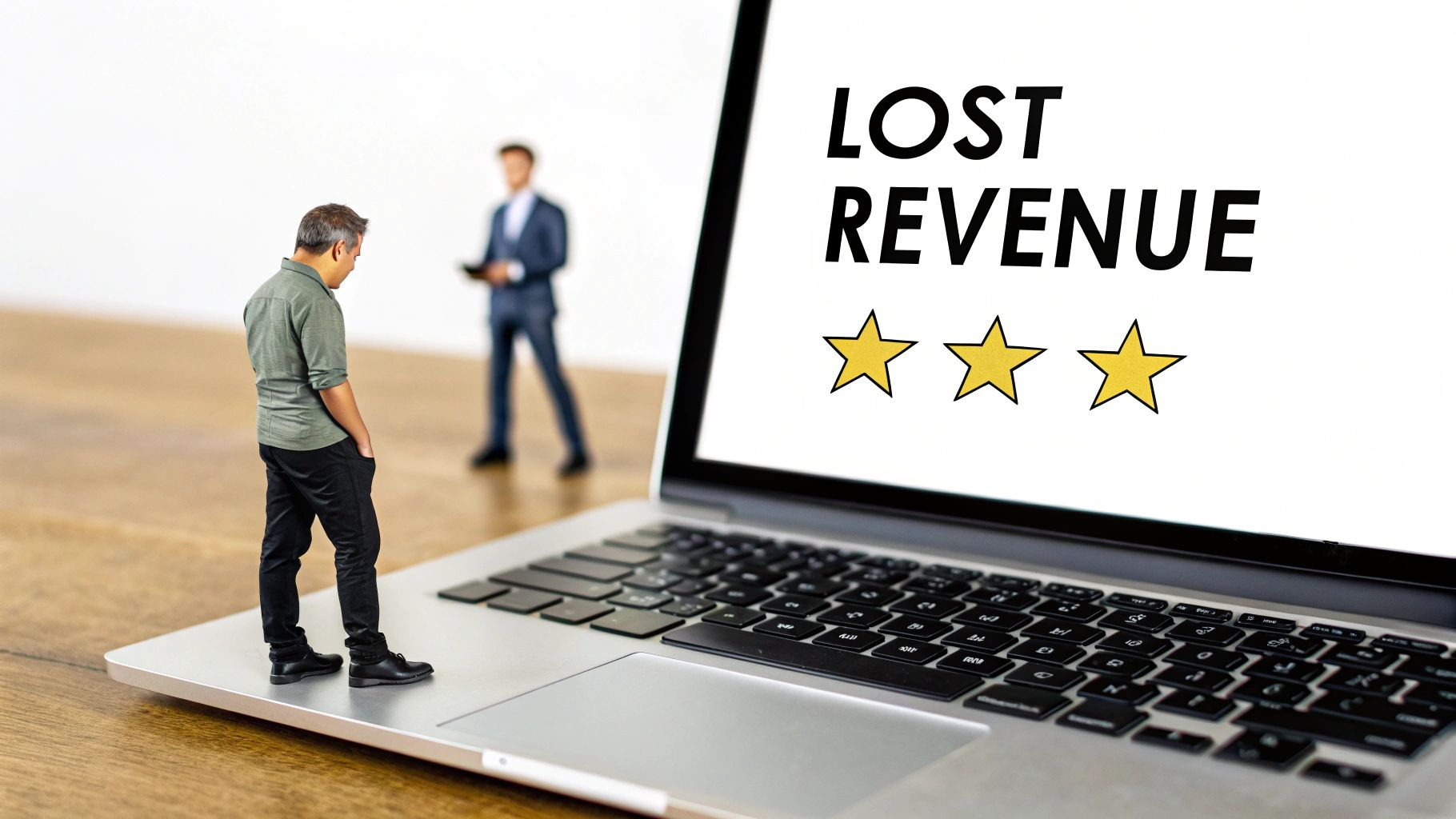
The numbers are pretty shocking. Data shows that a single negative review can turn away about 22% of potential customers. If you get hit with three bad reviews, that number skyrockets to 59.2%. Think about what that means in real terms: fewer people walking through your door, more abandoned shopping carts, and a calendar full of canceled appointments.
Diminished Trust and Credibility
Beyond the immediate cash crunch, negative reviews chip away at your most precious asset: trust. Modern consumers are savvy, and a staggering 86% of them think twice before buying from a business with bad reviews. Every nasty comment erodes the credibility you’ve poured your heart and soul into building.
In a sea of competitors, your star rating is your digital handshake. If trust is shaky from the start, customers will click away to a competitor without a second thought, even if your service is miles better.
This loss of trust has a nasty ripple effect. It kneecaps your marketing campaigns, because no matter how brilliant your ads are, they’ll struggle to win over customers who have already been spooked by negative social proof.
The Impact on Local Search Rankings
The fallout doesn’t end with customer perception. Search engines, especially Google, pay close attention to review signals when deciding who gets top billing in local search results. A steady stream of negative feedback tells the algorithm your business isn't delivering a great experience.
This can cause your search visibility to plummet for the very keywords you need to rank for. A lower star rating and fewer positive reviews can bury your Google Business Profile, making you all but invisible to local customers ready to spend money.
Here's how it plays out:
- Lower Click-Through Rates: When your listing shows up with 3.5 stars next to a competitor's 4.8, you know who’s getting the click.
- Reduced Engagement: Bad reviews stop people from taking the next step, whether that’s calling your business, asking for directions, or visiting your website.
- Negative SEO Signals: All these little signs of poor engagement tell Google that your business is less relevant and authoritative than your higher-rated competition.
The good news? A bad review isn’t a permanent stain on your record. By understanding what’s really at stake, you can move from panicked damage control to a smart, proactive strategy. This guide will show you how to use the platforms’ own rules for negative review removal to reclaim your online narrative.
Learning to Spot a Review You Can Actually Get Removed
That feeling when a one-star review pops up is universal—a mix of frustration and a spike of adrenaline. The first instinct is often to defend your business. But to actually get a negative review taken down, you need to switch gears from an emotional response to a tactical one.
The hard truth is that not every bad review is removable. However, a surprising number of them break the rules, and learning to spot those violations is the most important skill you can develop in reputation management.
This isn't about silencing unhappy customers. It's about identifying reviews that violate the terms of service set by platforms like Google, Yelp, or Trustpilot. Those rules are there for a reason: to keep the platform fair. Your job is to become an expert on them.
What to Look For: Decoding Platform Policies
Think of yourself as a detective. Each negative review is a piece of evidence you need to examine, comparing it against a clear set of platform guidelines. While the fine print varies from site to site, the most common violations fall into just a few buckets.
Get familiar with these, and you'll quickly learn which reviews are worth fighting.
- Conflict of Interest: This is a big one. The review comes from someone with an obvious bias—a disgruntled ex-employee, a direct competitor, or even a competitor's family member. Their goal isn't to share a real customer experience.
- Off-Topic Rants: The review has nothing to do with a customer experience at your business. It might be a political rant, a personal attack on an employee's life, or a complaint about the industry as a whole.
- Prohibited & Illegal Content: This is the nasty stuff. We're talking hate speech, legitimate threats, harassment, or obscene language. Platforms take this category very seriously and usually act fast.
- Impersonation: The reviewer is pretending to be someone they're not. They might be using a famous person's name or even posing as you or one of your employees to mislead people. It’s flat-out deceptive.
- Spam & Fake Content: This review clearly wasn't left by a real customer. Look for promotional links to other businesses, content that seems written by a bot, or a sudden wave of nearly identical negative reviews appearing all at once.
Here’s a common mistake I see all the time: trying to remove a review just because it’s factually wrong. It’s frustrating, but a customer simply misremembering the price or the date of their visit isn't a policy violation. You have to focus on how they're saying it, not just what they're saying.
Real-World Examples of Removable Reviews
It's one thing to read a list of rules, but it's another to see them in action. Let's walk through a few real-world scenarios that would almost certainly qualify for removal.
Scenario 1: The Disgruntled Ex-Employee
A staff member you let go last month for poor performance leaves a one-star review on your Google Business Profile. The review trashes your management style and company culture but never once mentions what it’s like to be a customer.
This is a classic conflict of interest. The review isn’t from a legitimate consumer and is clearly motivated by a personal grudge.
Scenario 2: The Misdirected Rant
A customer leaves a review for your plumbing company complaining that a different plumber in town charges too much. They mention your competitor by name and spend the entire post griping about that company’s pricing.
This is off-topic. The review offers zero insight into an experience with your business, making it useless and misleading for potential customers.
Scenario 3: The Threatening Comment
After a dispute over a bill, a customer posts a review that says, "People like you should watch their back."
This crosses the line into harassment and threats. Platforms have zero tolerance for anything that feels intimidating or dangerous. Make sure you screenshot this one immediately—it’s crucial evidence for a swift takedown.
Once you start recognizing these patterns, you'll be able to assess new negative reviews in seconds. You'll learn to filter out the noise of simple dissatisfaction and lock onto the specific, actionable policy violations that give you a real chance at getting a review removed.
Building Your Case for Removal
So, you've found a review that clearly crosses the line. Great. But spotting the violation is just the first step. Now, you have to build an airtight case for its removal, because the review platforms aren't just going to take your word for it. They run on evidence.
Your job is to shift from being a frustrated business owner to a meticulous detective. A well-documented report is often the single biggest factor that separates a quick, successful takedown from a frustrating denial. You're not writing a novel here; you're presenting a clear, factual argument that makes a moderator's job as easy as possible. You need to connect the dots for them, showing exactly which rule was broken and handing them the proof on a silver platter.
Start with Documentation
Before you even think about hitting that "report" button, your first move is to preserve everything. Reviews can be edited or deleted by the user at any moment, and if that happens, your proof evaporates. You need to act fast.
Here’s what to grab immediately:
- Take a full-page screenshot. Don't just crop around the nasty comment. You need the whole browser window—URL, date, reviewer's name and profile picture, the works. This context is critical.
- Save the direct URL. Copy the specific link to the review itself and paste it into a safe document. This is your direct line back to the evidence.
- Check your own records. If your argument is that this person was never a customer, you have to prove it. Dig into your CRM, payment history, appointment logs, or email lists. A simple "no match found" after a thorough search is powerful evidence.
This is especially true if the negative review spills over onto social media. Knowing how to properly go about archiving social media content can be a lifesaver, giving you a permanent record even if the original post disappears.
Navigating the Reporting Process
With your evidence folder ready, it’s time to file the report. Every platform has a slightly different interface, but the core idea is always the same. Look for the reporting function—usually a small flag icon or a three-dot menu next to the review—and get ready to state your case.
This simple flowchart breaks down the entire process.
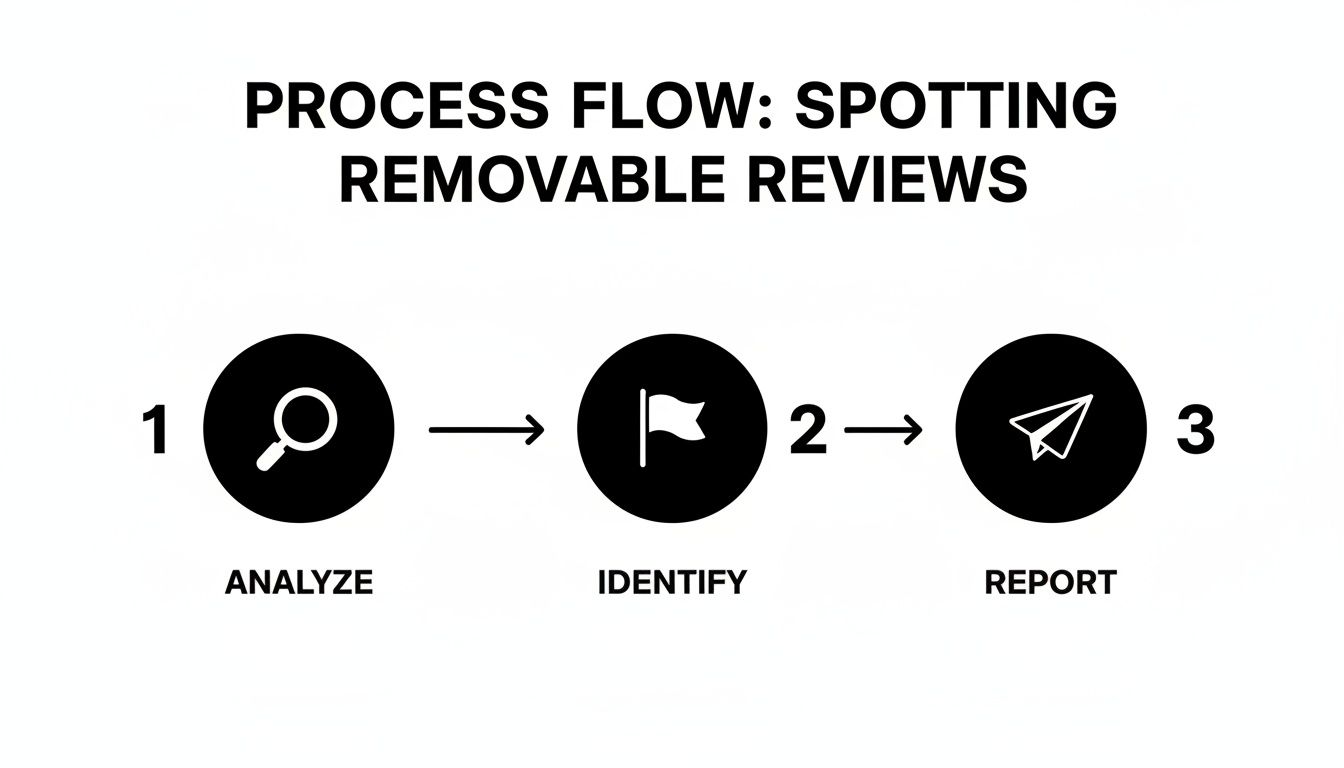
Think of it as three simple actions: analyze the review, pinpoint the specific violation, and then formally report it with the evidence you’ve gathered.
Keep in mind, these platforms are drowning in fake content. For example, Tripadvisor blocked 2 million fraudulent submissions in 2023 alone. That’s a staggering number, and it underscores why a clear, well-documented report is your best shot at getting a moderator’s attention.
Writing a Winning Justification
The little text box where you explain why you're reporting the review? That’s the most important part of this whole process. This is your one shot to make a direct pitch to a human moderator.
Don't waste their time with emotion or a long backstory. Get straight to the point. The moderator is looking for one thing: a clear policy violation. Make it impossible for them to miss it.
A simple, factual approach works best. State the reviewer's name, the exact policy they violated, and a single, crisp sentence explaining how. This is far more effective than a rambling paragraph.
Here’s a Simple Template to Follow:
- Reviewer Name: [Insert Reviewer's Display Name]
- Policy Violated: [Name the Specific Policy, e.g., "Conflict of Interest," "Off-Topic Content," "Harassment"]
- Justification: [Provide a concise, one-sentence explanation.]
Let's see this in action. Say a former employee named "John D." leaves a one-star review trashing your management style.
- Reviewer Name: John D.
- Policy Violated: Conflict of Interest
- Justification: This review was posted by a disgruntled former employee and is not based on a legitimate customer experience.
See how direct that is? It's professional and immediately ties the review to a clear violation. Once you submit, the waiting game begins. Be patient—it can take anywhere from a few days to several weeks for the platform to investigate your negative review removal request and make a final call.
What to Do When Your First Takedown Request Gets Denied
It’s a frustrating moment for any business owner: you get that automated email saying your removal request was rejected. You took the time to build a solid case, pointed out what you thought was a clear violation, and now... nothing. It can feel like you've hit a wall.
But don’t throw in the towel just yet. In my experience, that first rejection is often just part of the process.
The initial review is frequently handled by a junior-level content moderator, or sometimes even just an algorithm. They’re looking for obvious, clear-cut violations and can easily miss the context or nuance of your situation. An appeal often bumps your case up the chain to a more senior team member—a real person who can apply a bit more critical thinking. Persistence here is everything.
How to Appeal a Denied Request
Nearly every major review platform has an appeals process, whether it’s a formal button or an informal support ticket. The specific steps might vary, but the strategy is always the same: give them more context, sharpen your argument, and make it dead simple for the next person who sees it to agree with you. This is your chance to make an even better case.
Here’s a look at the typical escalation paths:
- Google Business Profile: Google actually has a structured appeals tool. You’ll usually find it right in your Business Profile dashboard after a rejection. This is where you can add more evidence and write a more detailed explanation of why the review violates their policies. For a deep dive, our guide on how to get a review removed from Google walks you through every click.
- Yelp: Yelp is a bit tougher. If your first flag doesn’t work, you’ll likely have to go through their general support channels. The key here is to be incredibly specific and quote the exact content guideline the review violates.
- Tripadvisor: Much like the others, Tripadvisor’s Management Center is where you’ll go to contest a decision. Don’t be afraid to follow up, and if you have any new information, make sure you include it.
A critical tip: When you appeal, never just resubmit the exact same report. That’s a recipe for a second rejection. Go back to the platform's policies, find a slightly different or stronger angle, and add any new proof you can find. For example, did you discover the reviewer’s public LinkedIn profile showing they work for your direct competitor? Screenshot it and attach it to your appeal.
Pivoting to Other Strategies
So what happens when even your best-argued appeal gets shot down? It happens. Sometimes a review lives in a policy gray area, or the moderator just doesn’t see it your way. When the platform refuses to step in, it's time to shift your focus from removal to mitigation. The review might be stuck there, but you can still control its impact.
One of the most effective tools you have is a well-crafted public response. A calm, professional, and factual reply can completely defang a negative review. It signals to all future customers that you’re a reasonable business owner who listens and takes feedback seriously. Keep it brief, take the emotion out of it, and just stick to the facts.
In more extreme situations, you may need to consider legal options. I want to be clear: this is not for reviews that are just someone's negative opinion. This route is reserved for reviews containing verifiably false statements of fact that are causing tangible harm to your business—what the law calls defamation.
Often, a cease-and-desist letter from an attorney is enough to get a reviewer to retract a false statement. But this is a big step with real costs and complexities. The legal standard for defamation is quite high, so you’ll need a rock-solid case and professional advice. Ultimately, the goal of negative review removal is to protect your reputation, and that means knowing which tool to use, whether it’s a simple appeal, a strategic reply, or, in rare cases, a lawyer.
Building a Resilient Online Reputation
Removing negative reviews is a great defensive move, but the best long-term strategy is a powerful offense. The single most effective way to neutralize a bad review is to simply drown it in a sea of authentic, positive ones. This is where we shift from cleanup mode to construction—building a reputation so solid that one negative comment is just a tiny blip on the radar.

Think of it as a numbers game. If you have ten reviews and one of them is a one-star bomb, your average plummets to a 4.6. But if you have a hundred reviews, that same one-star review barely makes a dent, leaving you with a stellar 4.9 rating. The goal isn't to be perfect; it's to build a large enough sample size of positive feedback that truly reflects the quality of your work.
This isn’t about faking it, either. Platforms are getting incredibly aggressive in their fight against fake reviews. In 2020 alone, Google blocked or removed an unbelievable 55 million reviews and shut down nearly 3 million fake business profiles. These numbers prove they mean business and show why earning genuine reviews is the only sustainable path forward.
The Art of Asking for Reviews
I see it all the time: business owners are scared to ask for reviews. They feel like they're being pushy or desperate. But if you do it right, it's one of the most natural and effective things you can do for your business.
The secret is all in the timing. You want to ask for the review right at the peak of their happiness—the moment they praise your service, right after a successful transaction, or when you’ve just solved a tough problem for them. That’s when they’re most motivated to share their positive experience.
Here are a few low-pressure ways I’ve seen work wonders:
- Personalized Emails: A simple follow-up note after a purchase or service is a classic for a reason. Keep it short, thank them for their business, and provide a direct link to your preferred review site.
- Text Message (SMS) Requests: For businesses that serve a lot of customers, a quick text with a review link is incredibly convenient. Open rates are often much higher than email.
- In-Person Cues: Sometimes the simplest things work best. A small sign at your register or a line on your receipt can be a gentle and effective nudge.
My golden rule: Make it stupidly easy for them. The fewer clicks between their good feelings and the "submit review" button, the higher your success rate will be. Eliminate every possible hurdle.
Turning Feedback Into Fuel for Growth
A truly proactive reputation strategy is about more than just collecting five-star ratings. It’s about creating a feedback loop. You have to actively listen to what people are saying—the good, the bad, and the ugly—and then use that intel to actually improve your business.
Start looking for patterns in your feedback. Are multiple customers calling out the same employee for their amazing service? That’s a training and recognition opportunity. Are people consistently complaining about a clunky step in your online checkout? That’s your roadmap for what to fix next.
While you're handling individual reviews, it's smart to think bigger. Preparing for a potential reputation crisis before it happens is what separates the pros from the amateurs. A great starting point is learning about developing a robust crisis communication plan to protect your brand when things go sideways. By treating every piece of feedback as a gift of data, you can turn your review profiles from a vanity metric into a powerful tool for building a better business.
Knowing When to Call in a Professional
It's one thing to handle the occasional bogus review that clearly breaks the rules. That's often something you can tackle yourself. But what happens when the problem is bigger than just one rogue comment?
Sometimes, a DIY approach isn't just inefficient—it’s a massive drain on your time and energy with a slim chance of actually working. Knowing when you've hit that wall is crucial for protecting your business and your sanity. If you're tangled in a complex issue or just don't have the hours to spare, it might be time to bring in an expert. These pros live and breathe platform policies; they've spent years learning the very systems you're trying to figure out for the first time.
Recognizing the Tipping Point
Certain situations are clear signals that you've outgrown the do-it-yourself method. These are the high-stakes scenarios, the ones with messy evidence, or just a sheer volume of attacks that no single person can realistically manage. Going it alone here can leave you feeling completely overwhelmed with nothing to show for it.
Here are a few signs that it's time to call for backup:
- You're Facing a Coordinated Attack: Suddenly, your profile is swamped with a wave of one-star reviews, many using suspiciously similar language. This is a classic "review bomb." Proving a coordinated, malicious campaign to the platforms requires a specific kind of evidence and a strategic response.
- The Review Involves Legal Complexity: The post isn't just a bad opinion; it's defamatory. It contains verifiably false statements of fact that are causing real, tangible harm to your business. A professional can help build the case and often works with legal counsel to navigate the tricky line between protected opinion and illegal defamation.
- You Just Don't Have the Time: Let's be honest, you're busy running a company. The hours it takes to screenshot everything, write detailed justifications, and constantly follow up on appeals are hours you're not spending on your actual business.
A professional's value isn't just about saving time; it's about their success rate. They often have established relationships with platform support teams and know the precise language and evidence needed to get a case escalated and approved quickly.
What a Professional Service Brings to the Table
Hiring a specialized service for negative review removal turns a frustrating, uphill battle into a clear, strategic action plan. These teams bring a level of focus and efficiency that’s nearly impossible to replicate on your own.
Their real advantage is deep institutional knowledge. They’ve seen it all—thousands of cases across every industry—and they know the unwritten rules and hidden escalation paths that aren't in any public help-docs. While you’re stuck guessing what might work, they’re already executing a proven playbook. This is especially true for firms offering dedicated online reputation management services, as their entire business is built around solving these exact problems.
When you're vetting a potential partner, don't be shy. Ask about their process, their success rate with cases like yours, and how they report back on progress. A reputable firm will be transparent and give you straight answers. Making this investment can be the difference between a problem that festers for months and a swift, decisive resolution.
Got Questions About Review Removal? Let's Clear Things Up.
When you start digging into the process of removing negative reviews, a few key questions always seem to pop up. Getting straight answers is crucial for setting realistic expectations and figuring out the best way forward for your business.
Let’s get right into the most common concerns I hear from business owners who are ready to take action against unfair or fake reviews.
How Long Does This Actually Take?
This is the million-dollar question, and the honest answer is: it depends. The timeline can swing wildly from one case to the next.
If you're dealing with a blatant policy violation on a platform like Google Business Profile, you might get a resolution in as little as 3-7 business days. It's a clean, straightforward process when the violation is obvious.
But things can get complicated. More nuanced cases, especially on platforms like Yelp that are known for slower review processes, can easily stretch into several weeks. If your first request gets denied and you have to file an appeal, you could be looking at a month or even longer.
The big takeaway here is that there are no guarantees on timing. Patience is your best friend, but so is persistence. If you have a solid case, don't be afraid to follow up professionally.
Can I Sue Someone Over a Bad Review?
In theory, yes, you can. But in practice, this should be your absolute last resort—the nuclear option you only consider when everything else has failed.
For a lawsuit to even have a chance, the review must cross the line from opinion into defamation. This means it has to contain a false statement of fact (not just an opinion) that causes real, measurable harm to your business's reputation. That’s a very high legal hurdle to clear. A customer's harsh opinion—"the food was terrible," for example—is protected speech.
Before you even think about calling a lawyer, make sure you've done the following:
- Tried every single removal option available through the review platform itself.
- Spoken with an attorney who specializes in defamation law to see if you even have a case.
- Seriously weighed the staggering potential costs (legal fees, time, and stress) against the actual damage the review is causing.
Should I Just Buy Some Positive Reviews to Drown Out the Bad Ones?
Let me be crystal clear: absolutely not. This is one of the fastest ways to destroy your online reputation, not fix it.
Purchasing fake positive reviews is a major violation of every single review platform's terms of service. The fallout when you get caught—and you likely will—is severe. You could have all your reviews deleted (even the real ones), get your business profile suspended or banned for good, and even face hefty fines from agencies like the FTC.
The only way to build a strong, lasting reputation is the old-fashioned way: by earning genuine positive reviews from your actual, happy customers.