


Online reputation management services are all about shaping how the public sees your business online. It’s a hands-on process of keeping an eye on, influencing, and responding to conversations about your brand everywhere—from Google search results and social media feeds to review sites like Yelp and Trustpilot.
Your Digital Storefront Needs Expert Management

Think of your online presence as your digital property. Just like a physical storefront, it needs constant upkeep and protection to keep customers coming in. Online reputation management (ORM) services are like the specialized property managers for this vital asset, making sure it always represents the quality and values of your brand.
Without someone actively managing it, your digital storefront is exposed to digital graffiti (fake reviews), trespassers (impersonation accounts), and even squatters (counterfeit product listings). These issues can quickly eat away at customer trust and take a real bite out of your bottom line.
To put it simply, ORM services are your first line of defense against the most common threats to your brand's digital integrity.
The table below breaks down some of the frequent challenges businesses face and how a dedicated ORM service steps in to solve them.
Key Threats Addressed by ORM Services
| Online Threat | Business Impact | ORM Service Solution |
|---|---|---|
| Negative & Fake Reviews | Erodes trust, discourages potential customers, and lowers star ratings. | Investigates and reports reviews that violate platform policies for removal; implements strategies to encourage genuine positive feedback. |
| Brand Impersonation | Confuses customers, dilutes brand messaging, and can lead to fraud or phishing attacks under your name. | Actively detects and reports fake social media profiles, websites, and email accounts for takedown. |
| Counterfeit Products | Steals revenue, damages brand quality perception, and can pose safety risks to consumers. | Identifies and removes unauthorized listings from e-commerce marketplaces and fraudulent websites. |
| Misleading Search Results | Outdated or false information can dominate your search results, hiding positive content. | Creates and promotes positive, authoritative content (SEO) to push negative results down and out of sight. |
| Data Broker Exposure | Publicly listed private or inaccurate company information can lead to security risks or misrepresentation. | Scans data broker sites and submits removal requests to protect sensitive company and executive information. |
Each of these solutions requires a specific skill set, making professional ORM a crucial part of modern brand protection.
Beyond Simple Monitoring to Active Enforcement
Years ago, ORM was mostly about passively listening for brand mentions. Today, it’s a proactive, enforcement-driven field. Modern online reputation management services don't just find problems—they go out and fix them.
This leap from just watching to actively doing is a game-changer. It’s the difference between knowing a fake review exists and having the expertise to actually get it taken down. This requires a deep, practical knowledge of each platform's rules and the skill to build a solid, evidence-based case for removing harmful content.
Your online reputation isn't just what you say about yourself; it's what Google, Yelp, and social media say about you. Modern ORM is the practice of ensuring that online story matches your brand’s reality and values.
The stakes have never been higher. With nearly 93% of consumers confirming that online reviews influence their purchasing decisions, your digital reputation is directly tied to your revenue. This reality has turned ORM from a "nice-to-have" into a business necessity.
The Financial Impact of Digital Trust
The demand for these services has exploded, fueling a market projected to hit USD 12.57 billion by 2030. This growth is driven by the undeniable link between a positive online presence and financial health, as a brand’s digital trust can influence up to 80% of its market value. You can find more data on the growing ORM market and what's driving it.
Effective ORM services deliver a clear return on investment by:
- Protecting Revenue: Hunting down and removing counterfeit listings and misleading ads that are siphoning off your sales.
- Building Trust: Making sure potential customers see authentic, positive feedback, not malicious or fake attacks.
- Securing Brand Equity: Fighting brand impersonations that can weaken your message and confuse your audience.
Ultimately, investing in professional online reputation management isn’t a luxury anymore—it’s an essential cost of doing business in a world where your digital front door is often your most important one. It's about taking back control of your narrative and building a resilient brand that’s built to last.
The Core Pillars of a Modern ORM Strategy
A solid online reputation management strategy isn't a single magic bullet. It’s a coordinated game plan built on a few core pillars that work together. Think of it like a security system for your brand—you need the cameras, the strong locks, and a team ready to respond. Each piece has its own job, but together they create a powerful defense.
This approach isn't just about playing defense when a crisis hits. It’s also about going on offense to proactively build a stronger, more positive story around your brand for the long haul.
Proactive Threat Detection and Monitoring
The first step is knowing what's being said about you. That's where Proactive Threat Detection comes in. You can't fix a problem you don't even know exists, right? This is your brand's early-warning system, constantly scanning the digital world for any mention of your name, your products, or your key people. It’s the digital version of having security cameras covering every angle.
This isn't just a manual Google search every now and then. This is about using smart tools to automatically track:
- New Reviews: Getting instant alerts for new feedback on sites like Google, Yelp, and Trustpilot.
- Social Media Mentions: Catching conversations about your brand, even when you aren't tagged.
- Impersonation Accounts: Finding fake profiles or copycat websites trying to trick your customers.
- Counterfeit Listings: Spotting unauthorized sellers on platforms like Amazon or eBay.
Without this kind of active monitoring, a single nasty review or a fraudulent account could sit there doing damage for weeks—or even months—before anyone on your team stumbles across it. This pillar makes sure you're the first to know, so you can jump on it immediately.
Content Takedown and Enforcement
Once a threat is flagged, the next move is Content Takedown and Enforcement. This is where the real expertise kicks in. Finding a fake review is one thing; actually getting it removed is a whole different ballgame. It’s less about hitting a "report" button and more like a paralegal building a case file.
Professional online reputation management services do this by digging deep into each platform's specific terms of service to build a rock-solid, evidence-based case for removal. For example, the reason a review gets taken down from Google for a "conflict of interest" might be totally different from why a social media account gets removed for "impersonation." Success hinges on presenting the right proof to the right people in the right way.
An effective takedown strategy isn't about getting into a shouting match with the person who wrote the content. It's about methodically proving to the platform that the content breaks their own rules. This turns a messy, subjective argument into a clear-cut policy violation.
This pillar is pure defense. It's about surgically removing content that is fraudulent, defamatory, or just plain unfair, leveling the playing field for your business online.
Search Result Management
While takedowns handle specific negative items, Search Result Management is all about the bigger picture: what people see on the first page of Google. This part of the strategy is about taking control of the narrative by making sure positive, accurate, and brand-owned content ranks highest. It’s both an offensive and defensive play.
Defensively, the goal is to push negative or misleading search results down and off the first page where they can't do much harm. Offensively, it’s about creating and promoting great content that you want people to see, dominating those top spots. This is usually done with a smart SEO strategy focused on:
- Your official website and blog
- Positive news articles and press mentions
- Well-maintained social media profiles
- Favorable reviews and articles on other websites
When you control the first page of the search results, you control the first impression most of your potential customers will ever have.
Strategic Review Management
The final pillar, Strategic Review Management, tackles reviews from two sides. The defensive part is all about identifying and removing fake, malicious, or policy-violating reviews that are unfairly dragging down your star ratings.
But the offense is just as crucial. This involves putting systems in place that encourage your actual, happy customers to share their positive experiences. Doing this builds a "reputational buffer" of genuine praise that naturally protects your brand from the impact of the occasional negative comment.
A steady flow of positive reviews is one of the most powerful ways to build trust and convince new customers to give you a shot. All together, these four pillars create a complete system that doesn't just clean up past damage but also builds a stronger, more resilient online presence for the future.
How Professional Content Takedown Services Work
Ever hit the "report" button on a nasty review and just... waited? If you have, you know that just hoping for the best rarely works. Professional takedown services operate on a completely different level. Think of it less like filing a complaint and more like building a legal case for a platform’s own content moderation team.
The whole goal is to remove any guesswork. You're not just saying "I don't like this"; you're presenting a clear, undeniable case that a specific rule has been broken. The entire workflow boils down to three core pillars: detection, enforcement, and management.
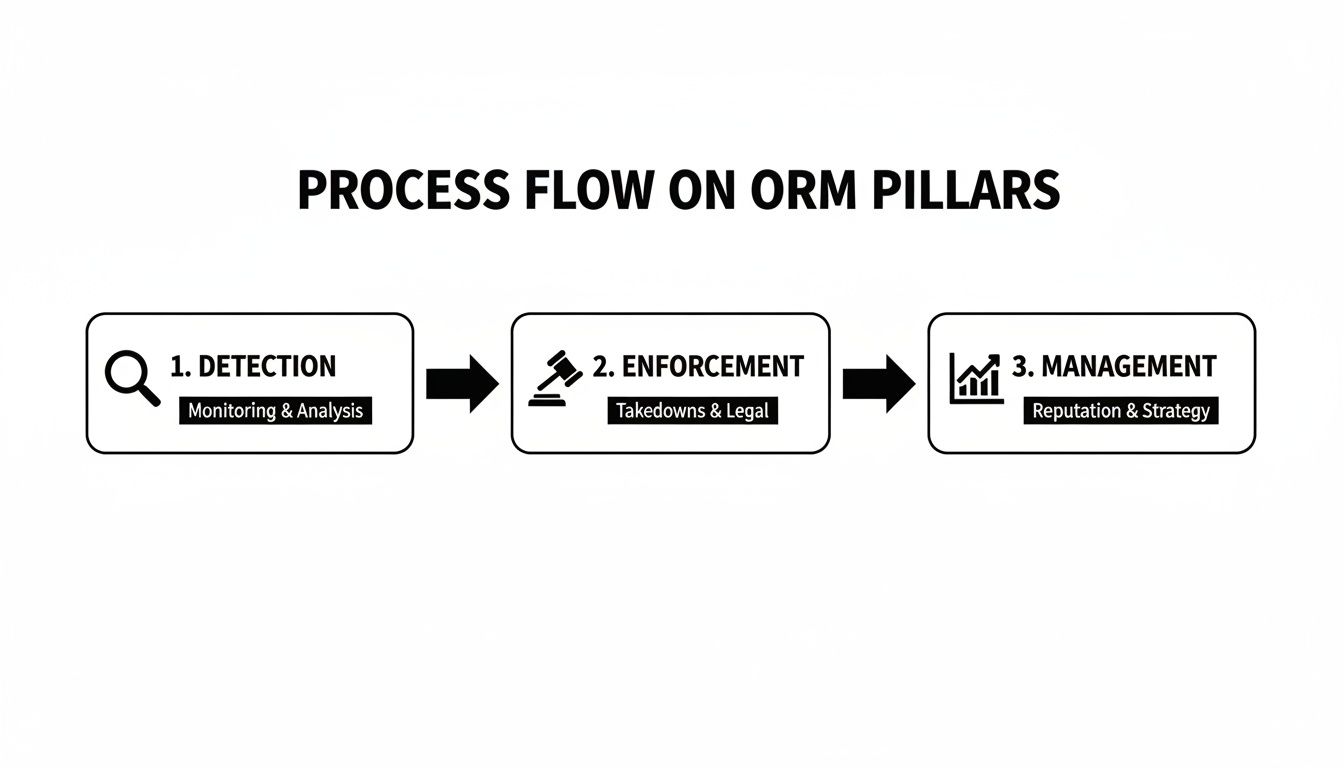
This process isn't just about finding a problem and trying to fix it. It's a continuous cycle designed to protect your reputation from start to finish. The real magic happens when a simple client report is transformed into a compelling, evidence-backed case.
Step 1: Case Submission and Initial Assessment
It all begins when a client flags a piece of harmful content. This could be anything—a fake one-star review, a website selling counterfeit versions of your product, or an account impersonating your brand on social media. That initial submission is the spark that ignites the whole operation.
From there, an expert team takes over for an initial assessment. They'll dig into the platform's specific terms of service to see if there's a legitimate case for removal. It's an important reality check: not all negative content can be taken down. It has to violate a concrete rule.
Step 2: The Investigation Phase
This is where the real detective work begins, and it’s what truly separates the pros from the amateurs. The team shifts from just assessing the problem to actively investigating it, hunting down every shred of evidence needed to prove a policy was violated.
This deep dive is all about building an airtight case:
- Evidence Collection: This isn't just taking a single screenshot. It might involve digging into user profiles to prove a reviewer is a direct competitor, or tracking down transaction records to show a customer never actually existed.
- Policy Alignment: The team pinpoints the exact platform policy being broken. Is it "conflict of interest"? "Impersonation"? "Hate speech"? Being specific is everything.
- Case Construction: All that evidence is bundled into a formal, detailed report. The case is laid out so clearly that a platform moderator can immediately understand the violation and make a quick decision.
This meticulous preparation is precisely what makes a professional takedown request so much more effective than a standard user report.
Step 3: Action and Enforcement
With a rock-solid case file in hand, it's time to take action. The formal takedown request is submitted, often through back-end channels that the general public doesn't have access to.
But it’s not a "fire and forget" mission. Online reputation management services don't just submit the case and walk away. They actively manage it, following up with platform support teams and providing any additional information requested. This persistent, professional follow-up is crucial for ensuring the case doesn't get buried in a support queue.
The secret to successful enforcement is speaking the platform's language. You have to frame the issue in a way that makes it their problem, too—by showing them how this specific piece of content is a liability because it breaks their own established rules.
Step 4: Resolution and Reporting
The final step is all about confirming the win. The service verifies that the harmful content has been scrubbed from the web and documents the successful outcome.
Clients get a straightforward report detailing exactly what was done and what the result was. This provides a transparent, measurable return on your investment and shows the direct impact the service had on your brand’s online presence. If you're looking to get into the weeds of this process, our guide on negative content removal offers an even deeper dive.
Ultimately, this methodical approach ensures your brand is protected by a system that is defensible, repeatable, and incredibly effective.
Navigating Complex Platform Enforcement Rules
Trying to get harmful content taken down online isn't a one-size-fits-all job. Every platform, whether it’s Google, Amazon, or Instagram, essentially operates like its own country—complete with a unique set of laws, a specific language, and its own cultural norms. If you try to use the same argument to remove a fake review on Yelp as you would to report a counterfeit product on Amazon, you'll get nowhere fast. It’s like trying to spend dollars in a country that only accepts yen.
This is where a professional online reputation management service really shows its worth. Think of them as expert translators and diplomats who are fluent in the constantly shifting terms of service for every major platform. They get that what makes content removable is defined by the platform's rulebook, not just by what a business owner feels is unfair.
Speaking the Platform's Language
A vague complaint like "this isn't fair!" is almost guaranteed to be ignored. To have any chance of success, a takedown request has to pinpoint a precise violation of a specific policy. You need to frame the evidence in a way that resonates with content moderators who are sifting through thousands of reports every single day.
It really boils down to this:
- On Google, a negative review from a bitter ex-employee can often be removed by flagging it as a "conflict of interest."
- On Amazon, a seller hijacking your product listing with a cheap knockoff can be taken down for selling "counterfeit" goods.
- On Instagram, a fake profile using your company’s logo to scam people can be shut down for "impersonation."
See the pattern? The core problem might feel the same—someone is damaging your business—but the official reason for removal is completely different depending on where you are. A pro knows exactly which violation to cite and how to build the case to prove it.
This deep policy expertise transforms a subjective complaint into an objective, evidence-based case that platform moderators can act on quickly.
Why Google's Rules Matter Most
As of March 2025, Google still dominates the search engine market with an incredible 79.1% global share. That means for nearly four out of five potential customers, your page-one results and Google Knowledge Panel are the front door to your reputation.
This dominance is why specialized enforcement providers like LevelField, which blend smart software with deep legal and policy knowledge, are becoming essential partners for brands. They help businesses police reviews, misleading ads, and impersonations across dozens of platforms at once. To dig deeper into these trends, you can explore more about the enterprise reputation management market.
The table below gives you a clearer picture of how different platforms handle similar issues, which really underscores the need for specialized expertise.
Platform Violation Examples
Each platform has its own rulebook for what's allowed. What might be a clear violation on one site could be perfectly acceptable on another. This table breaks down a few common examples.
| Platform | Example of a Removable Violation | Key Policy Focus |
|---|---|---|
| A review from a current employee praising their own workplace. | Conflict of Interest & Authenticity | |
| Yelp | A review demanding a refund or discount in exchange for removal. | Threats, Harassment & Extortion |
| Amazon | An unauthorized seller listing a knock-off of your patented product. | Intellectual Property & Counterfeit Goods |
| Meta (Facebook/Instagram) | A fake profile using your name and photos to defraud customers. | Impersonation & Authenticity |
| Trustpilot | A review that describes a competitor's service, not the one being reviewed. | Misinformation & Relevance |
This is exactly why a DIY approach so often falls flat. Without knowing the precise rules of engagement for each platform, even the most legitimate complaints can get lost in the shuffle or rejected outright.
The Evolving Rules of Engagement
Platform policies aren't set in stone. They're constantly being updated in response to new government regulations, emerging online threats, and changing user behaviors. For instance, as AI models play a bigger role in search and content discovery, understanding tools like this guide to using an llms.txt generator is becoming crucial for telling them how to interact with your site.
A professional ORM service doesn’t just know the rules as they are today; they are dedicated to tracking these changes to ensure their enforcement strategies remain effective. This constant vigilance is a full-time job.
Ultimately, navigating these complex rules is about more than just clicking the "report" button. It’s about building a compelling, policy-compliant case that makes it easy for a busy platform moderator to say "yes" to your takedown request. That specialized skill is the real engine behind any successful content removal strategy.
How to Measure the Success of Your ORM Investment

Reputation management isn't just about feeling better about your brand; it should deliver a clear, measurable return on your investment. To really know if your online reputation management services are working, you have to look past fuzzy metrics and zero in on Key Performance Indicators (KPIs) that actually affect your bottom line.
A solid ORM strategy produces numbers you can take to the bank. It's the difference between hoping your brand image is improving and having the cold, hard data to prove it. This means you should expect—and demand—transparent reporting from any provider, holding them accountable for specific, agreed-upon results.
Moving Beyond Vanity Metrics
The real goal is to track metrics that have real-world consequences. Sure, things like social media mentions are interesting, but they don't always paint the full picture of your brand's health. A results-driven approach focuses on four primary KPIs that connect directly to business value.
These are the core metrics that truly matter:
- Takedown Success Rate: This is the most straightforward measure of an enforcement service’s muscle. It answers a simple question: "Of all the damaging content we targeted, what percentage actually got removed?" A high success rate shows a deep, practical knowledge of how each platform’s policies work.
- Improvement in Average Star Rating: For any business that lives and dies by reviews, even a tiny bump in your average star rating can fuel major revenue growth. This KPI tracks the tangible lift in your ratings on crucial sites like Google, Yelp, or Trustpilot over a set period.
- Reduction of Negative Search Results: This metric shows how effectively negative or misleading articles are pushed off the first page of Google. The entire point is to make sure that when someone searches for you, the first thing they see is positive and accurate.
- Prevention of Revenue Loss: This KPI is absolutely critical for e-commerce brands. It puts a dollar figure on the impact of removing counterfeit product listings, shutting down impersonator accounts, and stopping fraudulent ads that were stealing your sales.
When you focus on these specific outcomes, you can draw a straight line from your ORM efforts to your brand's equity and growth.
A great reputation partner provides more than just activity reports; they deliver impact reports. The focus should always be on the tangible business outcomes achieved, not just the number of actions taken.
A Practical Before-and-After Scenario
Let’s see how these KPIs play out in the real world. Imagine a local healthcare practice, "Oakridge Medical," stuck with a 3.2-star Google rating. The low score is almost entirely due to two fake negative reviews and a counterfeit Facebook page spreading bad information.
- Before ORM: Potential patients searching for the clinic see a mediocre rating and a confusing, untrustworthy social media presence. They pause, and many will click over to a competitor with a 4.5-star rating instead. The clinic is actively losing new patients every single day.
- After ORM: An expert service digs in, gets the two fake reviews removed based on Google's "conflict of interest" policy, and boosts the clinic's rating to a much healthier 4.1 stars. At the same time, they successfully report the impersonation page to Meta and get it taken down.
The result isn't just a feeling of relief; it's a clear, measurable win. More potential patients now see a trustworthy rating, which leads directly to more appointment bookings.
Of course, effective ORM requires constant monitoring of your brand's presence across all online platforms, including Large Language Models. For more on that, check out a guide to monitor brand visibility in LLMs. This helps ensure the reputation you’ve worked so hard to build is protected everywhere your customers might find you.
How to Choose the Right Online Reputation Partner
Picking the right partner to manage your online reputation is one of the biggest calls you’ll make for your brand's future. Get it right, and you have a dedicated guardian for your digital presence. Get it wrong, and you could end up in a worse spot than when you started. You have to look past the slick sales presentations and zero in on what really matters: transparency, real expertise, and ethical practices.
Think of it this way: you’re not just hiring a vendor, you’re bringing on a partner. You need a team that gets your industry, plays by the rules of each platform, and can show you real, measurable results. To help you sort the experts from the amateurs, here’s what you should be looking for.
Vetting Potential ORM Providers
Before you even think about signing a contract, it’s time to do some serious homework. A top-tier firm will be an open book, happy to share their processes and results. If a company gives you vague answers or makes promises that sound too good to be true, walk away.
Here’s a practical checklist of questions to bring to the table:
- What is your exact process for content removal? A good answer will focus on a methodical, evidence-based approach that aligns with platform policies. A bad answer sounds like, "we have connections."
- Can you provide case studies or client testimonials? Nothing speaks louder than a track record of success with businesses like yours.
- How do you measure and report on success? You want a partner who talks about concrete KPIs—like takedown rates and improved star ratings—not just sending you reports on "activities completed."
- What is your pricing structure? The costs should be crystal clear, whether it’s a monthly retainer, a pay-per-performance model, or some combination of the two.
Be extremely cautious of any company that guarantees 100% removal of negative content. The final call always belongs to the platform, whether it’s Google, Yelp, or another site. An ethical service can never promise a specific outcome. A high success rate is fantastic, but an absolute guarantee is a massive red flag.
Key Evaluation Criteria
Once you’ve asked the initial questions, it’s time to dig a little deeper. These three areas are the non-negotiables for protecting your brand the right way.
- Commitment to Ethical Methods: Make sure the provider follows platform terms of service to the letter. Run from any firm that even hints at using "black-hat" tactics, like posting fake positive reviews or engaging in other deceptive strategies. You're trying to build a strong, resilient reputation, not a house of cards that could tumble at any moment.
- Proven Platform-Specific Expertise: A true pro knows that getting a review taken down on Google is a completely different ballgame from removing a counterfeit product listing on Amazon. Ask them to walk you through specific examples of their work on the platforms that matter most to you. Their team needs to have deep, hands-on knowledge of each platform's unique rulebook.
- Transparent Processes and Reporting: You should never be left wondering what’s going on. A trustworthy partner will give you a clear view of their entire workflow, from the initial investigation to the final enforcement action. They should also provide regular, easy-to-digest reports that show you exactly what progress they’re making.
Choosing the right ORM partner is a strategic investment in your brand’s longevity. If you're currently weighing your options, our guide to the best online reputation management software can give you more insight into the tools these expert teams use every day.
Frequently Asked Questions
When you're dealing with a reputation problem online, a lot of questions pop up. Let's tackle some of the most common ones to give you a clearer picture of how professional reputation management actually works.
How Long Does It Take to Remove a Fake Review?
Honestly, it depends. There's no single timeline, as every platform and every case is different.
If you're dealing with a blatant violation—think a review packed with hate speech or personal threats—it could be gone in just a few days. The platform's moderators can spot those pretty easily.
But what about the trickier situations? Proving a review was left by a competitor or a disgruntled ex-employee requires digging for evidence and carefully building a case. Those can take several weeks of back-and-forth communication with the platform. A good ORM team handles that entire headache for you, making sure the process keeps moving.
Is It Legal to Pay for Review Removal?
This is a big one, and the distinction is critical. Paying a professional firm to manage the removal process is 100% legal and ethical. You're not paying for a guaranteed takedown; you're paying for their expertise in investigating the review, gathering evidence, and navigating the platform's specific, often complicated, reporting system.
What's not okay is trying to bribe the reviewer or using black-hat tactics to manipulate the system. That's a fast track to getting your business profile penalized or even suspended. Professional ORM services stick to the rulebook, period.
A word of caution: No legitimate ORM service can promise a 100% removal rate. The final call always belongs to the platform, whether it's Google, Yelp, or another site. A high success rate shows they're great at their job, but a guarantee is a major red flag.
What Is the Difference Between ORM Software and an ORM Service?
It’s the classic "do-it-yourself" vs. "done-for-you" scenario.
ORM software is a tool. It's like a dashboard that alerts you to new reviews and mentions across the web. It gives you the information, but it's up to you to figure out what to do with it.
An ORM service, on the other hand, is a complete solution. It pairs that same technology with a team of actual experts. They don't just monitor your reputation; they take action. They're the ones who investigate negative content, file the takedown requests, and handle all the communication to see the issue through to resolution.