


That sinking feeling when a one-star review pops up is something every business owner knows. But your gut reaction—whether it's defensive, apologetic, or just plain panicked—is what defines your brand's resilience in that moment.
Before you type a single word, the smartest thing you can do is take a breath. Just pause. This isn't just about damage control; it's your chance to set a professional, calm tone that shows every other potential customer exactly how you handle criticism.
Your First Move After a Negative Google Review
The impulse to fire off a quick reply is strong. But acting too fast, especially when you're frustrated, can pour fuel on the fire. Your first move should always be a strategic pause to actually figure out what you're dealing with.
This brief analysis period is where you lay the groundwork for a solid resolution. It helps you decide whether you need to draft a public reply, fix an internal process, or go straight to Google and ask for a takedown. It’s less about deciding if the customer is "right" or "wrong" and more about sorting the feedback into the right bucket so you can take the right action.
Triage The Review: Genuine vs. Fake
Every piece of negative feedback you get will fall into one of a few categories. Nailing which one is your most critical first task.
Is it a real customer with a legitimate problem? Or is it something more suspicious? A clumsy response to a genuine complaint can alienate countless future customers. At the same time, failing to spot a fake review means you're letting someone actively sabotage your reputation.
Here’s a simple breakdown:
- Genuine Customer Feedback: This is the most common kind you'll see. The person likely had a genuinely bad experience and just wants to be heard. You'll often see specific details—they might mention an employee's name, a product that failed, a specific date, or a service mix-up. As painful as it is to read, this feedback is gold. It's a free consultation on how to improve your business.
- A Simple Misunderstanding: Sometimes, a customer is upset because of a miscommunication or a mismatched expectation. Maybe they're angry about a return policy they overlooked, even though it was clearly stated. These situations call for a delicate touch—you need to clarify things without making them feel blamed or foolish.
- Fake or Malicious Reviews: These aren't feedback; they're attacks. They often come from competitors, bitter ex-employees, or sometimes just people with a bone to pick. Spotting these is crucial to protecting your business from unfair hits.
Spotting a Fake Review
Fake reviews almost always leave clues. While no single red flag is definitive proof, a combination of them should make you suspicious. Before you even think about how to respond, look for these tell-tale signs.
A dead giveaway for a fake review is a total lack of verifiable details. Real, unhappy customers remember specifics—what they ordered, when they visited, who they talked to. Fake reviews are all vague, emotional attacks because there's no actual experience to pull from.
Think about it. A real review says, "I waited 20 minutes for my latte on Tuesday morning, and the barista was rude." A fake one is more likely to scream, "Terrible service and awful products. Stay away from this horrible place!"
Keep an eye out for these other patterns:
- No Specifics: The complaint is generic ("bad service," "total rip-off") with zero context.
- Reviewer Anonymity: The reviewer's name looks off (e.g., "A Google User") or their profile is completely blank.
- Weird Review History: Click on the reviewer's profile. Do they only leave one-star reviews? Have they reviewed 10 businesses in 10 different cities in the past hour? This is a huge sign of a bot or someone with an agenda.
- Mismatched Details: The review complains about a service or product you don't even offer. They've probably confused your business with another one.
- Promotes a Competitor: The review explicitly names one of your competitors and tells people to go there instead. This is a blatant violation of Google's review policies.
This decision tree gives you a visual workflow for that initial analysis, guiding you on whether the review is genuine feedback or something that violates Google's policies and needs to be flagged.
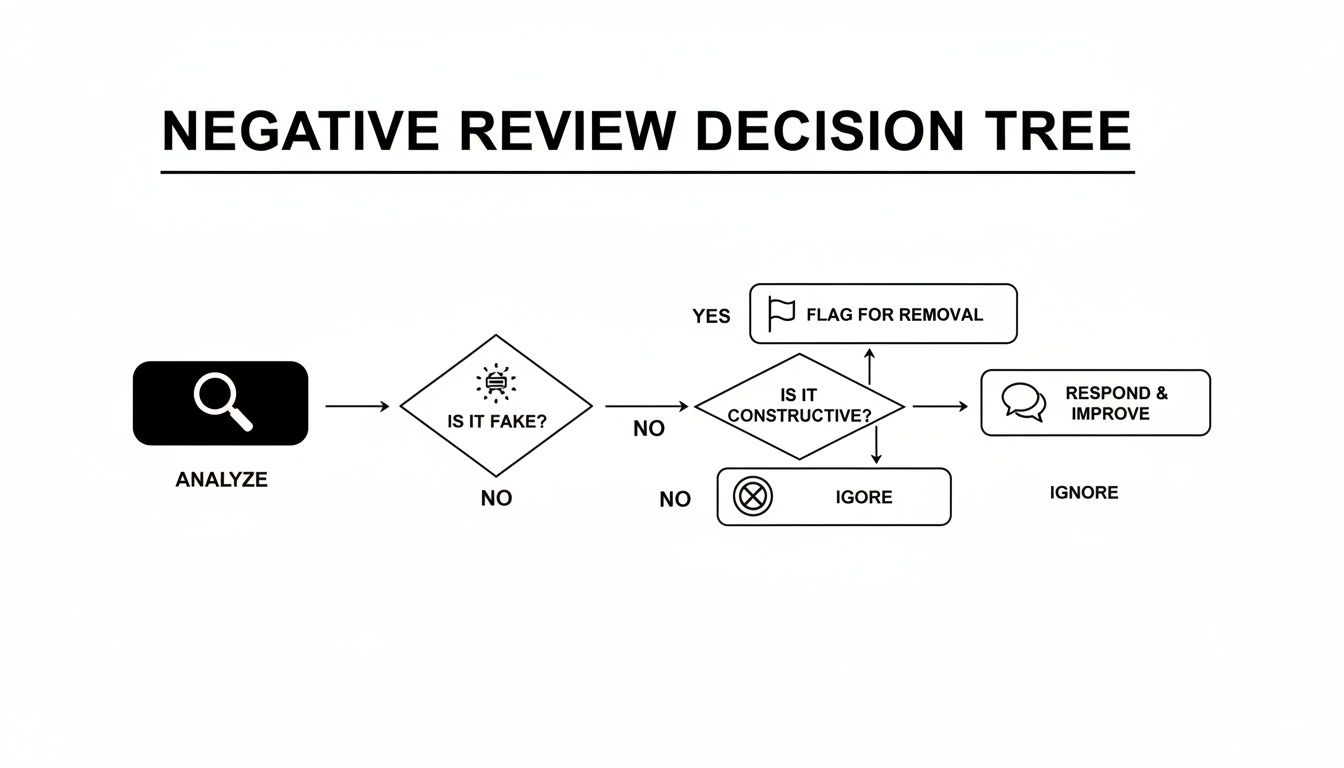
Ultimately, this all comes back to that first critical step: analyze before you act. Once you’ve confidently sorted the review into the right category, you can move forward with a clear head, knowing if your next step is to start writing a reply or to start the removal process.
Crafting a Public Response That Builds Trust
When you've confirmed a negative review is from a real customer, your public reply is more than just a comment—it’s a performance. Every potential customer scrolling through your reviews is in the audience, and they're watching closely to see how you handle criticism. This moment isn't about winning an argument with one person; it's about showing everyone else what your business is made of.
A defensive, knee-jerk reaction is the quickest way to prove the negative reviewer right. The real goal here is to show accountability, express empathy, and offer a clear path to make things right. When done well, a thoughtful response can transform a public grievance into a powerful display of your company's integrity.

The Anatomy of an Effective Response
I’ve found that the best responses follow a simple but effective framework: Acknowledge, Apologize, and Act. It’s a formula that helps you cover all your bases without sounding like a corporate drone.
Acknowledge Their Experience: Always start by thanking them for the feedback and mentioning the specific problem they had. Using their name makes an immediate difference. It proves you've actually read their complaint, not just fired off a canned reply.
Apologize Sincerely: Offer a genuine apology for their bad experience. This is key: you’re apologizing that their experience didn't meet expectations, not necessarily admitting fault for every single detail they’ve claimed. A simple, "We're so sorry to hear your visit fell short of the mark," works wonders.
Act with a Clear Next Step: This is the most important part of learning how to respond to a negative Google review. You absolutely must move the conversation offline. Provide a direct contact—a person's name, an email, a phone number—and invite them to get in touch. This shows you're serious about a resolution and keeps sensitive details private.
Your public reply is not the courtroom. Don't debate facts or get into a back-and-forth. The only job of this response is to de-escalate the situation and show prospective customers you take feedback seriously.
This approach puts you in control. You aren't hiding from the problem; you're tackling it head-on while guiding it toward a productive, private conversation.
Word Choice Matters—A Lot
The words you use can either calm the waters or add fuel to the fire. Your tone should always be professional, calm, and, above all, helpful.
Just look at the difference. Imagine a review complaining about a delayed shipment:
The Bad Response: "Our records show your package arrived on time. You must be mistaken. We aren't responsible for carrier delays anyway."
The Good Response: "Hi [Customer Name], thank you for letting us know about this. We're very sorry for the frustration the delay caused. That's definitely not the experience we want for our customers. Could you please contact our manager, Sarah, at [email/phone] so she can look into this for you right away?"
The first one is a disaster—it's defensive, accusatory, and slams the door shut. The second response validates their frustration without arguing facts, apologizes sincerely, and gives them a clear, helpful next step. It’s night and day.
Personalization Is Not Optional
A generic, copy-and-pasted reply is almost as bad as saying nothing at all. It tells everyone reading that you're just checking a box. Personalization shows you actually care.
Make every single reply feel unique:
- Use the reviewer's name. This is the easiest and most powerful trick in the book.
- Reference a specific detail they mentioned. For example, "We're sorry the fish tacos were cold..."
- Switch up your phrasing. Don't start every reply with the exact same "Thank you for your feedback."
This isn't just about good manners; it has a real impact. It turns out that 56% of customers are more likely to choose businesses that actively respond to Google reviews. And with 88% of consumers trusting online reviews as much as a friend's recommendation, your replies are a critical part of building that trust. You can discover more insights about how review engagement shapes customer decisions.
When And How To Get A Fake Review Removed
Let's be clear: not all negative feedback is created equal. While genuine criticism is a chance to get better, you're under no obligation to tolerate fraudulent or abusive content targeting your business.
The real trick is learning when a review crosses the line from an unhappy customer to an actual policy violation. This isn't about silencing critics; it's about protecting your online reputation from spam, harassment, and outright lies. If a review breaks Google’s rules, you have a legitimate path to get it taken down.
Knowing What Qualifies For Removal
Before you even think about hitting that "flag" button, you need to be sure the review actually breaks the rules. Your personal frustration, as justified as it might be, isn't enough to get a review removed.
Think of it this way: you have to build a case. It’s a lot like the process of winning retractions from rights owners on Amazon for baseless claims—you need to point to a specific, concrete violation.
This checklist outlines the most common reasons Google will remove a review. Get familiar with these so you can spot a violation immediately.
Google Review Policy Violations Checklist
| Violation Type | Description | Example |
|---|---|---|
| Spam and Fake Content | Content posted by bots, fake accounts, or anyone trying to manipulate ratings. | A sudden flood of 1-star reviews from accounts with no other activity. |
| Off-Topic Rants | The review isn't about an actual customer experience but is a social or political commentary. | "I hate that this company supports [political cause], so I'm giving them 1 star." |
| Restricted Content | The review promotes illegal products, contains malicious links, or is an advertisement. | A review that includes a link to buy counterfeit goods or prescription drugs. |
| Hate Speech & Harassment | Content that attacks individuals or protected groups. Includes personal attacks and threats. | "The receptionist is an idiot," or any review using racial slurs or personal threats. |
| Conflict of Interest | The review was posted by a competitor, a disgruntled ex-employee, or even yourself. | A 1-star review from someone you know works for the business across the street. |
Use this as your guide. If you can't confidently check one of these boxes, your removal request will almost certainly be denied.
Key Takeaway: The single most important thing you can do is match the review's content to a specific policy violation. Simply telling Google "this is fake" is a weak argument. Saying "this review violates your policy on hate speech" is how you get results.
The Step-By-Step Process For Flagging A Review
Once you’ve identified a clear violation, it’s time to take action. The process starts right inside your Google Business Profile.
First things first: gather your evidence. Before you do anything else, take a clean screenshot of the review. Make a note of the reviewer's name and the date it was posted. If you have proof the person was never a customer (e.g., their name isn't in your CRM system), keep that handy.
Next, you'll flag it directly from your profile. Find the review in your Google Business Profile dashboard, click the three dots next to it, and select "Report review." This is where your homework pays off. You'll be asked to choose the reason for your report—select the violation that most accurately describes the content.
Then comes the hard part: be patient but persistent. After you flag the review, it goes to Google's moderation team for assessment. This can take several days or even a couple of weeks. You'll usually get an email with their decision.
What To Do If Your Request Is Denied
So, what happens if Google denies your request? This is where most business owners give up, but you don't have to. If you are absolutely confident the review is a clear violation, you can escalate the issue.
You can appeal the decision through Google Business Profile support. This usually involves filling out a more detailed form where you can provide more context and attach the evidence you gathered earlier. This is why that initial documentation is so critical.
If you want to dig deeper into the nuances of this process, check out our comprehensive guide on how to get a review removed from Google: https://levelfield.io/blog/get-a-review-removed-from-google
Remember, fighting for removal is a strategic decision. Focus your energy on the most obvious, clear-cut violations rather than reviews that are just harsh. A targeted approach will dramatically improve your chances of success.
Navigating Responses for Law Firms and Healthcare
When a restaurant gets a bad review, it's a customer service problem. When a doctor or a lawyer gets one, it's a minefield. For these professionals, a response isn't just about PR—it’s a tightrope walk over a chasm of serious legal and ethical duties.
You can't just jump in and apologize or correct the record. A seemingly simple, well-intentioned reply can shatter confidentiality, leading to fines, sanctions, or worse. The entire game changes when you have to address a complaint without ever confirming that the person was actually your patient or client. It’s a completely different playbook.
Healthcare Providers: The HIPAA Hurdle
For anyone in healthcare, the Health Insurance Portability and Accountability Act (HIPAA) is non-negotiable. Its privacy rules are iron-clad. Saying something as simple as, "We're sorry your recent appointment was unsatisfactory," is a violation. Why? Because you just publicly confirmed they were a patient.
The only safe way forward is to create a single, generic, policy-based response that you use for every single review—good, bad, or indifferent. This uniformity is your shield. It makes it impossible for anyone to infer that your response confirms a patient relationship.
Here's what that looks like in practice:
- Acknowledge generally. Thank them for taking the time to leave feedback.
- Cite your privacy policy. Be direct and state that your commitment to patient privacy prevents a public discussion.
- Take it offline. Provide a clear, private channel for them to continue the conversation, like a dedicated phone line for a patient advocate.
A Solid, HIPAA-Compliant Example:
"Thank you for sharing your feedback. We take all comments seriously, but our commitment to patient privacy under HIPAA prevents us from addressing any specific details in a public forum. We encourage you to contact our patient advocacy team directly at [Phone Number] to discuss your experience."
This response shows you’re listening without risking a seven-figure fine. It moves the real conversation to a secure channel where it belongs.
Law Firms: Protecting Attorney-Client Privilege
Lawyers face a similar challenge with attorney-client privilege. This duty is sacred. You can't confirm someone was a client or discuss their case—not even to defend your firm against what you know are flat-out lies. One wrong move can spark a bar complaint and do lasting damage to your reputation.
A lawyer's public response to a negative review should never engage with the substance of the complaint. The goal is to show professionalism and provide an offline resolution path, not to win an argument or correct the public record at the expense of confidentiality.
Just like with HIPAA, the strategy is to be consistently non-specific. You can't validate their story, argue with their version of events, or reveal a single detail about their potential case. This is a foundational element of sound attorney reputation management, where you have to balance public perception with your unwavering ethical duties.
Your response should be built on three simple pillars:
- Thank the person for their feedback.
- Reaffirm your firm’s strict policy on client confidentiality.
- Invite them to contact the office privately to discuss the matter.
This approach protects your firm, your client, and your license. More importantly, it sends a powerful message to potential clients: you take your ethical obligations seriously. That kind of integrity is worth far more than the temporary sting of a bad review.
Don’t Just Play Defense: Build a Proactive Reputation System
Responding to a bad review is essential, but it’s just one play in a much bigger game. If you're only ever reacting to negative feedback, you're always on the back foot. The real win is building a reputation so solid that a single one-star comment looks like what it is—an outlier, not the norm.
Think of it this way: the best defense against a handful of bad reviews is a flood of good ones. By creating a reliable engine for generating positive feedback, you build a powerful buffer of goodwill that naturally insulates your business and speaks far louder than any detractor.
Cultivate a Steady Stream of Positive Reviews
Let's be honest, happy customers are usually quiet. It’s the unhappy ones who are most motivated to grab a megaphone and share their experience. Your job is to gently nudge that satisfied majority to speak up. This isn't about being pushy; it's about making it incredibly easy for them to leave feedback right when their positive feelings are strongest.
The trick is to weave the "ask" into your customer journey so it feels natural.
- The Post-Purchase Email: A simple, personalized email sent a few days after a purchase can work wonders. Frame it as a request for feedback to help you improve, and drop in a direct link to your Google Business Profile.
- The In-Person Ask: For brick-and-mortar shops, a friendly mention at the checkout is golden. When a customer is glowing about their experience, a simple, "That's so great to hear! It would mean the world to us if you shared that on Google," is often all it takes.
- The SMS Prompt: Text messages have incredible open rates. A quick text with a direct review link is a powerful tool, especially for service-based businesses that already have the customer's number.
Pro Tip: Don't just ask for a review; ask for feedback. Phrasing it this way makes customers feel like valued partners in your business, not just marketing pawns. It completely changes the dynamic.
To really get this system humming, you might want to look at some of the best online reputation management tools available. These platforms can automate the outreach and help you consistently gather feedback without bogging down your team.
Turn Feedback into Fuel for Your Business
Your reviews—good and bad—are more than just a star rating. They're a free, real-time focus group telling you exactly what's working and what isn't. A truly proactive system doesn't just collect reviews; it digs into them to find patterns that can drive real, meaningful improvements.
Start tracking the themes. Are multiple people complaining about long wait times on Tuesday nights? Are several positive reviews shouting out a specific employee by name? That’s not just feedback; that's gold.
This analysis is what allows you to fix the root cause of a problem, not just put a band-aid on a bad review. If you see repeated complaints about a confusing checkout process, that’s a flashing red light telling you to fix your website. Solving that one core issue can prevent dozens of future negative reviews before they ever happen.
Your Response Time is Part of Your Reputation
Even with the best proactive system, your response speed to the reviews you do get is critical. The public sees your replies. In fact, about 97% of consumers who read reviews also read the business's responses. What’s more, 53% of them expect a reply to negative feedback within a week.
This means you need a system to make sure nothing falls through the cracks. Assign a point person or use a tool that sends alerts for every new review. A quick response shows potential customers that you're listening, you're accountable, and you’re ready to make things right. It can take the sting out of a bad review almost immediately.
Ultimately, this approach transforms your reviews from a source of anxiety into a powerful growth engine. By consistently encouraging positive feedback and using all feedback to get better, you don't just protect your star rating—you build a more resilient, customer-focused business that's built to last.
Your Top Review Questions, Answered
Even with a perfect game plan for handling negative reviews, you'll eventually face a situation that makes you pause. Business owners often run into the same tricky scenarios, and it's easy to get stuck wondering what to do. Let's clear up some of that confusion with straightforward answers to the most common questions.
Think of this as your quick reference guide for those tough "what if" moments. Knowing how to handle these situations ahead of time will help you act quickly and professionally when a problem review hits your profile.
Do I Really Need to Respond to Every Single Negative Review?
Pretty much, yes. Responding to almost every negative review sends a powerful message to anyone browsing your profile. It shows you're paying attention, you value customer feedback (even the tough stuff), and you're committed to your service. You're building a public track record of accountability, and that speaks volumes.
The only real exceptions are the obvious outliers. If a review is blatant spam, filled with hate speech, or clearly part of a coordinated attack from fake accounts, don't engage. Your first move in those cases isn't to reply, but to immediately flag it for removal by Google. For everything else, a thoughtful response is the way to go.
What if the Review Is Just Plain Wrong?
This is incredibly frustrating, I know. But the absolute worst thing you can do is get pulled into a public fight. Never, ever get into a "he said, she said" debate in your review responses. It just makes your business look defensive and petty, even if you're 100% in the right.
Instead, your response should be calm and professional, gently correcting the record without pointing fingers.
Your goal isn’t to win an argument with one person. It’s to show every other potential customer reading the exchange that you are reasonable, professional, and dedicated to the truth.
A solid response might sound like this: "We're concerned to see the details mentioned in your review, as they don't seem to match our records. We take claims like this very seriously and would appreciate the chance to look into it. Please contact our manager at [email/phone] so we can understand what happened."
Can a Customer Change Their Review After I Fix the Problem?
They absolutely can, and this is exactly why resolving the issue offline is so critical. Google gives users the ability to edit or delete their reviews whenever they want. Once you've worked with the customer privately and they seem happy with the outcome, a gentle follow-up is perfectly fine.
You could send a final message saying something like, "Thanks again for giving us the chance to make this right. We're always looking to improve and truly appreciate your feedback." You'd be surprised how often a customer, impressed by your effort, will go back and change a one-star slam into a five-star rave, sometimes even adding a note about your great service recovery. Just remember: never pressure them or offer a discount to change a review. That's a fast track to violating Google's policies.
How Fast Do I Need to Respond?
Aim to reply within 24-48 hours. This hits the sweet spot—it shows you’re on top of things without forcing you to fire back an emotional, knee-jerk response. Speed matters, but a calm, well-thought-out reply is always better than a fast, angry one.
Before you type a single word, take a moment to investigate. Talk to your staff, check your CRM, and get the full story. This ensures your response is not only empathetic but also factually grounded. On the flip side, letting a bad review linger for more than a couple of days sends a signal that you just don't care. It’s all about finding that balance between being quick and being right.