


Your firm’s reputation used to be forged in the courtroom and whispered through back-channel referrals. Those days are gone. Now, your credibility is built, challenged, and defended on a digital battlefield—and most potential clients are vetting you there before they even think about picking up the phone.
They aren't just asking a friend for a recommendation anymore. They’re plugging your name into Google, scrolling through your Avvo profile, and checking reviews. This seismic shift means managing your online reputation isn't just a marketing task; it's a fundamental business necessity.
Ignoring it is a massive gamble. Whether you’re paying attention or not, your digital reputation is taking shape. It only takes one unhappy client, a disgruntled ex-employee, or a shady competitor to post a review that scares away dozens of high-value cases. The connection between your star rating and your revenue is direct and unforgiving.
Why Your Digital Reputation Is Your Greatest Asset
Think about the first thing a potential client does after getting your name. They search for you online. What they see in those initial moments forms an impression that’s incredibly hard to change. It can either be the reason they book a consultation or the reason they click away forever. This is where social proof isn't just helpful—it's everything.
The Power of Online Reviews
Online reviews are now the bedrock of trust for legal services. An incredible 98% of potential clients read online reviews before deciding who to hire. The impact is immediate and potent.
The data doesn't lie: 47% of people won't even consider a law firm that has less than a 4-star rating. You can dig into more of these eye-opening numbers in these legal marketing statistics from andava.com. This isn't just a trend; it's the new reality. Your reviews act as a gatekeeper, determining who even bothers to contact you.
A strong digital reputation is your best defense. It not only insulates you from the occasional negative comment but also actively draws in the high-quality cases you're looking for by building trust before you've even had a single conversation.
Shifting from Damage Control to Proactive Strategy
Too many law firms only start thinking about their reputation when a crisis hits. They get a one-star review and suddenly scramble to do damage control. That’s a losing game.
The real goal is to build such a powerful and authentic foundation of positive feedback that the occasional negative comment becomes background noise. It’s about being proactive, not reactive.
This means putting a real system in place:
- Always Be Listening: You need to be systematically monitoring what’s being said about your firm and its attorneys across the web.
- Respond with a Plan: Have a strategy for engaging with all kinds of feedback—good and bad—in a way that’s professional, ethical, and helpful.
- Build Your Own Momentum: Create a simple, consistent process to encourage your happy clients to share their stories online.
In the end, managing your reputation is about taking control of your own story. It’s making sure that when someone looks you up, they see the professionalism, expertise, and success that you and your firm work so hard to achieve every day.
Building a Reputation Monitoring System That Works
You can't defend what you can't see. For any modern law firm, the first line of defense for your reputation isn't a legal brief—it's a smart, consistent monitoring system. Without one, you're constantly playing catch-up, finding out about a reputation-damaging review or false claim long after potential clients have already seen it.
The good news is that building this system doesn't require a massive budget or a dedicated marketing team. It's about setting up the right tools and processes to create a reliable stream of intel, allowing you to act decisively instead of just reacting to crises.
Setting Up Your Digital Listening Posts
Your first move is to set up a few "digital tripwires" that alert you the moment your firm or its attorneys are mentioned online. The goal here is real-time awareness. A quick response to a negative comment can neutralize it, while a timely share of a positive mention can amplify its impact.
Get the basics in place immediately:
- Google Alerts: This is non-negotiable and it's free. Head over to Google Alerts and create alerts for your firm's name, the names of every partner and associate, and even common misspellings. This is your baseline, catching new web pages, news articles, and blog posts as they appear.
- Social Media Monitoring: Don't forget about platforms like X (formerly Twitter) and LinkedIn, where professional chatter happens. You can use their built-in search functions or more advanced social listening tools to keep an eye on conversations. This isn't just about clients; it's about what peers, competitors, and the media are saying.
These two steps alone create a fundamental safety net. You'll be among the first to know when someone is talking about you online, which is half the battle.
Claiming and Optimizing Your Core Profiles
Beyond simply listening, you need to take control of the digital properties where clients are actively making hiring decisions. For attorneys, this means legal directories. If you haven't claimed and fully built out your profiles on sites like Avvo, FindLaw, and Lawyers.com, you are ceding control of your own narrative.
Claiming these profiles is crucial. It lets you correct inaccurate information, add professional headshots and bios, and—most importantly—respond directly to reviews. An unclaimed profile with a one-star review looks like a derelict property; it tells prospective clients that you're either unaware or unconcerned about your reputation.
Think of a complete, optimized directory profile as the authoritative source of truth for your practice online. It projects professionalism and gives you a controlled space to highlight your expertise, case histories, and best client testimonials.
Unfortunately, most businesses are reactive. A staggering 17% of companies actually have a proactive reputation plan in place. Most wait for a crisis to hit before they even think about public relations or legal action. You can learn more about why a proactive stance is so critical from these important online reputation management statistics.
Expanding Your Monitoring Toolkit
Once you've secured your alerts and claimed your key profiles, it's time to layer in more sophisticated tools for a deeper view. This is where you can move from simple mention tracking to analyzing sentiment, tracking how you rank in search results, and even keeping an eye on what competitors are doing.
A well-rounded toolkit turns monitoring from a chore into a strategic advantage. Here’s a look at the types of tools that can give you a comprehensive picture of your digital footprint.
Essential Reputation Monitoring Toolkit for Attorneys
| Tool Category | Example Tools | Primary Use Case | Cost Level |
|---|---|---|---|
| Alerts & Mentions | Google Alerts, Mention | Tracks brand names and keywords across the web and social media. | Free to Paid |
| Review Platforms | Avvo, Yelp, Google Business Profile | Monitors and manages client reviews on key legal directories. | Free to Paid |
| Social Listening | Hootsuite, Sprout Social | Tracks social media conversations and sentiment analysis. | Paid |
| SEO & Ranking | Semrush, Ahrefs | Monitors search engine rankings for your firm’s name. | Paid |
This multi-layered approach transforms monitoring from a passive, defensive task into a proactive strategy. It helps you spot risks before they escalate, identify opportunities to engage, and ultimately, protect your firm's good name.
For law firms dealing with complex reputation issues or those wanting to implement a more advanced strategy, working with specialized AI reputation management consultants can provide the expert guidance needed to safeguard your digital presence effectively.
Responding to Reviews Without Making Things Worse
Your response to an online review is rarely just for the person who wrote it. It’s a public statement that demonstrates your firm’s character, professionalism, and client-centric approach to everyone who sees it down the road. How you engage with feedback—both glowing and critical—is a huge piece of managing your reputation.
A thoughtful strategy can turn a positive review into a powerful marketing asset. Even better, it can transform a negative review into an opportunity to showcase your integrity. Ignoring them, or worse, responding emotionally, can cause lasting damage.
Amplifying Praise from Positive Reviews
When a happy client takes the time to leave a positive review, your job is to acknowledge their effort and amplify their message. A generic "Thanks!" is a wasted opportunity. A well-crafted response adds a personal touch and reinforces the specific strengths the client already highlighted.
This simple act shows you appreciate them and quietly encourages other satisfied clients to share their own experiences. More importantly, it signals to potential clients that you value your relationships and pay attention.
When you reply to a positive review, try to include these elements:
- Use their name. Addressing the reviewer by name (if they provide it) makes the interaction feel personal and genuine.
- Mention a specific detail. Referencing something specific from their review, like "We're so glad we could provide clarity during your complex real estate transaction," proves you actually read and absorbed their comments.
- Tie it back to your values. Briefly connect their positive experience to your firm’s commitment. Something like, "Our goal is always to provide that level of clear communication and dedicated support."
This approach turns a simple thank you into a subtle but powerful piece of marketing content that reinforces your firm's brand.
The Art of Handling Negative Reviews
Getting a negative review can feel like a direct attack. The gut instinct for many attorneys is to jump in and correct the record, defending the firm’s actions. This is almost always the wrong move.
Getting into a public argument makes you look unprofessional and can easily escalate the situation, drawing even more attention to the complaint.
Even more critical are your ethical obligations. You simply cannot disclose confidential information about a client's case to defend yourself, no matter how wrong you think their claims are. Airing a client's private details online is a serious ethical breach and a reputation killer.
The primary goal when responding to a negative review is not to win the argument. It is to demonstrate to all future potential clients that you are a reasonable, professional, and empathetic firm that takes client concerns seriously.
Your response should follow a clear, de-escalating framework:
- Acknowledge and Empathize: Start by acknowledging their frustration. A simple, "We're sorry to hear that your experience did not meet your expectations," shows you are listening.
- Avoid a Public Debate: Do not argue the facts or dispute their version of events in a public forum. This only adds fuel to the fire and can lead to you inadvertently violating client confidentiality.
- Take the Conversation Offline: Provide a direct and specific point of contact to resolve the issue privately. Say something like, "We take this feedback seriously and would appreciate the opportunity to discuss this with you directly. Please contact our managing partner, John Doe, at [email address] or [phone number]."
This strategy accomplishes several key things. It shows you're responsive without getting drawn into a public fight. It moves the sensitive details of the dispute out of the public eye. And most importantly, it shows anyone reading the exchange that you are a professional firm committed to resolution.
For a deeper dive into specific tactics and templates, our comprehensive guide on how to respond to negative Google reviews offers more actionable advice.
What to Avoid at All Costs
In the heat of the moment, it's easy to make a critical mistake. Certain actions can turn a manageable issue into a full-blown crisis. Stay away from these at all costs.
- Never Disclose Confidential Information: This is the cardinal sin of responding to negative reviews. It's an ethical violation that can lead to bar complaints and irreparable damage to your reputation.
- Don't Use an Aggressive or Defensive Tone: This tells onlookers that you care more about being right than serving your clients.
- Do Not Blame the Client: Even if you feel the client is being unreasonable, placing blame on them publicly will be perceived as unprofessional and petty.
- Never Offer Compensation Publicly: Discussing refunds or settlements in a public response can set a dangerous precedent and may be misconstrued. Handle all resolutions privately.
Ultimately, your response is a performance for a much larger audience. Every potential client who sees that review is judging you not on the initial complaint, but on the maturity and professionalism of your reply. A calm, empathetic, and solution-oriented response can effectively neutralize a negative comment and sometimes even win over a skeptical prospect who is impressed by how you handle criticism.
Taking Down Defamatory Content and Fake Reviews
While a thoughtful response can often disarm a negative review, some comments cross a line. When you’re faced with content that’s clearly fake, defamatory, or just plain malicious, a simple reply won’t cut it. This is where your attorney reputation management strategy needs teeth. Getting harmful content removed requires precision, solid evidence, and a practical understanding of each platform's rulebook.
This isn’t about silencing legitimate client feedback. It’s about protecting your firm from fraudulent attacks that violate the very policies these platforms put in place. Whether it’s a review from someone you've never represented, a competitor trying to tank your rating, or an outright false statement of fact, you have options. The secret is building a compelling case based on evidence, not emotion.
The graphic below lays out the foundational steps for handling any client feedback. This is always the starting point before you decide to escalate to a removal request.
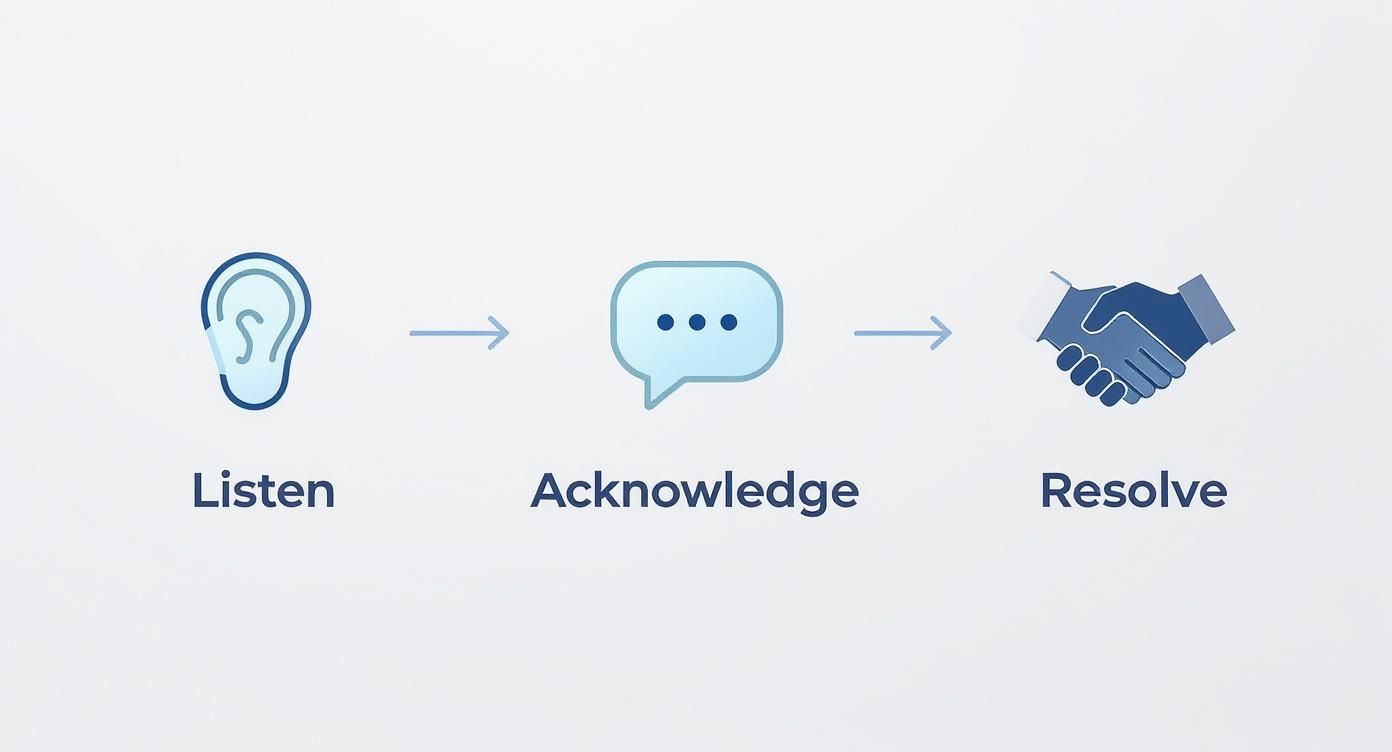
This framework helps you stay grounded and structured. You first listen to understand the issue and then try to resolve it privately—which should always be your go-to move for genuine clients.
Building Your Case for Removal
Before you hit that "report" button, you need to assemble your evidence. Platform moderators are buried in claims every single day. A vague complaint like "this is fake" is going straight to the bottom of the pile, if not the trash. Your job is to make their decision as easy as possible.
Start by meticulously documenting everything. Take clean, full-page screenshots of the review itself, the reviewer's profile, and anything else that looks suspicious. Critically, make sure your screenshots include the date and time.
Your removal request needs to be built around a specific violation of the platform's Terms of Service (TOS). Don't just complain—cite the specific rule they broke. The most common violations include:
- Conflict of Interest: A review left by a competitor, a disgruntled former employee, or anyone else with a clear axe to grind.
- Impersonation: An account pretending to be someone they're not, including a real client.
- Off-Topic Rants: Content that has nothing to do with a personal experience at your firm and is really just a personal attack or social commentary.
- Spam or Fake Content: Reviews that are obviously not from a real client. You can often spot these by their generic language or if the profile has zero other activity.
Think of a successful takedown request as a mini-legal brief. It presents a clear argument ("This review violates Policy X"), provides indisputable evidence (screenshots, client records), and requests a specific action (removal).
Platform-Specific Takedown Workflows
Every platform has its own process, its own quirks, and its own priorities. Knowing these nuances is what separates a successful removal from a frustrating dead end.
Removing Reviews on Google
Google is the big one for most firms, and thankfully, its process is relatively straightforward. The first step is to flag the review directly from your Google Business Profile dashboard. When you report it, you’ll be asked to pick a violation type from their list—choose the one that fits best.
After you’ve flagged it, you can track your request using Google's Review Management Tool. If your initial request gets denied (and it happens), you can appeal. This is where your evidence file becomes absolutely critical. In your appeal, you need to concisely explain why the review violates the specific policy you cited. If you can attach your documentation, even better.
Navigating Avvo’s Removal Process
Avvo's policies are designed for the legal world, so they are especially tuned in to issues like client confidentiality and fake attorney-client relationships. If you get a review from someone who was never your client, that's often your strongest card to play.
To start the process, dispute the review right from your Avvo dashboard. Be prepared to state clearly that you've checked your firm's records and have found no evidence the reviewer was ever a client. Because Avvo is a dedicated legal directory, a claim of a non-client relationship carries a lot of weight.
Handling Yelp Removals
Let's be blunt: Yelp is tough. They are notoriously strict about removing reviews and almost always lean in favor of the consumer's voice. Their system already filters out reviews it thinks are suspicious, but plenty still slip through the cracks.
When you report a review on Yelp, you need to focus on clear-cut violations of their content guidelines, like hate speech, direct threats, or a blatant conflict of interest. Yelp is far less likely to remove a review just because you claim it's factually wrong. Your best shot is to frame your argument around a specific policy violation. If it's from a non-client, make that the centerpiece of your complaint.
For more complex situations where damaging content is hard to remove, you might need to explore specialized strategies to remove negative search results to fully protect your firm’s reputation.
When these direct methods don't work, it may be time to call in the experts. For a closer look at the legal options available, our guide on https://levelfield.io/defamation-removal offers more detailed insights.
Playing Offense: Proactively Building Your Five-Star Reputation
Playing defense with your firm's reputation is a recipe for disaster. If you're only springing into action when a negative review pops up, you've already lost control of the narrative. The real power move is to build such a deep reservoir of positive, authentic feedback that the occasional bad review barely makes a ripple.
This is about getting ahead of the conversation. It means creating a steady stream of social proof—from glowing client reviews to insightful expert articles—that tells the story you want told. When you shape your own online presence, you're not just fending off attacks; you're building a beacon that attracts your ideal clients.
The Art of the Ask: Timing Your Review Requests
The most potent weapon in your arsenal is a collection of genuine reviews from happy clients. But how and, more importantly, when you ask for them makes all the difference. You have to catch clients at the peak of their positive emotion—that moment when they are most grateful for your work.
Think through your client's journey. Those moments of peak satisfaction are your golden opportunities:
- The Big Win: Right after a favorable verdict is read or a settlement is signed is prime time.
- A Key Milestone: In a long, drawn-out case, a major positive development is the perfect trigger for a review request.
- The Unprompted "Thank You": When a client emails you out of the blue to praise your team, that's a huge green light. Thank them sincerely and gently ask if they'd be willing to share that feedback publicly.
A generic email blast asking for reviews feels impersonal and is easy to ignore. Instead, a personal note that mentions their specific successful outcome shows you remember them and value their experience. This simple touch dramatically boosts your chances of getting a thoughtful, detailed review.
You can still use automation to make this efficient without sounding robotic. Create a solid email template, but have a paralegal or assistant customize it with a personal detail or two before hitting send. It’s the perfect blend of system and substance.
Beyond the Stars: Showcasing Your Expertise
While reviews on Google Business Profile and Avvo are non-negotiable, a truly bulletproof reputation is built on more than just star ratings. You need to demonstrate your expertise and success on platforms you own, starting with your firm's website. This kind of content doesn't just build trust; it’s also fantastic for your search engine rankings.
Make these assets a core part of your content strategy:
- In-Depth Case Studies: Don't just post a one-liner saying "we won." Write a compelling (and anonymized) story. Detail the client's initial problem, the strategy you developed, and the positive result you achieved. This shows prospective clients how you think.
- Website Testimonials: Hand-pick your very best reviews and feature them prominently on your homepage. Go a step further and ask clients for permission to use their photo or even record a short video. Seeing a real face alongside the praise is incredibly persuasive.
- Expert Content: Consistently publish articles and blog posts that answer the exact questions your ideal clients are searching for online. This positions your attorneys as the go-to authorities in their field, building a reputation for expertise that a star rating alone can't convey.
Making Reputation Management Part of Your Firm’s DNA
This can't be a side project you tackle on a slow Friday afternoon. Proactive reputation building needs to become a systematic, ingrained part of your firm's daily operations—as routine as client intake or sending out invoices.
The key is to create a simple, repeatable process that everyone understands and can follow. Add "Request Client Review" as a final item on your case-closing checklist. Assign one person to be the point person for monitoring online mentions and collecting testimonials.
By weaving these tasks into your existing workflows, you create a flywheel that constantly generates positive content. This builds a powerful reputational shield, making your firm far less vulnerable to the whims of a single disgruntled client and more accurately reflective of the great work you do every single day.
Your Toughest Attorney Reputation Management Questions, Answered
Managing your firm’s online reputation brings a unique set of challenges. You're constantly weighing client confidentiality against transparency, and the impulse to take legal action against the risk of public fallout. It can feel like walking a tightrope.
Here, we'll cut through the noise and tackle the most pressing questions I hear from attorneys. These aren't theoretical discussions; they are direct, practical answers to help you build a solid, defensible strategy.
Can I Sue Someone for a Negative Online Review?
The short answer is yes, but the better question is, should you? While suing for defamation is legally possible if a review contains a verifiably false statement of fact that damages your reputation, it should be your absolute last resort.
Frankly, it's a strategic minefield.
Defamation lawsuits are incredibly expensive, drag on for months or even years, and—critically—are public record. By filing a suit, you risk shining a massive spotlight on the very comment you want to disappear. This is the classic Streisand effect in action; instead of solving the problem, you could end up amplifying it across the internet.
Before you even think about litigation, exhaust the platform's own tools. They are faster, cheaper, and far more discreet.
- Report the review. Use the official reporting channels on Google, Avvo, or Yelp. If a review violates their terms of service (e.g., it's from a non-client, contains hate speech, or is clearly spam), the platform will often remove it.
- Resolve the issue offline. If the review is from a legitimate but unhappy client, a thoughtful, professional response that takes the conversation offline can work wonders.
Think of a lawsuit as a powerful, but blunt, instrument. Always consult with counsel specializing in internet law to get a realistic picture of the costs, potential outcomes, and reputational risks before heading down that path.
How Long Does It Take to Repair a Damaged Online Reputation?
There’s no magic timeline here. The recovery period depends entirely on the severity of the damage and how consistently you work to fix it. Think of your reputation like financial equity—it's built over time through steady, deliberate investment.
For relatively minor issues, like a few negative reviews dragging down your star rating, you can see a noticeable difference in three to six months. This requires a focused effort to generate a steady stream of new, positive reviews. The goal is to create a fresh wave of authentic feedback that buries the old negative comments and reshapes the first impression potential clients have of you.
However, more serious problems require a much longer view. If your firm is battling negative press, a viral blog post, or a targeted smear campaign, it could easily take a year or more of dedicated work. Repairing this kind of damage involves a sustained strategy of creating and promoting high-quality, positive content—articles, press mentions, case studies—to systematically outrank the harmful material in Google search results.
The key is consistency. A one-off effort won't move the needle. True reputation repair is about building a new, stronger narrative through persistent, proactive work.
Should My Firm Hire a Professional Reputation Management Service?
This really comes down to two things: complexity and capacity. Many firms can absolutely handle the fundamentals of reputation management in-house, and they do it well.
An in-house approach works perfectly well if your needs are centered on:
- Monitoring your main profiles on Google and Avvo.
- Responding promptly to new reviews.
- Asking satisfied clients for feedback on a regular basis.
But when you’re facing a full-blown crisis, the calculus changes. A professional reputation management service like LevelField becomes a vital partner when the threats are more complex.
You should seriously consider bringing in experts if you're dealing with:
- A coordinated, high-volume negative review attack.
- Damaging news articles ranking on the first page of Google for your name.
- Defamatory content that you've reported, but the platforms won't remove.
- Impersonation accounts or fraudulent business listings siphoning off clients.
Specialized services bring the tools, deep policy knowledge, and proven processes to the table. They can navigate the opaque world of platform appeals and execute sophisticated content strategies far more effectively than a law firm trying to manage a crisis on the side. They’re equipped to handle the high-stakes issues and help you reclaim your online narrative.