


Dealing with a bad review is frustrating. It can feel personal. But the secret isn't to fight every single negative comment that comes your way. It’s about knowing which battles to pick—specifically, which reviews actually break the rules.
The whole game is about spotting those specific violations, knowing the platform's rulebook inside and out, and documenting everything. Keep in mind, honest feedback, even when it’s tough to read, is usually there to stay. Those situations call for a thoughtful public response, not a takedown request.
Your Playbook for Handling Negative Reviews
Seeing a one-star review pop up can feel like a punch to the gut. It's a natural reaction for any business owner. The most important thing you can do in that moment is to take a breath and step back. Don't react emotionally. Your goal isn't to silence all criticism; it's to make sure your online reputation is a fair and accurate reflection of your business.
This playbook is your practical, step-by-step guide to identifying and removing the reviews that genuinely cross the line. Think of it as your roadmap for protecting your reputation the right way, without resorting to sketchy tactics. We'll get into the nitty-gritty of telling legitimate customer feedback apart from content that violates a platform's policies, so you can act with confidence.
The Modern Landscape of Online Reviews
Let's be honest: not all reviews are created equal. The internet is littered with fake, misleading, and flat-out malicious comments designed to either torpedo a business or artificially prop up a competitor. It’s a huge problem, and the big platforms are in a constant war to keep their review systems from turning into the Wild West.
The sheer volume of fake reviews has forced platforms to get much more aggressive with their moderation. Just look at the numbers. Google blocked or removed 170 million policy-violating reviews in 2023 alone. That’s a 45% jump from the year before. They also zapped 12 million fake business profiles in that same period. You can dig into more fake review statistics to see just how big this issue is.
What does this mean for you? It means the platforms are willing to take action when you give them a good reason.
Your job is to provide that clear evidence. A well-documented removal request that points to a specific policy violation has a far better chance of succeeding than an angry, one-line complaint.
Building Your Strategy
Before you can even think about getting a review removed, you need a process you can rely on every single time. It boils down to a few core principles that should guide every move you make.
- Act with Urgency, Not Haste: You want to jump on potential violations quickly, but not before you've done your homework. A rushed, sloppy report is a rejected report.
- Become an Expert on Policy: Don't just flag a review because it feels "unfair." You need to know the exact rule it breaks. Read the terms of service for Google, Yelp, or wherever the review was posted. Is it spam? A conflict of interest? Hate speech? Pinpoint the specific violation.
- Document Everything: Screenshots are your best friend. Screenshot the review, the reviewer's profile—everything. Keep a log of when you reported it and any communication you get back. This paper trail is crucial.
When you approach it this way, you're no longer just reacting out of frustration. You're taking control. You're not just a victim of a bad review; you're an advocate for your business, using the platform's own rules to ensure a level playing field. This playbook is designed to give you that control.
Identifying Reviews You Can Actually Remove
When a one-star review pops up, the gut reaction is to want it gone. But before you jump into the removal process, you have to figure out if you can actually get it taken down. This isn't about erasing all criticism; it's about protecting your business from comments that are genuinely fraudulent, malicious, or break the rules.
The truth is, most negative reviews—even the ones that feel incredibly unfair—are there to stay. The key is learning to tell the difference between a legitimate customer complaint and a review that violates a platform's terms of service.
Think like an investigator. Forget the star rating for a moment and focus on the content of the review. Is the person complaining about slow service on a busy night, or are they launching a personal attack on your hostess's appearance? Are they describing a real issue with your product, or does their "review" read more like an ad for your biggest competitor? The devil is always in the details, and that's where you'll find the evidence you need.
Legitimate Criticism vs. Policy Violations
Drawing the line between harsh feedback and a removable violation can feel tricky. Luckily, every major review platform has a rulebook. Your job is to become an expert at matching a bad review to a specific, broken rule.
Legitimate criticism, no matter how much it stings, is almost always protected. This includes things like:
- Complaints about poor customer service
- Honest disappointment in a product's quality
- Negative opinions on your pricing
- Feedback about a messy storefront or unpleasant atmosphere
On the other hand, reviews you can actually target for removal are the ones that have little to do with a real customer experience. These are the ones you should flag immediately.
Key Takeaway: Platform moderators don't care about your feelings. They care about their policies. Your success hinges entirely on your ability to clearly and concisely show them how a review breaks a specific rule.
This simple flowchart can help guide your initial gut check.
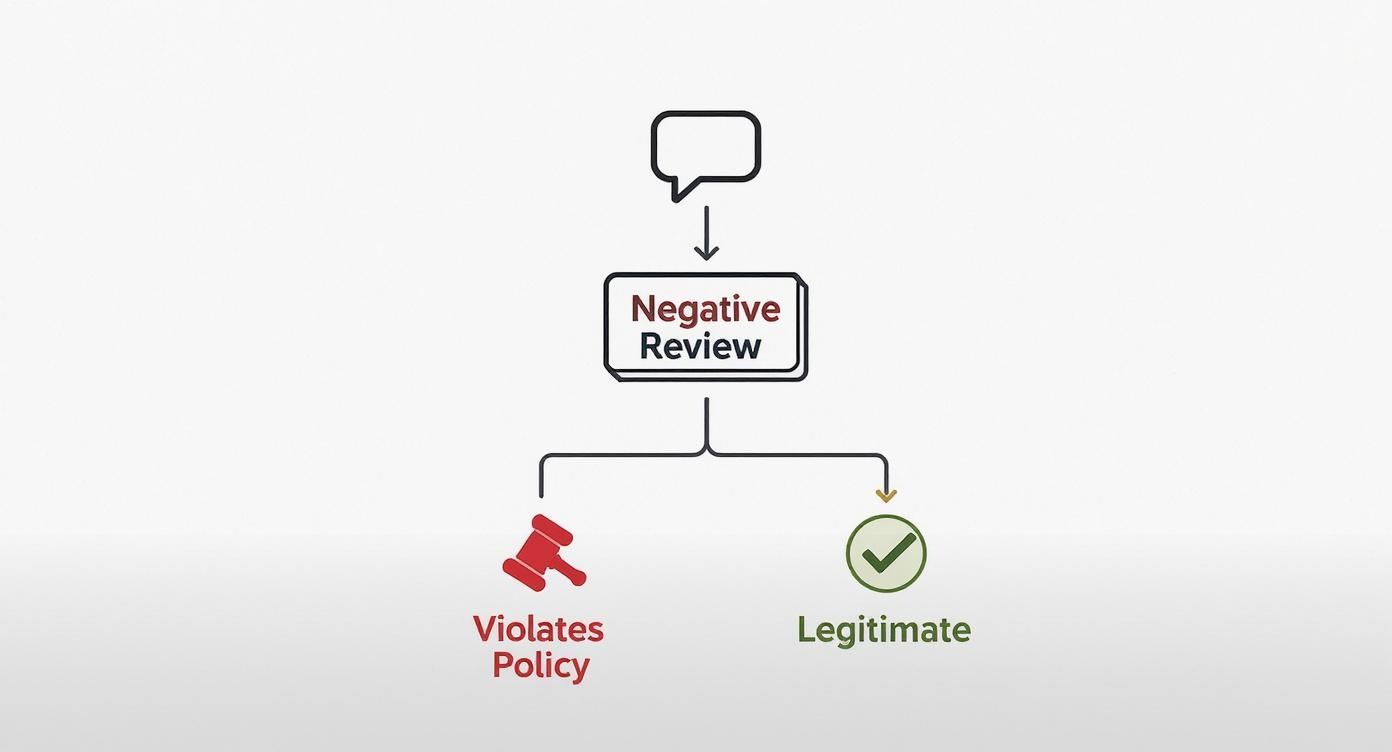
Use this to quickly sort reviews into two buckets: legitimate opinions you need to address, or clear violations you can report.
Common Grounds for Review Removal
So, what specific violations should you be hunting for? While the fine print varies a bit between Google, Yelp, Trustpilot, and others, the core rules are surprisingly consistent. Before you can report effectively, it’s a good idea to have some effective online review monitoring strategies in place so you can catch these issues quickly.
Once you spot a suspicious review, see if it fits into one of these common categories:
- Spam or Fake Content: Reviews from bots, clearly fake profiles, or people who have never been a customer. If you’re not sure, our https://levelfield.io/calculator/fake-reviews can help you spot the red flags.
- Conflict of Interest: This is a big one. It includes reviews from disgruntled ex-employees, your direct competitors, or even family members of competitors.
- Off-Topic Rants: The review isn't even about your business. It might be a political diatribe, a case of mistaken identity, or a personal grievance that has nothing to do with a transaction.
- Harassment or Hate Speech: Any review containing threats, personal attacks, bullying, or discriminatory language is a prime candidate for removal.
- Private Information: The reviewer posted someone’s full name, phone number, email address, or other private data. This is a serious violation and usually gets taken down quickly.
To make this easier, I've put together a quick cheat sheet to help you spot these violations in the wild.
Violation Identifier Cheat Sheet
| Violation Type | What to Look For | Example Scenario |
|---|---|---|
| Spam/Fake | Gibberish text, generic praise/criticism, user has reviewed 50 businesses in different cities in one day. | "Great place good service 5 stars" posted by a user with a stock photo and a nonsensical name. |
| Conflict of Interest | Mentions "I used to work here," or you recognize the name as a competitor's employee. | A review from "John D." who you know was fired last month, complaining about management. |
| Off-Topic | The review talks about politics, another company, or a social issue unrelated to your service. | "Their coffee is okay but this whole town has gone downhill ever since they elected that new mayor..." |
| Harassment | Personal insults, threats, obscene language, or attacks on an employee's appearance or identity. | A review that calls a specific server "stupid and ugly" and uses slurs. |
| Private Info | A full name, phone number, home address, or email address is included in the review text. | "Don't trust the manager, Jane Doe. Her cell is 555-123-4567, call her and complain!" |
Having this framework helps you move from an emotional reaction to a logical, evidence-based strategy. This methodical approach is exactly what platform moderators are looking for and is the foundation of a successful removal request.
Navigating Each Platform's Reporting Process
Every review platform has its own ecosystem. Each one comes with a unique set of rules, a different interface, and its own weird reporting quirks. Trying to remove a negative review with a one-size-fits-all approach is a surefire way to get your request denied. Simply clicking the "flag" button and hoping for the best just doesn't cut it. You have to tailor your strategy to what each platform's moderation team is trained to spot.
Let's get into the nitty-gritty of how to handle the reporting process for the major players. I'll walk you through the mechanics for Google, Yelp, Trustpilot, and TripAdvisor, showing you not just what to click, but why you're clicking it and what kind of proof will actually build a winning case.

Tackling Reviews on Google Business Profile
Google is usually the first place customers go to sound off, making it ground zero for managing your reputation. Their initial review system is mostly automated, which means you have to be incredibly precise. A vague report will get kicked back by the algorithm almost instantly.
When you spot a review that you believe breaks the rules, find it on your Google Business Profile, click the three little dots, and hit "Report review." This brings up a menu of violation types.
- Be specific with the violation. Don't just select "Hate speech" because it sounds dramatic. If the review is clearly from a disgruntled ex-employee, the correct category is "Conflict of interest." If it's just a political rant that has nothing to do with your business, choose "Off-topic."
- Keep your initial report brief. Google’s first form doesn’t give you space for a novel. The whole point is to get the review into the right internal queue. Your job is to categorize the problem correctly.
It can take a few days to hear back. If your report is denied, don't throw in the towel. You can appeal the decision using the Review Management Tool in your Business Profile dashboard. This is often what it takes to get your case in front of an actual person. For a much deeper look at the process, we have a complete guide on how to remove fake Google reviews that covers more advanced tactics.
The Yelp Reporting Funnel
Yelp prides itself on being a high-quality, community-focused platform, and its moderation process reflects that. They tend to be more hands-on than Google, but they’re also known for being incredibly strict. To report a review on Yelp, find the post, click the three dots, and select "Report."
Yelp’s form is a bit more involved. It asks you to pinpoint the violation and gives you a text box to lay out your argument. This is where all that evidence you gathered earlier comes into play.
Pro Tip: When you write your Yelp report, directly quote their own Content Guidelines. Instead of just saying, "This review is a lie," try something like, "This review violates Yelp's policy against conflicts of interest. The user's public profile shows they are an employee of our direct competitor, XYZ Corp, which we have documented."
Yelp moderators want to see clear, factual arguments. Leave the emotion out of it. Just stick to the facts, reference their rulebook, and attach any proof you have, like a screenshot of the reviewer's LinkedIn profile that confirms they work for the competition.
Managing Feedback on Trustpilot
Trustpilot is what’s known as a "closed" system, where reviews are supposed to be tied to a verified customer experience. Of course, policy-violating content still finds its way through. The good news is their reporting process is robust and heavily focused on authenticity and documentation.
Here's how to report a review from your Trustpilot business account:
- Go to the "Reviews" section and locate the one in question.
- Click the "Report" button and select the most fitting reason.
- Provide your evidence. Trustpilot will often ask for documentation that proves the reviewer was never a customer or that their claims are factually impossible.
For example, if someone complains about a product you have never, ever sold, a link to your official online product catalog is solid evidence. If they claim they visited your shop on a Sunday but you're always closed on Sundays, a screenshot of your official business hours can seal the deal.
Trustpilot's system is built to help businesses who can present clear, undeniable proof. The process might feel a little slow, but a well-documented report has a very good chance of succeeding.
TripAdvisor and the Travel Sector
For any business in the hospitality game, TripAdvisor is the undisputed king. A single nasty review can directly hurt bookings, so their moderation team is well-versed in handling complicated and often intense disputes.
The process starts out familiar: find the review, click the flag icon, and choose why you're disputing it. Your options will include things like:
- Review is suspicious
- Review is posted to the wrong location
- Review contains inappropriate content
TripAdvisor provides a text box for your explanation. This is your chance to be specific and professional. If you have a strong suspicion that a review is from a competitor playing games, lay out the logic. For instance: "This user has only reviewed our hotel and our top three local competitors. They gave all competitors 5-star ratings and our property a 1-star rating, all within a 24-hour period. This pattern strongly suggests a coordinated effort to manipulate our ranking, which violates TripAdvisor's fraudulent content policy."
That kind of calm, pattern-based argument is infinitely more powerful than just yelling that a review is "fake." The bottom line is that every platform has its own rhythm. Learning to work within their specific rules is a crucial skill for any business today.
How to Gather Evidence for a Stronger Case
Trying to get a review removed without hard proof is a losing game. Platform moderators aren't there to play referee between you and an unhappy customer; their sole purpose is to enforce their platform's rules. To do that, they need documented evidence that a rule was actually broken.
You have to shift your mindset from a frustrated business owner to a methodical investigator. Every detail you gather builds a more compelling case, turning a simple complaint into a well-supported claim that's tough for a moderator to dismiss.

Start with Timestamped Screenshots
The second you see a suspicious review, grab a screenshot. This isn't optional. The reviewer can edit or delete their post at any moment, and if they do, your proof disappears along with it.
Make sure your screenshots are comprehensive. You need to capture:
- The entire review: Don't crop it. Get all the text, good and bad.
- The reviewer's details: Their name, profile photo, and any other public info are crucial for spotting patterns.
- Date and time: The timestamp of the review is a must. Even better, make sure your computer’s clock is visible in the shot.
These images are the bedrock of your case. They create a permanent, undeniable record of what was said and when.
Uncovering the Story Behind the Reviewer
Often, the real smoking gun isn't in the review itself—it's in the reviewer's profile. A little digging can reveal clear policy violations that aren't obvious at first glance.
Spend a few minutes clicking through the user's profile history. Look for red flags. For instance, did they review your business and three of your direct competitors on the same day, giving everyone else five stars while slamming you with one? That’s a massive indicator of a conflict of interest.
When you document patterns like this, you're no longer arguing about someone's opinion. You're presenting a factual case that points directly to malicious intent or a coordinated attack—both clear violations of platform rules.
Organizing Your Evidence into a Report
Once you've collected your proof, don't just throw it all into the reporting form and hope for the best. You need to organize it into a simple, logical narrative that a busy moderator can digest in 30 seconds. A basic document or even a well-structured email draft is perfect for this.
Lay out your findings clearly:
- State your claim upfront: Start with a direct, one-sentence statement. "This review violates your policy on Conflict of Interest."
- Present your evidence: List your proof, referencing your screenshots. "The reviewer's public profile shows they are an employee at a competing local business (see Exhibit A)." or "This user has posted 15 one-star reviews for businesses in our industry in the last 24 hours (see Exhibit B)."
- Draw a clear conclusion: Reiterate why the evidence confirms the violation. "This employment relationship is a textbook conflict of interest under section 4.2 of your terms of service."
This structured approach does the work for the moderator, making their decision easy and significantly boosting your chances of getting the review taken down. For more complex situations, like false claims of inauthenticity, drawing on strategies for winning retractions from rights owners on Amazon can provide a powerful template for building an evidence-based argument.
What to Do When Your First Request Is Denied
It’s a frustrating moment. You've carefully built your case, submitted your report, and waited, only to get a rejection notice. It feels like hitting a brick wall, but honestly, an initial denial is often just part of the process. Don't get discouraged.
Many platforms rely on automated systems or first-level reviewers for the initial pass. They're looking for clear, obvious violations. This means your first attempt might not have gotten in front of the right set of eyes or triggered the right keyword in their system. The key is to understand that a "no" isn't always the final answer. It’s simply time to escalate.
Crafting a Compelling Appeal
When you appeal, your goal is almost always to get your case in front of an actual human being. This is where you can explain the nuances that an algorithm or a speed-reading moderator might have missed. You need to be more direct, more specific, and laser-focused on the platform's own rules.
Go back and re-read the platform’s terms of service or content guidelines. Don't just skim them—hunt for the exact clause the review violates. Your entire appeal should hinge on that specific language, making it incredibly difficult for a human reviewer to dismiss your claim.
Here’s how that looks in practice:
"Our initial request to remove this review was denied. We are appealing this decision as the content is a direct violation of your Conflict of Interest policy (Section 4b), which clearly states reviews must be unbiased. The reviewer’s public profile lists them as an active employee of our main competitor, XYZ Services. We have attached screenshots confirming this."
See the difference? This isn't a complaint anymore. It's a structured argument built on the platform’s own foundation. It shows you’ve done your research and you're not just trying to get rid of a comment you don’t like.
When to Consider a Formal Legal Notice
Sometimes, a review goes beyond simple criticism and veers into defamation. If a review contains verifiably false statements of fact—not opinion—that are causing real, measurable harm to your business, you might have legal grounds. This is a serious step, so tread carefully.
Before you call a lawyer, think about these points:
- Fact vs. Opinion: There's a huge legal difference. "The food was terrible" is an opinion and protected. "The restaurant served me spoiled food that gave me food poisoning" is a statement of fact that can be proven or disproven.
- Cost and Time: Legal fights are almost always expensive and drawn-out. You have to be realistic about whether the damage from the review outweighs the cost of pursuing it.
- The Streisand Effect: Be careful. Sometimes, taking legal action can amplify the situation, drawing far more attention to the negative review than it ever would have gotten on its own.
A common first legal step is to have an attorney draft a formal cease and desist letter. If the review uses your copyrighted images, a Digital Millennium Copyright Act (DMCA) takedown notice is another powerful tool. These official documents tend to get a platform's attention much faster than a standard report, but they carry weight, so they must be used correctly.
Engaging a Professional Reputation Service
If you're stuck in an appeal loop and legal action feels like a step too far, it might be time to call in a specialist. Professional reputation management services, like LevelField, live and breathe these situations. They know the ins and outs of each platform's escalation process—including the unwritten rules.
Bringing in a professional service is the right move when:
- You're out of time or expertise. Successfully navigating these complex appeals is practically a full-time job.
- You're dealing with a coordinated attack. If a flood of fake reviews hits you all at once, a dedicated team can manage the removal process at scale.
- The review is causing serious financial damage. In high-stakes cases, the investment in a professional service is often a fraction of the revenue you're losing.
These experts take over the entire workflow, from digging up evidence and building the case to filing the appeals and handling all the back-and-forth communication. For a business owner who needs to be focused on running their company, it can be a critical lifeline to protect the reputation you've worked so hard to build.
Your Top Questions About Review Removal, Answered
If you're trying to figure out how to handle negative reviews, you've probably got a lot of questions. It's a tricky area, and it's easy to feel like you're navigating it alone. Let's tackle some of the most common questions I hear from business owners.
How Long Does It Actually Take to Get a Review Removed?
This is the million-dollar question, and the honest answer is: it depends. The timeline for getting a review taken down can be all over the map. It really comes down to the platform you're dealing with, how obvious the violation is, and how busy their support team is at that moment.
For a clear-cut violation on a platform like Google, say, a review that includes a personal phone number or hate speech, you could see it gone in as little as 3-5 business days. It's a slam dunk for their automated filters.
But what about the gray areas? A review you suspect is from a competitor, for instance. Those cases need a real person to look at them, and that can easily stretch into several weeks. If your first attempt gets rejected and you have to appeal, you're looking at an even longer wait. Patience is key here.
Pro Tip: Always keep a record of when you reported the review. If you don't hear anything back within the platform's general timeframe (think 7-10 days), it's perfectly fine to send a polite follow-up.
Can I Sue Someone Over a Bad Review?
Technically, yes, you can sue for defamation. But should you? Almost certainly not. It's an incredibly high bar to clear, it costs a fortune, and it often just draws more negative attention to the review you're trying to get rid of.
To even have a shot, you have to prove the review contains a false statement of fact—not just an opinion—that directly caused your business financial damage. That's where things get tricky for most business owners.
- This is an opinion: "The steak was tough, and the service was the worst I've ever experienced." (This is protected speech, even if it feels unfair.)
- This is potentially defamatory: "I saw the chef drop my steak on the floor and still serve it." (This is a factual claim that can be proven true or false.)
Frankly, any good lawyer will tell you to exhaust all other options first. Reporting the review through the platform's channels is almost always the smarter, faster, and cheaper route. Save the legal threats for the most extreme, damaging, and verifiably false attacks.
What If the Review Is Legit and I Can’t Get It Removed?
Sometimes, you get a bad review from a real customer who had a genuinely bad experience, and it doesn't break any rules. In these cases, your only move—and your best move—is to respond.
A prompt, professional, and public reply can completely change the narrative. It shows everyone else reading the reviews that you're listening, you care, and you're willing to make things right. Your goal isn't to win an argument; it's to show you're accountable. Always aim to take the conversation offline to resolve the specifics. It's a powerful way to turn a negative into a net positive for your reputation.
Will Paying for Ads on Yelp or Google Help Me Remove Bad Reviews?
This rumor has been around forever, but the answer is a hard no. Big platforms like Yelp and Google have a strict firewall between their advertising and content moderation teams. Their entire business model is built on consumer trust, and playing favorites with advertisers would destroy that credibility overnight.
Paying for ads gets you more visibility; it doesn't buy you any special treatment for your reviews. Trying to use your ad spend as leverage won't work and might even get your account flagged. Your focus should stay on building a solid case based on the platform's actual content policies, period.