

Social media isn't just a place to post updates anymore. It's where you actively manage, shape, and defend how the world sees your brand. Think of it less as a marketing channel and more as a critical part of your company's defense system, protecting your brand equity and revenue from the instant, public feedback that defines the digital age.
Why Social Media Is the New Frontline for Your Brand

It’s tempting to view social media as just another place for ads and light customer engagement, but that mindset is dangerously out of date. Today, platforms like Meta, X, and LinkedIn are where reputations are forged, fought for, and sometimes, completely dismantled in a few short hours. This is where your potential customers come to size you up, current clients broadcast their experiences, and your competitors keep a close eye on everything you do.
The stakes are incredibly high. A single complaint that goes viral, a misleading review, or a fake account impersonating your brand can cause real, measurable damage to your bottom line. Information—and misinformation—spreads like wildfire, making these platforms a high-risk environment for any business.
The Widening Gap Between Expectation and Reality
Today’s consumers expect a direct line to your business through social media, and they demand quick, authentic answers. The numbers don't lie. Over 90% of consumers say a brand’s online reputation directly impacts what they buy, and a full 75% use social media specifically to research products before making a purchase.
This pressure has fueled a booming market for online reputation management tools, projected to rocket past $14 billion by 2031. But here's the disconnect: despite the obvious risks and consumer demands, only about 17% of companies actually have an active reputation management plan. That leaves a massive number of businesses exposed, with no structured defense when a crisis hits. You can explore the full breakdown of these online reputation management statistics to see the data for yourself.
For most businesses, this gap between what customers expect online and how they are prepared to respond is their biggest vulnerability. It's no longer enough to react after the damage is done.
What This Means for Your Business
This new reality, where you have to be an active participant in your brand's story, has a few direct consequences, no matter your industry or size:
- Your Brand Is Always On: People are talking about your company 24/7, whether you’re part of the conversation or not.
- Public Feedback Is Powerful: A single negative comment seen by thousands can easily undo the goodwill from dozens of positive, private reviews.
- Control Is an Illusion: You can't control what people say. But you absolutely can influence the conversation by being present, responsive, and proactive.
That's exactly what this playbook is for. We're going to skip the theory and get straight to the actionable steps you need to monitor threats, respond with confidence, get harmful content removed, and build a resilient brand reputation that can handle the heat of the modern social media landscape.
Building Your Brand Monitoring Dashboard
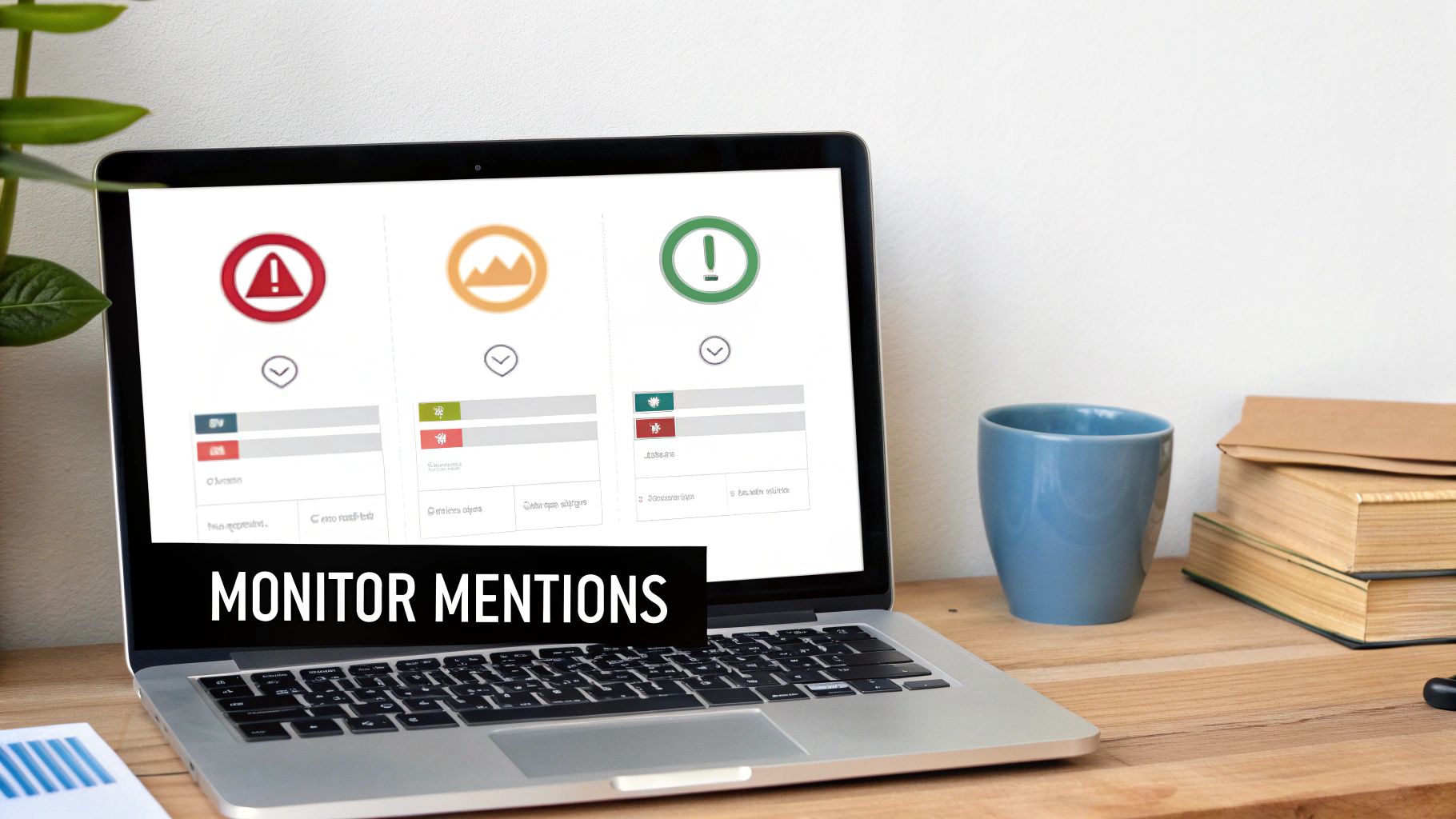
Smart social media online reputation management doesn't start when a crisis explodes—it starts long before, with a solid listening system. Think of it as your brand's early-warning network, constantly scanning the internet for mentions. Without it, you’re flying blind and will only find out about a problem after the damage is done.
Your goal here isn't to drown in every tweet or post. It's to build an intelligent, filtered listening post that flags high-priority conversations so you can jump in quickly and strategically. The good news? You don’t need a massive budget to get started. You can build a surprisingly powerful dashboard by layering tools as your needs grow.
Starting With the Free Essentials
For smaller businesses or anyone just dipping their toes in, free tools are more than enough to build a solid foundation. These are the basics, and they don't cost a dime.
First, go directly to the source. Head into the settings on Instagram, Meta, LinkedIn, and X to turn on notifications for every tag, mention, and comment. It's simple, but these alerts are your absolute frontline detectors for direct engagement.
Next, set up Google Alerts. Honestly, this is non-negotiable for any brand, big or small. It’s free, takes minutes to configure, and acts like your personal digital clipping service, emailing you whenever your keywords pop up in news articles, blogs, or new web pages. It’s your net for catching mentions beyond the immediate social media bubble.
Identifying What to Track
So, what should you be listening for? The biggest mistake I see is companies only tracking their official brand name. To really protect your reputation, you have to cast a much wider net.
Here’s a practical checklist to get you started:
- Brand and Product Names: The obvious ones. Your company name and any major products or services you offer.
- Common Misspellings: People make typos all the time. Add the most common misspellings of your brand and products, or you’ll miss those conversations.
- Key Executive Names: Your CEO, founder, and other public-facing leaders are part of the brand. Their personal reputation is directly tied to the company's.
- Campaign Slogans and Hashtags: Tracking your marketing slogans and hashtags is crucial for gauging sentiment and reach.
- Industry Keywords: Keep an ear on broader industry terms. This helps you spot trends and find conversations where you can add value.
A well-configured monitoring system does more than just find problems; it uncovers opportunities. By listening to broader industry conversations, you can identify customer pain points, competitor weaknesses, and chances to provide value.
When to Upgrade to Paid Tools
As your brand gains traction, the sheer volume of mentions will overwhelm free tools and manual checks. That’s your cue to invest in a paid platform. This is where you graduate from simple notifications to genuine, deep analysis.
Paid tools move you into the big leagues. Platforms like Brand24, Mention, or Sprinklr are built for mature social media online reputation management. They offer features like sentiment analysis, which automatically flags mentions as positive, negative, or neutral—saving your team countless hours. They also dig deeper, finding mentions on forums like Reddit or niche review sites that Google Alerts often misses.
Investing in a paid tool also unlocks sophisticated competitor tracking, letting you see exactly what people are saying about others in your market. To get a better sense of what's out there, you can explore some of the best online reputation management software and see which one fits your specific goals.
To get the most out of these powerful tools, many brands set up custom dashboards for social media monitoring to pull all this critical data into one place.
Choosing Your Social Media Monitoring Toolkit
Selecting the right platform can feel overwhelming. This table breaks down a few popular options to help you decide what's right for your business, from free and simple to powerful paid suites.
| Tool | Best For | Key Features | Price Point |
|---|---|---|---|
| Google Alerts | Startups & Solopreneurs | Basic keyword monitoring across the web, email notifications, zero cost. | Free |
| Brand24 | SMBs & Growing Brands | Sentiment analysis, influencer scoring, real-time mention tracking, PDF reports. | $$ (Starts around $79/mo) |
| Mention | Marketing & PR Teams | Competitor analysis, social media publishing, crisis management alerts, custom reports. | $$$ (Starts around $41/mo, with more robust plans) |
| Sprinklr | Large Enterprises | Unified customer experience management, advanced AI-driven insights, 30+ channel monitoring. | $$$$ (Custom Enterprise Pricing) |
Ultimately, whether you start with a free tool or a comprehensive paid suite, your dashboard is the command center for your reputation. It’s the system that lets you get ahead of the narrative, turning potential crises into moments to shine.
Creating Your Playbook for Response and Escalation
Okay, so your monitoring tools are up and running, and the mentions are starting to trickle in. The first instinct is often to jump on every single one. Resist it. That's a rookie mistake in social media online reputation management, and a reactive, emotional response can pour gasoline on a small fire.
This is exactly why you need a playbook. Think of it as your team’s official guide for navigating the choppy waters of online engagement. It ensures everyone stays calm, consistent, and on-brand, laying out exactly who responds, what they should say, and when it’s time to call in the cavalry.
Finding Your Brand's Voice Under Pressure
Before you even think about templates, you have to decide how your brand sounds when the heat is on. Are you going to be formal and apologetic? Or more conversational and empathetic? There’s no single correct answer here, but whatever you choose, it has to be consistent.
This tone should be a direct reflection of your company's values. A fun B2C brand might get away with a casual, friendly tone, but a financial institution will probably need something more buttoned-up and reassuring. Whatever it is, document it. Make sure everyone from the social media intern to the head of marketing is singing from the same hymn sheet.
Building Out Your Response Templates
Templates are your foundation, not a copy-paste script. They're there to provide a solid framework, making sure the important stuff gets said while still leaving room to personalize the message for the person on the other end. Your playbook should have a few go-to templates for the most common situations you'll face.
Here are a few essential ones to get you started:
Handling Legitimate Customer Complaints: The formula is simple: acknowledge their frustration, apologize for the bad experience, and immediately offer to move the conversation to a private channel like DMs or email. This shows everyone watching that you take problems seriously without getting into a public back-and-forth over sensitive details.
Engaging with Positive Feedback: Don’t just hit the "like" button. That’s a missed opportunity. Thank the person by name, pull out a specific detail from their post to show you’re not a bot, and let them know you appreciate it. A little bit of genuine engagement goes a long way in encouraging more of this great user-generated content.
Dealing with Trolls or Baseless Attacks: This one is critical, and the answer might surprise you: the best response is often no response at all. Engaging with trolls is like feeding a stray cat; it only encourages them to come back. The official policy should be to ignore, report, and block. Never argue.
A well-crafted response playbook gives your team the confidence to act decisively. It takes the emotion and guesswork out of high-stakes situations, ensuring every public interaction protects your brand's integrity.
Knowing When to Escalate an Issue
Your frontline social media manager can’t—and shouldn’t—handle everything. A critical piece of your playbook is a clear escalation path that defines the triggers for bumping an issue up the chain of command. This isn't about creating red tape; it's about making sure the right people are dealing with the right problems.
A solid escalation plan means you're never caught flat-footed. It creates a simple decision-making framework that stops small issues from festering into brand-damaging crises.
The Escalation Tiers
I like to think about escalation in tiers. Each one represents a different level of severity and requires a different set of eyeballs.
Tier 1: Frontline Response. This is your social media or community manager's domain. They'll handle the vast majority of day-to-day interactions—probably 90% of all comments, good and bad—using your approved templates as a guide.
Tier 2: Managerial Review. An issue gets kicked up to a marketing or communications manager when it's more complex. Maybe it involves multiple departments, there’s a threat of a public boycott, or the comment comes from a high-profile account like an influencer or a journalist. This person has the authority to coordinate a more strategic, big-picture response.
Tier 3: Leadership and Legal. The really serious threats need to be flagged immediately for executive leadership and, in some cases, your legal counsel. This top tier is reserved for the nasty stuff:
- Direct threats of violence.
- Serious accusations of illegal activity.
- Defamatory claims that are demonstrably false.
- Clear-cut intellectual property theft or brand impersonation.
When these tiers are clearly defined, your team doesn't have to hesitate. They know when to handle something themselves and when to sound the alarm. This ensures that serious threats, like a defamatory review or an impersonation account, are quickly put in front of the specialists who know the legal and platform-specific policies inside and out.
How to Get Harmful Content Taken Down
Monitoring and responding are essential, but some situations call for a more direct approach. This is where you shift from defense to offense. Getting harmful content removed is the enforcement side of social media online reputation management, and it's a whole different ballgame.
We're not talking about silencing unhappy customers or valid criticism. This is about taking down content that flat-out breaks a platform’s rules—think fake accounts impersonating your CEO, coordinated harassment campaigns, counterfeit product listings, or provably false reviews designed to tank your reputation.
Pulling this off is tough, but it's far from impossible. It takes a methodical approach, a ton of patience, and a solid grasp of what actually gets a platform moderator to take action. Simply smashing the "report" button on a post you dislike is a waste of time. You have to build a rock-solid case that proves a clear policy violation.
Know the Rules of the Game: Platform Policies
Every social media platform operates by its own set of community guidelines or terms of service. You have to treat these documents as your playbook. Before you even think about reporting a post, you need to pinpoint the exact rule the content violates. A vague complaint like "this is unfair" will be ignored instantly. You must be specific.
Some of the most common violations that give you grounds for a takedown include:
- Impersonation: An account is created to look like your brand or one of your executives. This is often the most straightforward violation to get removed.
- Harassment and Bullying: Content that targets your company or employees with threats, abusive language, or organized attacks.
- Hate Speech: Posts that attack people based on protected characteristics like race, ethnicity, or sexual orientation.
- Intellectual Property Theft: Someone is using your copyrighted images, videos, or registered trademarks without permission.
- Counterfeit Goods: Scammers create posts or listings claiming to sell your authentic products.
- Spam and Scams: This covers everything from fake reviews and fraudulent giveaways to phishing attempts aimed at your audience.
Each platform handles these issues differently. A successful takedown request on LinkedIn looks very different from one submitted to Meta. Your job is to speak the platform's language and make it incredibly easy for a content moderator to connect the dots and agree with you.
Build Your Takedown Case File
Once you’ve identified the specific policy being broken, it's time to gather your evidence. You need to think like a detective preparing a case for a judge—only your judge is a busy platform moderator with a massive queue of reports to get through. Your documentation has to be airtight.
Here’s what your case file must include every single time:
- High-Quality Screenshots: Don't just grab a small snippet. Capture the entire screen, making sure the offending username, the date, and all the content are crystal clear.
- Direct URLs: Always provide the direct permalink to the post, comment, or profile in question. Don't just send a link to the user's main feed. The less work they have to do, the better your chances.
- A Clear, Concise Explanation: In the report form, get straight to the point. State which rule was broken and how the content breaks it. If you can, reference the policy by name. For example: "This account violates X's impersonation policy by using our registered business name and logo to deceive customers."
Keep all of this organized in a dedicated folder. You'll often need to follow up, and having everything ready to go is crucial for the persistence this process demands. For platforms like Meta, you need a specific strategy; our guide on removing reviews from Facebook dives into the details.
The Modern Takedown Challenge
The explosion of fake and AI-generated content has made protecting a brand’s reputation a complex battle that most businesses are simply not equipped to fight. Fraudulent reviews, for instance, surged an estimated 758% since 2020. Projections show that by 2026, a staggering 30–40% of all online reviews could be manipulated in some way.
This creates a huge practical problem. Most companies don't have the in-house legal expertise or the sheer persistence required to file compliant takedown requests across dozens of different platforms. With only 17% of companies running active reputation programs, it's no surprise that specialized services are becoming essential for protecting a brand’s integrity.
When content crosses the line from merely negative to defamatory, you have more options. You can explore legal strategies for internet defamation to understand the potential paths forward.
The reality is this: pursuing content removal is a time-consuming, often frustrating grind. For many businesses, outsourcing this enforcement work to a specialized service isn't a luxury—it's a necessity to protect their reputation and, ultimately, their bottom line.
Building Your Digital Fortress of Positive Content
Playing defense is necessary when a reputational crisis hits, but the best long-term strategy is always a good offense. True social media online reputation management isn't just about putting out fires. It’s about building a digital presence so robust and positive that a few negative sparks simply can't catch hold. This is the pivot from damage control to constructing a fortress of authentic, positive content.
The core idea is simple: create and promote so much genuine goodwill that it naturally pushes down and outweighs any negativity. By owning the story on your social channels, you create a powerful buffer that protects your brand and builds real trust with your audience.
Cultivating Authentic Positive Reviews
Positive reviews are your foundation. They're powerful social proof that directly influences new customers. Getting a steady stream of authentic, glowing feedback is one of the most valuable things you can do for your brand. The trick is to encourage these reviews without crossing any lines.
Never, ever offer incentives for positive reviews. Most platforms forbid it, and it can backfire spectacularly. Instead, just make it incredibly easy for your happy customers to share their thoughts.
- Timing is Everything: The perfect time to ask for a review is right after a great experience—think moments after a successful delivery or a positive support call. The good vibes are still fresh.
- Keep it Simple: Give them a direct link to the specific platform you’re focused on, whether that’s Google, Trustpilot, or an industry-specific site. The fewer clicks it takes, the more likely they are to do it.
- Personalize the Ask: A simple, "Thanks for your business, [Customer Name]! We'd love it if you could share your feedback," feels genuine. A generic blast feels like a chore.
Your goal isn't to manufacture praise. It's to remove every bit of friction for the customers who already love you. When you make it effortless, your happiest clients become your most powerful advocates.
Turning Testimonials into Social Content
Don't let your best customer testimonials die on a static webpage. These are potent, dynamic pieces of user-generated content just waiting to be repurposed for your social media feeds to amplify your positive reputation.
When proactive measures aren't enough and you're forced to remove harmful content, having a clear process is critical.

This structured, evidence-based approach is key to getting platforms to act.
For your positive content, create clean, eye-catching graphics featuring a killer quote from a review. If you can get their permission, tag the customer to add another layer of authenticity. These posts work as incredible social proof and show your entire audience that you're listening and that you value their feedback.
Showcasing Expertise on Professional Platforms
Platforms like LinkedIn are goldmines for building authority. They're not just for hiring. When you consistently share valuable industry insights and thought leadership, you position your brand and its leaders as the go-to experts in your field.
Get past the standard company announcements. Create content that actually solves problems for your audience.
- Publish In-Depth Articles: Use LinkedIn's article feature to share your unique take on industry trends and challenges.
- Share Actionable Tips: Post quick, practical advice that your followers can use right away. This provides immediate value and keeps you top-of-mind.
- Engage in Relevant Discussions: Don't just post and ghost. Jump into conversations and comment thoughtfully on posts from other leaders in your space to build visibility and credibility.
This isn't just about filling a content calendar. You're building an entire library of positive, brand-owned assets that will start to dominate the search results for your company and executive names. Over time, this digital fortress makes it incredibly difficult for one negative comment or a bad review to define you. It ensures that when people look you up, what they find is a brand that’s helpful, confident, and trustworthy.
Frequently Asked Questions
When you're in the trenches of social media reputation management, a lot of questions come up. Let's tackle some of the most common ones I hear from businesses trying to protect their brand online.
How Long Does It Really Take to Get Fake Content Removed?
There’s no magic number here, and honestly, the timeline can be all over the place. It really comes down to the platform you're dealing with, how blatant the violation is, and how well you document your takedown request.
A clear-cut impersonation account? You might see that disappear in 48-72 hours. But for something more subjective, like a nasty review that tiptoes the line of harassment, you could be looking at weeks or even months of back-and-forth. The platforms are flooded, so your best shot at a speedy removal is to hand them an airtight case that makes a reviewer’s job easy.
Should We Jump on Every Single Negative Comment?
Definitely not. I know the impulse is to fight every fire, but that's a quick way to get burned. The real skill is learning to tell the difference between a legitimate customer complaint and a troll just looking for a reaction.
My rule of thumb? Always engage with genuine feedback. Acknowledge the comment publicly, then immediately offer to take the conversation private via DM or email to solve their problem. It shows everyone else you're responsive. But for the trolls? Don't give them the satisfaction. Engaging just pours fuel on the fire.
The best approach is to create a simple engagement policy: Respond to real customers. Learn from constructive criticism. And for anything that violates platform rules, just report, block, and move on without a word.
This strategy starves trolls of the attention they want while reinforcing your commitment to your actual customers.
What’s the Difference Between Social Media Monitoring and Social Listening?
People mix these up all the time, but they are two very different tools in your reputation toolkit. Think of it this way:
Social Media Monitoring is reactive. It's the day-to-day work of catching individual brand mentions and responding to them. This is your front line—thanking someone for a compliment or handling a customer service issue right then and there.
Social Listening is proactive. This is about zooming out to see the bigger picture. You're analyzing the trends and broader conversations about your industry, your brand, and your competitors to find strategic insights. It's how you spot a recurring customer pain point or an opportunity to innovate.
You absolutely need both. Monitoring manages the daily fires, while listening helps you build a more fireproof brand strategy for the long run.
Can I Sue a Platform to Force Them to Remove Something?
In most cases, the answer is no. You can't just force a platform to pull down content because you don't like it or it hurts your feelings. In the U.S., a law called Section 230 of the Communications Decency Act gives social media companies broad immunity from being held liable for what their users post.
This means your only real leverage is proving a clear violation of the platform's own rules—things like harassment, copyright infringement, hate speech, or impersonation. For something serious like defamation, you'll likely need to get a court order, which is a whole other battle. Success isn't about what you think is unfair; it's about building a case based on the platform's specific policies.