


For attorneys, reputation management is all about controlling the conversation about your firm online. It's a blend of actively building a positive digital presence and strategically handling any negative feedback that pops up. The goal is simple: make sure potential clients see a professional, trustworthy firm when they search for you.
Your Online Reputation Is Your Firm's Front Door
Long before a potential client calls your office, they've already formed an opinion. That first impression happens on Google, shaped almost entirely by the star ratings and reviews previous clients have left. This digital handshake has become the new word-of-mouth referral, and it holds incredible sway over your firm's ability to bring in new cases.
Think about it from a client's perspective. Someone needs a divorce attorney and searches for local options. They find two firms with great-looking websites. Firm A boasts a 4.9-star rating with dozens of glowing, recent reviews. Firm B is sitting at a 3.2-star rating with a handful of mixed comments, including a scathing one-star review that's been sitting unanswered for six months.
Who gets the call? It’s not even a contest. That one unanswered complaint can quietly steer countless qualified leads to your competitors before you even know they existed.
The Shift from Defense to Offense
Too many attorneys treat reputation management as a fire drill—something you only deal with when a bad review surfaces. That's a reactive and expensive mistake.
A much smarter approach is to see it as a powerful business development tool. A strong online reputation works around the clock to build trust and credibility, acting as a magnet for new clients.
Getting proactive means making a few key activities part of your routine:
- Systematically ask for reviews: Create a simple, ethical way to encourage satisfied clients to share their feedback.
- Showcase your expertise: Regularly publish content that cements your authority in your practice area.
- Keep your listings accurate: Make sure your firm’s name, address, and phone number are correct across all the important legal directories.
The real aim is to build such a powerful foundation of positive reviews and content that the occasional negative comment looks like an insignificant outlier, not the defining story of your firm. You're taking control of the narrative instead of just reacting to it.
Ultimately, investing in reputation management isn't just about damage control; it's about driving growth. It ensures the high quality of your legal work is accurately reflected where it matters most. To take it a step further, integrating these efforts with proven law firm marketing strategies can turn your online identity from a potential liability into your most valuable asset.
Building Your Digital Early Warning System
You can't manage what you don't monitor. That’s the hard truth of reputation management. For attorneys, this starts with a system that flags online conversations about your firm and its lawyers the second they happen. Without it, a single negative review can quietly poison the well for weeks, turning away potential clients before you even know there’s a problem.
A solid early warning system doesn't have to be complicated or expensive. The goal is simple: cast a digital net that catches mentions across the platforms that matter most to your clients, from major review sites to niche legal forums. This puts you in a position to respond quickly and professionally, containing small fires before they become a full-blown crisis.
Think about how a modern client finds you. It's a journey, and your online reputation is the most critical landmark along the way.
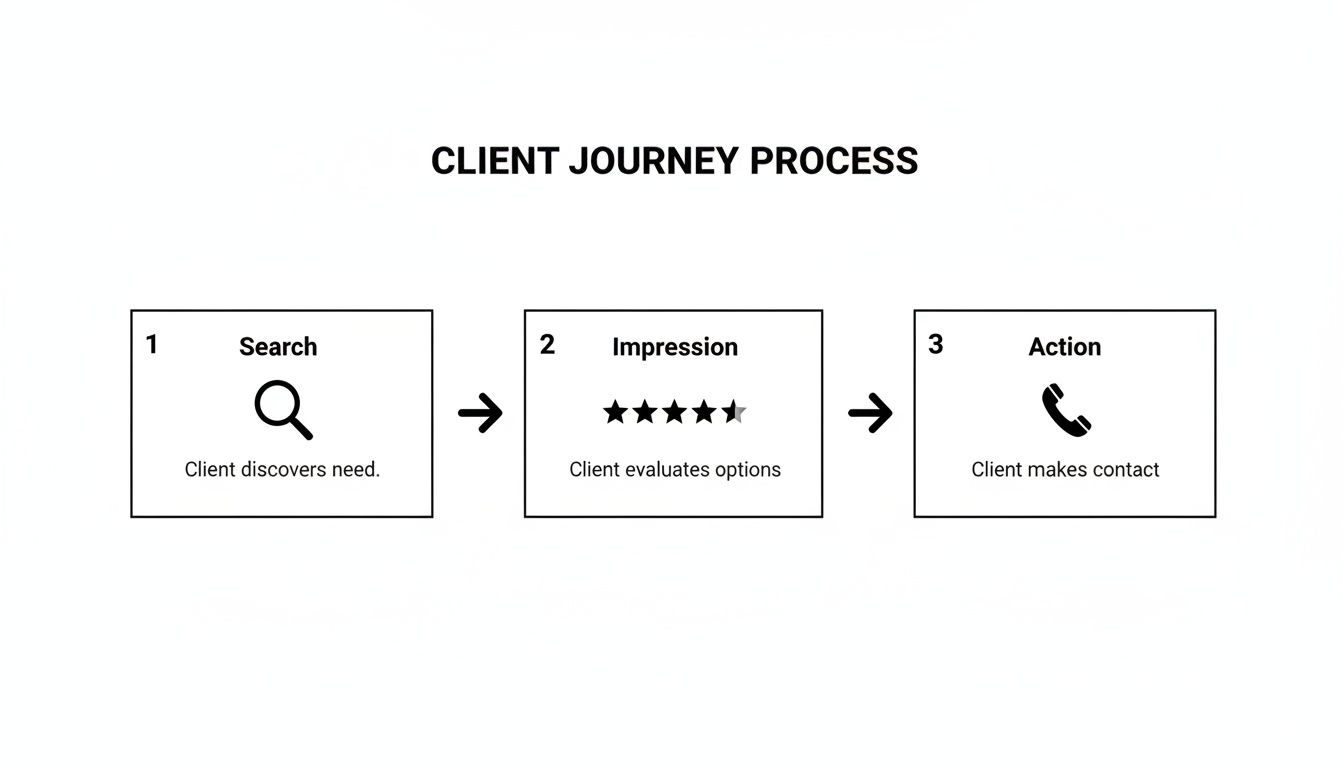
As you can see, that "Impression" stage is everything. It's the bridge between someone searching for a lawyer and actually deciding to pick up the phone and call your firm. And that impression is built almost entirely on what they find online—star ratings, reviews, and comments.
Assembling Your Monitoring Toolkit
Your first line of defense is a set of automated alerts. These tools do the tedious work for you, constantly scanning the web for your firm’s name and pinging you when they find something.
Here's where to start:
- Google Alerts: This is a no-brainer. It's free, easy, and should be your foundational tool. Set up alerts for your firm's name, the names of every attorney, and common misspellings of both. You’ll get an email whenever these terms pop up in a new article, blog, or web page.
- Social Media Monitoring: Tools like Brand24 or Mention are designed to listen in on social networks. They'll catch conversations on platforms like X (formerly Twitter), Facebook, and LinkedIn where people might be sharing informal feedback that you’d otherwise miss.
- Legal Directory Patrol: You absolutely must keep an eye on your profiles on Avvo, FindLaw, and Martindale-Hubbell. I recommend a manual check-in at least once a week. While some tools can monitor these, a quick, scheduled look-see ensures nothing on these high-stakes sites slips through the cracks.
The secret here is consistency. Block out time every week—or assign the task to a sharp paralegal or office manager—to review alerts and check your key profiles. This turns reputation monitoring from a frantic, reactive chore into a powerful, proactive business habit.
Navigating the Rise of Fake Content
This kind of vigilance isn't just a good idea anymore; it's essential. The internet is flooded with fake reviews and AI-generated content, making it harder than ever for potential clients to know who to trust.
The volume of inauthentic reviews has exploded between 2020 and 2024, leading to regulatory crackdowns and forcing platforms to get serious about verification. Research shows that consumers now read an average of seven reviews before trusting a business.
What does that mean for you? Authenticity is now a core driver of client acquisition. A passive, "set it and forget it" approach is a liability. You need to be actively monitoring your profiles and cultivating genuine feedback to stay ahead.
Make Your Team Your Eyes and Ears
Don't forget your most valuable intelligence asset: your staff. The people at the front desk, your paralegals, and your administrative assistants are on the front lines. They often hear feedback—both good and bad—directly from clients long before it ever makes its way online.
Train them to spot and report potential reputational issues.
Set up a dead-simple internal process for flagging online comments. It could be a dedicated email inbox (reviews@yourfirm.com) or a specific channel in your team's Slack or Microsoft Teams. This expands your reach and, just as importantly, creates a culture where everyone takes ownership of protecting the firm’s reputation.
Of course, spotting an issue is only half the battle. Responding effectively is a skill in itself. For a deeper look at what to do when things go wrong, check out our guide on law firm crisis management to get your team prepared.
How to Respond to Reviews The Right Way
For attorneys, responding to online reviews is a bit of a tightrope walk. You’re trying to balance great customer service with the strict ethical rules of our profession. Get it right, and your response doesn't just satisfy one person—it shows every potential client reading it that your firm is professional, caring, and trustworthy.

And the stakes couldn't be higher. Fresh data for 2024–2025 shows that nearly half of all consumers—around 47%—won't even consider a law firm with less than a 4-star rating. With a staggering 85% of potential clients using Google to find legal help, your Google Reviews are often the first, and most important, impression you make.
These numbers paint a very clear picture: A solid review profile, backed by thoughtful and quick responses, is a direct line to new clients. For a deeper dive into how online feedback shapes client decisions, discover more insights about legal marketing statistics.
Acknowledging Positive Feedback with Grace
When a happy client leaves a glowing review, it’s more than just a chance to say "thanks." It’s an opportunity to reinforce that positive feeling and show future clients what it’s like to work with you.
The key is to sound like a real person, not an automated message. A generic "Thank you for the review" is a wasted opportunity. You want to personalize the response just enough, without ever crossing the line into confidential details.
Here’s a great example:
"Thank you so much for your kind words, John. It was a pleasure to assist you, and we're glad you felt supported throughout the process. We wish you all the best."
It's simple, but it confirms there's a human on the other side who genuinely values their clients. That builds a ton of trust.
Navigating Negative Reviews with Professionalism
Getting a negative review can feel like a personal attack. It’s tempting to defend yourself or set the record straight right then and there. But your public response is not the place for an argument.
Remember who your real audience is: it isn't just the unhappy reviewer. It's every single prospect who will read that exchange. Your goals are to de-escalate, show your firm’s commitment to service, and fiercely protect client confidentiality.
Your response to a negative review is a public demonstration of your firm's character. A calm, professional, and empathetic reply can often do more to build trust than a dozen five-star reviews.
For every negative review, I recommend this simple, three-part approach:
- Acknowledge and Empathize. Start by acknowledging their feedback. Express regret that their experience wasn't what they hoped for. You aren't admitting fault; you are simply validating their feelings.
- State Your Commitment. Briefly mention your firm’s dedication to excellent service. This reinforces your values without diving into the specifics of their case.
- Take It Offline. This is the most crucial step. Immediately invite the reviewer to discuss the matter privately. Provide a direct contact—a specific person with their email or phone number—to show you’re serious about making things right.
A response can go wrong very quickly if it violates confidentiality.
Bad Example (Major Ethical Violation):
"We disagree with your version of events. You lost the case because you failed to provide the documents we repeatedly requested on May 10th and June 15th."
Good Example (Ethical and Professional):
"Thank you for sharing your feedback. We are sorry to hear that your experience did not meet your expectations, as we always strive to provide the highest level of service for every client. Please contact our office manager, Jane Doe, at [phone number] or [email address] so we can discuss your concerns directly."
This professional approach keeps confidential matters private, sidesteps a public spat, and demonstrates to prospects that you handle criticism with grace. Mastering this isn't just for the legal world; you can find some broadly applicable effective strategies for responding to customer complaints.
To help guide your team, here’s a quick-reference table for crafting the perfect response every time.
Review Response Framework for Attorneys
This table provides a quick-reference guide for crafting ethical and effective responses to both positive and negative online reviews, ensuring compliance and professionalism.
| Review Type | Key Objective | Do | Don't (Ethical Pitfalls) |
|---|---|---|---|
| Positive | Reinforce the good experience and show appreciation. | Thank the reviewer by name, mention your commitment to client satisfaction, keep it brief and genuine. | Never discuss case specifics, results, or any confidential details. Avoid overly generic, robotic language. |
| Negative | De-escalate, show professionalism, and move the conversation offline. | Acknowledge their frustration, express regret for their experience, and provide a direct offline contact. | Never argue, admit fault publicly, or disclose any information that confirms an attorney-client relationship. |
| Neutral (3-Star) | Show you're listening and encourage a private dialogue. | Thank them for the feedback, acknowledge their mixed experience, and offer to discuss it further offline. | Don't be dismissive or ignore the feedback. Treat it as an opportunity to improve and show you care. |
By handling every review with care and a clear strategy, you can turn client feedback from a potential liability into one of your most powerful reputation-building tools.
Going on the Offensive: How to Proactively Build a Five-Star Reputation
Playing defense by reacting to reviews is essential, but it's not how you win the game. The only way to build a truly resilient, client-attracting online presence is to go on the offense. It's about creating such a strong foundation of positive digital assets that a single negative comment looks like what it is—an irrelevant outlier, not the defining story of your firm.

This proactive strategy really comes down to three things: creating a system for generating authentic reviews, showcasing your expertise through high-value content, and locking down your accuracy across the web's most important legal directories. When you do this right, you take back control of your search results and make sure the online narrative truly reflects the quality of your work.
Build a System for Requesting Reviews
Your most powerful reputation asset is a steady, predictable stream of positive reviews from happy clients. Just hoping they'll leave one isn't a strategy. You need a simple, ethical, and repeatable process for asking for that feedback when client satisfaction is at its absolute peak.
That magic moment is almost always right after you've successfully resolved their case. The client is relieved, they're grateful, and they are most inclined to share how you helped them.
Here’s how to build a request system that actually works:
- Timing is Everything: The request should go out the moment you close the file. Every day you wait, the odds of them following through drop dramatically.
- Make It Painless: Send a direct link to the specific platform you're focused on, which should almost always be your Google Business Profile. Don't make them hunt for it.
- Personalize the Ask: The email or text should come from the attorney who handled their case, not a generic "info@" address. A quick, personal note goes a long way.
One of the biggest mistakes I see is "review gating"—where firms try to filter out unhappy clients and only send the review link to the happy ones. This is a bad look and a risky practice that can get you penalized by review platforms. The best, most confident approach is to ask every single client for their feedback. It shows you're transparent and stand by your service.
Showcase Your Expertise with Strategic Content
Reviews build trust, but content builds authority. Creating and publishing high-value content is how you dominate the search results for your name and practice areas with assets you completely own and control. Think about it: when a potential client Googles you, do you want them to find a list of review profiles, or a rich portfolio of your expertise?
Your content should be squarely focused on answering the real-world questions your ideal clients are asking.
- In-Depth Articles: Write practical guides on navigating common legal hurdles in your niche. Explain a recent change in the law and what it means for people. Break down a complex legal concept into plain English.
- Ethical Case Studies: Anonymize all client details and tell a compelling story about a problem you solved. I like the "Challenge, Solution, Result" framework—it's a powerful way to demonstrate your strategic thinking without a hard sell.
- Detailed Attorney Bios: Your website bios shouldn't be a dry CV. They need to highlight each attorney's unique experience, major accomplishments, and professional philosophy. Let your personality and passion come through.
This kind of content does double duty. It establishes you as an authority and simultaneously pushes down any negative noise in the search rankings, creating a buffer of positive, firm-controlled information.
Master Your Legal Directory Listings
Your firm’s presence on key legal directories like Avvo, FindLaw, and Martindale-Hubbell isn't optional. These sites carry immense weight with both search engines and potential clients. An incomplete or, worse, an inaccurate profile suggests a lack of attention to detail—not a great first impression for an attorney.
Run a thorough audit of your firm's listings. Check every single detail—from your firm's name and address to the specific practice areas for each attorney—and make sure it is 100% accurate and consistent on every platform. An old phone number or an outdated office address is an unforced error that can absolutely cost you new business.
Putting real resources behind this proactive work is fast becoming the standard. Economic surveys from 2024–2025 show a major shift, with 83% of law firms now hiring external marketing help because they recognize it's a specialized skill. The disconnect is that only about 47% of attorneys maintain a formal annual marketing budget, which means these critical proactive efforts often get left behind. Those who do invest see the payoff; for instance, businesses with systematic reputation programs have reported huge gains, like a 510% increase in review volume. You can read more about the trends shaping attorney marketing to get a better sense of where the industry is heading.
Handling Defamation and Malicious Reviews
Let's be clear: not all negative feedback is the same. There's a world of difference between a genuinely unhappy client airing a grievance and a review that crosses the line into something more sinister.
Sometimes, a comment isn't just criticism—it’s an outright attack. We're talking about defamation, harassment, or blatant violations of a review platform's terms of service. Knowing how to spot these and what to do is a non-negotiable skill for any modern law firm.
When a review contains a verifiably false statement of fact designed to harm your reputation, you may be looking at defamation. The same goes for reviews filled with hate speech, threats, or—a common one—posts from people who were never your clients. In these situations, your goal isn't just to respond. It's to get the review taken down.
Your First Move: Build Your Case
Before you even think about clicking that "report" button, you need to gather your evidence. Trust me on this. Platforms like Google and Avvo aren't going to remove a review just because you say it's fake. You have to prove it. Rushing this step is the fastest way to get your takedown request denied.
Start immediately. Take crystal-clear, time-stamped screenshots of the entire review. Make sure you capture everything: the reviewer's name, the date it was posted, and the full text. Save these files in a dedicated folder for this specific incident.
Your documentation needs to be targeted. You're building a case to prove a specific violation.
- Proving a Falsehood: Did a reviewer claim you no-showed a court date? Pull the court records or your calendar to prove you were there. Concrete evidence is your best friend.
- Proving They Weren't a Client: This is a big one. If you have no record of the person, document your search of your case management system or client database. A formal statement confirming they are not on record is powerful.
- Proving a Conflict of Interest: Is the review from the opposing party in a nasty divorce case? Document their role and relationship to the case. This is a clear conflict of interest and a direct violation of most platforms' policies.
This evidence isn't for a public shouting match. It's the confidential proof you'll submit with your removal request. Getting the details right on what legally constitutes a false statement is key. For a much deeper dive, our guide on how to prove defamation is an essential read for building a rock-solid case.
Navigating the Takedown Maze
Once your evidence is locked and loaded, it’s time to work through the platform's removal process. Each one has its own quirks and submission portals, and you have to play by their rules.
- Google Business Profile: Google is often the most straightforward. You can flag a review right from your dashboard. When you report it, stick to the clearest violations like "Hate speech," "Harassment," or "Conflict of interest." Proving something is simply "false" is tougher, but a well-documented case gives you a fighting chance.
- Avvo: Because Avvo is attorney-specific, they have a better grasp of the ethical lines. They're more likely to understand and act on reviews from opposing counsel or those that breach client confidentiality. Use their reporting tool and be very specific about the violation.
- Yelp: Yelp is tough. They are fiercely protective of reviewers and have a very high bar for removal. Your best shot here is proving the person was never a legitimate client or that the review violates a strict guideline, like containing private information or direct threats.
Expert Tip: Whatever you do, do not get into a public back-and-forth with a malicious reviewer while your removal request is pending. It can completely undermine your case, making the platform see it as a simple customer dispute instead of a serious policy violation.
Weighing the Nuclear Option: Legal Action
What if the platform rejects your appeal? You might be tempted to file a defamation lawsuit. Be very, very careful here. This path is complex, expensive, and should always be a last resort.
The burden of proof is incredibly high, and the process can drag on for months or even years. Worse, you risk triggering the Streisand effect—where trying to suppress something online only makes it go viral. A lawsuit can turn one obscure, nasty review into a major news story, causing infinitely more damage than the original post ever could.
Deciding to escalate to legal action requires a cold, hard calculation of the potential risks versus the rewards. It's a strategic decision that should never be made lightly.
How to Know If Your Reputation Management Is Actually Working
You can’t manage what you don’t measure. Reputation management isn't just about damage control; it's a core business function that needs to prove its worth. To justify the time and money you're investing, you need to look past your gut feelings and focus on hard numbers that show the real health of your firm's online presence.
Tracking the right metrics is how you turn this from a necessary expense into a measurable engine for growth. It shows you exactly what's working and where you need to shift your focus.
The Key Performance Indicators That Matter
To get a clear picture of your ROI, you’ll want to consistently track a few critical data points. Think of this as the dashboard for your firm's digital health.
These are the core metrics you should have your eyes on:
- Average Star Rating: Keep a close watch on your combined rating across crucial platforms like Google Business Profile and Avvo. The goal is a steady climb, with a particular focus on staying above the all-important 4.0-star threshold—a common cut-off for potential clients.
- Review Volume and Velocity: How many new reviews are you generating each month? A steady stream of fresh feedback tells both prospects and search engines that your firm is active, credible, and in-demand.
- Sentiment Analysis: Go beyond the stars. What are people actually saying? Are the comments positive, negative, or a mixed bag? Look for patterns in the words clients use—this feedback is pure gold for spotting operational strengths and weaknesses.
- Search Engine Rankings: Google your firm's name and your key attorneys' names. What shows up on that first page? Your objective is to own this "branded search" result page with positive assets you control, like your website, attorney bios, and favorable press.
Building a Sustainable Internal Process
Data is useless if you don't have a system to act on it. A straightforward internal process is what makes reputation management a lasting part of your firm's operations, rather than a task that gets pushed aside when things get busy. This isn't about creating a ton of new work; it's about establishing clear ownership.
A stellar reputation is never an accident. It’s built on a deliberate, documented process where everyone understands their role in protecting the firm's most valuable asset.
Assign clear responsibilities for these key functions:
- Monitoring: One person—maybe an office manager or a paralegal—should be the designated point-person for checking alerts and profiles every day or week.
- Responding: While the monitor can flag new reviews, the attorney involved should always be the one to draft or, at the very least, approve any public response. This is non-negotiable for maintaining ethical compliance.
- Reporting: Put together a simple monthly report tracking the KPIs we just covered. This quick summary keeps the firm's leadership in the loop and proves the ongoing value of your efforts, ensuring your reputation remains a top priority.
Answering Your Top Questions
When it comes to managing an online reputation, many attorneys get tripped up by the gray areas where platform rules and professional ethics collide. Let's clear up some of the most common questions we hear.
Can I Offer an Incentive for a Positive Review?
Let me be direct: absolutely not. Dangling a carrot—whether it's a gift card, a discount, or a raffle entry—for a good review is one of the fastest ways to get into hot water.
This kind of quid pro quo doesn't just feel wrong; it's a clear violation of the Federal Trade Commission's (FTC) guidelines. It also flies in the face of the terms of service for every major review site out there, from Google to Avvo. If you're caught, you risk having all your reviews wiped out. The only sustainable path is to ask satisfied clients for their genuine feedback, period.
How Do I Handle a Negative Review from a Non-Client?
It’s incredibly frustrating to get a one-star review from someone you've never represented. Maybe it’s the opposing party from a contentious divorce or just a random person with an axe to grind. The good news is that these are often the easiest reviews to get removed because they violate a core policy: the review isn't from a real customer.
Your first move is to grab screenshots of everything. Then, report it immediately.
- On Google, flag the review and select a reason like "Conflict of interest" or "Off-topic."
- In your explanation, be professional and concise. Simply state that you've checked your records and this individual has never been a client of your firm.
Don't engage with them publicly. Just follow the platform's process.
How Long Does It Take to Repair a Damaged Reputation?
This is the big one, and the answer isn't what most people want to hear. Fixing a damaged reputation is a marathon, not a sprint. There's no magic button.
The real strategy is dilution. It's about systematically building a mountain of positive, authentic feedback and high-quality online content that slowly but surely buries the negative stuff.
Expect this to be a long-haul effort. You're not going to see a dramatic shift overnight. It often takes several months of consistent, proactive work to genuinely improve your star rating and change the story people see when they search for your name.