


To win a defamation case, you have to do more than just show someone said something nasty about you. You need to prove four specific things: a false statement of fact was made, it was shared with someone else, the person who said it was at fault, and it actually hurt you in a measurable way.
Think of these as the legs of a table—if even one is missing, the whole case falls apart. Let's break down what you actually need to establish.
Core Elements You Must Establish
Before you dive into gathering evidence, it's crucial to understand the legal framework you'll be working within. The table below outlines the four essential pillars of any successful defamation claim. Mastering these is the first step in figuring out if you have a viable case and what you need to start collecting.
| Element | What You Must Prove | Common Example |
|---|---|---|
| A False Statement of Fact | The statement was an assertion of fact that can be objectively proven false. It was not just an opinion or an insult. | Saying "John embezzled money from his company," which is a verifiable claim, versus "I think John is a terrible boss," which is a subjective opinion. |
| Publication to a Third Party | The statement was communicated, either in writing or verbally, to at least one person other than you and the speaker. | An email sent to your colleagues, a public comment on a social media post, or a review left on a business listing. |
| Fault or Negligence | The person who made the statement acted with a certain level of fault—either negligently (for private figures) or with actual malice (for public figures). | A blogger publishes a false claim without doing any basic fact-checking to see if it was true. This demonstrates negligence. |
| Demonstrable Harm | You suffered real, tangible damage to your reputation, finances, or well-being as a direct result of the statement. | You were fired from your job, lost a major client, or experienced a quantifiable drop in business revenue right after the statement was made. |
Understanding these elements is non-negotiable. They are the bedrock of your entire strategy, guiding everything from evidence collection to legal arguments.
A False Statement of Fact
The absolute heart of any defamation case is proving the statement was a false assertion of fact. This is where many people get tripped up. Insults, harsh opinions, and even over-the-top exaggerations are usually protected by free speech. They might be hurtful, but they aren't illegal.
For a statement to count, it has to be something you can prove is objectively true or false.
- This is a factual claim: "The contractor failed to get the proper city permits for our renovation." You can check public records to verify this.
- This is a protected opinion: "That contractor does shoddy work." It's a subjective judgment and can't really be proven false in a legal sense.
But the line can get blurry. Someone might try to couch a factual claim as an opinion, like, "In my opinion, the CEO is committing tax fraud." The mention of a specific crime—tax fraud—implies a factual basis. Courts will often look at how a reasonable person would hear that statement, not just the words the speaker used to frame it.
Publication to a Third Party
Next, the statement had to be "published." In legal jargon, this doesn't mean it appeared in a newspaper or a book. It just means the statement was communicated to at least one other person besides you and the person who said it.
This part is usually pretty easy to prove in our connected world. A single email sent to a coworker, a comment left on a Facebook post, or a review on a public forum all count as publication. The more widely the statement was spread, the more potential for damage—and the stronger this part of your claim becomes.
Fault or Negligence
You also have to show the person who made the statement was at fault. The legal standard here depends entirely on who you are: a private citizen or a public figure. We'll get into the weeds on that distinction later, but it’s a critical piece of the puzzle.
For most private individuals, the standard is negligence. This simply means you have to prove the person acted carelessly and didn't bother to do basic fact-checking before hitting "publish." For public figures, the bar is astronomically higher—you have to prove "actual malice," meaning they knew it was false or acted with reckless disregard for the truth.
Demonstrable Harm
Finally, you must connect the false statement to real, tangible harm. This is often the make-or-break element of a case.
You have to draw a straight, undeniable line from their words to your losses. Simply saying you were "upset" or "offended" won't cut it in court.
You need cold, hard proof of the damage. For example:
- Financial Loss: Can you show you were fired, lost clients, or saw a measurable nosedive in business revenue immediately after the statement went live?
- Reputational Damage: Do you have evidence you were denied a professional license, kicked out of a trade organization, or that your standing in your community was clearly damaged?
Keep in mind that defamation laws and the standards of proof can change dramatically depending on where you are. In the United Kingdom, for instance, the law is often considered more friendly to plaintiffs. Their Defamation Act 2013 requires claimants to show "serious harm," but the burden often shifts to the defendant to prove their statement was actually true. This is a world away from the U.S. system, especially when it comes to the uphill battle faced by public figures.
Gathering Evidence to Build Your Case
A defamation claim without solid proof is just an empty accusation. Once you've got a handle on the core elements you need to prove—that a statement was false, published, and caused you harm—it's time to get tactical. Your success doesn't just depend on what you find, but on how carefully you collect, document, and preserve every last piece of it.
Understanding the importance of evidence is fundamental. This isn’t just about grabbing a screenshot of a nasty comment; it's about building a verifiable record that will hold up under intense legal scrutiny.
This visual flow chart breaks down the essential pillars of a defamation claim you need to support with evidence.
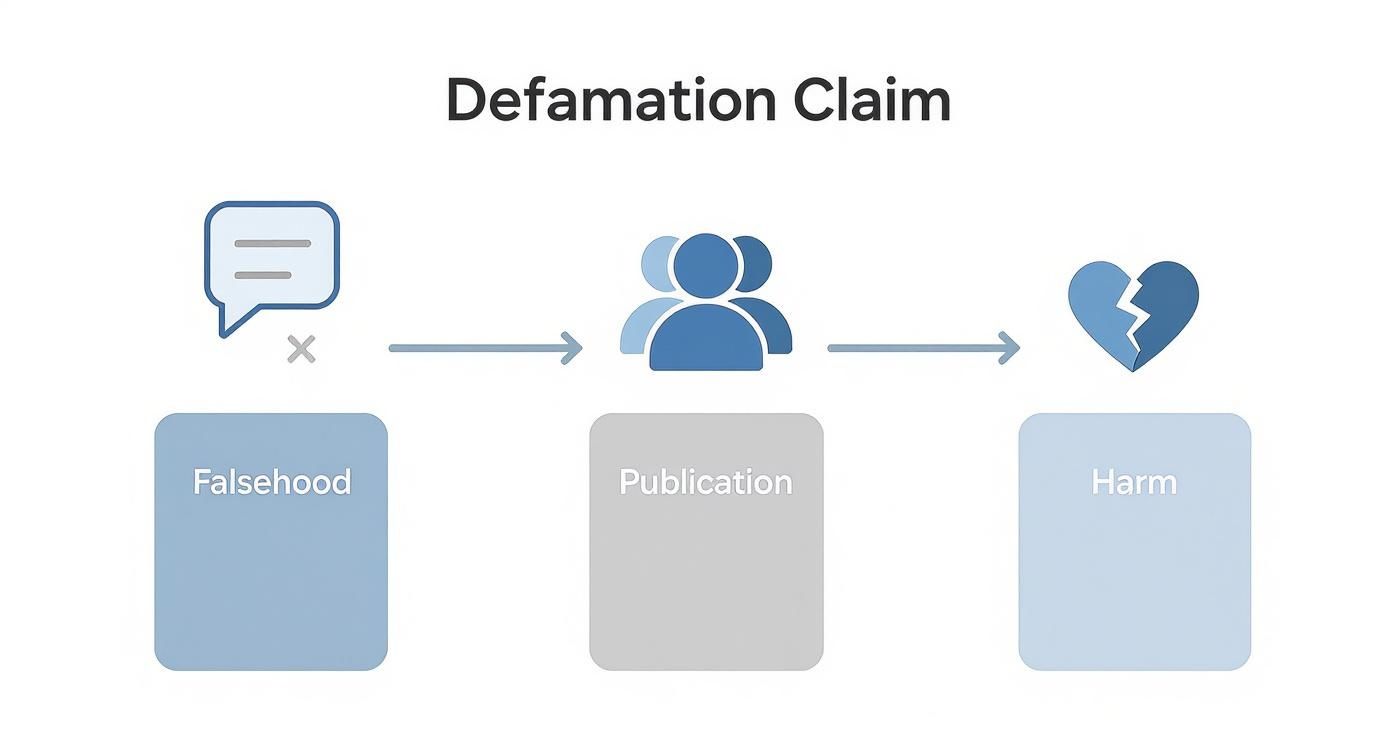
As you can see, your evidence has to create a clear line connecting the false statement directly to its publication and the damage that followed.
Documenting Digital Defamation
Today, most defamatory statements live online, and that digital content can vanish in a heartbeat. This makes immediate and proper documentation your absolute top priority. A simple screenshot is a decent start, but frankly, it’s often not enough on its own.
You need to assemble a more robust file with verifiable proof that the content existed, that it was public, and that you can attribute it to the defendant. This is how you create a record that's tough to challenge in court.
Here are the methods I always recommend for capturing digital evidence:
- Timestamped Screenshots: Don't just hit "Print Screen." Use tools that add a verifiable timestamp and the source URL directly onto the image. This proves exactly when and where you found it.
- Web Archiving Services: Services like the Wayback Machine or Archive.today are invaluable. They create a permanent, third-party snapshot of a webpage, which is incredibly powerful.
- Full-Page Screen Recordings: For things like expanding comment threads, social media stories, or videos, a static image just won't cut it. A screen recording captures the full context and user interaction.
Preserving the Chain of Custody
Collecting the evidence is only half the job. Now, you have to protect its integrity. The chain of custody is a critical legal concept—it's the chronological paper trail that documents every single person who has handled the evidence. If that chain is broken, your proof can be thrown out.
Think of your evidence like a sterile medical instrument. From the moment you collect it, you must prove it hasn't been contaminated or altered. Any gap in this timeline creates an opportunity for the opposing side to claim the evidence was tampered with.
For digital files, this means documenting how you saved them, where they’re stored, and who has access. My advice? Save original files to a secure, write-protected drive and only work with copies. For any physical documents, lock them up and keep a log of every time they’re touched.
Gathering Human Testimony and Witness Statements
While digital proof provides the hard facts, human testimony gives your case the context and emotional weight that can make all the difference. Witnesses can confirm the damage done to your reputation and show that other people actually saw and understood the defamatory statement.
Finding the right witnesses is key. You're looking for people who can speak directly to specific parts of your claim.
- Witnesses to Publication: This is anyone who saw the post, read the email, or heard the comment. Their testimony proves the statement reached a third party.
- Witnesses to Harm: Think of colleagues, clients, or partners who can attest to a change in your reputation. Did a lucrative business deal suddenly go cold? Did people start asking you awkward questions? That’s your proof of damages.
As soon as you identify a witness, get a signed and dated written statement. Memories fade, and a statement made while the event is fresh is far more credible. Make sure they are specific about the who, what, when, where, and how.
Trying to manage a flood of online attacks while also running a business is overwhelming. Partnering with a service that specializes in the process for review removal can be a smart move. They can work on getting the damaging content taken down, which helps stop the bleeding while you focus on building your legal case. A clear, organized evidence file empowers your legal team to build the strongest possible argument for you.
Public vs. Private Figures: A Whole Different Ball Game
When you're building a defamation case, your first and most critical question is: who are you in the eyes of the law? There’s a stark legal line drawn between private citizens and public figures, and where you fall on that line changes everything. It sets the standard of proof you have to meet, and for those in the public eye, that bar is set incredibly high.
Figuring out your status is step one. For a private individual, the standard is usually negligence. This is a much more straightforward hurdle. You essentially have to show that the person who made the false statement didn't do their homework—that they failed to act with reasonable care. Did they bother with even basic fact-checking before posting a career-damaging claim? If not, you’re on solid ground to argue negligence.
But for public figures, the legal terrain shifts dramatically. We’re not just talking about Hollywood celebrities or the President. This category can include CEOs, prominent activists, or even someone who intentionally becomes a central figure in a local public debate. For these individuals, showing a simple lack of care won't even get you to first base.
The "Actual Malice" Hurdle: A Tougher Standard for Public Figures
If you're considered a public figure, you must prove something called actual malice. This is a legal term that people often get wrong. It has nothing to do with whether the defendant acted out of personal hatred or spite.
In legal terms, actual malice means you have to prove the defendant either knew the statement was false when they published it or acted with reckless disregard for whether it was true or not.
This standard was designed to protect free speech, particularly when it comes to commentary on people who influence public life. It gives journalists and citizens breathing room to make honest mistakes but comes down hard on those who knowingly spread lies or willfully ignore obvious red flags.
As you can imagine, proving what someone was thinking is notoriously difficult. It often requires digging deep to find evidence that reveals a pattern of behavior or a complete and utter failure to look into the facts when it would have been easy to do so.
Who's Who? Drawing the Line Between Public and Private
So, how does a court decide if you’re a public figure? It’s not always black and white and often becomes a major battleground in the lawsuit itself. Courts generally place people into one of three buckets:
- Involuntary Public Figures: This is rare, but it happens. Think of someone who becomes a household name overnight because they were caught up in a famous crime or a major public disaster through no fault of their own.
- All-Purpose Public Figures: These are the people you’d expect—individuals with such pervasive fame and influence that they are public figures in all contexts. Famous actors, national politicians, and sports legends fit the bill.
- Limited-Purpose Public Figures: This is the most common and trickiest category. It covers people who have voluntarily put themselves at the forefront of a specific public controversy. For example, a local entrepreneur who leads a vocal campaign against a new city ordinance would likely be considered a limited-purpose public figure, but only for statements made about their role in that specific zoning debate.
This entire legal framework isn't new. It’s built on decades of precedent. Proving a basic defamation claim always requires showing a false statement was published and caused harm. But the "actual malice" requirement for public figures comes directly from the landmark 1964 U.S. Supreme Court case, New York Times Co. v. Sullivan. That decision established that public officials had to meet this higher standard, which was later extended to all public figures. You can explore more about these foundational legal concepts in various legal practice guides.
Ultimately, your status as a private or public figure will dictate your entire game plan. It directly impacts the evidence you need to collect, the questions you’ll ask, and the story you tell in court.
Taking Action: From Demand Letter to Lawsuit
Once you’ve built a solid file of evidence, you can finally shift from a defensive crouch to an offensive strategy. The path forward is a series of escalating steps, starting with a formal demand letter and, if necessary, moving into a full-blown lawsuit. This is the point where you put all that documented proof to work to force a resolution and start repairing your name.
Often, the smartest and most effective first move isn't filing a lawsuit. It's sending a cease and desist letter, also known as a demand letter. Think of this as the opening salvo. It’s a formal legal document that puts the defamer on official notice that you're serious and ready to take legal action. It’s a surprisingly powerful tool that can get the job done quickly and for a fraction of the cost of litigation.
Crafting a Powerful Demand Letter
A weak demand letter is easily ignored, but a strong one commands attention. To be effective, the document needs to be precise, professional, and carry the unmistakable weight of a pending lawsuit. This isn't the time to vent or get emotional; it’s about a cold, hard presentation of the facts and your non-negotiable demands.
Make sure your letter hits these key points:
- Specific Identification: Pinpoint the exact defamatory statements. You need to quote them word-for-word and include links or attached screenshots showing where and when they appeared.
- Assertion of Falsity: State unequivocally that the claims are false. If you can, briefly explain why and reference any direct evidence that proves your point.
- Outline of Harm: Briefly describe the real-world damage these statements have caused your business, from lost revenue to a tarnished professional reputation.
- Clear Demands: Be explicit about what you want. Typically, this means an immediate and permanent takedown of the content, a public retraction or apology, and sometimes, monetary compensation for the damages you've suffered.
- A Firm Deadline: Give the person a clear, reasonable deadline to comply—something like 10 business days—before you move on to filing a lawsuit.
A well-drafted demand letter shows you mean business and have already looped in legal counsel. It forces the other party into a simple cost-benefit analysis: is it worth the expense and public spectacle of a lawsuit to defend a false statement? More often than not, the answer is no.
If your letter is met with silence or an unsatisfactory response, your next move is to file a lawsuit. This takes the fight into the official legal arena, where you can leverage the power of the court to seek a remedy.
Navigating the Litigation Process
Filing a lawsuit kicks off a highly structured process governed by strict court rules. It starts when you file a complaint—the formal document that lays out your entire case for the court. The complaint details who is involved, quotes the defamatory statements, explains how each legal element of defamation has been met, and specifies the damages you’re seeking.
Once the complaint is served on the defendant, the case moves into the discovery phase. This is where things get interesting. Both sides are compelled to exchange information and evidence. Your legal team can use tools like depositions (sworn testimony taken outside of court), interrogatories (formal written questions), and document requests to uncover evidence you couldn't get on your own. This might include the defendant’s internal emails, early drafts of the defamatory post, or even proof that they knew what they were publishing was false.
For businesses dealing with a flood of fake reviews or coordinated online attacks, professional defamation removal services can be an invaluable partner during this stage, helping to track, document, and manage the ongoing harm.
Throughout the process, there will be chances to settle. Most defamation cases never actually make it to a trial. As the costs, time, and risks of litigation mount, both sides are usually motivated to find a resolution. That rock-solid evidence file you built from day one is your single greatest asset in these negotiations, showing the other side just how strong your case is and making a favorable settlement far more likely.
Anticipating Common Legal Defenses
Winning a defamation case is more than just telling your side of the story; it's about methodically taking apart the defendant's arguments before they even make them. When you file a claim, don't expect the other side to just roll over. They'll show up armed with a number of well-worn legal defenses built to protect free speech and get your lawsuit thrown out.
Understanding these common defenses from the get-go is absolutely critical for building a case that can withstand a legal fight.
Knowing what’s coming allows you to pressure-test your own claim, find the weak spots, and gather the evidence you need to counter their every move.
The Absolute Defense of Truth
In any defamation fight, truth is the ultimate shield. A statement that is substantially true cannot be defamatory, no matter how much it stings your reputation or hurts your business. This is an absolute defense—if the defendant can prove the core of what they said was true, your case is dead on arrival.
The key phrase here is substantially true. The defendant doesn't need to prove every single syllable was perfectly accurate. Minor errors won't win you the case if the main point—the "sting" of the accusation—is factually correct.
For example, say someone claims your company illegally dumped 1,000 gallons of waste into a local river. If the real number was 950 gallons, a court will almost certainly find the statement substantially true. The damaging heart of the claim is the illegal dumping, not the exact measurement.
The Opinion Defense
Another major roadblock is the line between a provable fact and a protected opinion. The First Amendment gives wide latitude to statements of pure opinion, which generally can't be defamatory. But this defense isn't a get-out-of-jail-free card for every negative comment.
What courts really look for is whether a statement implies a false assertion of fact. It’s a subtle but crucial difference.
- Protected Opinion: "I think that CEO is a terrible leader." That's a subjective judgment call; it can't be proven true or false.
- Actionable Statement: "In my opinion, that CEO is embezzling from the company." This statement, while framed as an opinion, implies the speaker has knowledge of a specific, verifiable criminal act.
Slapping "I think" or "in my opinion" onto a factual accusation won't save a defendant if the message they're really sending is a factual claim in disguise.
Privilege: Absolute and Qualified
The law carves out special exceptions for people to speak freely in certain situations without the threat of a lawsuit hanging over their heads. This protection is known as privilege.
There are two flavors of privilege you need to know about:
- Absolute Privilege: This is a complete immunity from defamation liability. It applies to statements made in specific, high-stakes contexts, regardless of whether they're false or even malicious. Think of participants in a courtroom (judges, lawyers, witnesses), legislators during official debates, and high-level government officials doing their jobs.
- Qualified Privilege: This is a more limited protection that applies where there's a social or moral duty to share information. A classic example is a former employer giving an honest, good-faith job reference. This privilege isn't absolute; it can be lost if you can prove the defendant acted with actual malice or reckless disregard for the truth.
The whole point of privilege is to protect communication that serves a greater public interest, like ensuring honest testimony in court or candid reporting on important matters. Your job is to prove why the statement made about you falls outside these protected zones.
Anti-SLAPP Statutes and Procedural Roadblocks
Finally, you have to be ready for procedural defenses, especially Anti-SLAPP statutes. "SLAPP" stands for Strategic Lawsuit Against Public Participation, and these laws are designed to get meritless defamation suits dismissed quickly.
Many states have these laws to protect people from being silenced by expensive lawsuits when they speak out on issues of public interest. If a defendant files a successful Anti-SLAPP motion, your case could be tossed out early, and you might even have to pay their legal fees.
To beat an Anti-SLAPP motion, you have to come out swinging, ready to show the court right away that your claim has genuine legal merit and is backed by solid evidence.
Common Questions About Defamation
When you’re dealing with a potential defamation claim, a lot of questions pop up. It’s a complicated area of law, so let's clear up some of the most common issues people face when deciding what to do next.
How Long Do I Have to Sue for Defamation?
The moment a defamatory statement goes live, a timer starts. Every state has a strict deadline for filing a lawsuit, called the statute of limitations. You’d be surprised how short this window is—often just one to three years, depending on your jurisdiction.
This deadline is non-negotiable. If you miss it, your right to sue is gone forever, no matter how solid your evidence is. That’s why it's absolutely critical to talk to a lawyer as soon as you discover the statement. Waiting could mean losing your chance to get justice on a simple technicality.
Can I Sue an Anonymous Poster?
You absolutely can, but it’s not as straightforward as suing someone you know. Since you can't just serve legal papers to a username, the process starts with filing what’s called a "John Doe" lawsuit against the unknown person.
Your attorney will then need to ask the court for a subpoena. This is a legal order that forces the website or social media platform to hand over information that could identify the anonymous user. Judges are careful here; they won’t approve these requests without good reason. You'll need to show them you have a real, legitimate defamation claim before they'll agree to unmask the poster.
Keep in mind that courts want to see a strong initial case. They need to be confident that you're pursuing a genuine claim of a false and damaging statement, not just trying to silence an online critic.
This approach balances the protection of legitimate anonymous speech with providing a path for those who have been genuinely harmed.
What's the Difference Between Libel and Slander?
Libel and slander are just two different flavors of defamation. The real difference is all about how the false statement was delivered.
- Libel is any defamation that’s written or published in a fixed form. This covers everything from online articles and social media posts to emails and even pictures. Since it creates a permanent record, it's often seen as easier to prove and potentially more damaging.
- Slander, on the other hand, is spoken defamation. Think of something said in a speech, during a live broadcast, or in a video.
This distinction used to be a huge deal in the legal world, but its importance has faded over time. After all, a viral video (technically slander) can now cause far more lasting damage than a small-town newspaper article ever could. Because of this, the core elements you need to prove are now practically the same for both libel and slander in most places. The goal is always the same: show that a false statement of fact was published and that it hurt you.