


A fake 1-star review is more than just frustrating. It’s a direct hit to your business’s credibility and, let's be honest, your bottom line. These phony testimonials can absolutely tank your local search rankings, scare away good customers, and stain a reputation you’ve poured your heart and soul into building.
So, taking action isn't just an option—it’s an essential part of defending your brand.
The Real Damage of Fake Google Reviews

Seeing a review you know is fake feels personal, doesn't it? But the damage goes way beyond hurt feelings. These malicious comments are a direct threat to your financial health because they systematically chip away at the trust that makes your business grow.
The impact isn't just theoretical; it's tangible and can be felt across your entire operation. A single fake review can set off a chain reaction of negative consequences.
How a Single Fake Review Hurts Your Business
| Impact Area | Description of Damage |
|---|---|
| Search Engine Visibility | Your average star rating is a huge factor for local SEO. A sudden drop can push you out of the coveted Google Local Pack, making you invisible to nearby customers. |
| Customer Trust | Shoppers rely on social proof. A few bad reviews, even fake ones, plant a seed of doubt, sending potential customers straight to your competitors. |
| Sales & Revenue | With 94% of consumers avoiding businesses with negative reviews, the direct hit to your sales can be immediate and significant. Fewer leads mean less revenue. |
| Brand Reputation | It takes years to build a great reputation. A handful of malicious comments can tarnish it overnight, creating a perception problem that's hard to fix. |
| Employee Morale | Public attacks on the business can be demoralizing for your team, especially when the criticism is unfair and untrue. |
As you can see, the problem isn't just about a bad comment. It's a digital landmine that can detonate your customer trust, cripple your visibility, and directly impact your revenue.
Dropping Off the Digital Map
One of the first things to suffer is your local SEO. Your star rating is a major ranking signal for Google. When a wave of 1-star reviews hits, your average plummets, telling Google’s algorithm that your business might not be as reputable as it once was.
This often means you’ll get booted from the Google Local Pack—that all-important map with three business listings at the top of local search results. Falling out of that prime real estate means people searching for services "near me" might never even know you exist.
The Erosion of Customer Trust
Today's consumers are smart, but they're also busy. They rely heavily on the social proof that reviews provide. Even if a string of negative comments is completely baseless, it plants a seed of doubt. Most people won't take the time to investigate; they'll just see a low star rating and click on the next business.
This trust deficit has a very real cost. It's estimated that roughly 11% of all Google reviews are fake, and this problem costs the global economy over $152 billion every year. When you consider that 94% of consumers say they avoid brands with negative reviews, the stakes are incredibly high for honest businesses like yours.
Common Types of Fraudulent Reviews
Not all fake reviews look the same. Knowing what you're up against makes it much easier to spot them and build a solid case for removal.
You’ll usually run into one of these:
- Competitor Attacks: A classic dirty trick. Rival businesses post malicious reviews to sabotage your reputation and try to steal your customers.
- Disgruntled Ex-Employees: This is a common one. A former employee with a grudge leaves a vindictive and often highly detailed review that can look very convincing.
- Review-for-Hire Scams: Comments posted by "click farms" or individuals who are paid to leave fake positive reviews for a competitor or fake negative ones for you.
- Mistaken Identity: It happens. A frustrated customer leaves a scathing review meant for another business that has a similar name or is located nearby.
Google's automated systems do their best to catch spam, but they aren't foolproof. They often miss the nuance and context needed to tell a cleverly crafted fake review from genuine feedback. That's why you have to be proactive.
If you're wondering just how much this could be costing you, use our calculator to estimate the financial damage of fake reviews. This can help shift your mindset from seeing this as a random annoyance to treating it as a core business priority.
How to Spot a Fake Review Like a Pro
Before you can even think about getting a fake Google review taken down, you have to be absolutely sure that's what you're dealing with. It's a skill, really—part detective work, part gut instinct. Mistakenly flagging a legitimate negative review can backfire and make you look defensive, so learning to tell the difference is your first critical step.
Most fake reviews aren't very sophisticated. Once you know the tells, they stick out like a sore thumb. Think of it this way: a real customer's review, good or bad, usually tells a story with specific details. A fake one is just there to do damage.
First, Look at the Reviewer's Profile
The clues often start before you even read the review itself. A quick click on the reviewer's name can be incredibly revealing.
Here’s what I always look for in a suspicious profile:
- Vague or Nonsense Names: Is the name super generic, like "John Smith" with no profile picture? Or is it just a random string of letters and numbers? That's your first red flag.
- No Profile Picture: While plenty of real people don't use a photo, a blank avatar combined with other suspicious signs is a strong indicator something's off.
- A History of Hating Everything: Take a look at their other reviews. If they’ve left a trail of nothing but 1-star ratings across dozens of different businesses, often using similar angry phrasing, you're likely looking at a professional complainer or a bot, not a genuine customer.
- Brand New Account: A profile that was just created, has no picture, and has only left one review—for you—is almost always fake.
For instance, a 1-star review from "A Google User" with no photo and zero review history is a classic sign of a bogus review. It’s the lowest-hanging fruit in this whole process.
Next, Pick Apart the Review's Content
After you've checked out the profile, it's time to analyze what they actually wrote. This is where the story (or lack thereof) falls apart. Fake reviews are often high on emotion and shockingly low on actual facts.
Pay close attention to these red flags:
- Super Vague Complaints: Watch out for phrases like "terrible service" or "awful product" with no context. A real unhappy customer will almost always tell you why they were unhappy. They’ll mention a specific interaction, a product flaw, or a timeline.
- Totally Irrelevant Details: This one is a dead giveaway. If your Italian restaurant gets a review complaining about the "poor quality of the sushi," you can be pretty certain it's fake. It’s a sloppy tactic, but it happens more than you'd think.
- Over-the-Top Dramatic Language: Fake reviews often lean on extreme, emotionally charged words like "nightmare," "complete disaster," or "total scam." While a real customer can certainly be upset, this kind of hyperbole is a common tool used to inflict maximum damage.
- Plugging a Competitor: Does the review end with something like, "Go to [Competitor's Name] instead, they're much better"? This is a blatant violation of Google's policies and one of the easiest types of reviews to get removed.
Expert Insight: One of the most damning patterns we see is a "coordinated attack." This is when a handful of 1-star reviews pop up in a very short period—sometimes just a few hours—often using strikingly similar language. If you see this, you’ve got a strong case for a spam campaign.
Finally, Look for Suspicious Timing
A single bad review is one thing; a sudden pattern is evidence. The timing and frequency of negative reviews can be just as telling as what they say. Most businesses have a natural rhythm to their reviews. A sudden flood of 10 negative ratings over a weekend is highly suspicious.
This kind of influx often follows a specific trigger, like letting an employee go or having a public dispute with another company. Documenting the timeline is crucial when you build your case for Google. It allows you to connect the dots and show that you're not dealing with a sudden drop in quality, but a targeted, malicious attack.
Once you’ve trained your eye to spot these signs, you can move forward with confidence, knowing you’re protecting your reputation from fraudulent claims, not just silencing unhappy customers.
A Practical Walkthrough for Reporting Fake Reviews
So you've spotted a fake review. Now what? It's time to shift from playing detective to taking action. Getting a fake Google review taken down isn't about arguing your case or pleading for mercy—it's about methodically building a clear, evidence-based argument that proves a specific policy violation. You have to be precise, organized, and factual to give yourself the best shot at success.
Your very first move, before you click a single "report" button, is to gather your evidence. Seriously, screenshot everything. Grab a clear shot of the review itself, the reviewer's profile (make sure to capture their name and any other reviews they’ve left), and the date it was posted. If you have customer records, like a CRM or sales database, showing this person has never been a customer, get that ready too. This documentation is your ammunition.
Document First, Then Report
The entire removal process hinges on your ability to prove the review breaks Google's own rules. You're not just complaining that a review is unfair; you're demonstrating that it violates a specific policy, like spam, conflict of interest, or harassment. Without solid proof, your report is just an opinion, and opinions rarely get reviews removed.
Think of it as building a case file. Every piece of evidence you collect makes it easier for the Google support agent on the other end to understand the situation and justify taking it down.
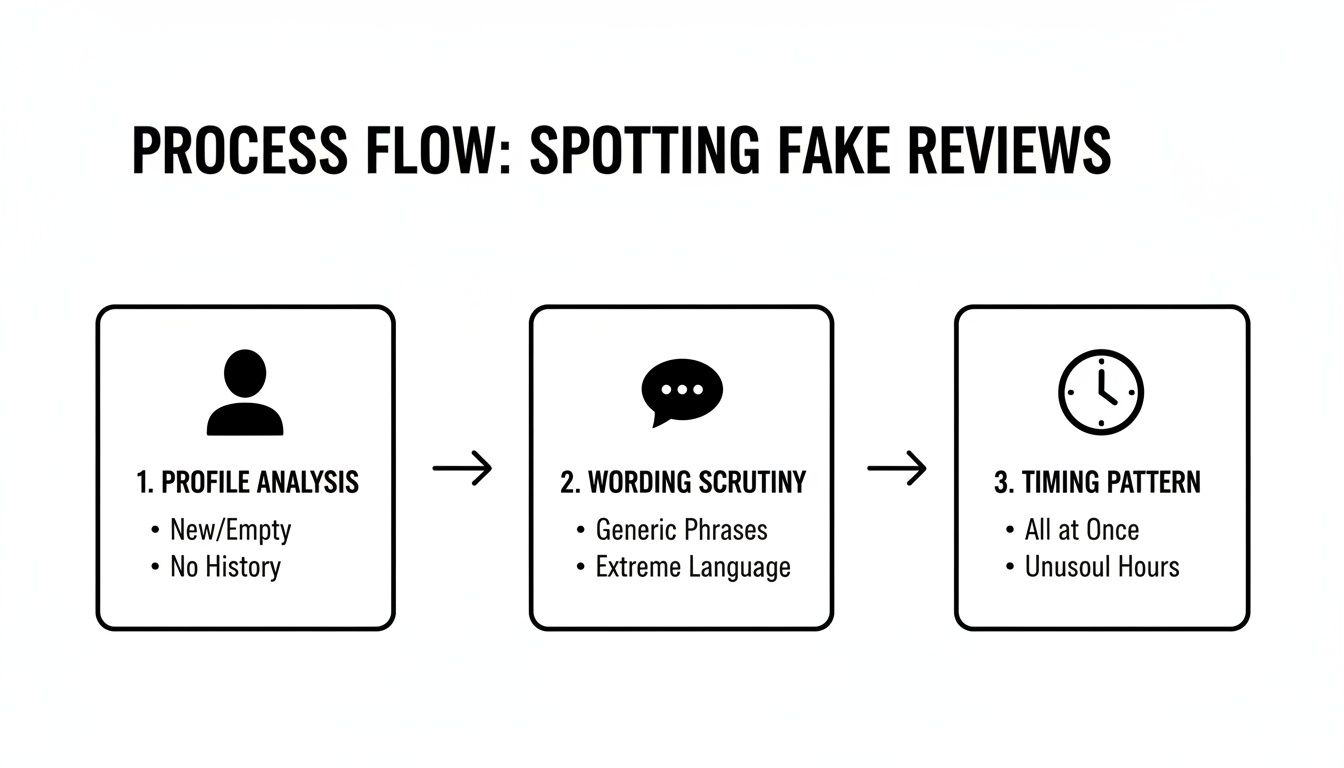
This is why analyzing the reviewer's profile, the wording they use, and the timing of the post are such crucial first steps. You need this context before you can effectively escalate your report.
Two Channels for Reporting Fake Reviews
Google gives you two main ways to report a fraudulent review. They might look similar at first glance, but they serve different functions, and one is vastly more effective than the other.
Flagging Directly on the Review: This is the fast and easy route. You just find the review on your Google Business Profile, click the three little dots, and hit "Report review." While simple, it's a black box. You send your report out into the ether and just have to hope for the best, with no way to check on its progress.
Using the Review Removal Tool: This is the method I always recommend. It’s a structured process where you select your business, pinpoint the exact review, and choose a reason from Google’s list of policies. The crucial difference? It gives you a case ID and lets you track the status of your request. Always, always use this tool if you can.
Pro Tip: When you're using the Review Removal Tool, get specific. Don't just pick "Spam." If you know it’s from a rival business, select "Conflict of interest." If the language is abusive, choose "Harassment." The more precise your claim, the easier it is for Google's team to verify and approve it.
Citing the Right Google Policy
Your success really boils down to how well you can match the fake review to one of Google's specific policies. Just saying it's "fake" won't cut it. You have to connect the dots for them.
This is a massive undertaking for Google. In 2023 alone, they blocked or removed a staggering 170 million reviews that violated their policies—that’s a 45% increase from the previous year. They also took down 12 million fake business profiles. The scale of this problem is enormous.
This is why being methodical is so important. By tying your claim directly to a policy violation, you change your role from a frustrated business owner to someone actively helping Google enforce its own platform rules. That simple shift in positioning can dramatically improve your odds of getting that fake review taken down for good.
It's also worth remembering that this isn't just a Google problem. Other platforms face similar challenges, and understanding their processes can be helpful. For example, looking into strategies for Amazon review removal shows how another major tech company tackles these issues, highlighting the nuances between different platforms.
What to Do When Google Denies Your First Request
It’s incredibly frustrating. You’ve done your homework, documented everything, submitted your report… only to get that dreaded automated email from Google saying your request was denied. It feels like a dead end, but I can tell you from experience, it’s usually just the beginning.
Think of that first report as getting past an automated gatekeeper. Many of those initial reviews are handled by algorithms or first-level support who might miss the crucial details of your situation. A denial doesn’t mean you’re wrong; it just means you need to get your case in front of a real person who can apply some common sense. So, don't get discouraged—get strategic.
The Art of the Appeal
If your request was denied through the Review Removal Tool, Google often offers a one-time appeal. This is your shot to make a better case, not just repeat the old one. Sending the exact same information again will almost certainly get you the exact same result.
Your appeal needs to be sharp, factual, and persuasive. Here’s how I’d approach it:
- Bring New Evidence: Did you dig a little deeper and find more? Maybe you discovered the same person left an identical review for a competitor across the country. Any new piece of the puzzle makes your case stronger.
- Connect the Dots for Them: Don't just say, "This review is fake." Instead, be explicit. For example: "This review violates the Conflict of Interest policy. The reviewer's public profile clearly states they are an employee at [Competitor's Name], our direct competitor."
- Be Brief and Professional: The person on the other end is likely dealing with a mountain of these. Get right to the point. Ditch the emotional language and stick to the cold, hard facts you’ve gathered.
A Critical Takeaway: Your goal is to make it incredibly easy for the support agent to say "yes." Hand them a clear, logical argument with airtight evidence. Don’t make them hunt for the policy violation—point it out with a spotlight.
Escalating to Google Business Profile Support
When the appeal doesn't work (or wasn't an option), it's time to contact Google Business Profile (GBP) support directly. This moves you out of the automated system and into a queue for a real conversation. You can usually find the contact form in the "Help" section of your GBP dashboard.
When you open a support ticket, have all your documentation ready to go, especially the case ID from your first removal request. This instantly shows the agent you’ve already gone through the proper channels. In your message, calmly lay out the situation, explain precisely which policy is being violated, and attach all your screenshots and proof.
You may have to be persistent here. The first person you talk to might be a generalist. If you aren’t getting anywhere, don’t be afraid to politely ask for your case to be escalated to a specialist or a senior team member.
Taking Your Case Public on Social Media
Sometimes, a little public visibility can move the needle when private channels have stalled. The Google Business Profile team keeps an eye on social media, especially on X (formerly Twitter). A well-crafted, professional post can sometimes catch the attention of a different team.
If you go this route, follow these simple rules:
- Stay Professional: No angry rants or accusations. It undermines your credibility.
- Be Clear and Concise: State the problem and what you need. Something like: "@GoogleMyBiz We've reported a defamatory review (Case ID: 12345) that violates your harassment policy and have been denied. Can someone please take a second look?"
- Protect Privacy: Never post private customer information or sensitive business details in a public forum.
This strategy adds a layer of public accountability and can sometimes be the push needed to get a fresh pair of eyes on your case.
When to Bring in the Lawyers
For reviews that cross the line from fake to defamatory—meaning they contain provably false statements of fact that are actively harming your business—you may have legal options. This is the last resort, a serious step you should only consider after you’ve tried everything else with Google.
Going the legal route means talking to an attorney specializing in internet law or defamation. The first step is often a formal legal takedown request sent to Google's legal department. If the reviewer is anonymous, the next step could be a "John Doe" lawsuit to compel Google to reveal their identity. This path is often long and expensive, but when a single review is causing significant financial or reputational damage, it can be the only effective way to protect your business.
Building a Bulletproof Online Reputation
Fighting fake reviews is a battle you have to wage, but it’s entirely reactive. The real long-term win isn't just about deleting the bad stuff; it's about building an online reputation so solid that a few fraudulent comments barely make a dent.
Think of it this way: a steady stream of genuine, positive feedback is your best defense. When you have a strong foundation of authentic reviews, your star rating and brand perception are insulated from those inevitable, isolated attacks.
Encourage Genuine Reviews Ethically
You can't just sit back and hope your happy customers will find their way to your Google page. You have to make it incredibly easy for them. The trick is to weave the "ask" into your customer experience so it feels natural, not pushy—all while staying within Google's rules.
Here are a few proven methods that work:
- Simple Post-Service Emails: A day or two after a purchase, send a brief, personalized email. A simple, "Thanks for choosing us! We'd love to hear about your experience on Google," with a direct link, is remarkably effective.
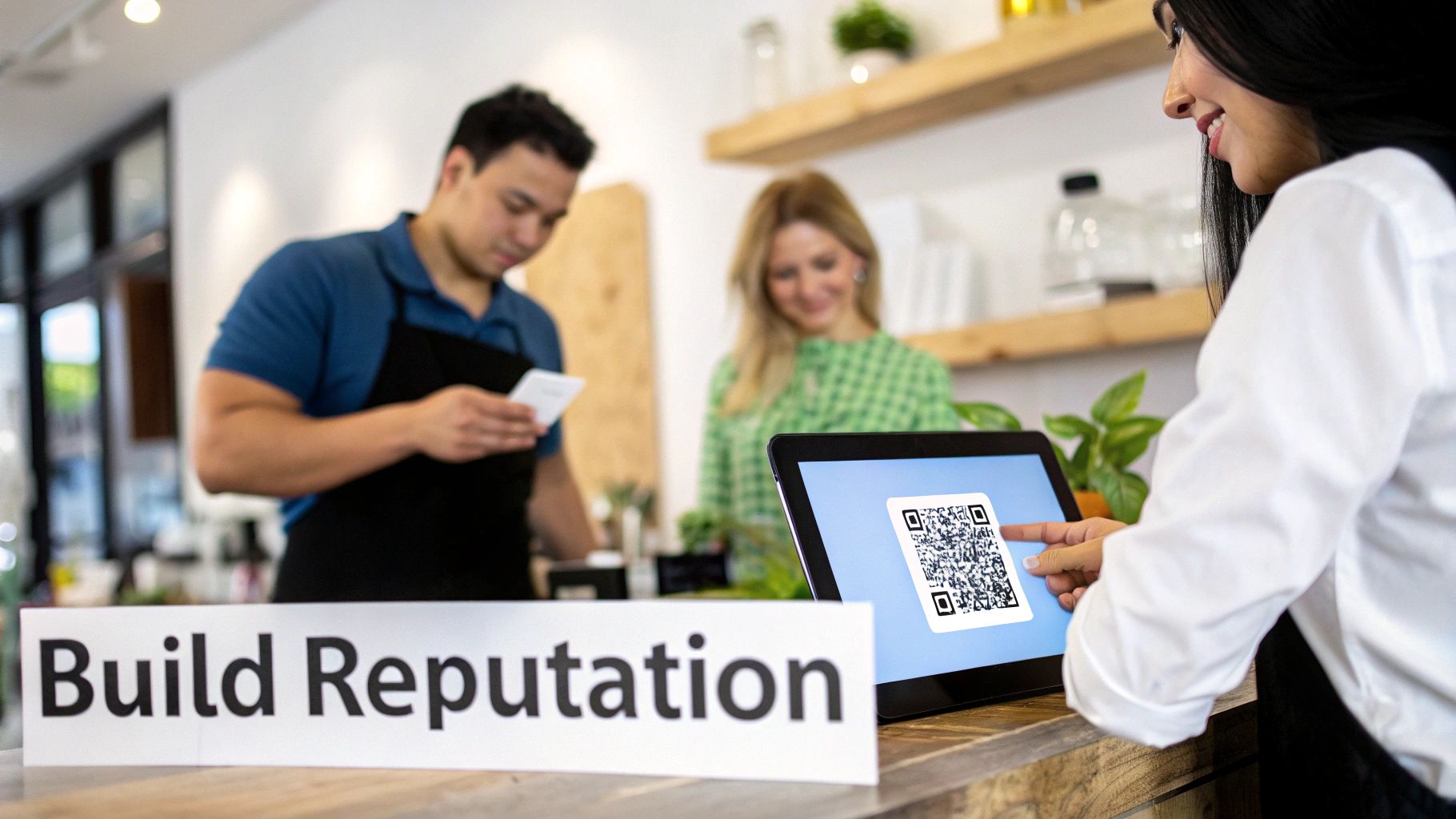
- In-Store QR Codes: Place a QR code at your checkout counter or on receipts that links right to your Google review page. This catches customers at the peak of their positive experience.
- SMS Text Requests: For service-based businesses, a text message follow-up can be a game-changer. It’s direct, personal, and has a much higher open rate than email.
The goal isn't to pressure anyone. It's to remove friction. By making the process simple and timely, you empower your happiest customers to become your most vocal advocates.
Building a resilient reputation means understanding the broader strategies for how to improve your overall online reputation and keeping a close eye on what people are saying. This ensures you're actively shaping your brand's story, not just playing defense.
Master the Art of the Reply
How you respond to reviews—both good and bad—says just as much about your business as the reviews themselves. A thoughtful response strategy shows potential customers you’re engaged, transparent, and truly care.
For positive reviews, skip the generic "thanks." Get specific. Mention something they highlighted in their review to show a real person is reading and appreciating their feedback.
For legitimate negative reviews, your response is everything. Just follow this simple formula:
- Acknowledge their frustration and thank them for sharing their feedback.
- Apologize for their experience. No excuses.
- Briefly mention your commitment to getting things right.
- Offer a direct way to take the conversation offline to resolve the issue.
This approach demonstrates real accountability and can often turn a critic into a loyal customer. Plus, it shows every future reader that you stand behind your service. For more advanced tactics, check out our guide on https://levelfield.io/blog/managing-your-online-reputation.
Knowing When to Call for Backup
Sometimes, trying to manage your reputation on your own becomes too complex or just plain overwhelming. Knowing when to hand the reins to a professional isn't a sign of failure; it's a smart business decision.
It might be time to hire an expert, like our team at LevelField, if you’re facing these scenarios:
- Large-Scale Attacks: If you're hit with dozens or even hundreds of fake reviews in a coordinated attack, the sheer volume is nearly impossible to handle alone.
- Complex Legal Issues: When reviews cross the line into defamation or harassment, you need professionals who understand the legal nuances and can escalate things properly.
- Lack of Time: As a business owner, your time is your most valuable asset. If you're spending hours every week fighting fake reviews, that's time taken away from actually running your business.
Deciding whether to tackle review management yourself or bring in a pro can be tough. This table breaks down common situations to help you make the right call.
DIY vs Professional Review Removal
| Scenario | DIY Approach | When to Hire a Professional |
|---|---|---|
| A few suspicious 1-star reviews | Flag them individually through your GBP dashboard. Document the evidence and wait for Google's decision. | You see this happen consistently month after month. |
| A review contains hateful or illegal content | Immediately flag the review for violating Google's policies and document it thoroughly. | The content is a serious legal threat (defamation, libel) and you need to explore legal options beyond just removal. |
| A sudden flood of 20+ fake reviews | You can try to flag them one by one, but it's time-consuming and Google may miss the pattern. | This is a coordinated attack. Professionals can bundle the reports and escalate them through back-channel support for faster, more effective action. |
| You're too busy running your business | You try to find time on evenings or weekends, but it keeps getting pushed back. | Your time is better spent on revenue-generating activities. An agency can handle this efficiently, saving you time and stress. |
Ultimately, choosing to hire a professional comes down to scale, severity, and your own bandwidth. For isolated incidents, a DIY approach often works fine. But for sustained attacks or complex legal issues, expert help is a sound investment.
Common Questions About Removing Fake Reviews
Getting fake reviews taken down can be a confusing and frustrating process. It’s natural to wonder about the timeline, how you should (or shouldn't) reply, or when it makes sense to get lawyers involved. Let's tackle some of the most common questions I hear from business owners.
Think of this as a quick-reference guide to reinforce the advice we've already covered and give you a bit more clarity.
How Long Does It Take for Google to Remove a Fake Review?
Honestly, the timeline is all over the place. Once you flag a review using Google's official tools, you can generally expect a decision within 3 to 10 business days. Sometimes you get lucky and it's faster; other times, it feels like it's gone into a black hole.
Your best bet for keeping tabs on it is to use the official Review Removal Tool. It at least gives you a status update so you aren't left completely in the dark.
But here's the reality: if your first attempt gets denied and you have to appeal or escalate to Google Business Profile support, the whole ordeal can easily drag on for several weeks. This is where you have to be persistent. Consistent, professional follow-up is the name of the game.
Should I Respond to a Review I Think Is Fake?
It's one of the biggest temptations, but my advice is almost always the same: don't do it. Responding to a fake review can actually backfire by signaling to Google's algorithm that it's a legitimate customer interaction, which can make getting it removed even harder.
Plus, you're just giving the malicious actor the attention they want. Engaging with them rarely makes them back down; more often, it just provokes them into leaving more fake reviews or trying to escalate their attack.
Our Recommendation: Pour 100% of your energy into the removal process. Stay focused on documenting your evidence, filing the report correctly, and following up. Save your public responses for your real customers—the happy ones and those with genuine issues you can solve.
Can I Sue Someone for a Fake Google Review?
The short answer is yes, you can. Legal action is a possibility, especially if the review crosses the line into defamation. A review is considered defamatory if it contains false statements of fact (not just someone's opinion) that you can prove have caused real financial damage to your business.
Taking this route, however, is a massive commitment. It usually starts with a "John Doe" lawsuit to get a court order (a subpoena) forcing Google to unmask the anonymous reviewer.
This isn't a quick or cheap fix. The legal process is incredibly expensive and slow, often taking many months, if not years, to play out. For most small and medium-sized businesses, it’s far more practical to first exhaust every single one of Google's internal reporting and appeal options. If you're seriously considering it, your first call should be to an attorney who specializes in internet law.
Does Removing a Bad Review Really Help My SEO?
It absolutely does, even if the connection isn't immediately obvious. Your overall star rating is a huge signal for local SEO. Google's algorithm looks at it as a measure of quality and trustworthiness, which has a direct impact on how you show up in local search.
Every bogus 1-star review you get taken down is a win for protecting that average rating. A higher score translates directly into a few key advantages:
- Better Local Pack Rankings: A strong rating is crucial for competing for a spot in that valuable Google Local Pack—the map with the top three business listings.
- Higher Click-Through Rate: Let's face it, users are wired to click on businesses with better ratings. This means more qualified traffic to your profile and, ultimately, to your door.
- Stronger Customer Trust: A great rating is powerful social proof. It builds the confidence a potential customer needs to choose you over a competitor with a shakier reputation.
Don't think of removing fake reviews as just a cleanup task. It's essential maintenance for your online presence and your sales funnel. You're protecting the reputation you've worked so hard to build.