


That sinking feeling when you stumble across a Ripoff Report about your business is brutal. It feels personal, like a direct attack on everything you've worked so hard to build. But here’s the tough truth: trying to get a Ripoff Report deleted is like trying to un-ring a bell. It’s almost impossible.
The real solution isn’t about making the report disappear from their website, but making it disappear from your potential customers' view. Think of it less as a deletion and more as a burial, using smart SEO, targeted legal moves, or specialized de-indexing services.
Confronting The Ripoff Report Challenge
Let's be clear: finding your company name on that site is more than just frustrating. It’s a permanent digital stain that can poison customer trust and send potential clients running straight to your competitors. Your first instinct is probably to fight it, to get it taken down immediately. That’s where the Ripoff Report problem gets uniquely complicated.
This isn't like other review sites. Ripoff Report has a deeply entrenched, iron-clad policy against removing content—any content. This isn’t a new thing. Since they launched back in 1998, their notorious 'no removal' policy has permanently locked over 2 million complaint reports online. Even if a report is proven to be completely false or defamatory, it stays. This makes it a minefield for honest businesses. You can get more background on this unyielding policy and its history over at minclaw.com.
Bottom line? Pleading your case with the website administrators is a complete waste of time.
Shifting from Deletion to Strategic Control
Since you can't win a direct fight with the platform, you have to change the battlefield. The goal isn't to get the report scrubbed from their servers; it's to get it scrubbed from the first page of Google. That’s where it counts.
This guide is designed to cut through the false hope and give you a realistic game plan. We’ll walk through the three proven strategies that put you back in the driver's seat and let you control your own online story.
- Proactive SEO Suppression: This is your long-term offensive. The idea is to create so much positive, high-quality content about your business—think blog posts, press releases, social profiles, and positive reviews—that you literally push the negative report down and off of page one of the search results.
- Targeted Legal Action: If the report is clearly defamatory (meaning it contains false statements of fact that harm your reputation), you have a powerful option. A court order can compel search engines like Google to de-index the specific URL, which effectively removes it from search results for good.
- Specialized Professional Services: Sometimes, the fastest route is to bring in the pros. Reputation management experts know the ins and outs of search engine policies and can often get a report de-indexed without a public court battle.
By focusing on these pathways, you can stop reacting and start acting. It’s about taking control, reshaping your digital footprint, and protecting the future of your business.
A Realistic Breakdown of Your Options
When you're staring down a negative Ripoff Report, the first instinct is to panic. But a clear-headed strategy is what you need, not a knee-jerk reaction. Since you can't just call up the site and demand they delete it, your real power lies in controlling who sees it.
There are really only three ways to tackle this problem, and each comes with its own price tag, timeline, and chance of success. The right choice for your business comes down to the specifics of the report, your budget, and how quickly you need the problem to go away. Let's break down the legal route, SEO suppression, and hiring a pro.
The Legal Route: Court Orders and Defamation Claims
Going to court is the nuclear option. It’s the most definitive path, but it's also the most difficult and expensive. This is only on the table if the report contains blatant, provable lies that rise to the legal standard of defamation. A customer's negative opinion or a simple complaint won't cut it. You have to prove the statements are factually false and have directly cost your business money.
The process involves hiring an attorney and suing the person who wrote the report—not Ripoff Report itself. The website is shielded from liability for user-generated content thanks to Section 230 of the Communications Decency Act. If you manage to win the lawsuit, the court will issue an order declaring the report defamatory.
A court order is your golden ticket. It won't make Ripoff Report take the post down, but it gives you the legal firepower to force search engines like Google to de-index the URL. Once it's de-indexed, it's gone from search results. This is a powerful, permanent fix, but be prepared for a long and costly battle.
SEO Suppression: Building a Digital Fortress
If a lawsuit isn't practical, the next best thing is to bury the Ripoff Report with positive content. This long-term strategy, known as SEO suppression, doesn't remove the report. Instead, it pushes it so far down in Google's search results that no potential customer will ever stumble upon it. Think of it as building a digital fortress of positive mentions that outrank the negative one.
This is an ongoing campaign that requires creating and promoting a ton of high-quality content, such as:
- Your company blog and website: Post detailed articles, case studies, and company news.
- Social media profiles: Keep your LinkedIn and X (formerly Twitter) accounts active and professional.
- Third-party mentions: Actively seek out positive press, guest blogging opportunities, and mentions on respected industry sites.
Suppression takes time and consistent effort. It isn't a quick fix, but a steady campaign to seize control of your brand's search results. For a deeper dive into the nuts and bolts, our guide to effective Ripoff Report removal has more detail.
Professional Reputation Services: The Direct Approach
For businesses that need a faster solution without the drama of a public lawsuit, professional reputation services are often the best bet. These firms live and breathe this stuff. They know the platforms and the processes inside and out, and they can get damaging URLs de-indexed from search engines quietly and efficiently.
These experts handle all the behind-the-scenes work—the research, the documentation, and the communication—to file a compliant takedown request on your behalf. It’s all about using their specialized knowledge to navigate the complex policies of search engines.
The flowchart below gives you a bird's-eye view of these three paths so you can start thinking about which one makes the most sense for you.
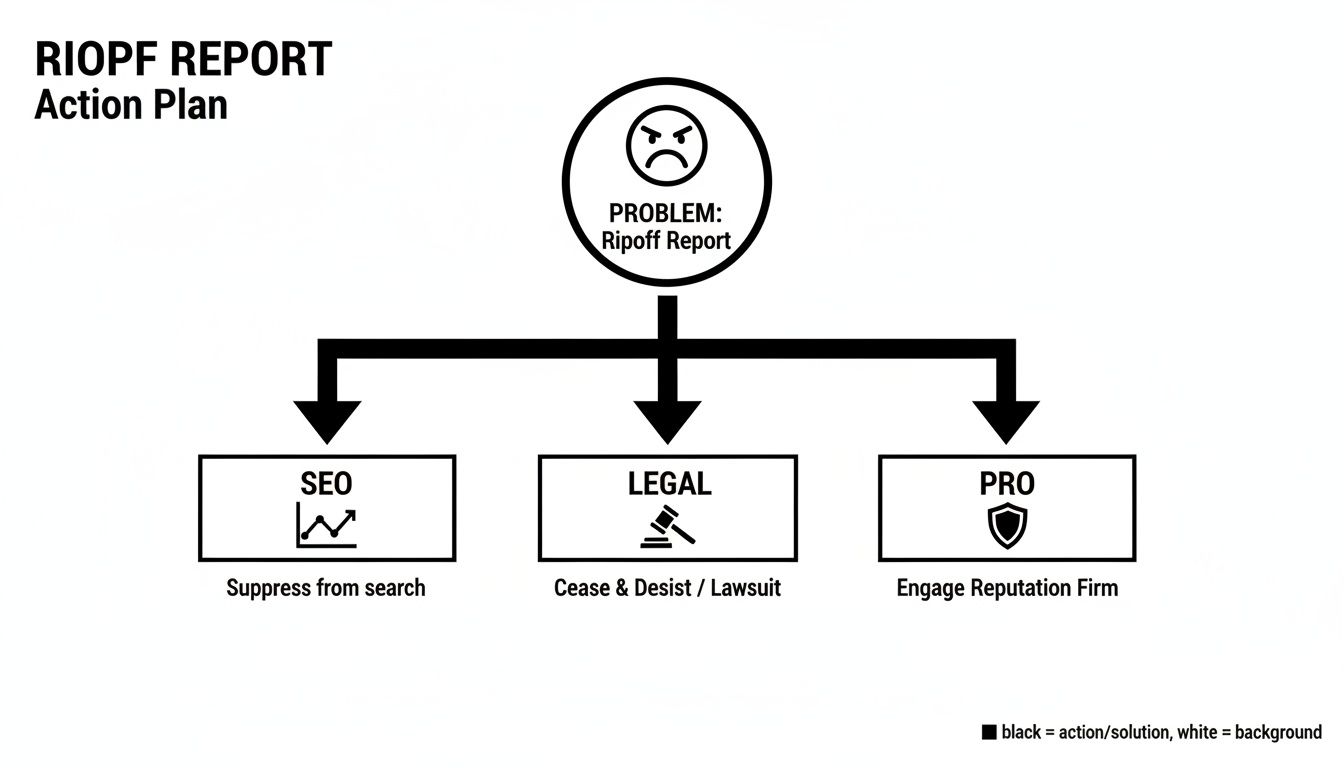
This decision tree shows that while you have options, they each demand different levels of money, time, and personal involvement.
Comparing Ripoff Report Mitigation Strategies
To make the choice even clearer, this table puts the key factors side-by-side.
| Strategy | Estimated Cost | Typical Timeline | Success Factor |
|---|---|---|---|
| Legal Action | $15,000+ | 12-24+ Months | High if you win, but the burden of proof is huge and victory is far from guaranteed. |
| SEO Suppression | $2,000 - $10,000+ | 6-12 Months | Moderate to High, but it's a slow burn that requires ongoing effort and real expertise. |
| Professional Services | Varies (often a one-time fee) | 2-4 Months | Very High with a reputable firm that guarantees its work. It's the fastest and most confidential option. |
As you can see, there’s a clear trade-off between speed, cost, and certainty. Choosing the right path depends on weighing these factors against your specific situation and goals.
Building Your Digital Defense with SEO Suppression
Since you can't force Ripoff Report to take down the post, it's time to change the game. Instead of focusing on deletion, we need to focus on domination. The single most effective, long-term strategy is SEO suppression.
The idea here isn't to make the report disappear—it's to make it irrelevant. We're going to bury it so deep in Google's search results that no one ever stumbles across it.
Think of Google's first page as prime digital real estate. Right now, that Ripoff Report is an ugly billboard on your front lawn. SEO suppression is how we build a series of beautiful, authoritative skyscrapers all around it, pushing that billboard off the block and into the digital wilderness. To get this done, you first need a solid grasp of what Search Engine Optimization (SEO) is, because it's the engine that drives this whole process.

This isn't a one-and-done task. It's a sustained campaign of creating and promoting positive content. You’re building a firewall of search results you control, making it virtually impossible for prospects to find the negative stuff.
Fortify Your Owned Digital Properties
Your own website is ground zero for this fight. It's the one corner of the internet where you write the rules and control the story. First things first: make sure your main company site is perfectly optimized for your brand name and any related search terms.
Your company blog, however, is your secret weapon. A well-maintained blog is a content machine, letting you pump out a steady stream of positive, relevant articles that Google loves to index. Every single post is another asset that can rank for your name and highlight your expertise.
Content that works wonders for building authority includes:
- Detailed Case Studies: If you're a B2B service, nothing speaks louder than showing off client successes backed by real data.
- Patient Success Stories: For medical practices, anonymous stories about positive patient outcomes are incredibly powerful for building trust.
- In-Depth Guides: Create genuinely helpful, comprehensive articles that solve your customers' biggest problems. This positions you as a go-to leader.
- Company News & Milestones: Got a new key hire, a charity partnership, or an industry award? Announce it. This creates positive buzz.
Consistency is everything. A couple of blog posts won't move the needle. You need to get into a regular rhythm of publishing valuable content to gain the momentum and authority that gets Google's attention.
Expand Your Reach with Third-Party Platforms
While your website is the foundation, you can't win this battle alone. You also need to build your presence on other high-authority websites that search engines already trust—think LinkedIn, major news outlets, and key industry directories. Getting positive mentions on these sites is like getting a powerful vote of confidence in Google's eyes.
Your social media profiles are the easiest place to start. A complete, active profile on platforms like LinkedIn and X (formerly Twitter) can often rank on the first page for your brand name. These are digital assets you can directly control and optimize.
Pro Tip: Don't just set up profiles and let them sit there—use them. Actively share your blog content, engage with others in your industry, and join relevant conversations. A living, breathing professional social media presence sends all the right signals to Google.
Beyond social media, look for opportunities to get your name out there in a positive light. This often involves:
- Guest Posting: Write insightful articles for respected blogs in your niche and link back to your site.
- Press Releases: Use a distribution service to send out press releases about newsworthy events, getting your name onto news sites.
- Positive Reviews: Actively encourage happy clients to leave detailed reviews on trusted platforms like your Google Business Profile, Yelp, or Trustpilot.
Executing a Cohesive Suppression Campaign
A successful suppression campaign isn’t about just throwing content at the wall and seeing what sticks. It's a coordinated strike where every piece works together to push down the negative and lift up the positive.
For example, a law firm could publish a detailed case study on its blog. Then, they’d share that case study on LinkedIn and X. After that, they might write a guest post for a legal industry publication that references the case study, earning them a powerful backlink. It's this kind of multi-layered approach that creates a dense web of positive content. For a deeper dive into these tactics, check out our guide on how to remove negative search results from Google.
I'll be honest—this requires patience. It's not a quick fix. It’s a long-term investment in your brand's reputation. It can take 6 to 12 months of consistent work to see real, lasting results. But the payoff is huge: a strong, positive online presence that not only solves today's problem but also builds a digital fortress to protect you from future attacks.
When It’s Time to Take Legal Action for Defamation
Let’s be clear: suing someone over a Ripoff Report is a big gun. You don’t pull it out unless you're facing a clear-cut case of defamation where the financial damage is real and you have the facts to back it up. This isn't about getting even with a disgruntled customer who left a scathing opinion—it’s about fighting provably false statements of fact that are actively harming your business.
One of the first things people ask is, "Can I sue Ripoff Report?" The short answer is no. Thanks to Section 230 of the Communications Decency Act, the site itself is protected from liability for what its users post. Your legal fight isn't with them; it's with the person who wrote the report. The entire goal of a lawsuit is to get a court order that officially declares the post to be false.

That court order is your golden ticket. Ripoff Report still won't take the post down, but that piece of paper gives you the leverage you need to go to Google and other search engines and demand they de-index the URL. Essentially, you make it disappear from public view.
Do You Actually Have a Case for Defamation?
Before you even dream of dialing an attorney, you have to get honest about what was written. There's a huge legal difference between a negative opinion and a defamatory statement.
If a customer writes, "I had a terrible experience with their service," that's an opinion. It's protected speech, and there's nothing you can do about it legally. But if they write, "The company stole $5,000 from me," that’s a statement of fact. It can be proven true or false, and that's where the law can step in.
To win a defamation case, you'll need to prove a few things:
- It’s a False Statement of Fact: This is the most critical part. You need ironclad proof the statement is untrue.
- It Was Published: Posting it on RipoffReport.com easily checks this box.
- It Identifies You: The post has to clearly name you or your business.
- It Caused Real Harm: You have to show the false statement led to tangible financial losses, like canceled contracts or a measurable drop in sales.
This means you need to get your ducks in a row. Start collecting every piece of evidence you can find—contracts, emails, payment records, customer communications—anything that proves the author's claims are false. You'll also need to document the financial fallout.
What the Court Order Process Looks Like
If you and your lawyer decide to move forward, you'll file a lawsuit against the report's author. What if they're anonymous? Your attorney can file what's called a "John Doe" lawsuit and then subpoena Ripoff Report for the poster's IP address and any other identifying information they have.
If you win your case, the judge will issue a court order that explicitly calls out the Ripoff Report content as false and defamatory. Be prepared for a long haul—this isn't a quick or cheap fix. The process can easily take a year or more, with legal fees often running north of $15,000.
This court order is your most powerful tool. It’s the official, legally binding document you need to submit to Google's legal department. With this in hand, you can formally request the de-indexing of the specific Ripoff Report URL.
Taking Your Courtroom Win to Google
Once you have that court order, the final move is to take it to Google. You'll submit it through their formal legal request portal, providing the exact URL of the offending report and a copy of the order.
Google's legal team will review everything to make sure it's legitimate and meets their standards. If it all checks out, they’ll remove the URL from their search index. The report will technically still exist on RipoffReport.com, but for all practical purposes, it will be invisible. No one will find it on Google.
As a potential first step, you might consider having an attorney send a strong cease and desist letter to the author. Sometimes, the threat of legal action is enough to persuade them to retract their statements, saving you a world of time and money. But when that fails, a lawsuit is the most definitive path to making a damaging, false report vanish from public view.
When It’s Time to Call in the Pros: Professional Reputation Services
For most business owners, trying to get a Ripoff Report removed feels like taking on a second full-time job. It's a daunting task, tangled in the technical weeds of SEO and the intimidating maze of legal options. It's easy to feel out of your depth, and that's precisely when a professional reputation management service can be a game-changer.
These specialists aren't just SEO freelancers. They are focused firms armed with deep policy knowledge, proven technical systems, and direct experience dealing with platforms like Google. They know exactly what kind of documentation and submission protocols search engines need to de-index a damaging link—a process that is anything but transparent to the public.

What a Professional Service Actually Does
Bringing in a reputation management firm shifts you from a defensive, reactive posture to a proactive one. Their entire workflow is built to take the burden off your shoulders, freeing you up to run your business while they handle the digital heavy lifting.
So, what does that look like in practice? It's a structured, methodical approach.
- Deep-Dive Analysis: First, they'll tear into the Ripoff Report itself. They'll analyze the specific claims, see how it's ranking in search results, and assess the broader digital footprint of your brand.
- Custom Strategy: With a full picture, they map out the best path forward. This could mean finding a specific search engine policy violation to exploit or deploying another one of their proven methods.
- Airtight Documentation: This part is critical. The team meticulously gathers and organizes every piece of evidence into a compliant package that meets the tough standards of search engine legal teams.
- Expert Submission and Follow-Up: The firm manages every submission and communication, navigating the bureaucratic hoops to make sure your case gets reviewed and resolved.
This isn't just about saving you a headache; it's about getting faster results. While an SEO suppression campaign can drag on for 6-12 months and a lawsuit can last even longer, a professional service can often de-index the report within just 2-4 months.
Experts Thrive in a Changing Digital World
The internet isn’t the lawless frontier it once was. Search engines like Google are getting much better at sniffing out and demoting low-quality, unverified content, which has really cut into the power of sites like Ripoff Report. This ongoing shift makes professional intervention more effective than ever.
A perfect example was Google's "Medic Update." In November 2018, this major algorithm change absolutely hammered Ripoff Report, wiping out a staggering 90% of its organic traffic almost overnight. It was a clear move by Google to weaken user-generated complaint sites that allow defamatory content to run rampant without verification. You can discover more about this update's impact on GuaranteedRemovals.com. By weakening Ripoff Report's overall authority, this change made it much easier for experts to target and de-index individual damaging pages.
When you partner with a service that lives and breathes these algorithm changes, you're not just hiring someone to file paperwork. You're getting their up-to-the-minute knowledge of a complex system that is always in motion.
The Real Advantages of Getting Help
Working with experts offers clear benefits that go way beyond just saving time. It’s about securing a better, quicker, and more private outcome. The main advantages are a high success rate, complete confidentiality, and freedom from the crushing stress of a reputation crisis.
For many businesses, the predictable, one-time fee for a professional service is a smarter investment than the endless costs and uncertainty of a long SEO campaign or a messy public lawsuit. When you need to remove a Ripoff Report with certainty and speed, bringing in a specialist is almost always the right call.
Common Questions About Ripoff Report Removal
Discovering a negative report about your business online brings on a wave of questions—and a lot of frustration. It's natural to feel angry and uncertain about what to do next. My goal here is to cut through the noise and give you straight answers to the questions I hear most often from business owners in this exact situation.
Getting a handle on these key points is the first step in moving from panic mode to taking back control. It's about knowing the lay of the land before you decide how to fight back.
Can I Get a Ripoff Report Taken Down Myself?
The short answer is no, you can't just delete a report from RipoffReport.com. Their company policy is built around never removing reports, so reaching out to them directly is almost always a waste of time. But here's the thing: removing it from their site isn't the real goal. What truly matters is getting it removed from Google search results, because that's where your customers will see it.
The main DIY method for this is SEO suppression. This strategy is all about creating a ton of positive, high-quality content that outranks the negative report, pushing it so far down in the search results that it becomes practically invisible. It works, but it’s a slow burn that requires a lot of effort and a decent grasp of how SEO works.
Your only other option for permanent removal from search is to get a court order for defamation. This is a long, complicated, and expensive legal process. Because of these hurdles, many businesses find that working with a professional service is the most reliable and efficient way to get the report de-indexed.
How Much Does It Cost to Handle a Ripoff Report?
The cost to remove a ripoff report from the public eye isn't a one-size-fits-all number; it really depends on the path you take. It's important to understand the potential costs of each approach before you commit.
Here’s a realistic look at the numbers:
- A comprehensive SEO suppression campaign will likely run you somewhere between $2,000 to $10,000+ over several months. The final price tag depends heavily on how competitive your business name is in search results.
- A defamation lawsuit is easily the most expensive option. You can expect legal fees to climb past $15,000, and even then, there's no guarantee you'll win.
- Professional de-indexing services usually work on a predictable, one-time fee. In many cases, this ends up being more cost-effective than a drawn-out legal battle or a long, uncertain SEO campaign.
Should I Post a Rebuttal on The Ripoff Report Website?
I strongly advise against it. Do not respond directly on their platform. I know the gut instinct is to jump in and defend your business, but engaging with the report on their site almost always makes things worse.
Here’s why it’s a bad idea: posting a rebuttal adds new content to the page. To Google, this fresh activity is a signal that the page is relevant and active, which can actually boost its ranking. On top of that, an emotional or hastily written response can just give the original poster more ammunition and escalate the conflict.
If you feel you absolutely must make a public statement, do it on your own turf. Post it on your company's website or blog. This way, you control the message, the narrative, and the comments, allowing you to tell your side of the story professionally without accidentally helping the negative report rank higher.
How Long Does It Take to See Results?
The timeline for getting a Ripoff Report out of sight depends entirely on the method you choose. You'll need some patience regardless, but some routes are definitely quicker than others.
Let's break down the typical timeframes:
- SEO Suppression is the long game. You're looking at 6 to 12 months of consistent, hard work to successfully bury the report off the first page of Google.
- Legal Action can be a marathon. The legal process to secure a court order can take a year or even longer. The upside is that once you have that order in hand, getting Google to de-index the link is relatively fast—usually just a few weeks.
- Specialized Professional Services offer the fastest path to resolution. These firms have established processes and a deep understanding of platform policies, which allows them to get reports de-indexed, often within a 2-4 month timeframe.