

That gut-punch feeling when you find a fake one-star review, a deceptive ad using your brand name, or someone flat-out impersonating your business online is unmistakable. It feels personal. Your first instinct might be to fire back a public reply or frantically report it. My advice? Take a breath. The most effective way to get this content removed is to resist that urge and start building a rock-solid case.
Your goal isn't just to report the content; it's to make it impossible for a platform moderator to ignore.
Your Immediate Action Plan for Negative Content

The moves you make in the first few minutes are critical. Rushing in can backfire spectacularly. Engaging a fake reviewer, for instance, can actually give their post more visibility in some algorithms. Making a public statement can draw a flood of unwanted attention to the very thing you want to disappear.
So, instead of reacting, you're going to pivot to a calm, strategic evidence-gathering mission. This shift in mindset turns a high-stress moment into a clear, manageable task. Think of yourself as an investigator preparing a file. Your objective is to hand a platform moderator—who is probably sifting through hundreds of reports today—an open-and-shut case. A methodical approach always wins out over an emotional one.
Document Everything—Right Now
Before you click another button, capture the evidence. The person who posted it could delete or edit the content at any moment, and your proof would vanish with it. Don't just save a bookmark; you need to take detailed, dated screenshots.
Here’s your evidence checklist:
- Full-page screenshots: Capture the entire browser window. Make sure the URL, date, and time are clearly visible. Context is king.
- The content itself: Zoom in and get a crystal-clear shot of the fake review, misleading ad, or impersonation profile.
- The poster's profile: Take a screenshot of the account that posted the content. Pay attention to the username, how long they've been on the platform, and any other activity.
- Direct URLs: Copy and paste the exact web addresses of the offending content and the user's profile into a secure document.
This isn't just busywork; this documentation is the foundation of your entire removal request. Without it, you have an opinion. With it, you have a case.
I've seen countless removal requests fail for one simple reason: someone only screenshots the nasty comment itself. Platforms need the surrounding context—the user's profile, the full URL—to do their job and verify the violation.
Assess and Classify the Violation
With your evidence secured, the next step is to pinpoint exactly why the content breaks the rules. Platforms don't take down content just because it's mean or you disagree with it. They remove it when it violates a specific policy.
Take a few minutes to read the platform’s terms of service or community guidelines. Now, match the content to a specific rule. Is it harassment? Defamation? Does it violate a copyright or trademark?
For example, a fake review on Google Business Profile from someone who was clearly never a customer falls under their "Spam and fake content" or "Conflict of interest" policies. A counterfeit product listing on Amazon is a textbook violation of intellectual property rights.
Identifying the correct violation is a game-changer. It tells you which reporting form to use and what kind of proof to submit. This simple act of classification shows the platform you've done your homework and are lodging a legitimate, policy-based complaint. It’s your first and most powerful move toward taking back control.
Building a Watertight Case to Get Negative Content Removed
Think of it this way: a removal request without solid proof is just another email in a moderator's crowded inbox. If you want to get that fake review or impersonation account taken down, you have to stop being a victim and start being a detective. Your mission is to build a case file so clear and convincing that it's simply easier for a platform to take action than to ignore you.
The goal is to leave nothing to interpretation. Don't make a busy content moderator dig for the violation or try to guess why you're upset. You need to hand them a perfectly packaged case that links the harmful content directly to a specific rule they enforce, all backed up by undeniable proof.
The Art of Collecting Evidence
Every successful takedown starts with meticulous documentation. Each piece of evidence you gather tells another part of the story, slowly closing any loopholes of doubt. I always tell clients to treat this like they're preparing exhibits for a court case—every single item needs to be clean, clear, and serve a distinct purpose.
Before you even think about hitting "submit," make sure you have these essentials nailed down:
- The Exact URLs: This is non-negotiable. You need the direct, specific link to the negative content itself—the review, the post, the ad—and a separate link to the profile of the person who published it. Saying "it's on Yelp" is a surefire way to get your request ignored.
- Full-Page, Unedited Screenshots: This is a pro move that instantly adds credibility. Capture the entire browser window, making sure the URL, date, and time are clearly visible. A cropped screenshot can look doctored, but a full-page capture shows the complete context.
- Key Profile Details: Document the poster's username, any visible account creation date, and a quick scan of their other public activity. A brand-new profile with no history that posted a scathing review just hours after being created? That’s a massive red flag for a fake account, and you want the moderator to see it.
This systematic approach shifts the tone from an emotional complaint to a professional, fact-based request. It signals to the review team that you're serious and have already done most of their work for them.
Highlighting the Proof for Maximum Impact
Once you have your raw evidence, it's time to make the moderator's job as easy as possible. You need to guide their eyes directly to the violation, and annotation is the perfect tool for that. Using a basic image editor, you can circle, highlight, or add short text boxes to your screenshots to point out exactly what's wrong.
For example, let's say a fake Google review clearly violates the "Conflict of Interest" policy because it was left by a disgruntled former employee. You'd highlight their name on the review, then provide a second, annotated screenshot of their public LinkedIn profile showing their employment history with your company. Boom. You've just connected the dots for the moderator in under five seconds.
A well-annotated screenshot is worth a thousand words of explanation. You're not just telling the moderator there's a problem; you're showing them exactly where it is and why it breaks their rules.
When you're up against more serious issues like defamation, the bar for proof gets higher. You have to clearly show that a statement is a false assertion of fact, not just someone's angry opinion. Taking the time to understand how to prove defamation can be the difference between a successful removal and a frustrating rejection.
Tailoring Your Evidence to the Violation
Not all negative content is created equal, and your evidence can't be one-size-fits-all. You have to tailor your proof to the specific rule you're claiming has been broken.
I've found it's helpful to have a mental checklist for what you'll need for different situations. Here’s a quick reference guide to get you started.
Evidence Checklist for Common Violations
This table breaks down the essential evidence you'll need for the most common types of takedown requests.
| Violation Type | Required Evidence | Pro Tip |
|---|---|---|
| Fake Review | Proof the person was never a customer (e.g., "No record of this name or email in our CRM"). | Include a screenshot of your CRM search results showing "0 results found." This provides visual confirmation. |
| Impersonation | The URL of the fake profile and the URL of your genuine, official account. | Provide a screenshot of your business registration or a government-issued ID to instantly verify your identity. |
| Trademark Abuse | Your official trademark registration number and a screenshot of the ad or listing using your mark. | Use a red box to highlight exactly where your trademarked name or logo is being used without permission. |
By customizing your evidence package, you're speaking the language of platform moderators and directly addressing the criteria they use to make decisions. It’s a focused approach that dramatically boosts your odds of success, helping you turn a major headache into a solved problem.
Navigating Specific Platform Takedown Procedures
If you want to get negative content removed, you have to play by the platform's rules. That’s the long and short of it. Every major player—Google, Meta, Yelp, you name it—has its own ecosystem of policies, reporting forms, and internal review processes. Trying to apply a one-size-fits-all approach is a recipe for getting your request ignored.
Think of each platform as its own country with a unique language and set of laws. To succeed, you have to speak their language. This means citing the exact policy violation they care about and using the specific channels they’ve set up for it. Generic complaints and guesswork just won’t cut it.
No matter where you're fighting this battle, the core strategy for building a solid takedown case remains the same.
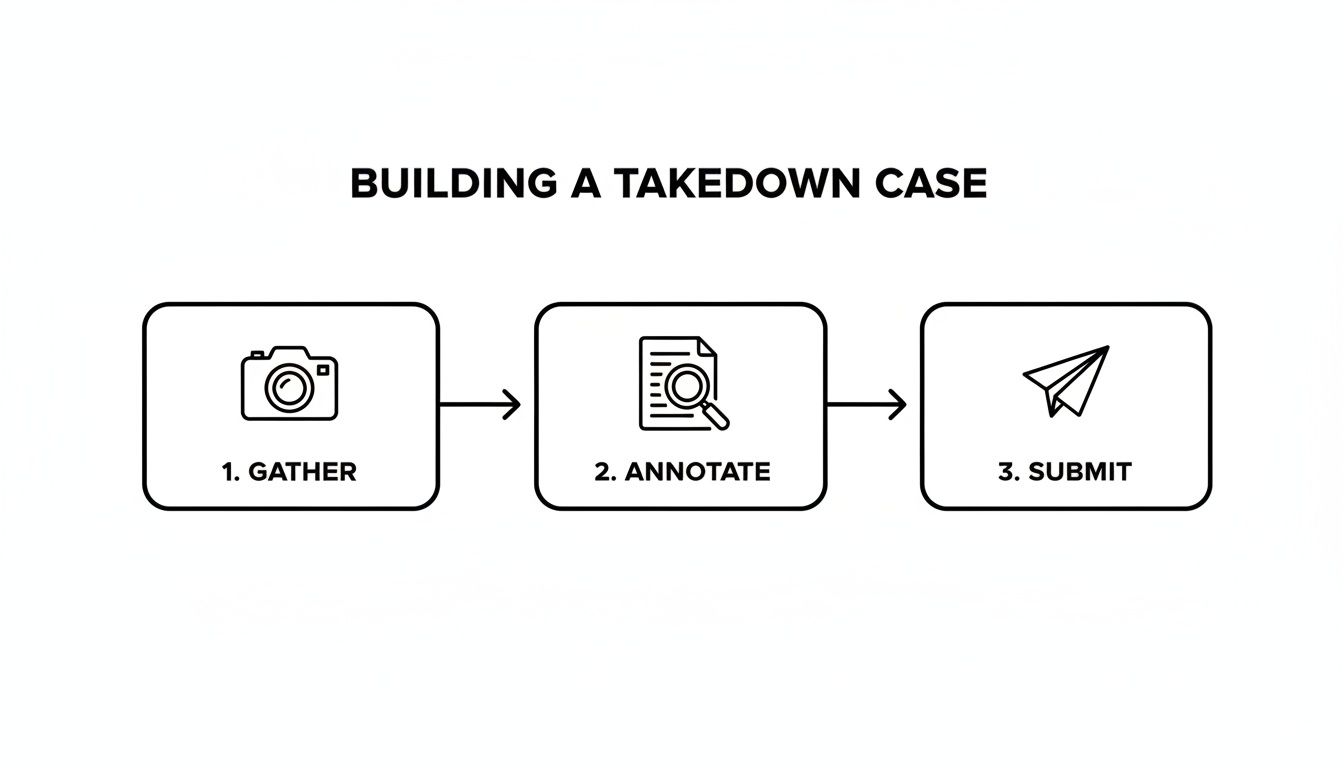
This simple "Gather, Annotate, Submit" process is the foundation of any successful negative content removal strategy. It’s how you build a clear, evidence-based claim that a human moderator can actually act on.
Mastering Google’s Reporting Tools
For most businesses, Google is the main event. It’s where your reputation is often won or lost, hosting everything from crucial business reviews to the search results that define you. Their system is massive, but the good news is they provide a central hub to report problems across their different products.
The first step is figuring out where the negative content lives. Is it a fake 1-star review on your Google Business Profile? A defamatory blog post that’s ranking high in search results? A deceptive ad? Each of these problems has a completely different reporting path. You'll flag a fake review directly from your Business Profile dashboard, but for a harmful search result, you’ll need to use a specific legal removal request form.
Getting this right is half the battle. Submitting your complaint through the wrong channel is like sending it to the wrong government department—it’ll likely get lost. Since each Google product has its own policy team, you need to get familiar with the rules for the specific platform where the content is hosted. You can get a much deeper look by checking out our guide on how to remove content from Google.
Expert Tip: A common mistake I see is people using the generic "report a problem" link for a very specific violation. Always dig a little deeper. Find the dedicated form for your exact issue, whether it's impersonation, a copyright claim, or straight-up spam. It makes a huge difference.
The Social Media Maze: Meta and LinkedIn
Social media platforms like Meta (Facebook and Instagram) and LinkedIn are swimming in user-generated content, which makes their moderation job incredibly difficult. Their processes are built for volume, designed to handle millions of reports a day. This means your takedown request has to be crystal clear and tied directly to a specific policy violation if you want it to get noticed.
With Meta, the reporting tools are usually located right on the offending post, comment, or profile itself. When you file a report, they'll ask you to categorize the issue. The main ones are:
- Harassment or Bullying: For when the attacks are personal and targeted.
- Hate Speech: For content that attacks protected groups.
- Intellectual Property: For clear-cut trademark or copyright infringement.
LinkedIn, being a professional network, is particularly strict about anything that could damage someone's career. A false claim about your credentials or shady business practices is a serious breach of their Professional Community Policies. For both Meta and LinkedIn, your report absolutely must include screenshots and direct URLs of the content and the user's profile.
Tackling Reviews on Yelp and Amazon
For any business selling a product or service, platforms like Yelp and Amazon are ground zero. A single fake review can seriously damage your star rating and sink your revenue. Fortunately, both platforms have explicit policies against reviews that aren't based on a real customer experience.
On Yelp, you can report a review for violating their Content Guidelines. From my experience, the most successful reports are those that can prove a clear conflict of interest—like a review from a direct competitor or a disgruntled former employee. Your job is to hand Yelp's moderators the evidence on a silver platter, making the violation impossible to ignore.
Amazon’s process is similar but focuses more on product authenticity and seller feedback manipulation. If you're an Amazon seller getting hammered by fake reviews meant to sabotage your product, you can report them through Seller Central. Be ready to show patterns of abuse, like a sudden flood of negative reviews from brand-new, unverified accounts.
The sheer volume of content these platforms deal with is hard to wrap your head around. In just the second quarter of 2023, Facebook took action on 18 million pieces of hate speech. In the last half of 2022, LinkedIn removed over 204,000 pieces of harassment-related content. These numbers show just how easy it is for a legitimate complaint from a business to get lost in the noise. It’s a huge hurdle, and it’s often why bringing in a specialist can be the difference-maker.
Ultimately, successful removal comes down to precision. You have to become a temporary expert on that platform's rules, find the right door to knock on, and present your case in a way that perfectly aligns with their policies. It's a methodical process, but it's what turns a frustrating problem into a solvable one.
What to Do When Your Takedown Request Is Ignored
It’s one of the most frustrating feelings: you’ve meticulously built your case, submitted a takedown request, and the response is… crickets. Or worse, a canned, automated rejection. This is where most people get discouraged and give up, but you shouldn't. Hitting this wall doesn't mean you've lost; it just means it's time to shift gears.
When an initial request fails, it’s usually because it was flagged by an algorithm or got a quick glance from a tier-one reviewer who missed the nuance. The next step is to push it up the chain to a real person who can apply some common sense. This is all about smart persistence.
Launching an Effective Appeal
Almost every major platform has an appeals process, but just resubmitting the same information is a waste of time. Your appeal is your chance to add more context, sharpen your argument, and spell out exactly which rule was broken.
Think of it this way: your first request was the basic story. The appeal is the director's cut with all the crucial commentary.
- Reference Your Original Case: Always lead with your original case or report number. This immediately gives the reviewer context and shows you’re following the correct procedure.
- Bring in New Evidence: Have you found more proof that the reviewer was never a customer? Can you now show a clear pattern of harassment from the same user across different sites? This is the time to add it.
- Pinpoint the Policy Violation: Don't be vague. State it clearly: "This content directly violates Section 3.2 of your Terms of Service regarding Conflict of Interest." You want to make it impossible for them to misinterpret your claim.
This approach turns a simple complaint into a compelling, evidence-backed argument that a human reviewer can quickly grasp and act on.
Escalating Beyond the Platform
Sometimes, even a perfect appeal goes nowhere. The sheer volume of content these platforms deal with is staggering. A 2025 Statista report showed that Facebook took down 1.2 million pieces of hate speech in a single quarter—and that was a decrease from the 3 million removed in the prior quarter. With moderation teams stretched that thin, it's easy for legitimate complaints from businesses to get lost in the noise.
When the platform's own system fails you, it’s time to look outside.
When you’ve exhausted a platform’s appeals process, the problem isn’t always your claim. Often, it’s just a matter of getting the right information in front of the right person. That's where a little external pressure can work wonders.
A formal cease and desist letter is often the most effective next move. Sent by an attorney, this legal document puts the person posting the content on notice that they are causing tangible harm and must stop. It immediately signals that you're serious and are ready to take legal action.
For many offenders, the simple threat of legal trouble is enough to make them back down and remove the content themselves. It transforms an online spat into a problem with very real-world consequences.
Knowing When to Bring in Professionals
So, you've appealed, sent a cease and desist, and you're still stuck. At this point, you’re probably dealing with something that requires a specialist. This is especially true if you're facing:
- Coordinated Smear Campaigns: One person using multiple fake accounts to create the illusion of widespread dissatisfaction.
- Complex Legal Issues: The content crosses the line into defamation, libel, or serious trademark infringement.
- Persistent Harassment: Someone who just keeps creating new accounts to get around your blocks.
In these situations, your time is far more valuable running your business than getting dragged into a draining, endless fight. A professional service like LevelField can step in and take over. They have deep institutional knowledge of platform policies and direct escalation paths that aren't available to the public. They turn a frustrating battle into a managed process, dramatically improving your chances of getting the result you need.
Proactive Strategies to Protect Your Online Reputation

Reacting to negative content is one thing, but the best way to handle a fire is to prevent it in the first place. I always tell my clients that true reputation management isn’t about just putting out fires. It’s about building a brand so strong and resilient that a single fake review or negative comment barely even registers.
This means shifting your mindset from reactive damage control to proactive brand building. Think of it as creating a digital moat around your business. You do this by keeping a close watch on what’s being said about you online and, at the same time, building up so much positive social proof that it insulates you from random attacks. It’s how you take back control.
Setting Up Your Digital Early Warning System
You can’t fix a problem you don’t know exists. The very first thing you need to do is set up a system that tells you the second your brand gets mentioned anywhere online. This gives you a critical head start to tackle issues before they spin out of control.
A few basic tools can create a surprisingly powerful listening post:
- Google Alerts: It’s free, simple, and non-negotiable. Set up alerts for your company name, your own name, key product names, and even common misspellings. You'll get an email as soon as Google finds something new.
- Social Media Monitoring: Pay attention to your platform notifications. You can also use dedicated tools to track tags and relevant hashtags across different sites. You need to know what people are saying, right now.
This isn’t about ego-surfing. It’s about business intelligence. Finding a nasty blog post on the day it’s published lets you respond or start the negative content removal process before it climbs to page one of Google and becomes a much bigger headache.
Building a Buffer of Positive Social Proof
Monitoring is your defense, but your offense is building a deep well of positive content. It’s simple math. If you have hundreds of glowing 4- and 5-star reviews, one fake 1-star review is just a drop in the bucket. But if you only have three reviews total? That same fake review can be absolutely devastating.
The most powerful thing you can do is to consistently encourage your actual, happy customers to leave feedback. This builds a steady stream of authentic, positive content that naturally suppresses any negativity and paints an accurate picture of your business.
You don't need a complex system. A simple follow-up email after a purchase or service with a direct, friendly request for a review on a specific platform can dramatically increase your positive feedback.
Of course, sometimes bigger issues pop up. Having a solid plan is crucial, which is where a modern guide to crisis public relations management becomes an invaluable playbook.
At the end of the day, a proactive reputation strategy is an investment in your brand’s future. When you combine vigilant monitoring with a real effort to generate positive press, you’re not just waiting for the next attack—you’re building a fortress that can easily withstand it.
When to Hire a Professional for Content Removal
Tackling one fake review on your own? Totally manageable. But what happens when it's not just one? When you're up against a full-blown assault, a tricky legal situation, or just don't have the bandwidth to handle a growing crisis, it's time to bring in the pros.
Knowing when to pass the torch is a crucial business decision. Trying to fight a multi-front battle by yourself can drain dozens of hours with no real guarantee you'll win. Your time is far better spent actually running your business, not getting a crash course in the ever-changing policies of a dozen different platforms. A professional service isn’t just about getting your time back; it's about bringing in specialized expertise to get the job done right.
Red Flags That Signal You Need Help
Some situations are just too much for a DIY approach. If any of these sound familiar, it's a strong sign you need professional backup for your negative content removal efforts.
- Coordinated Smear Campaigns: One bad comment is a nuisance. A sudden flood of them from brand-new, empty profiles is a calculated attack.
- Complex Legal Infringements: The content feels like defamation, misuses your trademark, or steals your copyrighted material. These issues need a careful, legally-savvy strategy.
- Persistent Harassment: You block one account, and the person just pops up with another one. This isn't a one-off complaint; it's targeted harassment.
- Platform Refusals: You’ve sent in legitimate, well-documented takedown requests, but the platform's moderators keep shutting you down or ignoring you completely.
When that negative content crosses the line into legally actionable territory, like defamation, the game changes. For a deeper dive into that, this guide to managing defamation claims in the business world provides some essential background.
A specialized service like LevelField lives and breathes this stuff. They know the platform policies inside and out and often have access to back-end escalation channels you can't get to. They turn a frustrating, uphill battle into a managed, strategic process.
Ultimately, hiring an expert is an investment in protecting your most valuable asset: your reputation. It’s about recognizing when the stakes are too high to go it alone and bringing in a dedicated team to get things back on track.
Answering Your Questions About Content Removal
When you're trying to get negative content taken down, you're bound to have questions. It's a confusing process, and a lot of business owners I've worked with have run into the same roadblocks. Let's clear up some of the most common points of confusion.
How Long Does Content Removal Usually Take?
This is the million-dollar question, and the honest answer is: it depends. I’ve seen straightforward violations on social media get taken down in 48 hours. But I’ve also seen stubborn, defamatory Google reviews take several weeks, sometimes months, to resolve after multiple appeals.
The key is to understand it’s rarely a one-and-done situation. You'll likely need to follow up, provide more evidence, and be persistent. Don't get discouraged if you don't see results overnight.
Can I Legally Force a Platform to Remove Content?
For the most part, you can't. In the U.S., platforms are protected by Section 230 of the Communications Decency Act, which means they generally aren't liable for what their users post. You can't sue Google just because someone posted a fake review about your business.
What you can do is take legal action directly against the person who posted the harmful content. If you get a court order declaring the content defamatory, platforms will almost always comply and remove it. It's a powerful route, but it's also the most time-consuming and expensive.
A lot of people think platforms have to take down anything you report as false. That's just not true. Their only obligation is to act on content that breaks their specific rules or is subject to a valid court order.
What Is the Difference Between Defamation and a Negative Opinion?
Getting this right is absolutely critical for any negative content removal effort. The line between a bad opinion and a defamatory statement can make or break your case.
An opinion is subjective and protected as free speech. "I didn't like their pizza, it was too greasy," is a classic example. It's just someone's personal take.
Defamation, however, involves a false statement of fact that damages a reputation. For example, "The restaurant uses expired ingredients and gave me food poisoning." This is a specific, factual claim. If you can prove it's false, you've got a case for defamation. Your entire removal strategy often hinges on showing that a statement isn't just an opinion, but a lie presented as fact.