


Think of online business reputation management as the art of shaping how people see your brand online. It’s not just about putting out fires when bad reviews pop up; it's a constant, thoughtful effort to build a positive image that people trust, which ultimately helps your business grow.
Your Digital Storefront and Why Reputation Matters
Picture your online presence as your main storefront. Before anyone even thinks about buying from you, they’re going to peek through that digital window. Every review, social media comment, and search result is part of that first impression.
This guide isn't about scrambling in crisis mode. Instead, we'll look at online business reputation management (ORM) as a way to proactively cultivate trust and build a brand that can weather any storm. It's a bit like tending a garden—you have to consistently pull the weeds (negative content), plant seeds (positive feedback), and nurture growth (real conversations with your customers).
The Real-World Impact of Your Digital Footprint
Let's be clear: a solid online reputation isn't just a vanity metric. It’s a core business asset that has a direct, measurable impact on your bottom line.
- Customer Decisions: It's no secret that over 90% of consumers read online reviews before they pull out their wallets. Just a couple of bad experiences can send a potential customer straight to your competitor.
- Revenue Growth: There’s a direct link between higher star ratings and more revenue. Investing in your digital image is a direct investment in your company's financial health.
- Talent Acquisition: It’s not just customers who are looking you up. The best job candidates are checking out your company’s reputation online before they even think about applying.
Your online reputation is the sum of every digital interaction and piece of content tied to your brand. It’s a living, breathing asset that needs constant attention to protect and grow.
Preparing for Modern Digital Threats
Unfortunately, the internet has its share of pitfalls that can quickly damage a reputation you've spent years building. For a deeper look at controlling your brand's story, check out these effective strategies for managing online reputation.
From fake reviews and impersonation scams to outright false advertising, you have to be ready for anything. The many benefits of online reputation management go far beyond just monitoring reviews—they create a protective shield around your brand. This guide will give you the practical framework you need to meet these challenges head-on.
Understanding the Digital Threats to Your Brand
To defend your brand, you have to know what you're up against. Think of your online reputation management strategy as your game plan—and it all starts with identifying the opposition and their tactics. These aren't just random bits of bad luck; they're often deliberate attacks designed to chip away at the credibility you've worked so hard to build.
The internet is full of opportunity, but it's also got its dark alleys. It’s like a vibrant city market; most people are there to have a good time, but you still have to watch out for the pickpockets and scammers. Getting a handle on their methods is the first real step to protecting what's yours.
The threats you'll face can range from outright sabotage to more subtle attempts to water down your brand's value. Spotting them early is the key to shifting from a defensive, "put-out-the-fire" mode to a proactive, strategic one. Let's break down the most common digital threats you're likely to encounter.
To give you a clearer picture, here's a quick rundown of the most common threats and where they tend to pop up.
Common Digital Threats and Their Business Impact
| Threat Type | Primary Platform | Potential Business Impact |
|---|---|---|
| Malicious Negative Reviews | Google, Yelp, Trustpilot, App Stores | Lowered search rankings, lost sales, damaged customer trust, decreased star ratings. |
| Social Media Impersonation | Facebook, Instagram, X (Twitter), LinkedIn | Customer scams, brand confusion, PR crises, misinformation spread, loss of followers. |
| False Advertising | Google Ads, Social Media Ads | Brand dilution, wasted ad spend, customer confusion, legal trademark issues, lost web traffic. |
| Counterfeit Listings | Amazon, eBay, Alibaba, Etsy | Lost revenue, brand erosion, negative reviews from faulty products, customer safety risks. |
As you can see, each threat carries its own unique sting, but they all lead to the same outcome: a damaged reputation and a hit to your bottom line.
The Problem of Malicious Negative Reviews
Let's be clear: not all negative feedback is a threat. Honest customer complaints are gold—they show you where you need to improve. Malicious reviews, on the other hand, are a different beast entirely. They are completely fabricated with one goal in mind: to do harm.
These attacks often come from shady competitors, disgruntled ex-employees, or even extortionists. The playbook is simple: flood your profiles with one-star ratings to sink your overall score. This can make you practically invisible to new customers who filter their searches by rating. It's not just a vanity metric; research shows that a single negative review can turn away as many as 30 potential customers. The financial hit is immediate.
The sheer scale of this problem is staggering. The market for online reputation management software is set to explode from $5.2 billion in 2024 to $14.02 billion by 2031. That's a huge jump, and it tells you everything you need to know about how seriously businesses are taking these threats. You can discover more insights into the growing need for reputation tools and why this investment is becoming non-negotiable.
The Rise of Social Media Impersonation
This one is particularly nasty. Impersonation is when someone sets up a fake social media profile that looks exactly like your official brand account—same logo, same name, the works. From there, they start interacting with your customers, spreading false information, or running outright scams under your name.
The motive is usually financial fraud or just causing chaos. An impersonator might launch a phishing scam by offering a fake "special discount" to steal your customers' credit card details. Or they could post offensive content, creating a PR nightmare that's incredibly difficult to shut down because you don't even control the account.
The Damage from False Advertising
Another sneaky tactic is when other people run false or misleading ads using your brand name and trademarks. This plays out in a few common ways:
- Rogue Affiliates: An affiliate partner gets a little too enthusiastic and makes wild claims about your product to boost their commissions, trashing your credibility in the process.
- Competitor Hijacking: A competitor bids on your branded keywords in Google Ads and runs ads that make false comparisons, confusing customers and stealing your traffic.
- Outright Scams: Scammers create ads for products that don't even exist, but they slap your branding all over them. When customers get ripped off, they blame you.
Every one of these tactics dilutes your brand message and breaks the trust you've painstakingly built with your audience.
The Threat of Counterfeit Listings
If you sell products online, counterfeit listings are a constant headache. You'll find them on major marketplaces like Amazon, eBay, and Etsy, where sellers list knockoff versions of your products, usually for a lower price.
This hits you from two directions: it directly eats into your revenue while simultaneously destroying customer trust. A customer who buys a fake thinking it's real gets a shoddy product and then, understandably, leaves a scathing review on your product page about how it fell apart. You not only lose a sale, but you're also left with a public complaint that can be almost impossible to explain away.
Building Your Proactive Reputation Management Framework
Great online reputation management isn't about frantically putting out fires. It’s about building a fortress before the battle ever begins. A proactive framework gives you control of the narrative, builds a resilient brand, and turns your reputation into one of your most powerful assets.
Think of it like preventative maintenance for your business. You regularly check the engine, change the oil, and inspect the tires to avoid a catastrophic breakdown on the highway. This is the same idea, just for your brand's digital health.
This practical approach stands on four essential pillars: Monitor, Respond, Build, and Prevent. Each one supports the others, creating a complete system that both protects and elevates your digital presence. When you put this framework in place, you shift from a defensive crouch to a position of command, ready to handle whatever comes your way.
The infographic below shows the most common digital threats this framework is designed to stop in their tracks.
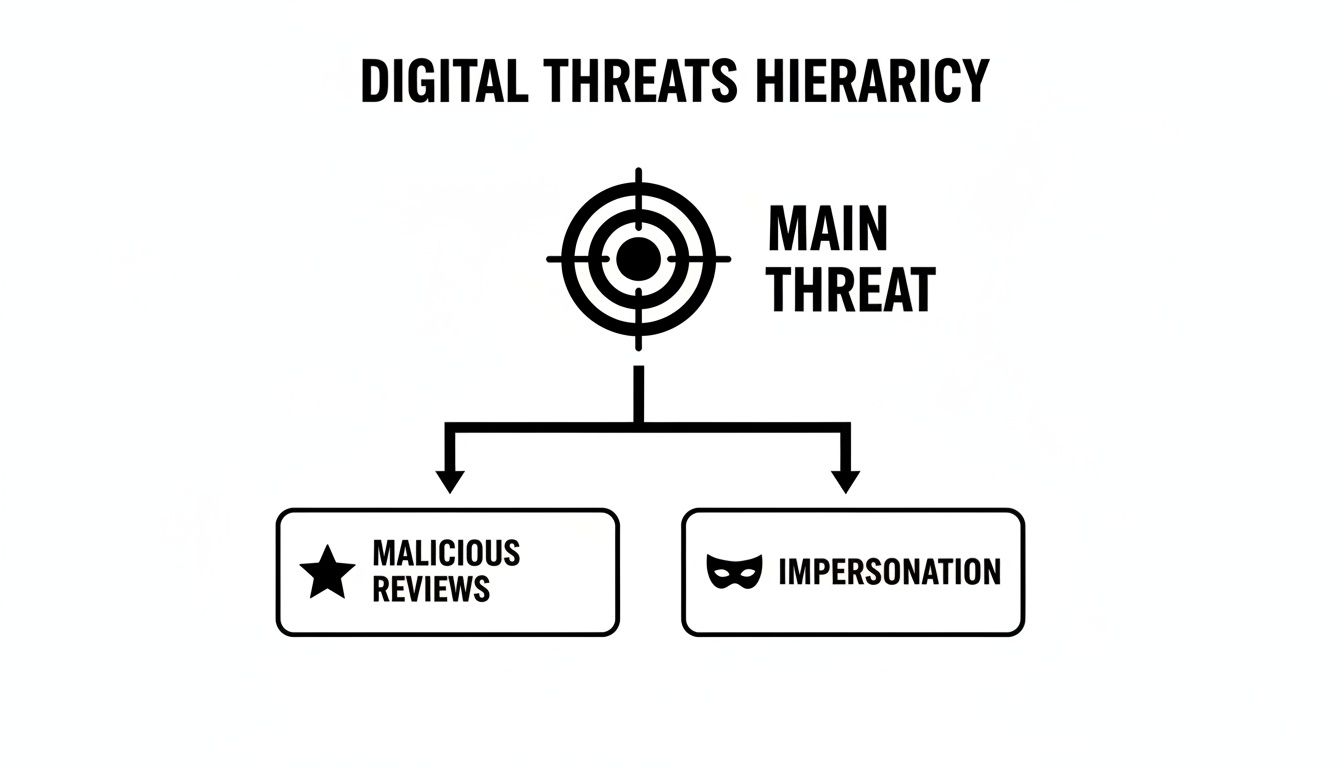
As you can see, problems that might seem separate—like fake reviews and social media impersonators—are really just different branches of the same core threat to your brand’s integrity.
Pillar 1: Monitor Your Digital Footprint
You can’t manage what you don’t measure. The first step is all about active listening. This means setting up systems to catch every mention of your brand across the web, giving you a real-time pulse on public sentiment. Consider this your early-warning system.
Effective monitoring is a mix of automated tools and good old-fashioned manual checks. Setting up Google Alerts for your company name, products, and key executives is a fantastic—and free—first step. It acts as a basic net to catch new mentions in articles, blogs, and forums.
But to get the full picture, you need to dig deeper. A truly strong framework depends on implementing robust social media monitoring tools. These platforms track conversations across social channels, giving you insight into customer moods that a simple alert would miss. For a closer look at the options out there, check out our guide on the best online reputation management software.
Here’s a quick checklist for what you should be watching:
- Review Platforms: Keep a close eye on Google, Yelp, Trustpilot, and any review sites specific to your industry.
- Social Media: Actively monitor tags, mentions, and important hashtags on platforms like Facebook, X (formerly Twitter), and Instagram.
- Search Engine Results: Every so often, open an incognito window and search for your brand. See exactly what potential customers are seeing.
Pillar 2: Respond to All Feedback
Once you know what people are saying, it's time to engage. Your response strategy is a public demonstration of your company's character. How you handle both praise and criticism can shape public perception more than almost any marketing campaign.
When it comes to negative feedback, the golden rule is to be quick, professional, and empathetic. Never, ever get dragged into a public fight. Acknowledge the person’s problem, apologize for their poor experience, and offer to take the conversation offline to find a solution. This shows everyone else watching that you care and you’re committed to making things right.
A prompt and professional response to a negative review can actually increase customer loyalty. It demonstrates accountability and a commitment to service, often turning a dissatisfied customer into a brand advocate.
Don't forget the good stuff! Responding to positive feedback is just as important. Thanking a happy customer for their kind words reinforces their decision and encourages others to share their own great experiences. It’s a simple act that helps build a community of genuine advocates for your brand.
Pillar 3: Build a Buffer of Positive Content
This pillar is all about going on the offensive. The absolute best defense against negative content is an overwhelming amount of positive content that you control. When you create and promote your own high-quality assets, you can dominate the first page of search results for your brand, pushing any negativity down where it's far less likely to be seen.
Actively asking for reviews from happy customers is a cornerstone of this strategy. Put a system in place to request feedback after a successful sale or service. By making it easy for satisfied clients to leave a review on key platforms, you create a steady stream of positive social proof.
Beyond that, focus on creating valuable content that highlights your expertise. This could be anything from:
- Blog Posts: Write helpful articles that answer the questions your customers are already asking.
- Case Studies: Show off successful projects and celebrate your clients' wins.
- Press Releases: Announce company milestones, new team members, or your involvement in the community.
Every piece of content you publish is another positive digital asset that fortifies your brand’s search engine presence.
Pillar 4: Prevent and Secure Your Brand Assets
The final pillar is all about minimizing your vulnerabilities before they can be exploited. This means locking down your digital real estate and having clear internal policies.
A simple first step is to claim your brand name on all major social media platforms, even the ones you don’t plan on using right away. This stops impersonators from grabbing them first and causing confusion down the road.
Next, make sure you have claimed and fully optimized your profiles on key business directories like Google Business Profile and Bing Places. These profiles are often the first stop for customers looking for information, and owning them puts you in the driver’s seat.
Finally, look inward. Create clear guidelines for your employees on how they should represent the company online. A basic social media policy can prevent accidental missteps that could spiral into a PR headache. By taking these preventative steps, you shore up your brand’s foundation, making it much harder for any threat to take hold.
A Platform-by-Platform Strategy for Managing Your Reputation
Let's get practical. A solid reputation management strategy isn't a single, catch-all plan. What works brilliantly on Google will likely fall flat on Instagram. Every digital platform is its own world with its own rules, user habits, and unique threats. To get real results, you need a custom playbook for each one.
Think of yourself as a diplomat. You wouldn't use the same script in every country, right? You’d learn the local customs and language first. The same goes for your brand. Mastering your online reputation means you have to get fluent in the "local customs" of Google, your social media channels, and any e-commerce marketplaces you sell on.
This section breaks down exactly what you need to do on each of the major platforms. We'll cover the key battlegrounds where your brand's reputation is either built or broken, giving you a clear path for monitoring, responding, and defending your good name.
Mastering Your Google Business Profile
For most businesses, your Google Business Profile (GBP) is the front door. It’s often the very first impression a potential customer gets, so getting it right is non-negotiable. A neglected profile isn’t just a missed opportunity; it’s a massive reputational risk.
Three parts of your GBP demand your constant attention: reviews, the Q&A section, and your photos.
- Responding to Reviews: Your mission here is simple: respond to 100% of reviews, good and bad. A fast, professional reply to a negative review can completely defuse the situation and shows other potential customers that you genuinely care. And don't forget to thank the positive reviewers—it strengthens their loyalty and encourages others to chime in.
- Managing the Q&A Section: This is a sneaky one. Anyone can ask and answer questions about your business here. Take control of the narrative by pre-populating this section with common questions and your official answers. Check it at least weekly to stomp out any misinformation posted by others.
- Curating Photos: Are your photos from five years ago? Low-quality or outdated images make you look unprofessional. Keep it fresh by regularly uploading high-resolution photos of your location, products, and team. It's great to encourage customers to share their photos, but keep an eye on them to make sure they reflect your brand well.
When—not if—you get a fake or malicious review, don't just get angry in your reply. You need to flag it immediately. Go to the review, click the three-dot menu, and select "Report review." Pick the reason that fits best, like "Spam" or "Conflict of interest," and let Google’s team take it from there.
Navigating Social Media Channels
Platforms like Facebook, Instagram, and LinkedIn are all about conversation. Your reputation here is built through active, daily engagement—managing your community and responding lightning-fast to mentions, comments, and DMs.
The name of the game is speed and authenticity. Conversations on social media move in real-time, and letting a comment sit unanswered for hours can look like you just don't care.
- Facebook: Keep a close watch on comments on your posts and any visitor posts on your Page. Use the built-in moderation tools to automatically hide comments that contain certain keywords you specify. If someone creates an impersonation account, go directly to the fake profile and use the "Find support or report" option to shut it down.
- Instagram: You need to monitor your comments and, just as importantly, photos you're tagged in. If a customer tags your brand in a post complaining about something, jump on it with a quick, public reply offering to sort it out in their DMs. For trolls, don't hesitate to use the restrict or block functions.
- LinkedIn: As a professional network, the tone here is a bit more buttoned-up. Engage thoughtfully with comments on your company’s articles and updates. This positions you as an industry leader. If you get negative feedback from former employees on sites like Glassdoor, the best defense is encouraging your happy, current team members to share their own genuine experiences.
The single best social media reputation strategy is to build a real community before you need it. When you have a loyal tribe, you'll often find that your own followers will jump in to defend you against negative comments, which is far more powerful than anything you could say yourself.
Defending Your Brand on E-Commerce Marketplaces
If you sell products on Amazon, eBay, or Etsy, the threats hit you right in the wallet. Counterfeit listings stealing your sales and fake reviews trashing your product can kill customer trust overnight.
Here, your strategy is less about conversation and more about enforcement.
- Addressing Counterfeit Listings: You have to be your own watchdog. Regularly search for your brand and product names to find unauthorized sellers piggybacking on your success. Use the platform’s official reporting tools—like Amazon's Brand Registry—to file formal takedown notices. You'll need to provide proof of your trademark and clear evidence of the infringing listing.
- Combating Review Manipulation: Suspect a competitor is "review bombing" your product with a wave of fake one-star ratings? Document everything. Look for weird patterns, like a dozen negative reviews popping up in two days, all from unverified purchasers. Report this suspicious activity to the marketplace's seller support team as a clear violation of their rules.
- Engaging with Product Reviews: Just like on Google, you need to respond to legitimate negative product reviews. Offering a refund or a replacement doesn't just solve one person's problem; it shows every future buyer reading those reviews that you stand behind your product.
By creating these distinct, platform-specific game plans, your reputation management efforts will go from scattered to strategic, giving you the power to protect and build your brand across the entire digital landscape.
When to Call in the Reputation Management Professionals
For most businesses, handling online reputation in-house is a great starting point. It's cost-effective, and a dedicated team can absolutely manage customer reviews, keep an eye on social media, and build a positive presence. But some fires are just too big to fight with a garden hose.
Knowing when to call for backup is one of the smartest decisions you can make. It’s the difference between applying a bandage and calling an ambulance. Some digital threats are so sophisticated or overwhelming that you need the specialized tools, deep experience, and relentless focus that only a professional service brings to the table.
Clear Signals You Need Expert Help
If any of these situations sound familiar, it's a flashing red light telling you to consider bringing in an online reputation management (ORM) agency. These aren't your run-of-the-mill bad reviews; they're often coordinated attacks or stubborn problems that an internal team just isn't built to solve.
- A Large-Scale Negative Attack: Suddenly, you’re drowning in a sea of fake one-star reviews across Google, Yelp, and other sites. This is a classic "review bombing"—a deliberate assault meant to crater your ratings overnight. It requires a fast, coordinated response on every single platform, all at once.
- Persistent Defamatory Content: Damaging articles, nasty blog posts, or toxic forum discussions are showing up high in search results for your brand name. You've tried reporting them, but they won't go away and are actively poisoning the well for potential customers.
- Lack of Internal Resources: Your team is already wearing too many hats. The sheer volume of online mentions and reviews is too much to handle, and no one has the dedicated time to monitor everything properly. This leaves huge gaps in your defenses.
When you've exhausted the standard reporting channels and defamatory content is still live, you've likely crossed the line from a customer service issue to a legal one. This is precisely where a professional service, often working with legal counsel, is essential for navigating the tricky takedown process.
Vetting a Reputable ORM Agency
Choosing the right partner is everything. You need an agency committed to ethical, "white-hat" strategies. Shady, "black-hat" tactics can easily backfire, making the problem even worse and potentially getting you penalized by search engines.
Before you sign a contract, ask some tough questions.
Start with their methodology. A transparent agency like LevelField will walk you through their process, which focuses on platform-compliant takedown requests. They should be honest and never promise guaranteed removals, because ultimately, the platforms have the final say.
Next, ask about their experience in your specific industry. An agency that understands the nuances of your market will be far more effective. Finally, demand to see what their reporting looks like. You need to see tangible results, like the number of negative items successfully removed or a measurable improvement in your brand's search rankings. This ensures you’re not just paying for effort, but for real outcomes that protect your bottom line.
Measuring the ROI of Your Reputation Management

Let's be honest: online business reputation management can feel a bit abstract. It’s easy to see it as a necessary expense rather than a true investment. But a strong reputation delivers tangible, bottom-line results, and if you’re not measuring it, you’re flying blind.
The trick is to stop thinking of your reputation as a fuzzy concept and start treating it like any other measurable business asset. It directly influences whether a customer chooses you over a competitor, and by tracking the right numbers, you can draw a straight line from your reputation efforts to your bank account.
Key Performance Indicators for Reputation
To see how well your strategy is working, you need to watch a few key vital signs for your brand's digital health. These are the Key Performance Indicators (KPIs) that tell the real story.
Here are the essential ones to keep an eye on:
- Average Star Rating: Are your ratings on Google, Yelp, and industry-specific sites climbing? Even a small bump can make a big difference. Tracking this trend over time is your most direct measure of progress.
- Sentiment Score: Beyond stars, what's the overall feeling of the conversation about you online? Social listening tools can analyze the tone, showing you if sentiment is shifting from negative to positive.
- Review Volume and Velocity: It’s not just about quality; quantity matters, too. An increase in the number of new reviews you’re getting each month shows that your customers are engaged and your strategy is encouraging feedback.
- Branded Search Rankings: When someone Googles your company name, what do they see? You want that entire first page filled with positive content you control—your website, social profiles, and positive press.
Connecting Metrics to Business Outcomes
Tracking these KPIs is just the first step. The real magic happens when you connect these reputation metrics to what the business cares about most: leads, sales, and customer loyalty. This is how you prove that managing your online reputation is actually making you money.
A positive reputation isn't just a nice-to-have; it's a direct financial asset. Studies show that strong public perception can boost a company's valuation by as much as 25%. Yet, a shocking 83% of businesses wait until the damage is already done to react.
It's a huge disconnect. Despite the clear financial upside, very few companies get ahead of the problem. A 2025 analysis found that a mere 17% of companies are proactive about managing their reputation. You can learn more about the financial impact of reputation management and see why this is such a missed opportunity.
Calculating Your Reputation ROI
So, how do you calculate a hard number for ROI? You need to connect your KPIs to actual dollars.
A perfect example is your Google Business Profile. By using UTM tracking links in your listing, you can see exactly how many people clicked to your website, called your business, or requested directions after seeing your profile.
As your star rating improves, you should see those numbers go up. If you know the average value of a new lead or customer, you can start putting a real dollar amount on that improvement. This is how you transform reputation management from a cost center into a proven revenue driver. It becomes an essential, justifiable part of your growth strategy.
Your Top ORM Questions, Answered
When you're dealing with your company's online reputation, a lot of specific questions pop up. Let's tackle some of the most common ones with practical, straightforward advice to help you handle these situations like a pro.
How Long Does It Take to Repair a Damaged Online Reputation?
Honestly, there's no quick fix. The timeline for reputation repair really depends on the severity of the problem. If you're just dealing with a single fake review, you might get it taken down in a few weeks. But if you’re facing a major crisis, like a negative news story that went viral, you could be looking at six months to a year of consistent work to turn things around.
Success isn't about one magic button. It's a long-term play that involves building up a ton of positive content—authentic reviews, articles, and social mentions—to push the negative stuff further down in search results where fewer people will see it. Think of it as a marathon, not a sprint.
Is It Illegal to Pay for Positive Reviews?
Yes, and it's a huge mistake. Paying for positive reviews isn't just unethical; it's illegal in many places. Here in the U.S., it's a direct violation of the Federal Trade Commission’s (FTC) guidelines on deceptive endorsements.
All the major players—Google, Yelp, and Amazon—have strict policies against paid reviews. If you get caught, the penalties are steep. They could wipe out all your reviews, suspend your profile, or even take legal action.
Instead of trying to buy praise, focus your energy on earning it. Set up a simple, automated process to ask every real customer for their honest feedback. That makes it easy for your happy customers to share their great experiences.
What Is the First Thing I Should Do After Getting a Negative Review?
How you react in that first moment can make all the difference to every potential customer who sees that review. The single most important thing is to avoid a knee-jerk, defensive response. Take a deep breath before you do anything.
Your very next move should be to post a professional and public reply—and do it quickly. Here’s a simple game plan:
- Acknowledge and Apologize: Always start by acknowledging their bad experience and apologizing for their frustration. It doesn't matter who was right or wrong.
- Take It Offline: Give them a direct way to contact you (an email address or phone number works great) to solve the problem privately. This pulls the argument out of the public spotlight.
- Look Into It: Once you've replied, figure out what actually happened. Was it a genuine slip-up on your end? Use it as a chance to improve.
This strategy shows everyone watching that you take customer feedback seriously and are committed to making things right. Never, ever ignore a negative review. Silence looks like you just don't care.