


A bad Google review can feel like a punch to the gut, but how you handle it publicly is one of the most powerful marketing moves you can make. Learning how to respond to bad reviews on Google isn't just about damage control; it's about turning a negative comment into a public display of excellent customer service.
Why Responding to Bad Google Reviews Is Non-Negotiable

It’s tempting to just ignore a bad review and hope it gets buried. That’s a massive missed opportunity.
When potential customers scroll through your reviews, they aren't just looking at the star rating. They're trying to figure out what happens when things go wrong. Your reply is less about winning back that one unhappy customer and more about showing everyone else watching that you’re a professional who cares.
And people are watching. Research shows that a staggering 97% of consumers who read reviews also read the business's response. This means your reply is speaking directly to nearly every single person considering your business.
Your Response Is Your Reputation
Think of every reply as a mini-advertisement for your customer service. A thoughtful, calm, and helpful response can completely neutralize a bad review. It might even win over prospects who value businesses that take ownership.
Here’s the breakdown:
- It showcases your customer service. You get a public stage to prove you listen to feedback and are committed to making things right.
- It builds trust and transparency. Admitting when you've made a mistake makes your business feel more human and credible than hiding from it.
- It can improve your local SEO. Google's algorithm likes to see activity. Responding to reviews signals that your profile is active and managed, which can help your visibility.
All of this ties directly back to effectively optimizing your Google Business Profile, which is the central hub for all these customer interactions.
A prompt, professional response does more than just damage control—it's an active investment in your brand's reputation. It tells future customers that even if something goes wrong, you are a business that will step up to fix it. This assurance is often more valuable than a flawless five-star record.
To keep it simple, I’ve found that a straightforward framework helps you stay calm and professional, even when a review feels unfair.
The A.A.A.I. Quick Response Framework
The A.A.A.I. framework—Acknowledge, Apologize, Action, Invite—is a simple mental checklist to run through before you type a single word. It ensures your response is constructive, professional, and moves the conversation in the right direction.
| Step | Action | Why It Works |
|---|---|---|
| Acknowledge | Start by addressing the customer's specific complaint. Show you've read and understood their issue. | It validates their experience and shows you're listening, not just sending a canned reply. |
| Apologize | Offer a sincere, simple apology for their negative experience. No excuses, no "buts." | This de-escalates the situation and demonstrates empathy and accountability. |
| Action | Briefly explain what you're doing to fix the issue or what you've learned from their feedback. | It shows you're proactive and committed to improvement, not just offering empty words. |
| Invite | Ask them to contact you offline via phone or email to resolve the issue directly. | This takes the conflict out of the public eye and shows a genuine desire to make things right. |
Following this structure helps you avoid an emotional, defensive reply and instead craft a response that builds trust with every potential customer who reads it.
Before You Type a Single Word
That gut-punch feeling when a one-star review pops up is real. The first instinct for most business owners is to jump in and defend their company, especially when the complaint feels unfair.
Don’t do it.
Seriously, the most critical move you can make is to pause, take a breath, and put on your detective hat before your fingers even think about hitting the keyboard. A knee-jerk, emotional reply can pour gasoline on a small fire, turning a single bad review into a much bigger problem.
Your first job isn't writing—it's investigating. Dive into your own records. Does the reviewer's name show up in your CRM? Can you find them in your sales history or appointment book? Do the details they mention, like a specific date, project, or employee interaction, actually line up with a real event? This internal fact-finding is non-negotiable; it stops you from responding based on assumptions.
This quick bit of homework helps you slot the review into one of three buckets. Knowing which bucket it belongs in will determine your entire response strategy.
What Kind of Complaint Are You Dealing With?
Before you can craft the right response, you have to accurately diagnose the problem. Almost every negative review you'll encounter will fall into one of these categories:
The Genuine Customer Complaint: This person is a real customer, and they had a genuinely bad experience. Their review will likely have specific details, you'll find them in your records, and their story, while tough to read, sounds credible. These are actually your golden opportunities to show amazing customer service.
The Misunderstanding: This review is also from a real customer, but their frustration stems from a simple mix-up. Maybe they misinterpreted your return policy, expected a feature that wasn't included, or misunderstood the scope of your service. Your goal here is to clarify, not argue.
The Fake or Malicious Review: This one just feels... off. The reviewer has zero history with your business, their claims are generic ("terrible service!"), and their profile might be empty, brand new, or have a suspicious pattern of trashing other local businesses. These require a completely different playbook focused on removal, not engagement.
The whole point of this initial triage is to separate fact from fiction. By gathering your own data first, you equip yourself to write a measured, professional, and effective reply—one that addresses the reviewer while also reassuring the hundreds of potential customers who are watching how you handle it.
Once you’ve sorted the review, you know exactly what to do next. For a legitimate complaint, you’ll lead with an apology and a solution. For a misunderstanding, you’ll focus on polite education. And for a fake, you’ll shift your energy toward getting it taken down. This simple pause-and-assess habit ensures you always make the right move.
Crafting the Right Response for Every Situation
Not all negative reviews are the same, so your replies shouldn't be either. Using a copy-and-paste template is a surefire way to come across as robotic and insincere. The real art is tailoring your response to fit the context, whether you're dealing with a genuine service slip-up, a simple misunderstanding, or a review that just feels… off.
Getting this right can turn a public complaint into a powerful display of your company's character and commitment. And it's not just about damage control; it's smart business. Research shows 56% of customers are more likely to choose a business that actively responds to reviews. Standing silent isn't an option.
When You Genuinely Messed Up: The Sincere Apology
Look, mistakes happen. When you've dropped the ball, the best thing you can do is own it—quickly, completely, and without excuses. This is where you can actually win back a customer for life. A good apology is direct and gets straight to the point.
- Name the problem. Don't hide behind vague language like "we're sorry for the inconvenience." Instead, say something like, "We are so sorry the delivery was late and that the product arrived damaged."
- Explain how you're fixing it. Briefly mention what you’re doing to make sure this doesn't happen to the next person. "We've reviewed our packaging protocols with the shipping team to fix this." It shows you listen.
- Take the conversation offline. The goal is to resolve the problem, not have a public back-and-forth. Provide a direct email or phone number to a real person who can make things right.
A Real-World Example:
"Hi [Customer Name], thank you for letting us know about this. We are truly sorry that your order was delayed and didn't arrive in the condition you expected. That's not the standard we hold ourselves to. We've already spoken with our delivery partner to address the issue. Please contact me directly at [email address] so I can personally arrange a replacement and make this right for you."
When It’s Just a Misunderstanding: The Gentle Clarification
Sometimes, a customer is unhappy simply because their expectations didn't match reality. Your job here isn't to prove them wrong; it's to clarify the situation with grace and empathy, not defensiveness.
Steer clear of phrases like "Actually, our policy is..." which can sound dismissive. The key is to validate their frustration first before you offer any new information.
Imagine a customer leaves a 1-star review because they were charged for a feature they assumed was free.
How to Respond:
"Hi [Customer Name], thank you for your feedback. We're sorry for the confusion around the billing for the advanced analytics feature, and we understand how frustrating an unexpected charge can be. That feature is part of our premium package, and we apologize if we didn't make that clear enough during the sign-up process. Please reach out to us at [support email] so we can review your account and find a good solution for you."
When You Smell a Fake: The "Just the Facts" Response
If a review feels fake or malicious, your public response isn't for the person who wrote it—it’s for everyone else who will read it. The goal is to calmly signal that the claim is unsubstantiated while you work behind the scenes to get it taken down.
This decision tree can help you map out your next move.
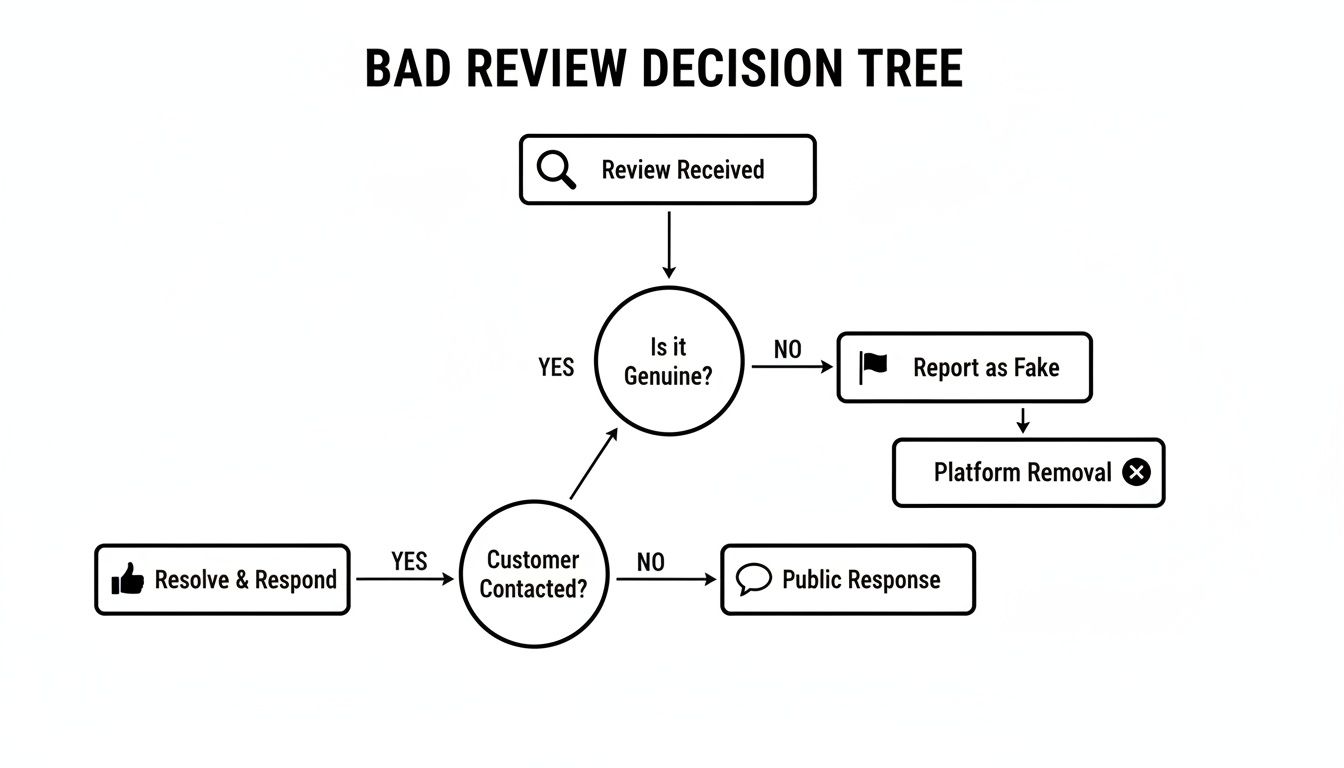
As you can see, the path forward changes dramatically depending on whether the review is legitimate.
For a suspected fake, keep your response short, professional, and emotionally neutral.
- State that you can't find them in your records. This is a simple, factual statement that immediately casts doubt on their claim.
- Invite them to provide details privately. This shows you're willing to resolve legitimate issues, but it also puts the ball in their court to prove they're a real customer (which they likely can't).
The Professional Pushback:
"Hello. We take all customer feedback seriously, but we have no record of any customer or transaction matching your name or the details provided. If you have been a customer, we invite you to contact our management team directly at [email address] with your order details so we can investigate your claim."
This response masterfully protects your reputation in the public eye while you escalate the review to Google for removal.
How to Report and Remove Fake Reviews
Sometimes, a review isn't just negative—it's completely fabricated. When you suspect a comment violates Google's policies, a simple reply won't cut it. You need to escalate. These bogus reviews can come from anywhere—a competitor, a disgruntled ex-employee, or even a bot—and they have no place on your business profile.
The good news is that Google has a process for business owners to flag and request the removal of reviews that cross the line. The real trick is knowing what actually qualifies for removal and how to build a solid case.
Flagging a Review Through Your Google Business Profile
Your first move is always to flag the review directly from your Google Business Profile dashboard. This is the official, frontline method.
- Head over to your Google Business Profile manager.
- Find the review in question.
- Click the three-dot menu next to it and select "Report review."
- You'll be asked to choose a reason. Pick the one that fits best, like "Conflict of interest" or "Hate speech."
Once you hit submit, you have to play the waiting game. It can take several days for Google's team to look at it. Whatever you do, don't get into a public back-and-forth with the reviewer while you wait. It just looks unprofessional. If you feel you must reply, a simple, "We have no record of you as a customer but would be happy to discuss this offline," is more than enough.
Escalating a Denied Claim
So, what happens when Google denies your initial request? Don't give up. The first pass is often automated or a quick glance that misses crucial context. Your next step is to use Google's redressal form, which lets you provide a much more detailed explanation and evidence.
This is your chance to really plead your case. We've put together a full walkthrough on this, and you can learn exactly how to report fake Google reviews effectively in our deep-dive guide. This form is where you can attach screenshots, reference internal records, and clearly explain why the review violates a specific policy.
A critical tip: When you escalate, frame your argument around policy violations, not your feelings. Google removes reviews that break its rules, not just because you think they're unfair. Focus on proving it’s spam, a conflict of interest, or defamatory.
Review Violation and Action Plan
Knowing which Google policy a review violates is half the battle. This table breaks down common violations and the best way to approach them.
| Type of Violation | Example | Recommended Action |
|---|---|---|
| Conflict of Interest | A review from a current or former employee, or a paid review from a competitor. | Flag for "Conflict of Interest." In an escalation, provide any internal evidence you have. |
| Spam or Fake Content | The review is posted by a bot, contains promotional links, or is posted multiple times. | Flag as "Spam." Note the repetitive nature or irrelevant content in your report. |
| Hate Speech/Harassment | The review contains threats, slurs, or personal attacks against you or your staff. | Flag immediately for "Hate Speech" or "Harassment." This is a high-priority violation. |
| Off-Topic Content | The reviewer rants about something unrelated to their experience with your business. | Flag as "Off-topic." Explain clearly why the content is not relevant to a customer experience. |
Focusing on these clear-cut violations gives you the best chance of getting a fake or malicious review taken down. Always tie your report back to a specific rule in Google's playbook.
Important Legal and Privacy Considerations
When you're dealing with potentially defamatory reviews, you're stepping into sensitive territory where legal and privacy lines are critical. Under no circumstances should you ever reveal a customer's private information in a public reply.
This is a HIPAA minefield for healthcare providers. Just confirming someone is a patient—even to defend your practice—is a serious violation that can carry heavy penalties.
Be equally careful throwing around the word "defamatory." In legal terms, defamation means a false statement presented as a fact that damages someone's reputation. If you genuinely believe a review meets that high bar, talk to a lawyer before you do anything else. An attorney can help you navigate your options without accidentally putting your own business at legal risk.
Building a Proactive Reputation Management System

Knowing how to handle bad reviews is a crucial defensive skill. But let's be honest, the best defense is a great offense. A truly effective long-term strategy isn't about just playing defense—it's about building a reputation so solid that a few negative comments barely make a dent.
It's time to shift from a reactive crouch to a proactive stance.
The real goal is to create a consistent flow of positive reviews that paints an accurate picture of your business. This builds a powerful buffer. Think about it: when you have a stellar 4.8-star rating from hundreds of happy clients, a single one-star review loses its power. It starts to look like an outlier, not a trend.
Actively Encourage Positive Feedback
Happy customers are often quiet customers. They got what they needed, had a great experience, and went on with their lives. If you want them to share that positive story, you’ll likely need to give them a gentle nudge.
Timing is everything here. The absolute best time to ask for a review is right after a positive interaction, when the good feelings are still fresh.
- Right after a project wraps up: Pop a follow-up email into their inbox. Thank them for their business and drop in a direct link to your Google review page.
- When a customer praises you directly: If someone compliments your work in person or over email, thank them sincerely and say, "That means a lot to us! If you have a free minute, we'd be so grateful if you could share that on Google."
- On your receipts and invoices: A simple QR code or a short URL at the bottom of a receipt makes it incredibly easy for customers to act on the spot.
The golden rule is to make leaving a review as frictionless as possible. Never make a customer hunt for your profile. Always give them a direct link.
Set Up Your Monitoring and Alert System
You can't respond to reviews you never see. Speed is a huge factor in managing your reputation well, but most of us are too busy running a business to check our Google profile every hour. This is where automated alerts are an absolute lifesaver.
Your Google Business Profile has email notifications for new reviews. Make sure they're turned on and sending alerts to an inbox that you or a team member checks constantly. A fast response, ideally within 24 hours, shows both the reviewer and the public that you’re paying attention. This simple system is the foundation for properly managing your online reputation.
Turn Feedback Into Your Growth Engine
Your reviews are a goldmine of free business intelligence. A proactive system doesn't just collect reviews; it looks for patterns. Are multiple people mentioning long wait times? Is the checkout process confusing? You've just uncovered a critical operational flaw that needs to be fixed.
This internal feedback loop is what separates the good companies from the great ones. You take public feedback, use it to make your business better, and in doing so, you naturally reduce the number of future bad reviews. It’s a powerful cycle of continuous improvement.
For those who want to build a more robust strategy or simply don't have the time to handle the complexities, exploring professional reputation management services can offer the expert support you need. This proactive mindset transforms your review profile from a source of anxiety into a valuable engine for growth.
Common Questions About Managing Google Reviews
Once you get the hang of responding to bad reviews, you'll inevitably run into some odd or tricky situations. Let's tackle some of the most common questions I hear from business owners trying to protect their online reputation.
How Quickly Should I Respond to a Negative Review?
You need to be fast. I always tell clients to aim for a response within 24 hours. A quick reply shows the unhappy customer—and every potential customer reading the reviews—that you're paying attention and you actually care.
While some studies say most people are fine waiting up to a week, a same-day response does wonders for de-escalating a problem. It signals that you take their feedback seriously and can often stop a bad situation from getting worse.
Should I Offer a Discount or Freebie in My Public Reply?
Absolutely not. Never offer compensation publicly. It’s a dangerous game to play because it can encourage other people to leave negative reviews just to see if they can get a freebie out of you. You don't want to put a bounty on bad feedback.
Instead, keep your public reply focused on fixing the problem, not offering a handout.
- Show you understand their specific complaint.
- Offer a sincere apology for their experience.
- Take the conversation offline to resolve it.
A simple, "Our manager would love to make this right. Please give us a call at [phone number] or email us at [email address]," works perfectly. It shows you're committed to a solution without setting a precedent that every complaint gets a reward.
The goal is to solve the customer's problem, not to advertise a reward for complaining. Keep compensation discussions private to maintain control and fairness.
Does Deleting My Google Business Profile Remove Bad Reviews?
No, and this is one of the worst things you can do. Deleting your profile wipes out everything you've built: all your reviews (good and bad), your photos, and your hard-earned local search ranking.
It's not even a real fix. Google or a customer can easily recreate the listing, and sometimes the old reviews just pop right back up. The only real path forward is to address the feedback head-on, respond professionally, and drown out the negativity with a flood of new, positive reviews.
Can a Customer Change Their Review After I Respond?
Yes, they can! This is the best-case scenario and exactly what you're aiming for. Customers can edit or delete their reviews at any time.
When you handle a complaint with genuine empathy and deliver a real solution, many reviewers will go back and either raise their star rating or update their comment. Sometimes they’ll even add a note praising your customer service. Turning a public complaint into a glowing testimonial is one of the most powerful moves you can make.