

That gut-punch feeling when a one-star Yelp review pops up? We've all been there. But can you actually get it taken down? The short answer is yes, but it's not as simple as wanting it gone. A review has to specifically violate Yelp's Terms of Service; you can't just remove a review because you disagree with the customer's opinion.
The Ground Rules for Removing Bad Yelp Reviews
Before we get into the "how," let's set some realistic expectations. Yelp’s entire platform is built on being a space for consumer opinions, even the brutally honest ones. That means their bar for removing a review is pretty high. The goal isn't to wage war on every negative comment but to strategically identify the ones that truly cross the line.
Getting this right from the start is key. Pouring time and energy into fighting a legitimate (though painful) review is a recipe for frustration. You need to focus your efforts on content that is clearly out of bounds.
Why Every Single Review Packs a Bigger Punch Today
The pressure to manage your online reputation has never been more intense. Modern consumers rely almost entirely on what others have experienced to make their own buying decisions. Your star rating isn't just a vanity metric; it's a lead-generation machine.
Consider this: 87% of consumers say they won't even consider a business with low ratings. And nearly 95% of shoppers read online reviews before they pull out their wallets. This isn't just a trend; it's a fundamental shift in how people decide where to spend their money. Your online reputation is now just as powerful as a word-of-mouth recommendation from a close friend. You can explore more data on how review management affects consumer trust to see the full picture.
Here's the most important mindset shift you can make: You’re not trying to silence critics. You're simply holding the platform accountable to its own rules to ensure the feedback about your business is fair, authentic, and based on real experiences.
Violations vs. Unhappiness: The Critical Difference
Your success in getting a Yelp review removed hinges entirely on one thing: proving a clear policy violation. A customer simply being unhappy, disappointed, or angry about their experience is not a violation. This is the distinction that matters most.
Let's look at a real-world example:
- Legitimate Criticism (Not Removable): "The service was incredibly slow, and my steak was cold by the time it got to the table. For what I paid, I was really disappointed." This review stings, but it describes a personal customer experience. It stays.
- Policy Violation (Potentially Removable): "The owner is a total crook! I heard him screaming at his employees in the back. Honestly, just go to his competitor down the street, they're way better and cheaper." This one is different. It includes a personal attack, secondhand gossip, and promotes a competitor—all potential violations.
Understanding this difference is what separates a successful removal request from a rejected one. It helps you build a strong, fact-based case and moves your thinking from "I hate this review" to "This review breaks the rules."
Quick Guide to Review Removal Eligibility
It can be tough to remember all of Yelp's specific rules in the heat of the moment. Use this table as a quick reference to gauge whether a review might be eligible for removal before you even start the flagging process.
| Violation Type | What It Means for Your Business | Is It Removable? |
|---|---|---|
| Conflicts of Interest | The review was posted by you, an employee, a competitor, or someone paid to write it. | Yes. Yelp has a zero-tolerance policy for biased or fake reviews. |
| Not Based on Experience | The reviewer describes someone else's story (hearsay) or rants about your business's politics or other non-consumer issues. | Yes. Reviews must be about a firsthand consumer experience. |
| Inappropriate Content | The review contains hate speech, threats, lewd comments, or harassment targeting you or your staff. | Yes. This is a clear violation of content guidelines. |
| Privacy Violations | The review includes an employee's full name, a customer's personal phone number, or other private information. | Yes. Posting private information is strictly prohibited. |
| Promotional Content | The review reads like an ad, promotes another business, or includes commercial URLs. | Yes. Reviews are for feedback, not advertising. |
| Just Plain Negative | A customer had a bad time and described their poor service, disappointing product, or high prices accurately. | No. Unhappiness or disagreement is not a policy violation. |
Remember, this table is a guide. The final decision always rests with Yelp's content moderators, but having a clear violation to point to dramatically increases your chances of a successful removal.
2. A Policy Deep Dive: Identifying Removable Reviews
When a bad Yelp review lands on your page, the first instinct is often emotional. "This is unfair!" or "That's not what happened!" But to get a review taken down, you have to switch from an emotional mindset to a strategic one.
Yelp's moderators aren't arbiters of truth; they're policy enforcers. They don't care if a customer's opinion is wrong, but they do care if it breaks their rules. Your job is to become an expert at spotting those broken rules.
A review saying your service was "slow and overpriced" is, unfortunately, just a protected opinion. It stings, but it’s not removable. But a review that attacks an employee's race, shares a story they heard from a friend, or promotes a direct competitor? That's a different ballgame entirely.
This isn't just about finding obvious violations. It's about learning to read between the lines to find the specific rule that gives you the leverage you need to build a case. A successful removal request isn't a complaint—it's a well-argued report backed by evidence.
The Anatomy of a Removable Review
Certain red flags should immediately jump out at you. These are the most common violations that give business owners a solid foundation for a removal request. Think of yourself as a detective, combing through the text for the one clue that breaks the case wide open.
Keep a sharp eye out for these patterns:
- Conflicts of Interest: Is the reviewer a bitter ex-employee? Or maybe a direct competitor? Sometimes they’re even paid to post negative content. Yelp's rules are clear: reviews must come from unbiased customers.
- Secondhand Stories: Does the review start with "My friend told me..." or "I heard that..."? That's hearsay. Reviews must be based on the writer's own firsthand experience.
- Irrelevant Content: Rants about your political signs, complaints about street parking, or attacks on your personal life have no place in a review. The content has to be about the actual customer experience.
- Private Information: This is a big one. If a review shares an employee's full name, a customer's phone number, or any other non-public detail, it's a serious and highly actionable violation.
This decision tree perfectly illustrates the first question you need to ask with every single negative review you get.
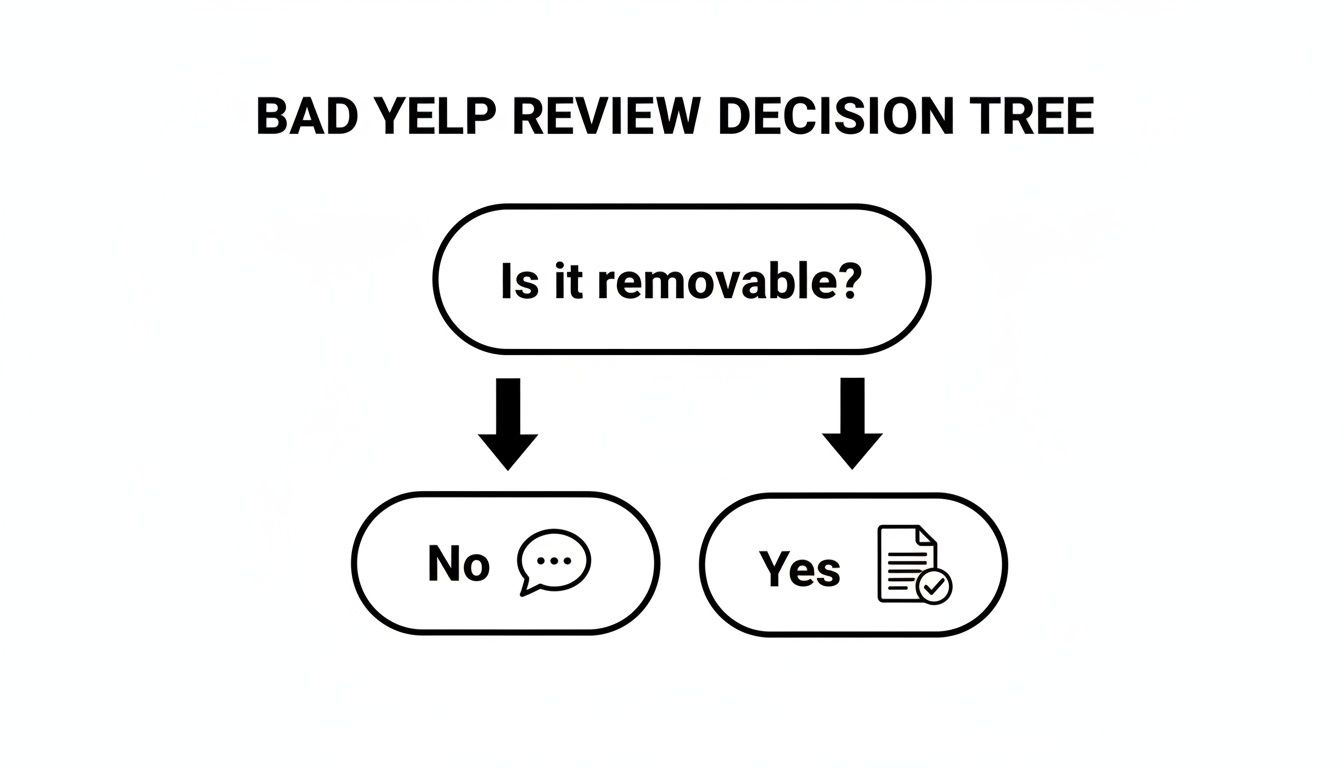
It really is that simple. The entire process boils down to that single branching path: is it just a negative opinion, or is there a clear policy violation that makes it removable?
Know the Rules Better Than They Do
To build an airtight case, you have to know Yelp’s Content Guidelines inside and out. These guidelines are the rulebook for every moderation decision, and they are your most powerful tool. When you report a review, you have to tell them exactly which rule was broken. A vague report is an ignored report.
Yelp takes its own policies very seriously. According to their own data, the platform’s team and automated systems removed over 47,900 reviews for violating these policies in 2024. They also closed more than 551,200 user accounts for violations, which automatically scrubs all reviews associated with those accounts. You can dig deeper into these numbers in Yelp's 2024 Trust & Safety Report.
My Pro Tip: Never just say a review is "fake" in your report. You have to cite the specific guideline. Instead of writing, "This person works for my competitor," state: "This review violates the 'Conflicts of Interest' policy. The user's profile lists their employer as [Competitor's Name], a direct competitor located two blocks away."
Real-World Violation Examples
Let's look at a few anonymized scenarios. Seeing how these policies play out in the real world is the key to understanding how to get a bad review removed.
Scenario 1: The Disgruntled Ex-Employee
- The Review: "Don't work here. The owner, Bob Smith, is a total psycho and shorts everyone on overtime. I quit last week and it was the best day of my life. The food is probably expired anyway."
- The Violation: This is a textbook conflict of interest. It's written from an employment perspective, not a customer one. Plus, it's packed with personal attacks and speculation, both of which are also against the rules.
Scenario 2: The Hearsay Story
- The Review: "My sister went here and said her car was damaged in their lot. She told me the manager was incredibly rude and refused to do anything about it. I'm definitely never going to this place."
- The Violation: The reviewer openly admits they never visited the business. The entire story is secondhand, which is a direct violation of the policy requiring a firsthand consumer experience.
Scenario 3: The Privacy Breach
- The Review: "The cashier, Jane Doe, was so nasty to me. She lives at 123 Main Street and everyone in town should know what a horrible person she is. Make sure you don't get her."
- The Violation: Sharing an employee’s full name and home address is a massive privacy violation. This type of review almost always gets a fast removal.
By breaking down each negative review with this level of detail, you can stop feeling helpless and start feeling empowered. You now have a clear framework for spotting violations, gathering your evidence, and presenting a compelling case to Yelp. This is how you reclaim control of your online reputation.
How to Effectively Report a Review to Yelp
So you’ve found a review that crosses the line and clearly violates one of Yelp’s policies. Good. Now it’s time to report it, and there’s a right way and a wrong way to go about it.
Think of your report not as an angry complaint, but as a clear, factual case you’re presenting to Yelp's moderators. Their job is to enforce the rules, and your job is to make it incredibly easy for them to see which rule was broken. A well-constructed report can be the difference between getting a review taken down in days and having it stick around forever.

Walking Through the Reporting Process
Flagging a review is pretty straightforward, but you have to follow Yelp’s official channel to the letter. Don't try to find a back door or send an email to a general support address; it won't work.
Here’s the step-by-step:
- First, log into your Yelp for Business account.
- Head to the “Reviews” section in your dashboard.
- Scroll down and find the review in question.
- Look for the three dots (...) or a small flag icon next to the review and give it a click.
- From the options that pop up, select "Report Review."
- You'll see a list of reasons for reporting. This is where your homework on the Content Guidelines pays off. Pick the option that best matches the violation.
Once you hit submit, your report is in the queue for Yelp’s moderation team. It can take a few business days to hear back, and you’ll get an email letting you know their decision. Just a heads-up: reporting the same review over and over again doesn’t help. In fact, it can hurt your case.
How to Write a Report That Actually Works
The most important part of the entire process is the little text box where you explain why you're reporting the review. This is your one shot to make your case. Keep it short, factual, and tie it directly to a specific Yelp policy.
This is not the place to vent.
A Poor Report (The kind that gets ignored):
"This review is a complete lie! This person was a nightmare customer, and now they're trying to ruin my business with this fake story. You need to delete this immediately."
See the problem? It’s all emotion and provides zero evidence of a policy violation. A moderator will likely roll their eyes and move on.
An Effective Report (The kind that gets results):
"This review violates Yelp's 'Conflicts of Interest' guideline. The user states they are a former employee who we let go last month. Their review is not based on a consumer experience and stems from a workplace issue."
This version is professional, cites the exact guideline, and gives the moderator the critical context they need to make a decision. This approach of building a fact-based case is universal, and you can see a similar strategy in our guide on how to get a review removed from Google.
Expert Takeaway: Always write your report as if the person reading it knows absolutely nothing about you, your business, or the situation. Make their job easy. Point to the specific rule and provide a quick, factual summary.
What Happens After You Click 'Submit'
Once your report is sent, you just have to wait. The Yelp team will review the flag and make a call. There are really only three ways this can go:
- Success! The Review is Removed. If the violation is cut and dry, Yelp will take the review down. You'll get an email letting you know.
- A Partial Win: The Review is Moved. Sometimes, if a review is questionable but not a blatant violation, Yelp will move it to the "Not Recommended" section. It's still there, but it's hidden from plain sight and doesn't factor into your star rating.
- No Dice: The Report is Rejected. If the moderators feel the review doesn't break any rules, it stays up.
It's crucial to be prepared for any of these outcomes. A removal is never a guarantee, even if you feel your case is airtight. If the review remains, it's time to stop focusing on removal and shift your strategy to a public response, which we’ll tackle in the next section.
What to Do When a Bad Review Can't Be Removed
You’ve made your case to Yelp. You carefully analyzed the negative review, built a report based on their content guidelines, and hoped for the best. Then the email from the moderation team lands in your inbox, and the verdict is in: the review stands. It’s a frustrating, but incredibly common, outcome.
So, what's next? Your strategy has to shift from removal to reputation management. When a review is permanent, the way you respond becomes your most powerful tool. A thoughtful, strategic reply can completely neutralize a negative comment, showcase your professionalism to future customers, and sometimes even salvage the relationship with the original reviewer.

Remember, this isn’t about winning an argument online. It's about demonstrating your commitment to great service for everyone else who's watching.
The Power of the Public Reply
Never forget who you're really talking to with a public response. While you're typing a reply to one unhappy person, your actual audience is the hundreds, maybe thousands, of potential customers scrolling through your page. Your response is your chance to control the final impression.
With Yelp's enormous audience, that impression matters. As of March 2025, the platform was drawing around 178 million unique visitors a month. About 2.5 million of those users are on the site every single day, specifically looking for local businesses. A professional reply on such a high-traffic site can turn a negative into a major positive. If you're curious, there's some great data on Yelp's continued relevance for local businesses that shows just how valuable this audience is.
A well-crafted response does a few critical things:
- It shows you're listening. Acknowledging feedback—even when it stings—proves you care about the customer experience.
- It lets you correct the record. You can calmly and factually clarify any misinformation without getting into a fight.
- It builds trust with prospects. Future customers see a responsible business owner who doesn’t hide from criticism.
How to Craft the Perfect Public Response
The tone you strike is everything. You're aiming for a blend of professional, empathetic, and brief. The biggest mistake you can make is getting defensive or dragged into a point-by-point rebuttal.
Here’s a simple framework that works every time:
- Acknowledge and Apologize: Always start by thanking them for the feedback. Offer a simple apology that their experience didn't meet expectations. This isn't an admission of guilt; it's an acknowledgment of their frustration.
- Keep It Short and Sweet: Don't write a novel. Get to the point quickly and maintain a calm, professional demeanor.
- Take the Conversation Offline: The public page is not the place for a back-and-forth. Offer a direct way to connect—a specific person's email or a direct phone number—and invite them to discuss it privately.
Pro Tip: Don't even think about using a generic, copy-and-paste response. Customers can spot a canned reply from a mile away. Personalize each one by mentioning a specific detail from their review. It shows you actually read it and took their feedback to heart.
The Private Message: Your Path to Resolution
Beyond the public reply, Yelp also lets you send a private message to the reviewer. This is where you can have a real conversation, dig into what went wrong, and work toward a resolution. Combining a public reply with private outreach is one of the most effective ways for how to deal with bad reviews on any platform.
The goal here is totally different. In a private message, you can be much more direct about finding a solution. Ask clarifying questions. Offer a real remedy, like a refund, a discount on a future visit, or just a sincere, personal apology.
Here’s an example of a solid private message:
"Hi [Reviewer Name], I'm [Your Name], the owner of [Your Business]. I just read your review and wanted to reach out personally. I'm truly sorry about the experience you had with us. We clearly missed the mark, and I'd like to understand a bit more about what happened so I can make sure we improve. If you're open to it, I'd appreciate the chance to connect directly."
This approach often disarms even the angriest customer. When you show genuine concern and a real willingness to make things right, you can sometimes motivate them to update or even remove their review. That should never be the primary goal, but it’s a fantastic bonus when it happens.
Knowing When to Call in the Experts: Legal and Reputation Management
Sometimes, Yelp’s internal tools just aren't enough. You’ve flagged the review, you’ve followed the process, but the post remains. If that review goes beyond a simple bad experience and into the territory of outright lies causing real harm, it's time to weigh your next steps.
This isn’t about every one-star review that stings. This is for the truly damaging stuff—the reviews that cross a legal line or threaten the viability of your business. Let's talk about when it's time to bring in the legal and reputation professionals.
Drawing the Line: Is It Defamation?
In the legal world, the word we're looking for is defamation. It's a heavy term, but it has a specific meaning: a false statement of fact, presented as truth, that damages a reputation. The key here is distinguishing a subjective opinion from a factual claim.
- Opinion (Not Actionable): "I thought the service was slow and the food was overpriced." This is a classic opinion, and it's protected speech.
- Potential Defamation (Actionable): "The restaurant's kitchen is infested with roaches, and they water down their liquor." See the difference? This isn't about feelings; it's a specific, factual accusation. If it's untrue, you might have a case.
Just be warned: pursuing a defamation lawsuit is a serious undertaking. It's often a long, expensive road, so you should only consider it when a review is causing significant, measurable financial damage and you have clear evidence of its falsity.
The First Shot: A Cease and Desist Letter
Before you even think about court, the standard first play is to have a lawyer send a cease and desist letter. Think of it as a formal, legal warning shot. The letter clearly identifies the defamatory statements, explains that they are unlawful, and demands the reviewer take down the post by a certain date or face legal proceedings.
Often, a formal letter from a law firm is enough to make the reviewer rethink their post. It shows you're not messing around and can resolve the issue without ever setting foot in a courtroom. It's a powerful tool for a fraction of the cost of a lawsuit.
Expert Tip: Never, ever try to write a cease and desist letter yourself or download a generic template. This is a legal document with specific requirements. Get a qualified attorney to draft it to ensure it’s effective and doesn't create more problems for you.
When to Hire an Online Reputation Management (ORM) Firm
What if the review isn't quite defamatory, but it's still a nightmare? Or maybe you're dealing with a flood of negative posts all at once. This is where a professional online reputation management (ORM) firm can step in.
Be careful, though. The ORM industry has some shady operators who promise they can get any review deleted for a fee. That's a huge red flag and a violation of Yelp's policies.
A legitimate, professional ORM service, like LevelField, operates differently. Here’s what you should expect from a reputable partner:
- A Forensic Review: They'll dig deep into the review, the poster's history, and Yelp's nuanced policies to find violations you likely missed.
- Expert Reporting: They know exactly how to frame a removal request to platform moderators, citing the specific terms of service that have been violated. Their experience dramatically increases the chances of success.
- Review Generation and Suppression: If a review can't be removed, the strategy shifts. They'll help you implement systems to encourage a steady stream of authentic, positive reviews from your real customers, effectively pushing the negative one down until it's out of sight.
- Proactive Monitoring: They act as your eyes and ears online, catching new reputation threats the moment they appear so you can get ahead of them.
Bringing on an ORM firm is a significant investment. It makes the most sense when the cost of the bad review—in lost customers and revenue—is greater than the cost of their services. They bring a level of expertise and dedicated focus that most business owners simply don't have time for, giving you a powerful ally in protecting your brand.
Got Questions About Bad Yelp Reviews? We Have Answers.
When a bad Yelp review pops up, it’s easy to feel a mix of frustration and confusion. You're not alone. Most business owners have been there, wondering what to do next. Here are some quick, no-nonsense answers to the questions I hear most often.
How Long Does Yelp Take to Review My Report?
So you've flagged a review. Now what? You can typically expect to hear back from Yelp's content moderators within a few business days. That said, the exact timing can vary based on how swamped they are. You'll get an email letting you know their decision either way.
My best advice? Make their job easy. A single, well-argued report that points directly to the specific Yelp Content Guideline the review breaks is your best shot. Bombarding them with multiple flags on the same review won't speed things up—it just adds to the noise.
Can I Actually Sue Someone Over a Bad Yelp Review?
The short answer is yes, but the real answer is that it’s almost always a bad idea. Taking legal action is a huge step, reserved for the most extreme situations.
To even have a case, you'd need to prove defamation. This isn't about someone having a bad opinion; you have to show they published a verifiably false statement of fact that cost your business real money. That’s a very high bar to clear, as opinions—even harsh ones—are protected speech.
Think long and hard before going down this road. Lawsuits are a massive drain on time and money, and they play out in public. It's a last-ditch option for genuinely damaging, provably false claims, and you should never even consider it without talking to an experienced attorney first.
What’s the Deal With Yelp’s "Not Recommended" Reviews?
You've probably seen that little link at the bottom of your Yelp page for "reviews that are not currently recommended." This is where Yelp's automated software tucks away reviews it finds a bit suspicious. These reviews are hidden from plain view and, importantly, don't affect your star rating.
Why does a review end up there? It could be a few things:
- The reviewer is brand new or doesn't use Yelp much.
- The review seems unusually glowing or overly aggressive, which can signal bias.
- It's just a short, unhelpful rant without any real substance.
There's no magic button you can press to move a review into this section. It's all up to Yelp's algorithm. The only real strategy here is to consistently encourage genuine reviews from all your customers over time.
If I Reply to a Negative Review, Will More People See It?
This is a fear I hear all the time. Technically, engaging with a review might give it a tiny, temporary bump in visibility because you're creating activity on the page. But that effect is minimal and fades quickly.
Honestly, the upside of replying publicly is so much greater than any minor algorithmic blip. A thoughtful, professional response shows every single person who visits your page that you care, you listen, and you’re committed to making things right. That's a powerful message that builds trust and is worth way more than a review's temporary position on a list.
Can I Just Pay Someone to Make a Bad Review Go Away?
Let me be perfectly clear: No. You absolutely cannot pay Yelp to remove a negative review. It's against their policy, period.
Be very wary of any company that claims they can guarantee review removal for a fee. They are either running a scam or using methods that violate Yelp's Terms of Service, which could get your entire business profile suspended.
The only legitimate way to get a review removed is to report a genuine policy violation through Yelp's official system. A reputable service like LevelField can help you spot those violations and build a strong case, but they work within the rules—they don’t have a secret backchannel to pay for removals.