

Let's be blunt: you can't just delete a bad Yelp review because it stung your ego or you disagree with the customer's take. Getting a review removed hinges on one thing and one thing only: proving it violates Yelp's specific Content Guidelines. This is a crucial distinction. Your first move isn't to argue the point, it's to see if the reviewer broke the rules.
Your First Move Against a Negative Yelp Review
Seeing that one-star review notification is a gut punch. It’s tempting to fire back, but a cool, strategic head will get you much further. Think of yourself as a detective, not a defendant. Your job is to dissect the review and cross-reference it against Yelp's official rulebook.
Did the review feel personal and unfair? That's frustrating, I get it, but it’s not grounds for removal. But does it contain threats, hate speech, or was it obviously posted by a competitor down the street? Now we're talking. You've got a case. The entire goal here is to separate legitimate—albeit painful—customer feedback from content that simply doesn't belong on the platform.
Differentiate Between Opinion and Violation
This is where most business owners stumble. The line between a harsh critique and a policy violation can feel blurry. A customer who says your service was slow is just sharing their experience. But a "customer" who never set foot in your establishment and is just parroting a story they heard? That's a secondhand account, and that's a clear violation.
Here’s a quick way to look at it:
- Legitimate Opinion: This is all about their direct experience. "The steak was overcooked," or "I waited 30 minutes past my reservation time." Annoying to read, but not removable.
- Potential Violation: Now you're looking for red flags. Is the review completely off-topic? Does it share private information? Is the language harassing? Does it reek of a conflict of interest, like a review from a disgruntled ex-employee or a direct competitor? These are the reviews you can act on.
This decision tree gives you a great visual of the fork in the road you're facing. You either report the violation or you handle it with outreach.
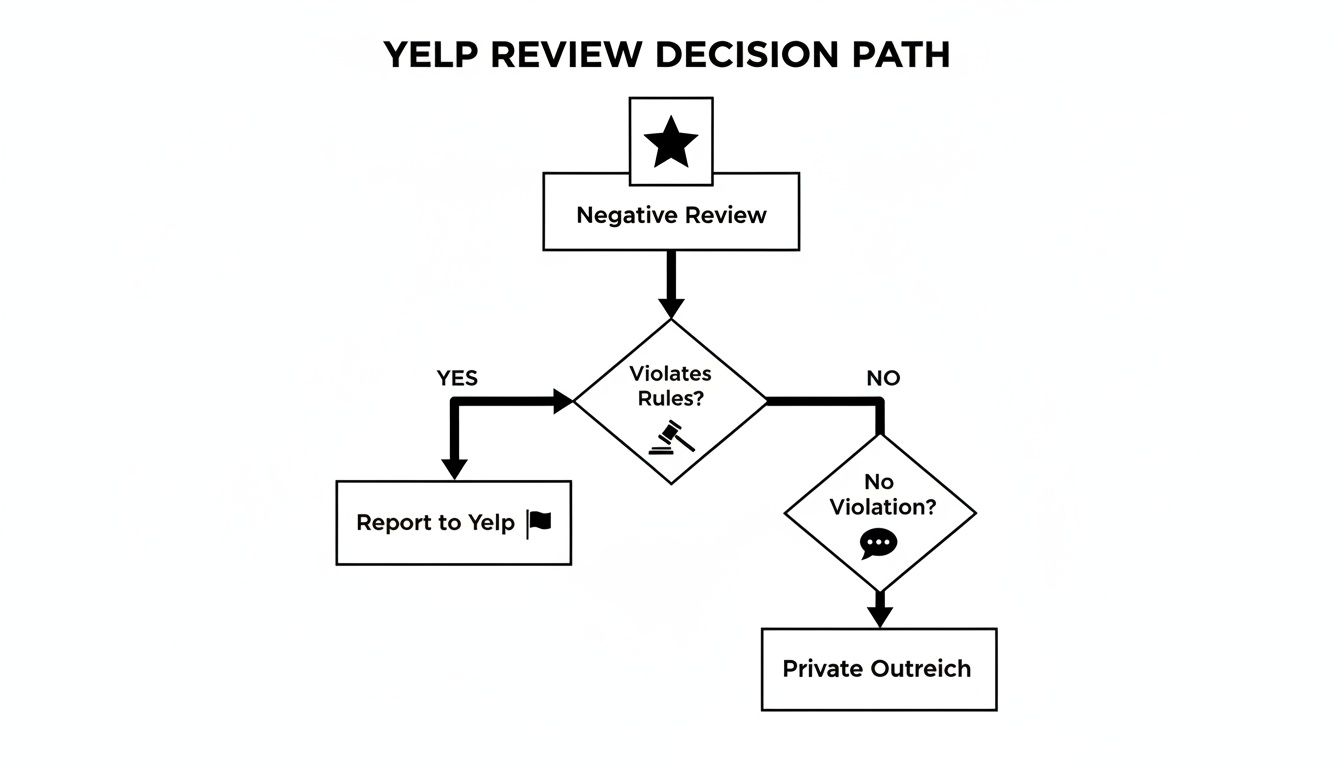
As the chart shows, your path splits right away. Reporting is just one tool in the toolbox, and it's not always the right one.
Your Initial Action Plan
Before you jump to hit that "report" button, think about direct outreach. It's often worth exploring strategies for effectively resolving customer complaints first. A sincere apology and a genuine attempt to make things right—sent privately or posted publicly—can sometimes be all it takes for a reviewer to edit or even take down their post on their own.
Pro Tip: A professional public reply does more than just appease one unhappy customer. It shows every potential customer reading your reviews that you take feedback seriously and are committed to good service. That alone can neutralize the impact of a bad review, even if it never comes down.
If you're dealing with a clear-cut violation, it's time to use the reporting tools in your Yelp for Business account. Document everything. I mean everything. Take screenshots. When you file the report, be ready to explain exactly which policy was broken.
Don't just write, "This review is fake!" That's a one-way ticket to getting your report ignored. Instead, be specific: "This review violates the 'Relevance' guideline because it is a secondhand account from a non-patron." Providing a factual, evidence-based case is your best shot at getting a Yelp moderator to take you seriously and remove the review.
2. Think Like a Yelp Moderator: Decoding the Rules of Removal
The biggest mistake I see business owners make is reporting reviews because they’re “unfair” or “not true.” From Yelp’s perspective, that’s just a he-said-she-said situation. They aren’t there to play referee between you and a customer.
Yelp moderators are simply enforcing a very specific set of Yelp Content Guidelines. Your job is to make their job easy. Instead of arguing about the facts, you need to pinpoint a clear, undeniable violation of their written rules.
Think of it this way: A review complaining that your prices are too high is just an opinion. It’s staying up. But a review from an angry ex-employee ranting about your management style? That’s a conflict of interest, and it’s a slam-dunk for removal. Understanding this difference is everything.
Common Yelp Violations That Justify Review Removal
To help you get started, I've put together a quick-reference table. Use this to quickly scan a negative review and see if it falls into one of these common violation categories.
| Violation Type | What to Look For | Real-World Example |
|---|---|---|
| Conflict of Interest | Mentions of being a former employee, ties to a competing business, or family connections. | "I used to work here and the owner is a cheapskate. That’s why the food is bad." |
| Not Relevant | Rants about your political views, parking availability, or other topics unrelated to the core customer experience. | "I'm giving them one star because I saw a political bumper sticker on an employee's car. I won't support a business like that." |
| Secondhand Information | The reviewer is recounting someone else's story. Look for phrases like "My friend told me..." or "I heard that..." | "My mom went there last week and said the service was incredibly slow and the waiter was rude to her." |
| Privacy Violation | Includes private information, like an employee's full name, personal phone number, or home address. | "The cashier, Jane Smith, who lives on Maple Street, was so unprofessional. Her number is 555-1234 if you want to complain too." |
| Hate Speech or Threats | Contains discriminatory language, slurs, or threats of violence against you or your staff. | "Avoid this place at all costs. The people who run it are [slur] and someone should do something about them." |
| Harassment | The review is a personal attack, contains insults, or is clearly meant to bully or intimidate. | "The owner is the ugliest person I've ever seen. Just looking at him made me lose my appetite." |
Remember, your goal is to match the bad review to a specific policy violation. The clearer the violation, the higher your chance of getting it removed.
Conflicts of Interest: The Low-Hanging Fruit
One of the easiest violations to spot and prove is a conflict of interest. Yelp's entire model is built on the idea of authentic reviews from actual customers. When that foundation is cracked, they take it seriously.
You're looking for reviews from people who aren't genuine customers, like:
- Current or Former Employees: This is a classic. A disgruntled ex-employee who takes to Yelp to settle a score is an open-and-shut case. Their experience is from behind the counter, not in front of it.
- Competitors: It happens all the time. A rival business owner, or one of their employees, tries to drag your rating down. Proving this can take a little digging, but if their Yelp profile name or other reviews give them away, you have a solid case.
- Friends and Family (of competitors): This rule also applies to negative reviews. If you can show that a one-star reviewer is the spouse or relative of your direct competitor, that’s a clear conflict of interest.
The key is providing proof. Don't just report it and say, "This is a competitor." You have to connect the dots for the Yelp moderator. For example: "The reviewer 'Dave P.' is Dave Peterson, the owner of Dave's Auto Repair, our main competitor. His ownership is listed on his business's Facebook page, which uses the same profile photo."
Not Relevant or Based on Hearsay
Every review is supposed to be about a person's direct, firsthand experience with your business. When a review veers off that path, it becomes removable.
Keep an eye out for reviews that are mostly about:
- Someone Else’s Story: Any review starting with "My husband said..." or "I heard from a friend..." is based on hearsay, not a personal experience. Yelp considers this secondhand information and will often remove it.
- Social or Political Rants: If a review is less about your service and more about the reviewer's opinions on politics, social justice, or other unrelated topics, it's a violation. The review has to be about the consumer experience.
- Critiques of Your Business Model: A complaint about your hiring practices, supplier choices, or even your business hours isn't a valid review if the person never actually had a consumer experience.
My Two Cents: A review must be about a personal consumer journey. If it's about anything else—politics, gossip, another person's experience—it's likely violating the relevancy rule and you should flag it.
For instance, a review that says, "I would never go here because I disagree with the owner's political donations" is removable. The person is judging your business on external factors, not on a service they actually received.
Harassment, Threats, and Privacy Violations
These are the most serious violations, and thankfully, the ones Yelp acts on most quickly. This isn't about a bad opinion; it's about creating a safe environment.
Report these immediately, as they are non-negotiable violations:
- Hate Speech and Threats: Any language that's discriminatory, uses slurs, or threatens violence against you, your staff, or your customers is a major red line.
- Harassment: This goes beyond simple criticism. It includes personal insults, name-calling, and content meant to bully or intimidate anyone at your business.
- Posting Private Information: This is a huge one. If a review reveals an employee's full name, home address, personal email, or phone number, it's a severe breach of privacy and will be taken down.
When you see a review like this, it's no longer just a "bad review"—it's a potential safety issue. Be direct in your report, clearly stating which guideline was violated. This is how you work with Yelp's system, not against it, to protect your business's reputation.
How to Effectively Report a Review to Yelp
So, you've found a review that clearly crosses the line and violates Yelp's policies. Now what? It's time to report it, but this isn't about firing off an angry email. Think of this process less like a complaint and more like building a legal case for Yelp's moderation team.
Your entire goal is to make a moderator's job as simple as possible. These folks see hundreds of reports a day. A clear, factual, and well-documented submission is a breath of fresh air for them and far more likely to get the result you want. Vague, emotional pleas like "this is a fake review!" almost never work and usually get your report tossed aside.
The image above says it all: be careful and deliberate. One of the biggest mistakes I see business owners make is rushing through the report, which almost always ends in rejection.
Getting Your Report into the System
Starting a report is the easy part. You’ll need to do it directly from your Yelp for Business account to ensure it's officially logged and you can track its status.
- First, log in to your Yelp for Business account.
- Head over to the Reviews tab in the main menu.
- Scroll down and find the exact review you need to report.
- Click the three dots (...) icon next to the review and select Report Review.
Clicking that button kicks off the formal process. This is where all the evidence you’ve gathered comes into play. You’re not just flagging something; you're providing the information needed for a moderator to make a decision.
Choosing the Right Reason for Your Report
Once you click "Report Review," Yelp gives you a list of potential violations. This is arguably the most important decision you'll make. You have to select the most specific and accurate reason for the report.
Let's say a disgruntled former employee leaves a one-star review trashing your management style. Your gut reaction might be to select "It contains false information." That's a mistake. The much stronger, more precise reason is "It's from someone with a conflict of interest."
Pro Tip: I always tell clients to frame their report using Yelp's own language. Don't just say, "The reviewer is a liar." Instead, state, "This review violates Yelp's policy against conflicts of interest because the user identifies themselves as a former employee." That immediately puts the issue into terms a moderator can act on quickly.
This simple shift takes your report from a subjective "he said, she said" argument to a clear-cut policy violation, dramatically boosting your odds of success.
Writing a Factual and Persuasive Message
Yelp gives you a text box to add more detail, and you should absolutely use it. This is your chance to connect the dots for the moderator. Keep your message short, stick to the facts, and leave the emotion out of it.
Your message should always include:
- The Specific Violation: Name the exact policy you believe was broken.
- The Proof: Quote the specific sentence or phrase from the review that proves your point.
- Essential Context: Briefly explain why the quote is a violation. If you have external proof (like a customer record), mention that you have it.
We cover this and other advanced strategies in our complete guide on how to delete bad Yelp reviews.
Here's how that looks in practice:
Good Example:
"This review violates the 'Conflict of Interest' guideline. The reviewer states, 'When I worked here, the kitchen was always a mess.' This confirms they are a former employee, not a customer, and their feedback is based on an employment experience, not a consumer one."
Bad Example:
"This person is a bitter ex-employee who we fired for being lazy! None of this is true and they are just trying to hurt my business. Please remove this fake review immediately!"
The first example is professional, objective, and helpful. The second is just an emotional rant. After you submit your report, the waiting game begins. It can take several days to hear back. Resist the urge to report the same review over and over—it won’t speed things up and might even hurt your case.
When Your First Report Doesn't Work
It’s incredibly frustrating. You’ve laid out a clear case for a review violation, only to get that generic email from Yelp saying it doesn’t breach their guidelines. It feels like you've hit a wall, but don't give up just yet.
Getting an initial "no" from a moderator is more common than you'd think. It doesn't mean your case is closed. Often, it just means the first person who looked at it didn't catch the nuance or see the violation as clearly as you do. The key is what you do next.
This isn't about spamming the report button with the same information. That's a fast track to being ignored. Your goal is to re-approach the problem with fresh, compelling evidence that forces a second look.
Requesting a Secondary Review with New Evidence
Think of it this way: your first report was the opening argument. If it didn't land, you need a stronger rebuttal. A second request is only going to work if you can bring something new to the table that wasn't in your original flag.
So, what counts as "new evidence"? It’s anything that firms up your claim and leaves less room for interpretation.
- Connecting a User to a Competitor: Maybe you initially just had a hunch about a conflict of interest. Now, you’ve found the reviewer’s public LinkedIn profile, and—lo and behold—they’re an employee at the shop down the street. That’s a smoking gun.
- Proving They Weren't a Customer: A reviewer claims they had a terrible experience on a specific Tuesday. You’ve checked your security footage and point-of-sale records for that entire day. They were never there. A timestamped screenshot can be powerful proof.
- Showing a Pattern of Abuse: You do a little digging and find the same user has copy-pasted the same harassing review on the pages of five other similar businesses in your area. This paints a picture of a troll, not a legitimate customer.
When you resubmit, be direct. Spell out exactly what’s new. A good approach is to lead with, "We are re-flagging this review because we have new evidence. The attached screenshot from LinkedIn confirms this user is an employee of a direct competitor, which is a clear violation of Yelp's conflict of interest policy."
Escalating to Legal Action
Sometimes, a review crosses a critical line. It's no longer just a negative opinion; it's defamatory. This means it contains verifiably false statements of fact that are actively harming your business's reputation. When that happens, you might need to consider your legal options.
This is a serious step, and it’s not for every bad review. But for malicious, damaging lies, it’s a necessary tool.
The legal process operates on a completely different track from Yelp’s regular content moderation. While Yelp is generally shielded from liability for what users post, they have a formal process for handling legal demands, like a court order.
A court order is the most decisive tool for getting a defamatory review removed. Yelp won't take down a review just on your word that it's false, but they will comply with a legal directive from a court that has officially ruled the content is defamatory.
Getting there isn’t easy. You have a high burden of proof. In court, you have to show that the reviewer's statements are factually false—not just their opinion—and that those false statements have caused measurable harm to your business. It's a complex and often expensive journey that absolutely requires a lawyer.
Understanding the Legal Takedown Process
If you and your attorney decide this is the right path, the process usually starts with a cease and desist letter sent to the reviewer (if you can identify them). If that doesn't resolve the issue, the next step is often filing a lawsuit for defamation.
Should you win in court and secure an order stating the review is defamatory, you can submit that order directly to Yelp via their Legal Support Portal. Yelp's legal team will then review the document. If it's a valid court order, they will remove the review in question.
Be prepared for a significant commitment of time and money. Legal fees can escalate quickly, and these cases can drag on for months, sometimes even years. This strategy is best reserved for the most damaging and demonstrably false reviews—the ones where the financial hit to your business justifies the cost of fighting back.
Building a Reputation That Resists Bad Reviews

Chasing down and fighting every bad review is exhausting. It's a purely defensive game. While you absolutely need to handle them, the real power comes from playing offense—building a reputation so solid that one negative comment is just a blip, not a crisis.
Think of it as building a buffer. When your Yelp page is overflowing with dozens of glowing, authentic reviews, that one scathing critique just doesn't carry the same weight. It immediately looks like an outlier, and potential customers are smart enough to see it for what it is.
The Art of the Public Response
How you respond to reviews—good, bad, and indifferent—is a live demonstration of your customer service. In many cases, your public reply to a negative review is more influential than the original complaint itself. This is your chance to show everyone watching that you listen, you care, and you're accountable.
A calm, professional, and empathetic response can completely defang a bad review. It tells potential customers that you're engaged and committed to making things right. On the flip side, ignoring the feedback or getting into a public argument is the fastest way to confirm the complainer's story and send new business running for the hills.
Key Insight: Never underestimate the power of a thoughtful public response. It can transform a disgruntled customer into a loyal advocate and showcases your professionalism to every potential customer who reads your Yelp page.
When you're facing criticism, keep it cool and courteous. Always thank the person for their feedback, acknowledge their specific points without getting defensive, and offer to resolve the issue privately. This simple approach is a bedrock of good online reputation management. We dive deeper into specific communication tactics in our guide on how to deal with bad reviews.
Dilute Negativity by Encouraging Positive Feedback
Yelp has a strict "no-solicitation" policy, so you can't just ask customers for reviews. The best strategy will always be providing a five-star experience that naturally inspires people to share it.
That said, you can give happy customers a gentle nudge without breaking the rules:
- Promote Your Yelp Presence: Put official Yelp branding on your website or a "Find us on Yelp" sticker on your front door. It’s a simple reminder for satisfied customers that you're on the platform.
- Share Positive Reviews: Got a great review? Ask for permission to share it on your social media. This not only highlights the positive feedback but also subtly encourages others to join the conversation.
The more positive reviews you collect, the less a single negative one stings. You can also implement strategies to outrank bad reviews using SEO, which is a great long-term play focused on pushing positive content about your brand higher in search results.
At the end of the day, some negative feedback is just part of doing business. Yelp itself states that about 9% of all submitted reviews are ultimately removed for violations. While that's a significant number, it also means the vast majority of reviews stick. The real skill lies in learning how to manage, respond to, and ultimately dilute their impact.
How Yelp Fights Fake and Malicious Reviews
To get any traction with review removal, you have to get inside Yelp’s head. Think of it this way: Yelp is already fighting its own war against fake content. They’ve invested a ton of resources into systems designed to protect the integrity of their platform, mixing powerful software with actual human beings. If you understand how they police their own territory, you'll have a much better chance of success.
Yelp’s main gatekeeper is its recommendation software. This isn’t a simple filter; it’s an automated system that looks at hundreds of different signals for every single review. It considers things like how active the reviewer is, who they're connected to, and the overall quality of their past reviews. The whole point is to push the most helpful and reliable content from established users to the top.
So, what happens to reviews the software doesn't trust? Maybe it’s from a brand-new account with no profile picture, no friends, and a single, glowing (or scathing) review. These often get relegated to the “Not Recommended” section at the very bottom of your business page. While they aren't technically deleted, they're hidden from plain sight and, crucially, do not affect your overall star rating.
Human Moderation and Consumer Alerts
The algorithm isn't the only thing at play. Yelp also has a team of human moderators who jump in to investigate flagged reviews and look for shady patterns. When they find businesses trying to game the system—either by buying positive reviews or launching attacks on competitors—they don’t mess around.
One of their biggest tools is the Consumer Alert. This is a public notice slapped right onto a business’s Yelp page, warning customers that something fishy is going on.
Yelp's Stance: Yelp is surprisingly open about this. For example, a "Suspicious Review Activity Alert" is their way of saying they’ve found clear evidence a business is trying to manipulate its rating, often by begging for positive reviews or hiring a shady company to do it for them.
Knowing what sets off these alarms is vital. If you’re tempted to offer a discount for a 5-star review, just don't. You not only risk getting that review buried, but you could also end up with a public scarlet letter on your page, completely torpedoing your reputation.
Taking Decisive Action Against Policy Violations
Yelp's efforts don't stop at filtering. The platform comes down hard on anyone trying to systematically cheat. Recent data shows their trust and safety team removed over 47,900 inappropriate reviews and shut down more than 551,200 user accounts for breaking the rules. And when an account gets the boot, all of its reviews disappear with it. You can see the full breakdown in Yelp's 2024 Trust & Safety Report.
This aggressive stance highlights the most important lesson for any business owner: work with Yelp’s system, not against it. When you focus your energy on reporting clear, legitimate violations, you’re on the same team. You’re helping them clean up their platform, which dramatically improves your odds of getting that bogus review taken down.
Your Yelp Review Removal Questions Answered
When you're dealing with Yelp reviews, a lot of specific questions can pop up. Even after you've got a handle on the rules and how to report a problem, you might still find yourself scratching your head over certain situations. Let's tackle some of the most common questions business owners ask when trying to get a handle on their Yelp profile.
Can I Pay to Have a Bad Review Removed?
Let's cut right to the chase: No. You absolutely cannot pay Yelp to take down a negative review. This is a hard and fast rule. Yelp's entire business model is built on being a trusted source for consumers. If businesses could just pay to erase criticism, that trust would evaporate overnight.
Be very careful with so-called "reputation management" companies that claim they can guarantee review removal for a price. Many of them use shady tactics that can blow up in your face. If caught, Yelp might even slap a public Consumer Alert on your business page, which is far worse than the original bad review. Always stick to Yelp's official reporting process.
The Bottom Line: Any service promising to remove Yelp reviews for cash isn't legitimate. Your only real path is to prove the review clearly violates Yelp's Content Guidelines.
Why Did Yelp Remove My Good Review?
It’s incredibly frustrating to get a fantastic five-star review only to see it disappear a few days later. What's usually happening is that Yelp's automated software has flagged the review and moved it. It’s not actually deleted, but shifted into the "Not Recommended" section at the bottom of your profile, where it no longer counts toward your overall star rating.
So, why does this happen? It's often due to one of these reasons:
- The user is brand new to Yelp or doesn't have much activity on their account.
- The review is very short and lacks detail, like a simple "Great place!"
- The software flags something unusual, like a sudden burst of reviews from the same IP address or location.
Unfortunately, there's no way to appeal these software-driven decisions. The best you can do is focus on encouraging genuine reviews from a wide range of established, active Yelp users over the long haul.
How Long Does a Review Removal Take?
Once you've reported a review, you'll need to be patient. Real people—Yelp's content moderators—are looking at your report, and it's not an instant process. Expect it to take anywhere from a few business days to a week or more to get a response. The exact timing really depends on how complex your claim is and how many reports the moderation team is currently working through.
Whatever you do, don't report the same review over and over again while you're waiting. It won’t speed things up and might just clog their system. If your report is denied, the only time you should flag it again is if you have brand-new, compelling evidence that you didn't include the first time around.