

That sinking feeling when a one-star Yelp review pops up is something every business owner knows. Your first instinct might be to wish you could just delete it, but the reality is a bit more nuanced. You can't simply erase a review because you disagree with it or feel it's unfair.
However—and this is a big however—you absolutely can get a review removed if it breaks Yelp's Content Guidelines.
What to Expect When Removing a Yelp Review

It’s easy to feel powerless against a scathing review, but the key is to change your perspective. Stop thinking, "This is unfair," and start asking, "Does this break a specific rule?"
Yelp's entire platform is built on user trust, so they protect genuine customer opinions—even the harsh ones. A review complaining about slow service or a disappointing product, as frustrating as it is, probably isn't going anywhere. But Yelp is just as invested in keeping the platform fair and authentic, which means they have a strong incentive to remove content that poisons the well.
Understanding Removable vs. Non-Removable Content
The whole removal process comes down to one thing: finding a clear policy violation. Your energy is best spent looking for evidence that a review crosses a line, not arguing about the customer's opinion.
Here are some of the most common reasons a review gets the boot:
- Conflicts of Interest: The review is from a competitor, a disgruntled ex-employee, or even a current staff member trying to boost ratings.
- Not a Firsthand Experience: The reviewer is retelling someone else's story ("My mom said your service was terrible...") or clearly never visited your business.
- Irrelevant Rants: The review complains about your political leanings, the lack of street parking, or something else that has nothing to do with the actual customer experience.
- Hate Speech or Harassment: The content contains threats, slurs, or direct personal attacks against you or an employee.
- Private Information: The review includes someone's full name, phone number, or other private details.
Don't just take my word for it. Yelp is serious about policing its platform. According to its own Trust & Safety Report, the company removed over 47,900 reviews for inappropriate content in a single year and shut down more than 551,200 user accounts for policy violations.
Think like a moderator. Your job isn't to debate the reviewer's feelings. It's to give Yelp's team a clear, evidence-based reason why the review doesn't belong on their platform.
A Quick Checklist for Spotting Violations
Feeling overwhelmed? Use this quick reference to help you decide if a review is worth flagging.
Review Legitimacy Checklist
| Violation Category | What to Look For | Is It Removable? |
|---|---|---|
| Conflict of Interest | Mentions working for a competitor; has the name of an ex-employee. | Yes |
| Not a Real Experience | "I heard from a friend..."; reviewer has no purchase history. | Yes |
| Irrelevant Content | Rants about politics, the neighborhood, or other non-business topics. | Yes |
| Harassment/Hate Speech | Threats, slurs, attacks on race, gender, or personal identity. | Yes |
| Private Information | Includes full names, phone numbers, or home addresses. | Yes |
| Negative Opinion | "The food was cold," "The service was slow." | No |
| High Price Complaint | "It was too expensive for what I got." | No |
This checklist isn't exhaustive, but it covers the most common violations you'll encounter. If a review ticks one of the "Yes" boxes, you have a solid case to make.
Setting Realistic Expectations
Successfully removing a review takes patience and a methodical approach. You can’t just hit "report" and hope for the best; you need to build a concise, compelling case.
While not every bad review will disappear, focusing on the ones that clearly violate policy gives you a path forward. By understanding the rules, you can regain some control and ensure your business is being represented fairly.
Spotting and Documenting Yelp Policy Violations
Your best shot at getting a negative Yelp review taken down comes down to one thing: building a rock-solid case. It’s not enough to feel a review is unfair. You need to put on your detective hat and meticulously document clear, undeniable violations of Yelp’s Content Guidelines.
This isn't about arguing your side of the story; it's about presenting cold, hard facts that give Yelp’s moderators an easy "yes." Think of them as judges—they won't rule in your favor without compelling evidence. A vague complaint like "this review is fake" will get you nowhere. But a well-documented report proving a blatant conflict of interest? That’s a different story entirely.
Pinpointing Clear Policy Breaches
The first step is to set aside the frustration and look at the review objectively. Get intimately familiar with Yelp's guidelines and hunt for specific, flaggable offenses. Too many business owners miss the obvious violations because they're caught up in the sting of the criticism.
Here are the most common violations to look for:
- Conflicts of Interest: This is a big one. Is the reviewer a disgruntled ex-employee you just let go? A direct competitor from down the street? Maybe you recognize the name from a job application you recently rejected. These are all clear-cut violations.
- Secondhand Information: Yelp reviews have to come from a firsthand consumer experience. If the review starts with, "My friend told me..." or "I heard this place was awful," it’s not valid. It's hearsay, and it's removable.
- Irrelevant Content: A review that’s really a rant about your political views, the lack of street parking in your neighborhood, or general industry pricing has nothing to do with the actual customer experience you provided.
- Threats, Harassment, or Hate Speech: This should be a no-brainer. Any review containing threats, personal attacks against your staff (especially tied to race, gender, or religion), or lewd comments needs to be flagged immediately.
- Private Information: Did the reviewer post an employee's full name, personal phone number, or home address? This is a major privacy breach and usually gets a review removed fast.
When you focus on these specific violations, you change the conversation. It's no longer a subjective disagreement but an objective policy breach—the only language Yelp's moderators are paid to understand.
Gathering Your Evidence
Once you've spotted a potential violation, your job is to prove it. You need to create a simple, clear file that leaves no room for doubt. Don't ever assume the moderator will connect the dots for you. You have to lay it all out for them. To successfully remove a bad Yelp review, you have to play by the platform's rules. It can be helpful to see how other platforms handle this; for example, you can learn a lot from Amazon's approach to removing reviews based on policy violations.
Documenting a Conflict of Interest
This is where your inner investigator gets to shine. If you suspect a review came from a competitor or a former employee, you need proof.
- Scenario: A scathing 1-star review pops up from "John D." You just had a messy parting of ways with an employee named John Doe last week.
- Action: Head straight to LinkedIn or Facebook. Find John Doe's public profile. Does it list him as a former employee at your company? Take a clear, dated screenshot. Does his profile now proudly display that he works for your direct competitor? Screenshot that, too.
- Result: You've just created a direct, undeniable link between the reviewer and a major conflict of interest.
Proving a Review Isn't Firsthand
Sometimes a review just feels... off. The details are fuzzy, or the story doesn't match your records at all.
- Scenario: A review complains about a terrible steak dinner they had at your restaurant on a Tuesday.
- Action: Pull up your calendar and sales records. Were you closed that Tuesday for a deep cleaning? Did you even sell any steak that day?
- Result: You can now present a factual discrepancy. In your report to Yelp, you can state, "This user claims they visited on Tuesday, October 26th. Our business was closed on this date, as documented by our public business hours and internal sales records, which show $0 in revenue."
By gathering this kind of specific, verifiable proof, you transform a simple complaint into a well-supported case file. This dramatically boosts your chances of getting that damaging review taken down for good.
Reporting and Appealing a Review on Yelp
Alright, you’ve done the detective work and have your evidence. Now it’s time to formally report the review to Yelp. This isn’t about firing off an angry complaint; think of it as presenting a clear, evidence-backed case to Yelp’s moderators for why a specific policy has been broken.
How you frame this initial report can make all the difference. Your goal is to make it dead simple for a Yelp moderator to look at your submission, see the violation you're pointing out, and agree that the review needs to go.
How to Flag a Review the Right Way
Every review on Yelp has a little flag icon or a three-dot menu with a "Report Review" option. This is where you start. Clicking it brings up a form asking you to pick a reason for the report. This is your first chance to be precise. If you know the reviewer works for your competitor, choose "It contains a conflict of interest," not something vague.
Next, you'll get a text box to plead your case. This is where your evidence folder comes in handy. Keep your explanation short, factual, and laser-focused on the policy violation.
- Be Specific: Don't just say, "This review is fake." A much stronger approach is, "This review violates the conflict of interest policy. The reviewer, John S., is an employee at our direct competitor, Downtown Coffee Roasters. I've attached a screenshot of his public LinkedIn profile."
- Reference Your Proof: Clearly mention the evidence you have. For example, "The user claims they visited on a Monday, but our restaurant is closed every Monday, as stated on our Yelp profile and company website."
- Stay Professional: Keep emotion out of it. Venting about how unfair the review is won't help. Just stick to the facts and show the violation.
This flowchart gives you a good visual for which types of reviews are the most likely to get taken down.
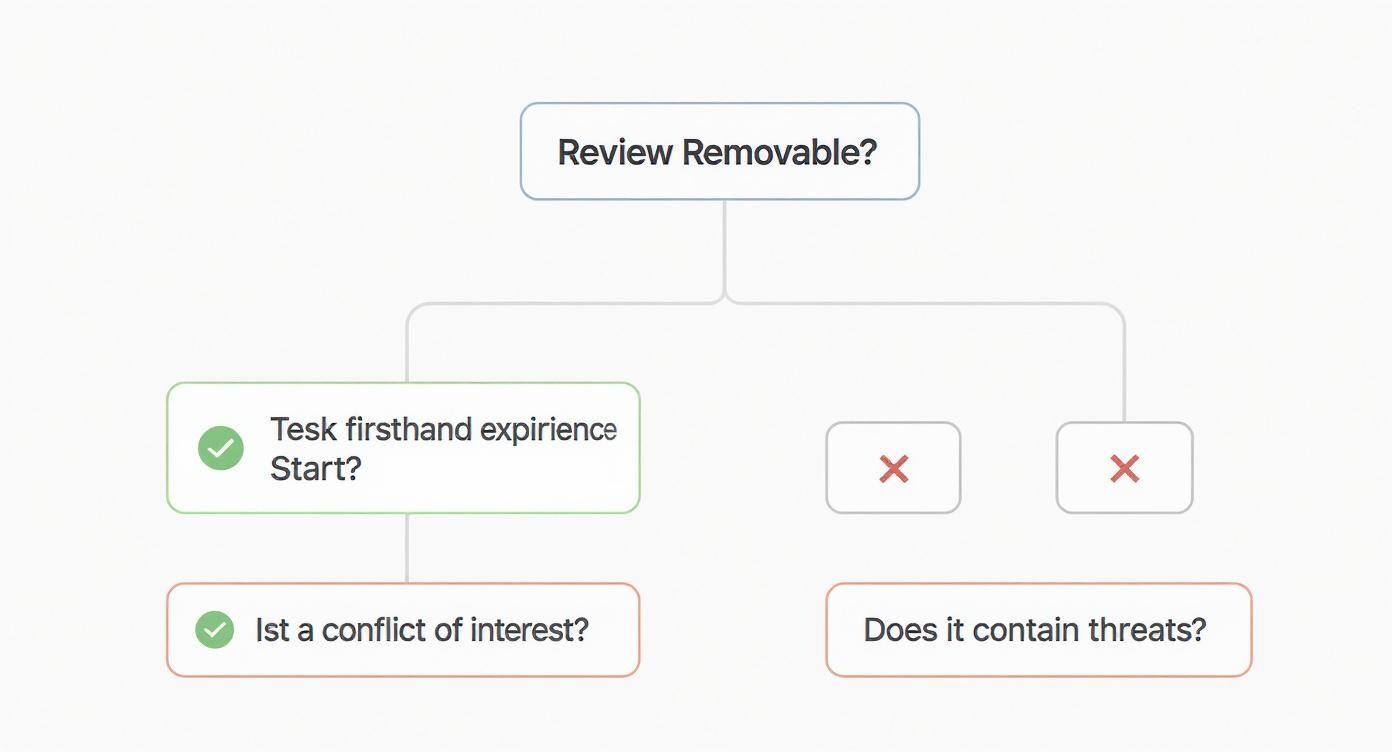
As you can see, proving a lack of firsthand experience or a clear conflict of interest are often your most direct paths to getting a review removed.
What to Do if Your Report is Denied
Don't panic if your first report gets denied. This happens all the time, especially if the violation isn't something an automated filter or a first-level moderator can spot immediately. When Yelp sends the denial email, they usually include a link to appeal the decision. This is your opportunity to get a senior moderator to take a second look.
When you write your appeal, reframe your argument slightly. Assume the first person who reviewed it simply missed your key piece of evidence and make it impossible to ignore this time.
Pro Tip: In your appeal message, lead with a clear statement like, "I am appealing the recent decision on report #[your report number]." Re-attach your evidence and re-state your case, but put your single most compelling fact right in the first sentence.
Patience is a virtue here. The process can feel slow, but persistence often pays off.
Understanding the Timeline and Follow-Up
You should hear back from Yelp within 2-5 business days after flagging a review. If your report is denied and you appeal, that clock essentially resets. It’s a process that requires you to stay on top of things.
If you find yourself juggling multiple reports, you might consider bringing in a professional service that specializes in this. They know the ins and outs of each platform's process and can handle the tedious follow-up. We've put together a guide on how LevelField handles the review removal process that shows what this looks like in practice.
Remember, the idea is to be persistent but not a pest. If your appeal is also denied, that's likely the end of the road for removal. At that point, it’s time to shift your focus to writing a calm, professional public response.
Responding to Negative Reviews You Can’t Remove
Let's be real—sometimes, a bad review is just there to stay. After you’ve gone through the process of flagging and appealing, some critiques will inevitably stick around. When that happens, your public response becomes your most powerful tool. This is your chance to show every potential customer who reads that review that you're professional, empathetic, and in control of the situation.

A well-written reply can do more than just damage control; it can actually win you new business. Think about it: your response isn't just for the person who wrote the review. It’s for everyone else watching from the sidelines. Businesses that take the time to reply are seen as far more trustworthy.
The Anatomy of an Effective Response
Crafting the perfect response is an art. It’s a delicate balance of empathy, professionalism, and strategy. Your goal is never to win an argument online—that’s a battle you’ll almost always lose. Getting defensive or emotional only makes you look bad and, in the eyes of other readers, validates the original complaint.
Instead of a rigid formula, think of it as a simple framework:
- Acknowledge and Thank: Kick things off by thanking them for their feedback, even if it’s harsh. This immediately disarms the situation and shows you're listening.
- Express Empathy: Use phrases like, "We're sorry to hear your experience didn't meet your expectations," or "This isn't the standard of service we strive for." You're validating their feelings without necessarily agreeing with every point they’ve made.
- Touch on the Issue (Briefly): If it’s a legitimate complaint, briefly mention the problem and state that you're looking into it. Keep it short and sweet—no long-winded excuses.
- Take It Offline: This is the most critical part. Offer a direct line of contact, like an email address or a manager's name, and invite them to continue the conversation privately. This proves you're serious about finding a solution and moves a messy public argument behind closed doors.
Handling Legitimate Complaints Gracefully
When a customer has a valid point, your response is a golden opportunity to show you care. Let's imagine a restaurant gets a review about a long wait time and a cold meal.
A poor response might look like this:
"We were really busy on Saturday, and the kitchen was backed up. Other customers seemed happy."
That’s defensive, dismissive, and just makes the business look bad. It completely invalidates the customer's experience.
Here’s an excellent response instead:
"Hi Sarah, thank you for sharing your feedback. We're truly sorry to hear that your visit was disappointing due to the wait and the temperature of your meal. That's certainly not the experience we want for any of our guests. We'd appreciate the chance to learn more and make this right. Please reach out to our manager, David, at david@ourrestaurant.com."
See the difference? This reply is perfect. It acknowledges the specific issues, offers a sincere apology, and gives a clear path to resolution—offline. Future customers reading this will see a business that listens and takes responsibility.
Neutralizing Unfair or Vague Criticism
What about those reviews that just feel unfair? The ones that are exaggerated or so vague you can’t even figure out what happened. For these, your response should be polite but firm. You can calmly correct clear misinformation without picking a fight.
Let's say you get a review that just says, "Terrible service. Avoid."
A professional reply could be:
"We're sorry to hear you had a disappointing experience with us. We're always working to improve our service and would appreciate more specific details about your visit so we can address any issues with our team. Please feel free to contact our management directly at manager@ourbusiness.com when you have a moment."
This response is buttoned-up and professional. It shows you take all feedback seriously, but it also subtly points out the review’s lack of substance to other readers. You're putting the ball back in the reviewer's court and demonstrating transparency.
Your public response is permanent. Before you hit "post," ask yourself: "How will this look to a potential new customer a year from now?" Keep it brief, professional, and resolution-focused.
Remember, the goal isn't always to change the original reviewer's mind (though it’s a nice bonus if it happens). Your real audience is the silent majority of potential customers doing their research. By consistently responding with grace, you build a powerful narrative of a business that listens, cares, and is committed to quality. That’s how you neutralize the impact of a bad review you simply can't delete.
Taking on Defamatory Reviews with Advanced and Legal Options
Sometimes, a bad review isn't just an opinion. It crosses a line into something far more damaging—a deliberate, factually false attack on your business. When you're facing outright defamation, harassment, or even copyright theft within a review, your toolkit needs to expand beyond Yelp's standard flagging process.
Let's be clear: this isn't about trying to erase every negative comment. This is about knowing what to do when a review contains provably false statements of fact that are actively hurting your livelihood. In the legal world, this is called defamation—and in its written form, it's known as libel.
What Actually Counts as Defamation?
It's easy to get emotional, but the law is specific. A customer saying "the service was slow" is an opinion, and it's protected. But a statement like "the owner waters down the drinks" or "the chef uses expired ingredients" is a statement of fact. If you can prove it's false and that it's causing real harm, you might have a case.
To successfully argue for defamation, you generally have to prove a few things:
- A False Statement of Fact: The core of the review has to be a claim you can demonstrably prove is untrue. It can't just be someone's subjective take.
- It Was Published: The statement appeared on a public platform like Yelp where others could see it.
- It Caused Harm: You need to show that the false statement led to tangible damage, like a drop in sales or a client pulling their contract.
The scale of Yelp is staggering. Every minute, an estimated 26,830 new reviews are posted. With over half of consumers checking Yelp before making a decision, a single, potent lie can do an immense amount of damage. For more on the power of online reviews, check out the data on Exploding Topics.
Knowing When to Call a Lawyer
Tackling libel law on your own is a bad idea. If you genuinely believe a review is defamatory, your first move should be to find an attorney specializing in internet law. They'll give you a straight answer on whether you have a legitimate case and map out the best way forward.
One of the first tools a lawyer will use is a cease and desist letter. This is a formal, legally-backed demand sent to the reviewer, telling them to remove the defamatory content immediately. You'd be surprised how often the simple threat of legal action is enough to make the problem disappear without ever seeing a courtroom.
For a deeper dive into the specifics, you can learn more about how to prove defamation in our comprehensive guide.
The DMCA Takedown: A Different Angle of Attack
There's another, more specific path you can take if the review involves stolen content. Did the reviewer lift a professional photo from your website to use in their post? Maybe they took a video you produced and twisted its context.
If a review uses your copyrighted material without permission, you can file a Digital Millennium Copyright Act (DMCA) takedown notice with Yelp. This isn't about the text of the review; it's a legal claim that they are hosting your stolen intellectual property.
The process is straightforward:
- Identify the specific copyrighted work they used (e.g., your photo).
- Pinpoint exactly where it appears in the infringing review on Yelp.
- File an official DMCA complaint through Yelp's designated process.
This is a powerful, niche strategy. It sidesteps the usual review-flagging system and forces Yelp to act on a direct legal claim of copyright infringement. When the situation fits, it can be the fastest way to get a harmful review removed.
Proactive Strategies to Minimize Bad Reviews

Knowing how to get a bad Yelp review taken down is a valuable skill, but frankly, it’s a reactive one. The best long-term strategy is to play offense. You need a system that stops most negative feedback from ever hitting your public profile in the first place.
Think of it as shifting from constant damage control to building an unshakeable positive reputation. When you have a strong foundation of authentic, positive reviews, the occasional bad one looks like what it is—an outlier—instead of a sign of a bigger problem.
Implement a Private Feedback Loop
One of the most effective things you can do is create a private channel for customer feedback. I’ve found that many people post on Yelp simply because they feel like they have no other way to be heard. Give them a direct line to you first, and you can intercept a huge chunk of those would-be negative reviews.
This doesn't have to be complicated. An automated text or email after a purchase or service is a great start.
- Post-Service Surveys: A quick, one-question survey—"How did we do today?"—can immediately flag a customer who had a bad time.
- Dedicated Feedback Email: Set up an easy-to-remember email like
feedback@yourbusiness.comand put it everywhere: on receipts, signs, and your website. - QR Codes: A simple QR code at your register that links to a private feedback form is incredibly effective. People can scan and vent while the experience is still fresh.
The goal here is simple: catch problems while they’re small and fixable. You get the chance to turn a negative experience into a positive one before the customer ever thinks about taking it public.
By creating an internal feedback loop, you're not just preventing bad reviews; you're gathering priceless business intelligence that can help you improve your operations and customer service.
Master the Art of the Follow-Up
Getting the feedback is step one, but what you do next is what really counts. When you get a private complaint, a quick, personal response is non-negotiable. A canned, automated reply will only make things worse.
You need to acknowledge their specific issue, offer a real apology, and propose a concrete fix. That could mean a refund, a discount on their next visit, or a personal call from a manager. That level of personal attention shows you genuinely care, and it can turn a furious customer into a lifelong advocate. It’s also one of the best strategies to improve customer retention you can employ, as it builds loyalty and tackles issues head-on.
Ethically Encourage Positive Reviews
This is a tricky one because Yelp has very strict rules against directly asking for reviews. But you can—and should—create an environment that encourages happy customers to share their good experiences. You just have to be smart and compliant about it.
Here’s how to do it the right way:
- Use Yelp-Branded Materials: Yelp actually provides official "Find us on Yelp" signs, stickers, and web badges. Using their approved materials is a perfectly compliant way to remind customers that you're on the platform.
- Link in Your Email Signature: A small, passive link to your Yelp profile in your business email signature works wonders. It’s not pushy, just a gentle reminder.
- Focus on Exceptional Service: At the end of the day, this is the most powerful tool you have. Deliver an experience so good that customers feel an internal push to tell others about it.
When you pair genuinely outstanding service with these proactive measures, you're not just managing your reputation—you're building a fortress around it.
Answering Your Top Questions About Yelp Review Removal
When you're dealing with a damaging review, a million questions can race through your mind. Your reputation is on the line, and you need straight answers. Let's cut through the noise and tackle the most common questions business owners have about getting a bad Yelp review taken down.
How Long Does Yelp Take to Remove a Flagged Review?
There’s no magic number here, but you can generally expect Yelp’s moderators to look at a flagged review within a few business days—typically somewhere between 2 to 5 days. If you’ve flagged something truly egregious like hate speech or a direct threat, you might see it disappear very quickly.
The timeline really depends on how clear-cut the violation is. A review packed with profanity is an easy call for a moderator. Proving a conflict of interest, on the other hand, requires more digging and can stretch out the process. Keep in mind, if your first report gets denied and you decide to appeal, you're essentially starting the clock over. The best way to get a speedy resolution is to build a rock-solid case with clear evidence right from the start.
Can I Pay Someone to Get Rid of Bad Yelp Reviews?
Tread very, very carefully here. If a company guarantees they can delete any bad Yelp review for a fee, it's a giant red flag. Most of these services are either scams or use shady tactics that violate Yelp's rules. Getting caught could land a nasty "Consumer Alert" badge on your business page, which is often worse than the original review.
Legitimate reputation management companies play by the rules. They can be incredibly helpful in spotting policy violations you might have missed, gathering the right proof, and handling the official flagging process for you. Think of them as experienced guides, not miracle workers. They navigate the exact same system you do, just with more expertise.
The Bottom Line: If a service promises guaranteed removal, run the other way. A real partner helps you build a strong case based on Yelp’s actual policies, they don’t sell you impossible shortcuts.
What If I Threaten to Sue a Customer Over Their Review?
This is a strategy that almost always blows up in a business owner’s face. Trying to scare a reviewer with legal action can ignite the "Streisand Effect"—where your attempt to hide something only makes it a much, much bigger story. Suddenly, a single negative review can morph into a viral news piece about a business bullying its customers.
Beyond the bad press, many states have Anti-SLAPP (Strategic Lawsuit Against Public Participation) laws. These are specifically designed to protect people’s right to share their opinions. If a court decides your lawsuit is just a tactic to silence a critic, you could end up paying their legal bills. Unless a review contains a provably false statement of fact that has caused you direct financial harm (the legal standard for defamation), a lawsuit will likely cause far more damage to your reputation than the review ever could.
Will Responding to a Negative Review Make It More Visible?
This is probably the most common myth I hear, and thankfully, it's completely false. Yelp has stated clearly that a business response does not affect a review's ranking in any way. The algorithm that decides which reviews get top placement looks at things like the reviewer’s history, the date of the review, and votes from other users—not whether you replied.
So, don't ever hold back from posting a professional and calm response because you're worried about "bumping" the review. Your public reply is a powerful reputation management tool. It shows every single person who reads that review that you're listening, you care about feedback, and you're committed to making things right. You're not just writing for the unhappy customer; you're writing for all your future customers.