


Figuring out how to remove bad reviews is one thing, but fully grasping why it's so critical is the real starting point. A single fake comment might seem like a small problem, but it can actively drive away customers, shatter the trust you’ve worked hard to build, and take a real bite out of your revenue.
The True Cost of a Single Bad Review

Before we get into the nitty-gritty of filing takedown requests, let's talk about the actual damage a single illegitimate review can do. It's not just an online annoyance; it's a financial liability that’s out there working against your business 24/7.
That one piece of negative content can instantly undo years of trust-building. For someone just discovering your business, a scathing one-star review is often a deal-breaker, stopping their journey with you before it even has a chance to start.
Differentiating Feedback from Attacks
Of course, not all negative feedback is a four-alarm fire. A review from a genuinely unhappy customer is actually a gift. It's a chance to listen, fix a problem, and show everyone watching that you care. That's just smart business. A malicious attack, on the other hand, is a different beast entirely.
These damaging reviews usually fall into a few familiar buckets:
- Competitor Sabotage: A rival business posts fake, damaging claims to make themselves look better and poach your customers.
- Disgruntled Former Employees: Someone who used to work for you uses their inside knowledge to craft a public narrative that sounds convincing but is completely false.
- Extortion Attempts: A "customer" threatens to post a nasty review (or keep posting them) unless you pay them off or give them free stuff.
- AI-Generated Spam: Automated bots churn out generic, sometimes nonsensical negative reviews just to drag down your rating or probe the platform's defenses.
When you consider how customer reviews influence lead generation, the real cost of letting these attacks slide becomes crystal clear.
High-Stakes Industries
For some businesses, the stakes are much, much higher. Think about law firms, medical clinics, or financial advisors. Their entire business model is built on a foundation of trust and credibility. Here, a single defamatory review can do disproportionate damage by calling their professional integrity into question.
A false accusation of malpractice against a surgeon or unethical behavior by a lawyer can cause immediate and lasting career damage. For them, knowing how to remove bad reviews isn't a marketing task—it's a professional necessity.
The scale of this problem is absolutely staggering. Fake reviews are a plague online. While platforms are getting better at spotting them, millions slip through the cracks. Take Google, for instance—they blocked or removed 240 million policy-violating reviews in 2024 alone, which was a 45% jump from the year before. The economic fallout is massive, with fake content projected to cost consumers over $770 billion globally in 2025.
Identifying what you’re up against is the first, most important move. It dictates your entire strategy. Do you need to craft a thoughtful public response to a real customer, or is it time to build a rock-solid case for removal against a malicious actor? Making that distinction is the cornerstone of defending your reputation.
Building Your Case to Get a Review Taken Down
When you spot a review that feels more like a malicious attack than honest feedback, your first instinct might be to just hit the 'report' button and hope for the best. But if you want to actually get it removed, you need to be much more strategic.
Think of it this way: platform moderators are overworked gatekeepers. They see thousands of flagged reviews a day, and a simple, "This is fake!" complaint is background noise. Your job is to hand them a clean, undeniable, evidence-backed file that makes removing the review the easiest and most logical decision they can make. It takes a bit of detective work, but it’s the only way to reliably clean up fraudulent reviews.
Pinpoint the Exact Policy Violation
First things first, you have to play by their rules. Every platform, from Google to Yelp to Trustpilot, has its own set of detailed content policies. Your mission is to find the specific rule the bad review breaks.
Vague complaints go straight to the bottom of the pile. You need to speak their language.
Instead of saying a review is "unfair," frame it as a clear policy breach:
- Is it a conflict of interest? Maybe you can prove it was posted by a direct competitor or a bitter ex-employee.
- Does it contain hate speech or personal threats? That's a clear-cut violation.
- Is it completely off-topic? For example, someone complaining about your prices when they never even bought anything.
Key takeaway: You're not there to argue whether the review is true or false. You are there to demonstrate, with evidence, that it violates a specific, written policy. This small shift in approach is everything. It changes your request from a subjective plea into a formal violation report, which moderators are required to act on.
Before you submit anything, it's worth getting familiar with the most common violations. They're often quite similar across platforms but have important nuances.
Platform Violation Policies at a Glance
This table is a quick reference for the kind of violations that platforms actually care about. Use it to identify the strongest argument for your takedown request.
| Violation Type | Google Business Profile | Yelp | Trustpilot | Amazon |
|---|---|---|---|---|
| Spam/Fake Content | Prohibited. Includes content not based on a real experience and fake engagement. | Prohibited. Reviews must be from a consumer's first-hand experience. | Prohibited. Must be a genuine purchasing or service experience. | Prohibited. Reviews from non-verified purchases are heavily scrutinized. |
| Conflict of Interest | Prohibited. Reviews from current/former employees, competitors, or owners are not allowed. | Prohibited. Businesses cannot solicit reviews from customers or post about competitors. | Prohibited. Companies cannot review themselves or their competitors. | Strictly prohibited. Sellers cannot review their own products or competitor products. |
| Off-Topic/Irrelevant | Prohibited. Reviews must be about the specific experience with that business location. | Prohibited. Reviews must be relevant to the consumer experience. No rants or political commentary. | Prohibited. Reviews must be about the specific company and the service/purchase experience. | Prohibited. Reviews must be about the product itself, not the seller, shipping, or pricing. |
| Harassment/Hate Speech | Prohibited. Content that harasses, bullies, or incites hatred is not allowed. | Prohibited. Threats, harassment, lewdness, and hate speech are not tolerated. | Prohibited. Defamatory, abusive, threatening, or obscene language is not allowed. | Prohibited. Obscene or harassing content is explicitly banned. |
Knowing these policies inside and out is your biggest advantage. A moderator is far more likely to approve a request that says, "This review violates your conflict of interest policy," than one that just says, "This person is lying."
Gather Cold, Hard Evidence
Once you've identified the violation, it's time to gather your proof. Your goal is to build a case so strong that there's no room for doubt. The more concrete evidence you can provide, the less work a moderator has to do, and the quicker they can justify the removal.
Here’s the kind of evidence that makes a real difference:
No Customer Record: This is your silver bullet. If you can confidently say the reviewer never did business with you, you have a powerful case. Check your CRM, payment systems, email lists—everything. A simple statement like, "We have searched all our records from 2021-2024 and have no customer record under the name 'Jane Smith' or with the email address associated with this profile" is incredibly effective.
Screenshots are Everything: Don't just describe the problem; show it. Take crystal-clear screenshots of the review itself, the reviewer's profile, and any other shady activity you find. Make sure the date and time are visible if possible. A visual record is undeniable.
Suspicious Profile Activity: A little digging can uncover a goldmine. Click into the reviewer's profile. Do they only leave 1-star reviews? Did they suddenly post five negative reviews for local dentists all on the same afternoon? This kind of pattern points to a fake account or a coordinated attack, both of which are usually policy violations. Document it.
This evidence is the foundation of your entire request. It elevates your claim from "I don't like this review" to "Here is objective proof that this review violates your platform's rules."
How to Submit Your Request on the Major Platforms
Every platform has its own bureaucratic maze for reporting reviews. You can't just copy and paste the same complaint everywhere and expect it to work. You have to tailor your approach.
For a Google Business Profile, you start by flagging the review directly from your profile. But don’t stop there. Use Google’s Review Management Tool to track the status and, if necessary, appeal the decision. Be brief but specific. For example: “This review violates the policy on conflict of interest. We have evidence suggesting the reviewer is an employee of a direct competitor, [Competitor Name].”
Yelp is notoriously tough, but they do follow their own rules. When you report a review, you need to clearly connect your evidence to their Content Guidelines. If you suspect a review is from a disgruntled former employee, report it as a conflict of interest and provide any context you can.
On Amazon, reviews are all about the product. If you're a seller, you report problematic reviews through Seller Central. The winning arguments here are usually policy violations like a competitor leaving a review, someone using obscene language, or comments that are exclusively about shipping or price—things Amazon’s guidelines specifically forbid in product reviews.
And with Trustpilot, the focus is on genuine experiences. You can report reviews for not being based on a real purchase or service encounter. Be prepared to provide documentation showing the user was never a customer.
Your first submission is your best chance, so make it count. Write a clear, factual, and unemotional argument supported by all the evidence you’ve gathered. This is a business process, not a personal feud. A well-built case is one a moderator can understand, verify, and close out in minutes.
What to Do When Platforms Delete Good Reviews
We spend so much time focused on removing negative reviews that it’s a real gut punch when the platforms come for the good ones. You know the feeling: a genuinely thrilled customer leaves a glowing five-star review, and you're riding high. Then, a few days later, it's just… gone. Vanished into thin air.
This isn’t just bad luck. Platforms like Google are running aggressive AI systems to fight the tidal wave of fake positive reviews. The problem is, these algorithms can be clumsy, flagging and deleting legitimate feedback without a second thought. This "collateral damage" punishes honest businesses, so you need to understand why it’s happening and what you can do about it.
Why Your Best Reviews Get Flagged
At the end of the day, an algorithm is just looking for patterns—it doesn't understand the human context behind a review. A completely valid piece of feedback can get caught in the spam filter if it accidentally trips one of these common wires.
Here’s what these systems are trained to look for:
- A Sudden Burst of Praise: If you typically get a couple of reviews a month and then suddenly receive ten five-star ratings in one day, the system might assume you're paying for them. This can happen organically after a successful event or a viral social media moment, but the AI doesn't know that.
- Location & IP Address Pings: Multiple reviews coming from the same IP address—like your office Wi-Fi—is a massive red flag. This often happens when well-meaning business owners ask happy customers to leave a review on the spot, using the business's internet.
- Generic, Vague Language: Reviews that just say "Great service!" or "Five stars!" feel empty and can easily be mistaken for low-effort bot spam.
- Suspicious Reviewer Profiles: If the person leaving the review has a brand-new profile with no history, or a history of leaving only perfect five-star reviews for everyone, the algorithm might see their feedback as less credible.
The process for fighting to get a good review reinstated is almost identical to getting a bad one removed. It all comes down to evidence and a clear argument.
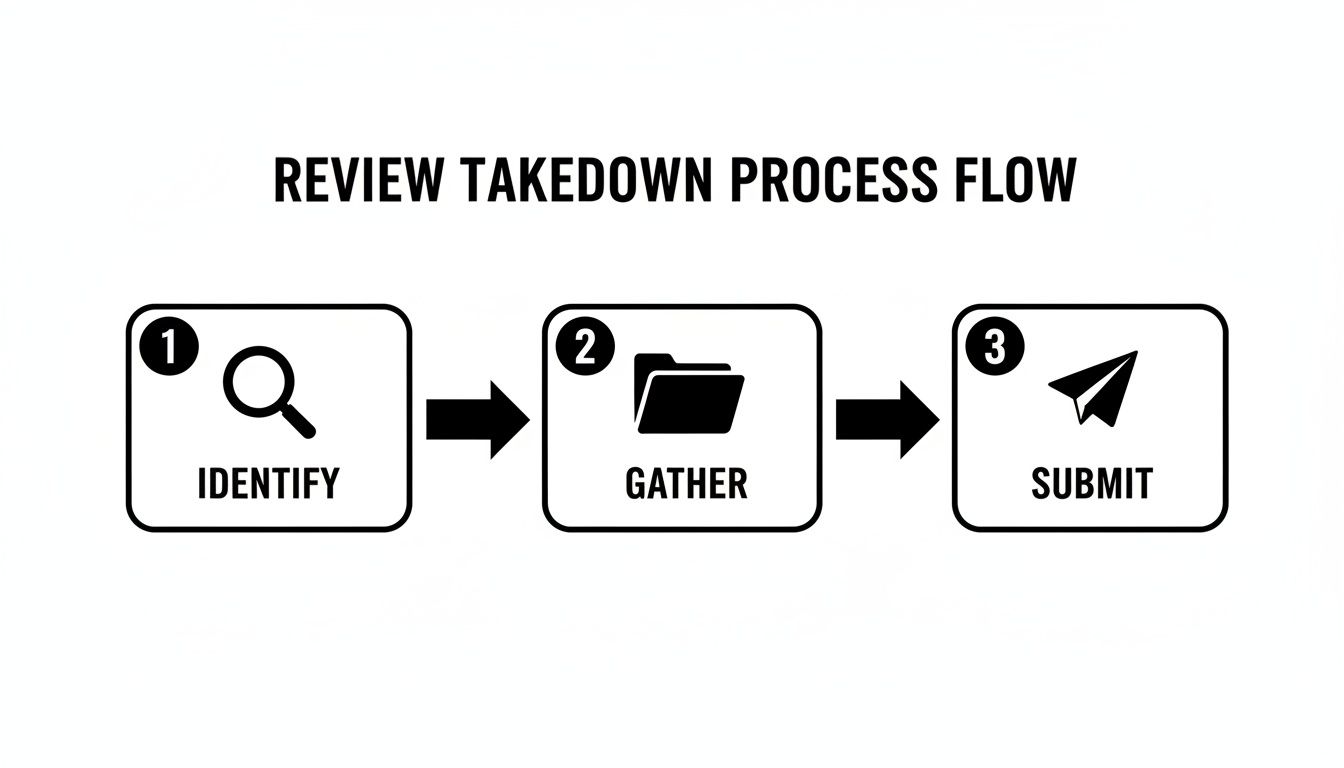
Whether you're trying to save a good review or remove a bad one, the core principle is the same: success depends on organized documentation and a clear, policy-based case.
Appealing an Unfair Positive Review Removal
If you're confident a legitimate review was deleted by mistake, you absolutely should appeal it. There’s no guarantee it’ll work, but a well-prepared appeal gives you the best shot.
Your first move should be to contact the customer who left the review. Politely ask if they happen to have a copy of what they wrote. Their original text is gold for your appeal. From there, you'll need to contact platform support. For Google, the best place to start is usually the Google Business Profile support forum.
When you write your appeal, be direct and clear. Explain why you believe the removal was an error and provide any context that supports your case. Mentioning a recent event or promotion that led to a natural spike in customer feedback can be incredibly helpful.
Pro Tip: Don't just insist the review was "real." Give them a narrative. For instance: "This review was from a client who attended our annual open house on May 15th, where many attendees shared their positive experiences on their own phones." This gives the support team a concrete reason to dig deeper.
This problem is getting worse, not better. In 2025, we saw Google’s deletion rates spike by over 600% in just seven months. What's shocking is that somewhere between 42-45% of those deleted reviews were perfect five-star ratings. The data suggests these AI systems are heavily biased toward removing positive feedback, as they're tuned to fight the fake reputation-boosting that platforms see as a bigger threat. You can learn more about Google's AI-driven takedowns and their impact.
Ultimately, prevention is much easier than a cure. When you ask for reviews, encourage your customers to be specific and detailed. Gently remind them to write it from their own device and network when they get a moment. This helps their feedback look authentic to both the algorithms and, more importantly, to your future customers.
Advanced Strategies When Takedown Requests Fail
So, you’ve done everything by the book. You found a clear policy violation, compiled airtight evidence, and sent off a perfectly worded takedown request. Then, days or even weeks later, you get that gut-punch of an email—usually an automated one—saying the review doesn't violate their policies.
It’s frustrating, but this isn't the end of the line. It's just a signal that you need to escalate, especially when a review is causing real financial or reputational damage. When the platform’s first line of defense fails you, it’s time to move beyond their standard channels and apply a different kind of pressure.
Knowing When You Can Take Legal Action
Before you start drafting legal threats, you have to be crystal clear on the difference between a negative opinion and an outright lie. A customer saying, "The service was slow and overpriced," is just their subjective opinion. It stings, but it’s legally protected speech.
But what if the review claims, "The contractor stole jewelry from my home"? That’s a statement of fact, something that can be proven true or false. If it's false and it's damaging your reputation, it might cross the line into defamation (or libel, since it's written). This is the legal ground you’ll stand on for most advanced removal tactics. You're no longer just trying to remove a bad review; you're fighting to get a false, damaging statement taken down.
Crafting a Formal Legal Notice
A formal legal notice is your way of getting past the frontline content moderators and directly into a platform's legal department inbox. It’s a professional, concise document that shows you’re serious and prepared to go further if needed.
Your notice needs to be direct and to the point. Include these key elements:
- Pinpoint the Problem: Provide the exact URL of the review and a screenshot for their records.
- State the Falsehood: Clearly and specifically call out which claims in the review are factually untrue.
- Show Your Proof: This is crucial. Attach evidence like customer records (or the lack thereof), timestamps, emails, or anything else that directly contradicts the reviewer's claims.
- Cite the Legal Basis: Mention the relevant legal issue, usually defamation, and briefly explain how the false statements have caused tangible harm to your business.
This isn’t the place to get emotional or tell a long story. Keep it factual and present your case as a lawyer would. The goal is to make it obvious to their legal team that the content is a liability they should probably address.
Sending a Cease and Desist Letter
While a legal notice is aimed at the platform, a cease and desist letter goes directly to the person who wrote the review (if you can figure out who they are). This is a more direct and often more intimidating step, formally demanding that they remove the defamatory content and stop making false statements.
This approach works best when a few things are true:
- You know who the reviewer is. It’s pretty hard to send a letter to an anonymous username.
- You can prove clear financial harm. Have you lost clients who mentioned the review? Document it.
- The claims are demonstrably false. The more absurd the lie, the stronger your position will be.
Often, the threat of legal trouble is enough to make a reviewer think twice and take the post down themselves. It sends a clear message: you will defend your reputation. For a deeper dive into managing this kind of harmful content, our guide on how to remove negative search results offers more strategies.
The Last Resort: A Court Order
If both the platform and the reviewer dig in their heels and refuse to budge, your final option is to get a court order. This is a legally binding document from a judge that orders a platform like Google or Yelp to remove the specific content in question.
A court order is the most powerful tool in your arsenal. Platforms are legally obligated to comply with one, making removal virtually guaranteed once it's in your hands.
The process usually means filing a lawsuit against the reviewer (sometimes named as "John Doe" if they're anonymous) and proving to a judge that the statements are defamatory. Once you've made your case, the court can issue the order. Yes, it’s the most expensive and time-consuming route, but for exceptionally damaging reviews that won't go away, it's also the most surefire solution.
DIY vs. Professional Help: Making the Right Call
Deciding whether to roll up your sleeves and tackle a bogus review yourself or call in a professional is a critical first step. It's a choice that directly impacts your time, budget, and, most importantly, how quickly you can stop the damage. There’s no single right answer here—the best move depends entirely on the nature of the attack and the resources you have at your disposal.
For many businesses, going the DIY route seems like the obvious choice at first. If you’re dealing with a single, blatantly fake review on Google from someone you can prove never did business with you, handling it in-house is often the quickest path. You've got the records, you know the real story, and you can fire off a violation report in minutes. This is the low-hanging fruit of review removal.
But the moment things get more complicated, a DIY approach can quickly turn into a frustrating, time-sucking dead end.
When to Handle Review Removal In-House
A hands-on approach works best in straightforward situations. If you have someone on your team who can dedicate a few hours to the process without letting their main responsibilities slide, it's a perfectly good option. You should feel confident going it alone if your situation looks like this:
- Low Volume: You're dealing with one or two isolated reviews, not a coordinated barrage of negative comments.
- Clear Violation: The review is an obvious breach of the platform's rules—think spam, hate speech, or a competitor leaving a fake review.
- A "Smoking Gun": You have undeniable proof, like CRM data showing the reviewer was never a customer or screenshots of the exact same review plastered across multiple business profiles.
- Familiar Ground: You're already comfortable navigating the reporting tools on platforms like Google or Facebook.
Red Flags That Signal You Need an Expert
The game changes completely when you're facing a more sophisticated or widespread attack. The time, energy, and specific expertise needed to fight these battles can quickly overwhelm a business, allowing the negative content to sit there and do more harm every day. It's time to bring in a professional when you see these warning signs:
- Coordinated Attacks: You get hit with a sudden wave of negative reviews in a short time, often using similar phrasing. This almost always points to a targeted campaign from a competitor or a disgruntled ex-employee.
- Defamatory or Legal Trouble: The review contains serious, false accusations of illegal activity, professional misconduct, or other claims that could do real legal damage to your business or reputation.
- Fighting on Multiple Fronts: The problem isn't just on Google. The same damaging content is popping up on Yelp, Trustpilot, industry forums, and social media ads.
- The Platform Pushes Back: You’ve already tried reporting the review with clear evidence, but the platform has rejected your takedown requests. This is where expertise really matters.
This dilemma is very similar to what sellers face with an Amazon account suspension. Deciding whether to handle it yourself or hire specialized Amazon reinstatement services comes down to the same factors. In both scenarios, an expert understands the platform’s internal processes and can build a much more compelling case than an outsider can.
The real value of a professional service isn't just about saving time; it's about their deep expertise. They know the unwritten rules, the specific language that gets a moderator's attention, and the escalation paths a business owner might not even know exist.
Making the Decision: An In-House vs. Professional Service Breakdown
To make the choice clearer, think about your specific situation. A simple, one-off issue is very different from a sustained, multi-platform attack. This table can help you map your problem to the right solution.
Deciding Your Approach In-House vs Professional Service
| Scenario | Recommended for In-House (DIY) | Recommended for Professional Service |
|---|---|---|
| A single, clearly fake review on Google | Yes, this is a perfect DIY task. | Overkill, unless your initial attempts fail. |
| A negative but policy-compliant review | No. Focus on a public response instead. | No. Professionals can't remove legitimate opinions. |
| Sudden blast of 10+ negative reviews | No, this is a clear sign of a coordinated attack. | Yes, they can identify patterns and build a stronger case. |
| Reviews containing defamatory claims | No, the legal risk is too high. | Absolutely. They can work with legal counsel if needed. |
| A stubborn review that's been rejected | No, you've hit the limits of the standard process. | Yes, they know the escalation paths and appeals process. |
| Negative content across multiple sites | No, this requires a coordinated, time-intensive effort. | Yes, this is their core strength. |
Ultimately, bringing in an expert is about protecting your brand's value and freeing up your internal resources to focus on what they do best: running your business.
Thinking Through the Cost vs. Benefit
The decision often boils down to a simple question: What is your time worth, and what is the real cost of letting that review stay up? An employee spending 10 hours fighting a review is 10 hours they aren't spending on sales, customer service, or growing the business. You're paying for that time, whether you get the review removed or not.
Now, think about the lost revenue. For a local contractor, a single prominent one-star review can scare off dozens of potential customers every week. The fee for a professional service is often a fraction of the revenue you're losing every single day that review remains online.
Professional online reputation management services are built to manage this entire workflow. They handle the investigation, evidence gathering, submissions, and all the follow-up, letting your team stay focused. An experienced partner will almost always have a higher success rate and get it done faster, simply because this is what they do all day, every day. They aren't learning on the job—they’re applying a proven process to protect your brand.
Common Questions About Removing Bad Reviews
When you're dealing with a bad review, it's easy to feel frustrated and even a bit lost. The process can feel confusing and, frankly, unfair. Let’s tackle some of the biggest questions I hear from business owners so you can move forward with confidence.
How Long Does It Take to Get a Bad Review Removed?
This is always the first question, and the honest answer is: it depends. The timeline for getting a bad review taken down varies wildly from one platform to the next, and it's heavily influenced by the specifics of your case.
On Google, a clear-cut violation like hate speech or an obvious conflict of interest might be resolved in just 3 to 7 business days. But if the issue is more nuanced and requires a human moderator to dig in, you could be looking at several weeks. A well-documented report with solid evidence will always get faster results than a vague complaint.
Every platform has its own pace.
- Yelp often responds within a few days, but they are notoriously strict about what they consider a policy violation.
- Amazon can be a real mixed bag. Some reports get handled in a day, while others seem to disappear into a void.
- Trustpilot is generally pretty responsive, especially if you have proof the reviewer was never a real customer.
If you have to escalate with a court order, buckle up for a much longer wait. This moves the request to a different legal department and can easily take a month or more. Your best bet for a speedy resolution is always a high-quality initial report.
Can I Pay to Have Bad Reviews Removed?
Let's get this out of the way right now: you should never pay a reviewer to take down their post or hire a shady service promising guaranteed removals for a flat fee. It’s a terrible idea. At best, you’re violating platform policies, which can get your business profile penalized or suspended. At worst, you're opening yourself up to accusations of bribery or extortion.
That said, there is a legitimate way to pay for help. You can hire a professional reputation management service. These firms aren't paying anyone off. Think of them as your legal representatives in the court of online opinion.
A legitimate reputation service leverages its deep understanding of platform policies to build the strongest possible case for removal. You're paying for their time, expertise, and proven process—not a back-alley deal.
These specialists know exactly what evidence to gather, how to frame an argument that gets a moderator’s attention, and which escalation paths to use if your first request is denied. It's a service designed to maximize your chances of a successful, policy-compliant removal.
What Should I Do About a Review from a Real but Unhappy Customer?
This is where your strategy shifts from removal to response. If a review is from a genuine customer, you shouldn’t try to remove it unless it clearly breaks a rule (like using slurs, sharing private info, or making threats). Trying to silence legitimate feedback, even when it stings, almost always backfires.
Instead, respond publicly, professionally, and with empathy.
- Acknowledge their complaint without getting defensive. A simple, "We're sorry to hear your experience didn't live up to expectations," can defuse a lot of tension.
- Briefly state facts if you need to clarify something, but never get into a public argument.
- Offer to take the conversation offline. Provide a direct contact email or phone number and invite them to discuss the matter privately so you can resolve it.
A thoughtful, professional response shows potential customers that you take feedback seriously and are committed to making things right. It demonstrates integrity and can actually be more powerful than another five-star review.
Can I Sue Someone for a Fake Negative Review?
Yes, you can absolutely sue over a fake negative review, but it's a serious and costly endeavor. The legal claim is usually defamation—specifically libel, since it's written. To win a case like this, the burden of proof is on you.
You have to show the court that the review contains false statements of fact (not just opinion) and that those lies caused measurable financial harm to your business. For example, "The food was bland" is an opinion. "The kitchen is infested with roaches" is a statement of fact that can be proven true or false.
The big catch? Lawsuits are expensive and drag on for months, or even years. The first major hurdle is often just identifying the anonymous reviewer. You’d likely have to file a "John Doe" lawsuit and then get a court order compelling the platform to unmask the user. For most small businesses, focusing on platform removal channels or hiring a specialist is a far more practical first step.