


Finding harmful or false information about you online can be deeply unsettling. It’s easy to feel a surge of panic, but the best response isn't a scramble—it's a deliberate, methodical approach. The game plan is actually quite simple: Find it, document it, and then act on it. This core strategy is your foundation for taking back control.
Your First Steps in Tackling Unwanted Online Content
When you stumble upon a fake review, a misleading article, or an impersonation account, that initial gut punch is real. The trick is to pivot from that reactive feeling to a proactive, structured plan. The first phase is all about investigation and gathering solid evidence. Think of yourself as a digital detective on your own case.
Start by systematically hunting down every single instance of the damaging content. Don't just do one search on Google. Use multiple search engines (Bing, DuckDuckGo) and experiment with different keyword combinations involving your name or business. You need to dig past the first page of results to get a complete picture.
Document Everything Meticulously
Once you've located the problematic content, your next move is arguably the most important: document everything with precision. I can't stress this enough—if you don't have concrete proof, your requests for removal will likely go nowhere.
Build a case file for yourself. It should include:
- Screenshots: Take full-page screenshots of the content. If you can, make sure the URL in the address bar and the date and time on your computer are visible.
- URLs: Copy and paste the exact web address for every single page where the content appears. A simple text file or spreadsheet works perfectly for this.
- Timestamps: Jot down the date and time you discovered each piece of information. This helps establish a clear timeline of events.
This evidence is the bedrock of your entire effort. It's what you'll use when you contact website administrators, platform moderators, or, if things escalate, a lawyer.
Understanding Your Removal Options
With a solid file of evidence in hand, you can start looking at your options for getting the content taken down. Generally, there are three main avenues you can go down. The entire process really boils down to finding the content, documenting it, and then taking decisive action.
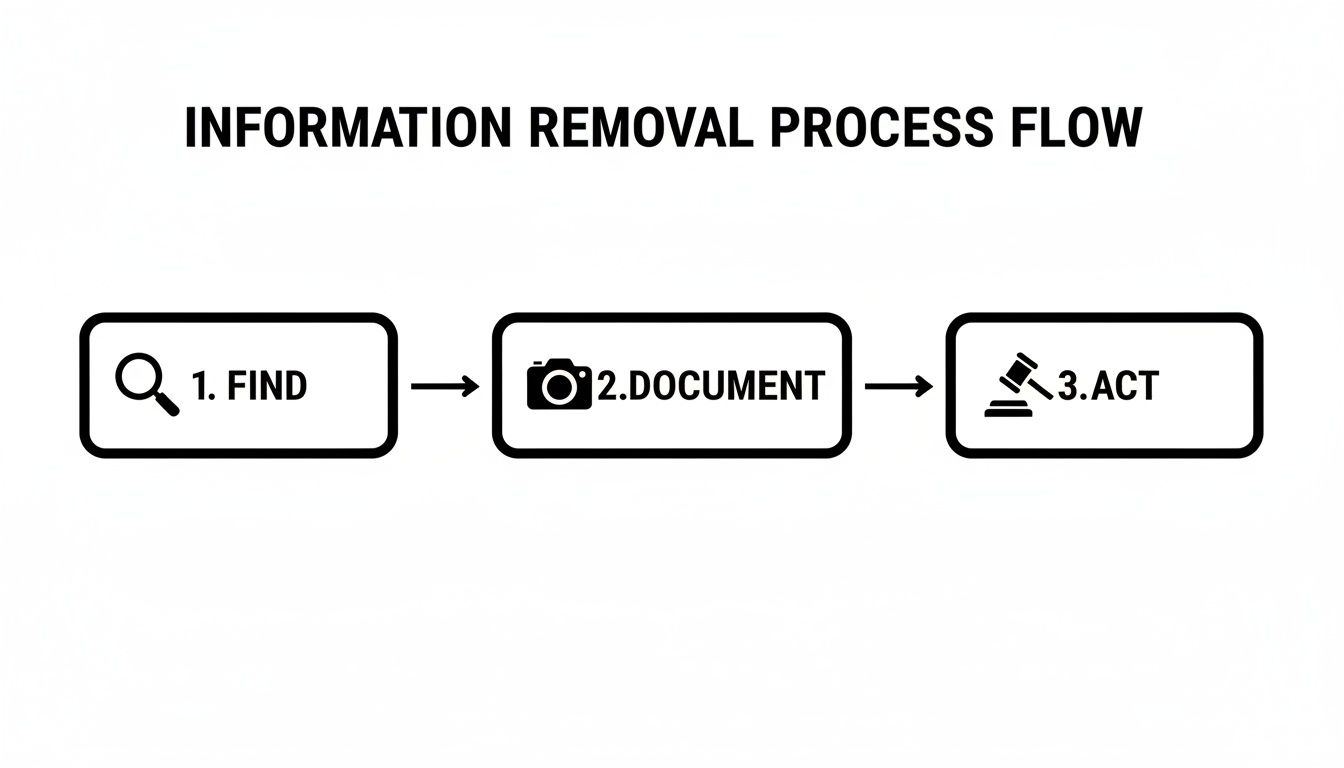
This simple workflow—Find, Document, Act—is your repeatable game plan for any removal effort.
One of the most effective strategies is to focus on search engines themselves. By using methods for removing indexed pages from search engines, you can make the content practically invisible to the public, even if the original page still exists somewhere online.
Taking control of what appears online is a fundamental part of modern brand protection. A proactive and informed approach ensures that you're not just reacting to problems but actively shaping your digital presence. For more insights, our guide on https://levelfield.io/blog/managing-your-online-reputation offers deeper strategies.
When you get down to it, your options are:
- Direct Platform Requests: Go straight to the source. Contact the website owner or use the platform’s built-in reporting tools (like the "report post" function on social media).
- Legal Notices: When the content crosses a legal line (like defamation), you can send formal requests, such as a cease and desist letter.
- Professional Services: If the situation is complex or you're short on time, you can hire a reputation management service to handle the entire process for you.
Knowing these paths from the beginning gives you a huge strategic advantage, letting you pick the best route for your specific situation.
Navigating Specific Platform Takedown Procedures
With your evidence in hand, it's time to go directly to the source. Every social network, review site, and online marketplace has its own rulebook for what's allowed on their turf. Getting something taken down is less about demanding it and more about understanding their specific rules and framing your request in a language they understand.

Simply hitting the "report" button and hoping for the best rarely works. You need to build a concise, compelling case that clearly shows how the content violates a specific term of service. A generic complaint gets you a generic (or no) response, but a targeted request that does the work for the moderator is far more likely to succeed.
Tackling Social Media Giants
Social media platforms are constantly battling a tidal wave of content, which means their moderation systems are built for volume. The trick is to flag your issue in a way that their teams can quickly identify and act on. Things like harassment, hate speech, impersonation, and direct threats are almost always on their high-priority list.
And they do act. Statista found that in just one quarter of 2023, Meta removed a staggering 18 million pieces of hate speech content from Facebook alone. That’s on top of millions of other posts flagged for bullying and graphic violence. TikTok and LinkedIn are similarly removing hundreds of thousands of posts. The systems are there, you just have to know how to use them.
When you file your report, be surgical. Don't just say a post is "offensive." Instead, be specific: "This comment violates your community standards on harassment by using targeted, abusive language." Always provide a direct link to the post or profile and attach the screenshots you’ve already collected as proof.
Removing Defamatory Online Reviews
A fake or malicious review on Google, Yelp, or Trustpilot can poison your reputation. Fortunately, these platforms have policies against reviews that aren't based on a genuine customer experience. Your job is to prove the review is fraudulent.
When you make your case, zero in on clear policy breaches. Common violations include:
- Conflict of Interest: The review is from a competitor, a bitter ex-employee, or someone you have no record of ever serving.
- Harassment or Hate Speech: The language is abusive, discriminatory, or makes threats.
- Off-Topic Content: The review is a rant about politics or something else totally unrelated to your business.
- Impersonation: The reviewer is clearly pretending to be someone they're not.
In your takedown request, spell it out. If you can't find the reviewer in your customer database, say so. While they won't remove it just on your say-so, that context is crucial for the moderation team. For a deeper dive, this guide on how to remove negative links from Google search offers some great related strategies.
Addressing Marketplace and E-Commerce Issues
If you sell on platforms like Amazon, Etsy, or eBay, you're more likely to run into counterfeit listings or intellectual property (IP) theft. The good news is that these marketplaces take IP violations extremely seriously to protect themselves from liability.
If someone is stealing your copyrighted photos or selling knock-offs of your trademarked product, you can file a formal IP infringement complaint. This is a much more formal process than a standard content report and will require you to provide proof of ownership for your copyright or trademark.
Pro Tip: Make the moderator's job easy. When reporting IP theft, provide direct links to the infringing listing and to your own original product page or website. This side-by-side comparison makes the violation undeniable and can significantly speed up the removal.
To make this process a bit easier, here’s a quick-reference table for some of the biggest platforms.
Platform Takedown Request Guide
| Platform | Common Violations to Cite | Where to Report |
|---|---|---|
| Fake engagement, hate speech, harassment, impersonation, non-customer review. | Google Business Profile Help | |
| Bullying & harassment, hate speech, nudity, intellectual property theft. | Directly on the post, or via the Facebook Help Center | |
| Impersonation, hate speech, self-injury, sale of illegal goods, IP violations. | Report directly on the post, comment, or profile. More info at the Instagram Help Center. | |
| Yelp | Not a firsthand experience, conflicts of interest, harassment, private information. | Find the review, click the three dots, and select "Report Review." |
| Amazon | Counterfeit products, trademark infringement, copyright infringement (e.g., images). | Use the Report Infringement Form. |
This table is a starting point, as policies can change. Always check the platform's latest community guidelines before submitting a report.
Ultimately, success comes down to the same core principles, no matter the site: be precise, be persistent, and anchor your argument in their own rules. Keep emotion out of it; stick to the facts and your evidence. If your first request is denied, don’t just give up. Read their reasoning, see if you can provide more evidence, and try an appeal. It takes patience, but a methodical approach always wins in the end.
Moving Beyond Platform Reports: Your Legal and Regulatory Toolkit
So, you've filed the reports, followed the platform's rules, and… nothing. The harmful content is still live. It's a frustrating spot to be in, but it’s far from a dead end. When a platform's internal tools don't get the job done, it's time to bring out the bigger guns.
Think of it this way: your initial reports are the first line of defense. Legal and regulatory options are the heavy-duty reinforcements you call in when that line is breached. These aren't just suggestions; they carry real authority and can force action where a simple user report might be ignored. Knowing when and how to use them is the key.
The Cease and Desist Letter: A Formal Warning Shot
Often, the first move up the legal ladder is sending a cease and desist letter. This isn't just an angry email—it's a formal document, usually drafted by a lawyer, demanding that the person or entity responsible stops their harmful actions and removes the content in question.
The letter lays out the legal grounds for your request, whether it's defamation, copyright infringement, or harassment, and puts the recipient on notice that you're prepared to take things further. For many, the threat of a lawsuit is enough. Faced with the potential time, cost, and risk of a legal battle, they often decide that simply taking down the post is the path of least resistance. It's a surprisingly effective step that can resolve the matter quickly and without ever setting foot in a courtroom.
Using Data Privacy Laws to Your Advantage
Data privacy laws have become a game-changer for individuals trying to regain control of their online footprint. The two heavy hitters here are Europe's General Data Protection Regulation (GDPR) and the California Consumer Privacy Act (CCPA). These laws establish a "right to be forgotten," giving you the power to request the deletion of your personal data under specific conditions.
This isn't a blanket right to erase anything you don't like, but it's powerful when the criteria fit. You can often make a strong case for removal if the information is:
- Outdated or no longer relevant for the purpose it was collected.
- Published without your consent in the first place.
- Factually inaccurate and causing you harm.
Navigating these regulations requires a bit of homework. For example, understanding the nuances of data management, as detailed in this practical AI GDPR compliance guide, can give you a better grasp of what's possible. When you file a request under GDPR or CCPA, you’re not just asking nicely—you're exercising a legal right.
The Ultimate Step: Securing a Court Order
For the most stubborn and damaging content, a court order is the final word. This is a binding directive from a judge that legally requires a website, hosting company, or search engine to remove specific material. It’s the most powerful tool in your arsenal, typically used in serious cases of defamation or illegal activity where all other attempts have failed.
Yes, getting a court order is a serious undertaking. It means filing a lawsuit, presenting your case, and getting a favorable judgment. It can be a long and expensive road. But its effect is absolute. Once a court order is issued, compliance isn't optional.
This isn't a rare occurrence anymore. Since 2020, Google alone has received nearly 330,000 content removal requests from governments and courts. That number is growing at a staggering 34% annually, showing just how often legal channels are now used to force action. You can see more on these global content removal trends to understand the scale.
The trend is clear: when platforms won't act, the legal system provides a structured and authoritative path forward. If your legitimate requests are being ignored and the content is causing real damage to your reputation or finances, it might be time to stop clicking "report" and start talking to a legal expert.
DIY or Hire a Pro? Making the Right Call for Online Content Removal
You've mapped out the problem and know the pathways for getting unwanted content taken down. Now comes the big question: Should you tackle this yourself, or is it time to bring in the professionals?
There's no single answer that fits everyone. The best path forward really boils down to the complexity of your situation, how much time you can spare, and frankly, your tolerance for a process that can be incredibly frustrating.
The Case for Rolling Up Your Sleeves
Going the DIY route is tempting, mainly because it doesn't cost anything upfront. If you're dealing with a simple, one-off problem—say, a single fake Google review that clearly breaks their rules—handling it yourself is often the most sensible option. You can report it, submit your proof, and often get it resolved without spending a dime.
But the "free" part comes with a catch. The learning curve is steep, and it almost always takes more time than you think. Every platform has its own maze of policies and reporting procedures. One small mistake in how you frame your request can get it rejected, sending you right back to the start. This approach requires serious patience and an eye for detail.
When Does the DIY Approach Make Sense?
Think of the DIY approach like basic home maintenance. You can probably fix a leaky faucet yourself, but you wouldn't attempt to rewire the whole house without an electrician.
Going it alone is a solid choice if your situation involves:
- A single, obvious violation: A defamatory review, a clear-cut impersonation account, or a product listing using your copyrighted photo on one platform.
- You have time to spare: You can dedicate the hours needed to research policies, draft persuasive requests, and follow up relentlessly.
- The emotional stakes are low: You're able to treat it like a business task and not let the frustration get to you.
The biggest hidden cost of DIY is the emotional and mental toll. Having to repeatedly look at and document harmful content can be incredibly draining and pull your focus away from what really matters—running your business.
Remember, a "no" from a platform isn't necessarily the final word. But appealing that decision often requires a much deeper understanding of their rules and a completely different workflow. This is where the time and stress can really start to snowball.
When to Call in a Professional Service
As soon as the problem gets complicated or starts spreading across the web, the value of a professional reputation service becomes crystal clear. These aren't just people sending emails for you; they bring specialized expertise, established processes, and sometimes even direct platform relationships to the fight. Companies like LevelField live and breathe this work, so they can navigate the system far more effectively than an outsider ever could.
Hiring a professional is the smart move when you're facing:
- A widespread negative attack, with false information popping up on multiple review sites, blogs, and social media channels.
- Stubborn content that you’ve already tried to remove without success and now requires a more advanced strategy.
- A lack of time or internal resources to handle the meticulous documentation and persistent follow-up that complex cases demand.
- The need for total confidentiality, as a service can act as a buffer, shielding you from direct contact with platforms or the people posting the content.
These firms often have access to back-end reporting portals and industry contacts that the general public doesn't. This inside track can dramatically speed up the removal process. Their experience means they know exactly which policy violation to cite and what kind of evidence will give your case the best shot at success.
Comparing DIY vs Professional Removal Services
So, how do you make the final call? It starts with an honest look at the scale of your problem. A single inaccurate business listing is a manageable DIY project. A coordinated smear campaign with dozens of fake reviews and attack websites is a job for a professional.
This table breaks down the key trade-offs to help you decide.
| Factor | DIY Approach | Professional Service (e.g., LevelField) |
|---|---|---|
| Cost | Free (monetarily) | Paid service with a clear scope of work. |
| Time Investment | High. Involves research, drafting, follow-up, and appeals. | Low. The service handles the entire process for you. |
| Expertise | You have to become an expert on platform policies overnight. | Deep, pre-existing knowledge and established processes. |
| Success Rate | Variable and often lower, depending on your persistence and the case. | Typically very high (95% for some services) due to experience. |
| Emotional Toll | Can be significant, requiring you to constantly engage with the negative content. | Minimal. They handle the stressful parts so you can focus on your work. |
| Best For | Isolated, clear-cut violations on a single platform. | Complex, widespread, or persistent content issues. |
Ultimately, choosing how to tackle unwanted online content is a strategic business decision. You have to weigh the immediate cost savings of a DIY approach against the long-term value of getting a fast, successful, and stress-free resolution from a team of experts.
Building a Proactive Defense for Your Online Reputation
Playing whack-a-mole with negative content is a losing game. A far better strategy isn't about scrubbing every last bad comment from the internet—that's often impossible. It's about building such a powerful and positive digital footprint that the occasional negative item simply gets drowned out. This proactive mindset shifts reputation management from a frantic, reactive chore into a steady, deliberate business practice.

Think of it as building a digital fortress. A single negative review or a snarky social media post can’t do much damage if it’s surrounded by a high wall of authentic, positive feedback and valuable content. You're creating a buffer that protects your brand from the inevitable bumps in the road.
Set Up Your Digital Early Warning System
You can't fight what you can't see. The very first move in building a proactive defense is to set up a reliable way to monitor mentions of your name or your business online. This doesn't have to be a complicated or costly affair.
For most people, the best place to start is with Google Alerts. It's completely free and surprisingly effective. Just plug in your name, your company’s name, and maybe a few product names, and Google will email you whenever they pop up in new articles, blogs, or web pages.
If you need more horsepower, paid platforms can scan deep into social media, forums, and niche review sites. While these tools offer deeper insights, they're often overkill for small businesses. The main goal is just to have some kind of system in place so you’re not the last to know what people are saying about you.
Build Your Digital Fortress with Positive Content
Once you’ve got your alerts set up, the real work begins. The objective is simple: dominate the first page of Google search results for your name with content you own and control. When a potential customer looks you up, you want them to find a trove of positive, professional, and genuinely helpful information.
This body of positive content acts as a natural suppressor. It pushes any rogue negative results down to the second or third page of search results, where they’re far less likely to be seen.
Consider this: 89% of consumers say they read reviews before making a purchase. If the first page of your search results is packed with glowing testimonials and well-written articles, that one negative review hiding on page two loses nearly all of its sting.
Here’s how you can start building that positive presence:
- Encourage Authentic Reviews: Don't be shy about asking your happy customers to leave a review. A steady stream of 4- and 5-star feedback on Google, Yelp, or industry-specific sites is your strongest defense against the occasional disgruntled one.
- Publish Valuable Content: Start a blog. Write helpful guides. Post insightful articles on your LinkedIn profile. Every piece you publish establishes you as an authority and gives you one more asset you control in search results.
- Maintain Professional Social Media: Claim your brand’s name on social media platforms that are relevant to your field. Keep the profiles active, professional, and consistent with the voice you want to project.
Secure Your Accounts to Prevent Impersonation
A critical, and often overlooked, part of your defense is basic digital security. A compromised social media or email account can instantly become a reputation nightmare, with an attacker posing as you or your business.
Good security hygiene can stop a crisis before it even starts. These two practices are non-negotiable for any important account:
- Use Strong, Unique Passwords: Stop using "Password123" and never reuse passwords across different services. A password manager is the best tool for this job—it creates and remembers complex passwords for you.
- Enable Two-Factor Authentication (2FA): This adds an essential layer of security. Even if someone steals your password, they can't log in without a second piece of information, usually a code sent to your phone.
These preventative steps are your first line of defense. By actively monitoring what's said about you, building a buffer of positive content, and locking down your accounts, you create a resilient online reputation that can weather just about any storm.
Answering Your Biggest Questions About Online Content Removal
When you're trying to get something taken down online, it can feel like you're navigating a maze in the dark. You're left with a lot of questions and not a lot of clear answers. Let's shed some light on the most common concerns I hear from people and set some realistic expectations for the road ahead.
How Long Does This Actually Take?
Everyone wants to know the timeline, but the honest answer is: it varies wildly. There’s no magic number.
A simple, slam-dunk case—like a fake Google review that's obviously spam—might get zapped in just a couple of days. Platforms have automated filters that are pretty good at catching these clear-cut policy violations.
The moment a human needs to get involved, though, the clock slows way down. For more complicated issues like defamation, harassment, or someone impersonating you, you're likely looking at a timeline of several weeks to a month. A real person has to investigate, look at the evidence you’ve provided, and make a judgment call. If your first request is denied and you have to appeal, that tacks on even more time.
And if you have to escalate things legally? That’s a whole different ballgame. A cease and desist letter might get a reply within a week, but if it's ignored, you're looking at a much longer process. Getting a court order is a marathon, not a sprint, and can easily stretch out for months.
Here's the one thing you can control: the quality of your initial takedown request. A clean, well-documented report that directly points to the specific policy being broken can cut through the clutter and dramatically speed things up.
What Happens If the Platform Says No to My Request?
Getting that rejection email is frustrating, but it's rarely the end of the line. Before you do anything else, read their explanation carefully. A lot of the time, a request is denied for simple reasons, like you didn't provide enough evidence or you cited the wrong community guideline.
If you can build a stronger case, use the platform’s appeal process. Resubmit your request, but this time, add more documentation, include better screenshots, or write a clearer explanation of how the content violates their rules. Sometimes, all it takes is getting a fresh set of eyes on the problem.
If the platform still won't budge, you have other moves to make:
- Go to the Website’s Host: The company hosting the website (think GoDaddy, Bluehost, etc.) has its own rules. If the content breaks their terms—like harassment or illegal activity—they might step in and take action, even if the website owner refuses.
- Target the Search Engines: You can ask Google and Bing to de-index the page. This doesn't actually delete the content from the original site, but it makes it virtually impossible for anyone to find it through a search. It becomes a tree falling in a forest with no one around to hear it.
- Bring in the Pros: When you're dealing with content that is genuinely illegal or defamatory and you're hitting a wall, it’s time to talk to a legal expert or a reputation management service. They have the tools and experience to explore more forceful options.
Is It Possible to Permanently Delete Something from the Internet?
The blunt answer is no. True permanent erasure is a myth. The second something goes online, it can be screenshotted, saved, or archived on sites like the Wayback Machine. The internet was built to remember things, not to forget them.
But don’t let that discourage you. The real goal isn't to achieve digital oblivion. It's to make the unwanted content functionally invisible to the vast majority of people who might look you up.
Your strategy should have two main objectives: first, get the content taken down from its original source, and second, make sure it’s de-indexed by the major search engines. If you can do that, you've solved 99.9% of the problem. Sure, a determined digital sleuth might be able to unearth an archived copy somewhere, but it won't be affecting your business, popping up in search results, or doing any real damage to your reputation. That's the win.
Should I Respond to Negative Posts or Just Try to Remove Them?
This is a huge strategic question, and the right move completely depends on the situation. You need two different playbooks for two very different scenarios.
If you're dealing with legitimate criticism from a real customer, a calm, professional public response can be incredibly effective. Acknowledging their complaint and offering to make it right shows other potential customers that you listen and you care. It can actually turn a negative into a positive.
On the other hand, if the content is fake, malicious, defamatory, or just straight-up harassment, do not engage. Ever. Responding to trolls or bad-faith attacks only adds fuel to the fire. It bumps their post higher in the algorithm, makes you look defensive, and drags you into a public mud-slinging contest you can't win.
The rule of thumb is simple: Respond to real feedback, but report and remove malicious attacks. For the nasty stuff, your only interaction should be to quietly screenshot and document it for your removal request.