


That gut-punch feeling when a one-star review pops up? We've all been there. But before you fire off a defensive reply, take a deep breath. The real skill isn't just about reacting—it's about knowing which reviews you can actually get removed and which ones you simply have to manage.
This isn't about silencing unhappy customers. It’s about protecting your business from content that’s genuinely fraudulent, defamatory, or flat-out breaks the rules of the platform it's on.
Why You Can't Afford to Ignore Bad Reviews

Every single review, good or bad, adds a brushstroke to the public portrait of your brand. In the past, maybe you could get away with ignoring a few grumbles here and there, but that strategy just doesn't work anymore.
The first, most critical step is learning to tell the difference between a legitimate complaint and a malicious attack. A real customer who had a bad experience? That’s an opportunity. It’s a chance to publicly demonstrate your commitment to customer service and maybe even win them back. But a fake review from a competitor, a disgruntled ex-employee, or a post laced with hate speech? That’s a direct threat that needs to be dealt with swiftly.
The Staggering Cost of Fake Reviews
This battle isn't just about your pride or your star rating; it's a massive economic issue. Fake reviews muddy the waters for everyone. Think about it: estimates suggest around 30% of all online reviews are fake. That’s a staggering number.
It gets worse. A full 82% of consumers say they've spotted a fake review in the last year. This erosion of trust is projected to cost consumers an eye-watering $787 billion in 2025 alone. Diving into the global impact of fake review statistics really puts into perspective why this is a skill every business owner needs.
The goal of good reputation management isn't to create a fantasy world where nothing ever goes wrong. It's to make sure the story your online presence tells is fair, accurate, and free from abuse.
Before you can decide on a course of action, you need to quickly assess the situation. Is this something you can report, or is it something you need to respond to?
First Response Triage: Is This Review Removable?
Use this quick reference table to categorize a negative review and decide if it's a candidate for removal or needs a public response.
| Review Characteristic | Potential Platform Violation | Recommended First Action |
|---|---|---|
| Contains profanity, hate speech, or threats | Harassment/Hate Speech | Report Immediately. This is a clear violation and has a high chance of removal. |
| Mentions a competitor by name or promotes them | Conflict of Interest / Spam | Report. Platforms want to keep their ecosystem clean from blatant advertising. |
| The reviewer has never been a customer | Fake Engagement / Not a Real Experience | Report, but be prepared to provide evidence that they aren't in your customer database. |
| The review is about the wrong business/location | Off-Topic / Irrelevant | Report. This is often an easy win as it's a straightforward mistake. |
| An unhappy customer describes their genuine experience | None | Respond Publicly. Acknowledge their issue and offer to resolve it offline. |
Once you've triaged the review, you'll have a much clearer path forward.
Your Game Plan for Taking Control
Feeling helpless when a bad review hits is normal, but it's not productive. What you need is a repeatable playbook. Instead of scrambling every time, you'll know exactly what to do.
A structured approach looks something like this:
- Spotting the Red Flags: You'll learn to instantly recognize the tell-tale signs of a review that violates a platform's terms of service.
- Building Your Case: It’s all about documentation. We'll cover how to gather the concrete evidence you need to prove your claim.
- Playing by Their Rules: Every platform is different. You have to know the specific process for Google, Yelp, and Amazon.
- Responding with Poise: For the legitimate negative reviews that can't be removed, you'll learn how to craft a professional response that protects your brand.
By mastering these tactics, you'll be able to confidently defend your reputation and ensure your online profile is a true reflection of your hard work.
Spotting Removable Reviews and Building Your Case
Before you can get a bad review taken down, you have to learn to think like a platform moderator. It’s a common misconception that you can remove a review just because it’s negative or feels unfair. The reality is, platforms only act when a review clearly violates their specific rules.
Your mindset has to shift from, “This review is hurting my business,” to, “Which specific policy does this review break?” Every platform, from Google to Yelp, has a terms of service agreement. Get familiar with it. You're hunting for a clear-cut violation, not just a customer's grumpy opinion.
Pinpointing Clear Policy Violations
I see so many business owners get hung up on proving a review is "fake." While that’s certainly one reason for removal, the list of what platforms consider a violation is actually much broader. Learning to spot these infractions is the first real step to cleaning up your online reputation.
Keep an eye out for these common, and often removable, types of reviews:
- Conflict of Interest: This is a big one. It covers reviews from competitors, current or former employees, or even their family members. A classic example? A sudden 1-star review pops up from someone whose public social media profile proudly lists your main competitor as their employer.
- Off-Topic Content: A review is supposed to be about a customer's firsthand experience with your business. Rants about your personal politics, complaints about the city's parking meters, or broad critiques of your entire industry don't belong. These are prime candidates for removal.
- Harassment or Hate Speech: Platforms have zero tolerance for this. Any review containing threats, discriminatory language, or personal attacks against specific employees is a direct violation. These are usually the quickest to get removed.
- Spam or Advertising: If a review reads like an ad, includes links to other websites, or has a coupon code, it's spam. Another dead giveaway is a sudden flood of nearly identical negative reviews from brand-new profiles with no other activity.
Here’s how to think about it: A customer who writes, "The service was slow, and I was disappointed," is just sharing their opinion. But a review that says, "The manager, Jane Doe, is a horrible person, and you should go to ABC Competitor instead!" is a different story. That one has a personal attack and promotes a competitor—two clear violations you can act on.
Gathering Your Evidence
Once you spot a review that breaks the rules, don't just hit the "report" button and cross your fingers. You need to build a short, compelling case that makes the moderator's job simple. These folks see hundreds of flags a day, so you need to make yours stand out with undeniable proof.
The very first thing you should do is take a full-page, timestamped screenshot. Don't just grab the review text—make sure you capture the reviewer’s name, their profile picture, and the date it was posted. This is your insurance policy in case they try to edit the review later to hide the violation.
Next, do a little digging on the reviewer. Does their profile look legitimate? An account with a generic name, no photo, and only one review in its entire history (the one left for you) is incredibly suspicious. Screenshot their profile page, too; it’s a great piece of supporting evidence.
Pro Tip: When you submit your report, skip the emotional backstory. Keep it short and factual. Clearly state which policy was violated and point directly to your proof. For example: "This review violates your conflict of interest policy. The reviewer is an employee of our direct competitor, XYZ Corp. I have attached a screenshot of their public LinkedIn profile which confirms this."
Your goal is to connect the dots for the platform’s content team. The more direct and evidence-based your report is, the better your odds. I always recommend keeping a simple log of every review you report—the date, the reviewer's name, the violation you cited, and any reference numbers. This little bit of organization can be a lifesaver if you need to escalate the issue.
Your Platform-Specific Playbook for Review Removal
Trying to get a fake or defamatory review taken down can feel like you're speaking a different language. That's because, in a way, you are. Each platform—from Google and Yelp to Amazon and TripAdvisor—operates like its own little country with unique laws and customs. What works on one platform will fall completely flat on another.
A generic "this is unfair" report is almost always an ignored report. The secret is to master the specific nuances of each site. You need to frame your case in a way that lines up perfectly with a moderator's checklist, making it not just easy, but logical, for them to remove the review.
No matter the platform, a solid removal request always comes down to three core actions: spotting the violation, documenting your evidence, and arguing your case based on their rules.
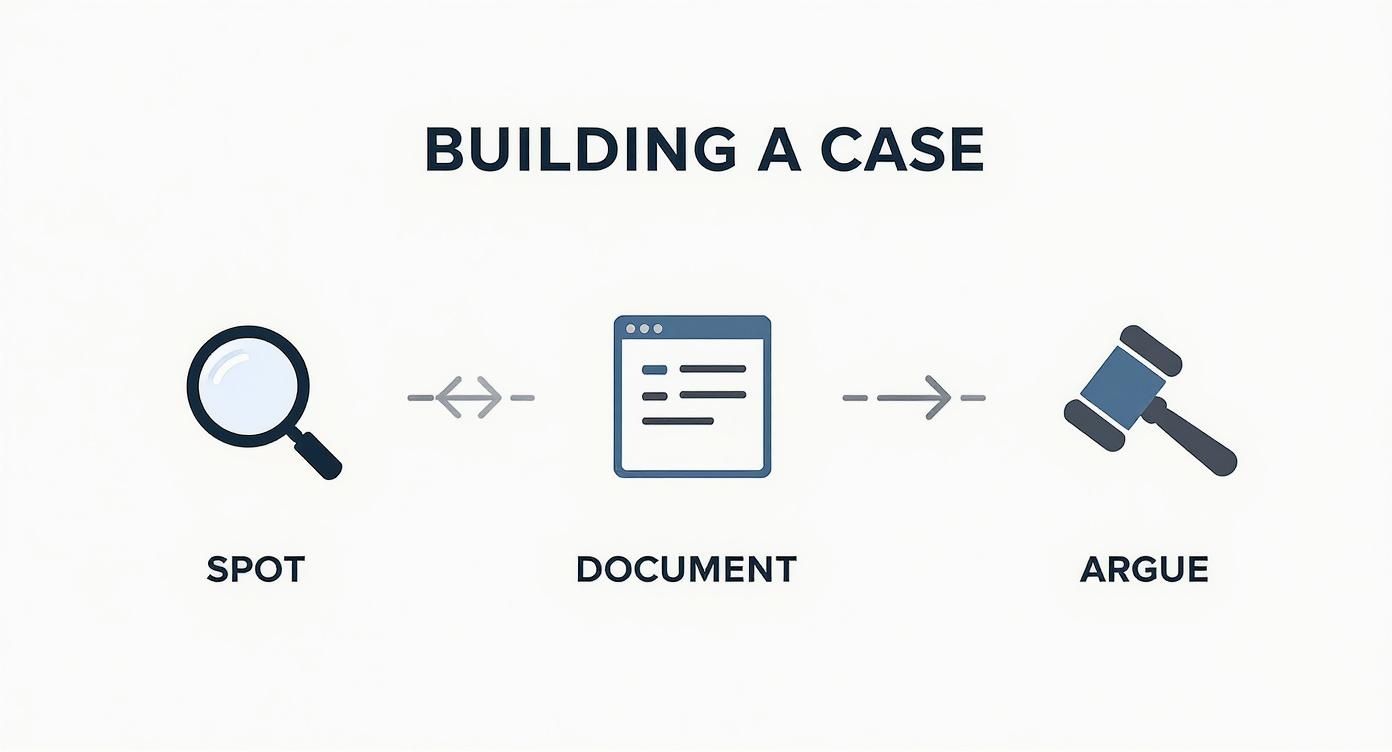
This simple framework—Spot, Document, and Argue—is your foundation. It keeps you focused and methodical instead of reacting emotionally.
The Google Business Profile Takedown Strategy
For most local businesses, Google is the main event. The good news is their reporting process is fairly direct, but you have to be specific. Just flagging a review as "inappropriate" is like trying to get a bartender's attention by clearing your throat in a noisy pub—it won't work.
To successfully get a review removed from Google, your report has to be laser-focused on one of their specific content policies.
Here’s how you do it:
- Find the Review: Go to your Google Business Profile and locate the review on either Search or Maps.
- Flag It: Click the three little dots next to the review and hit "Report review."
- Cite the Violation: This is where you win or lose. Don't just guess. Choose the exact violation that fits, whether it's "Harassment," "Conflict of interest," or "Off-topic."
Once you submit, Google will send you an email with a case ID. Do not lose this email. If a week goes by and the review is still up, you can use that case ID to appeal the decision directly through Google's Business Profile help center.
Google's algorithms are working overtime to clean up the platform. In 2023, they blocked or removed a staggering 170 million reviews that violated their policies, which is a 45% jump from the year before. What's really interesting is that this crackdown isn't just on 1-star reviews; some data suggests nearly 90% of deleted reviews are actually fake 5-star ratings.
Navigating Yelp’s Stricter Moderation
Yelp is notoriously tough. They are fiercely protective of the "consumer voice," which means your case for removal needs to be absolutely airtight and clearly violate their specific Content Guidelines.
Here’s the thing about Yelp: they care less about whether a reviewer is factually correct and more about whether the review describes a genuine consumer experience. A customer can be completely wrong about the details, but if they are describing their own perception of their experience, Yelp will almost always let it stand.
So, where's your leverage? Focus on these clear-cut violations:
- Secondhand Experiences: The review was written by someone who wasn't actually your customer.
- Conflicts of Interest: It's from a competitor, a disgruntled ex-employee, or someone with a clear bias.
- Private Information: The review doxes an employee by including their full name or personal contact info.
Find the three dots next to the offending review, select "Report Review," and get straight to the point. Write a brief but strong explanation that quotes the specific guideline being broken.
Tackling Reviews on Amazon and TripAdvisor
For marketplaces like Amazon or travel sites like TripAdvisor, their specific focus is your biggest advantage. Amazon obsesses over product-specific feedback, and TripAdvisor is all about relevant, travel-related experiences.
For Amazon Sellers
One of the most common violations you'll see is a product review that's really about shipping. If a customer leaves a 1-star review on your product page saying, "The box was crushed when it arrived," you have a case. That's a fulfillment issue, not a product issue.
Use the "Report abuse" link next to the review and state plainly that the feedback is a complaint about the seller or shipping experience, which violates Amazon's product review policies.
For TripAdvisor Listings
TripAdvisor is strict about firsthand accounts and relevance. If a review is about something that happened five years ago, talks about the wrong location, or is based on a story a friend told them, it's fair game for removal.
Use the "Report a Review" function and choose the most accurate reason, like "Review is not a firsthand experience."
By swapping a hopeful, generic request for a targeted, strategic case, you dramatically increase your odds of getting reviews removed that are unfairly hurting your business.
Review Removal Process Across Major Platforms
To help you stay organized, here's a quick comparison of the review flagging and removal process for the sites that matter most to your business.
| Platform | Typical Response Time | Key Violation Policies to Cite | Escalation Path |
|---|---|---|---|
| 3-7 business days | Conflict of Interest, Off-Topic, Spam, Harassment | Yes, via the Review Management Tool using your case ID | |
| Yelp | 3-10 business days | Not a Consumer Experience, Conflict of Interest, Private Info | Limited; relies on initial moderator decision |
| Amazon | 1-3 business days | Seller/Shipping Feedback, Profanity, Promotional Content | Yes, through Seller Central case logs |
| TripAdvisor | 5-7 business days | Not a Firsthand Experience, Irrelevant, Blackmail | Yes, through the Management Center |
| Trustpilot | 2-5 business days | Not Based on a Genuine Experience, Harmful/Illegal Content | Yes, via direct support tickets if initial flag fails |
Think of this table as your cheat sheet. Knowing what to expect and which rules to cite from the start will save you time and frustration, leading to a much higher success rate.
What to Do With Negative Reviews You Can't Delete

It's a tough pill to swallow, but here’s the reality: you can't get every single bad review taken down. Once you've done your due diligence and confirmed a review is from a real customer and doesn't break any rules, your strategy has to pivot from removal to response.
But don't think of this as a fallback plan. A well-handled public reply is one of the most effective reputation management tools you have. It turns a moment of public criticism into a live demonstration of your company's character and commitment to its customers. You’re on a public stage, and future customers are watching how you perform under pressure.
Responding quickly and sincerely shows you’re paying attention. It validates the customer’s feelings and proves you take feedback seriously—sometimes, that’s all it takes to defuse the tension and show everyone else that you genuinely care.
The Acknowledge, Apologize, and Act Framework
When you sit down to write your reply, the last thing you want to do is get defensive or argue about what "really" happened. Keep it simple and stick to a three-part structure that has proven time and again to resolve conflict while protecting your brand.
- Acknowledge Their Experience: Kick things off by validating their feelings. A simple opener like, "Thank you for sharing your feedback," or "We're very sorry to hear your experience fell short of expectations," immediately shows respect and helps lower their guard.
- Apologize Sincerely (Without Admitting Fault): You can be sorry for their frustration without taking the blame for the entire situation. Phrasing it as "We apologize for the frustration this has caused" is worlds apart from "We were wrong." It’s about showing empathy, not accepting liability.
- Act by Taking it Offline: The goal is always to move the conversation out of the public square. End your reply with a clear, direct invitation. Something like, "We want to make this right. Please reach out to us at [email address] or [phone number] so we can understand what happened and work toward a solution."
This approach keeps your public response tight and professional, moving the messy, specific details to a private channel. For more in-depth examples, our guide on how to respond to negative Google reviews has templates you can adapt.
A study of over 50,000 deleted Google reviews found something fascinating: business engagement matters. Between 66% and 73% of the reviews that got deleted had no reply from the business owner. This suggests that totally ignored reviews—good or bad—are more likely to get flagged and removed by Google's own systems.
Choosing Your Words Carefully
The language you use in a public reply is incredibly important. Your tone should always be calm, professional, and genuinely helpful.
Phrases That Build Trust:
- "We appreciate you bringing this to our attention."
- "This is certainly not the standard of service we aim for."
- "We would value the opportunity to discuss this further with you."
On the flip side, some phrases are like pouring gasoline on a fire. They immediately cast you as the villain and can escalate the situation in a hurry.
Phrases to Avoid at All Costs:
- "You are mistaken..." or "Actually, what happened was..."
- "As our policy clearly states..."
- "We've never had this complaint before."
These responses come across as defensive and dismissive, instantly telling the customer (and everyone else reading) that you don't care about their experience.
The Real Audience for Your Reply
Here’s a secret I’ve learned from years of managing brand reputations: your reply isn't just for the unhappy customer. It’s for every potential customer who will read that review in the future.
They want to see that if something goes wrong for them, you’ll be there to help make it right.
A thoughtful, professional response can completely neutralize a bad review's impact. When a potential customer sees a one-star rant followed by a calm, solution-focused reply from the business, their trust often shifts to the business. It proves you're accountable—and that’s a brand attribute money can't buy.
What to Do When Your Removal Request Gets Rejected
It’s one of the most frustrating moments for any business owner: you meticulously report a review you know violates a platform’s rules, and you get back a canned denial. The initial moderation, which is often just an algorithm, didn't see it your way.
Don't throw in the towel. This isn't the end of the road—it’s just time to escalate. Think of your first request as the opening statement. Now, it's time to build your appeal.
Appealing the Decision and Bringing More Evidence to the Table
When your first attempt is shot down, your next move is to find the platform’s official appeal channel. On a Google Business Profile, for instance, you'd use the Review Management Tool and plug in the case ID from your original report. This signals to them that you're not just re-reporting but escalating a denied claim.
This is your second chance to make a much stronger case. What new evidence have you found? Maybe you dug up the reviewer's public social media profile and found a screenshot showing they work for your biggest competitor. Or perhaps you discovered a pattern where they've left nearly identical fake reviews for other businesses in your industry.
When you submit your appeal, beef it up with things like:
- New Screenshots: Any fresh visual proof you’ve uncovered is gold.
- Specific Timestamps: If you can cross-reference your own records (like appointment logs or sales receipts) to prove the person was never a customer on the date they claim, include that.
- A Direct Policy Connection: Don’t just say the review is fake. Go back to the platform's terms of service, find the exact rule it breaks, and quote it directly in your appeal. Make it impossible for them to ignore.
When a removal request is denied, whatever you do, don't just hit the "flag" button again. To a moderator, this can look like spam. Always follow the formal appeals process to show you’re serious and have a legitimate case.
Taking Your Case to Community Forums and Direct Support
Sometimes the standard support channels feel like talking to a brick wall. That’s when you need to find the people who can actually help: volunteer experts and senior support staff.
For Google issues, the Google Business Profile Help Community is an absolute game-changer. It's filled with volunteer Product Experts who have a deep understanding of the system and sometimes even have a direct line to Google employees.
If you post in a forum like this, make it easy for them to help you. Be professional, get straight to the point, and provide everything upfront:
- A link to your business profile.
- A screenshot of the review in question.
- The specific policy you believe it violates.
- The case ID from your initial denied request.
This level of organization shows you respect their time and allows an expert to quickly assess the situation and, hopefully, escalate it for you.
Knowing When to Explore Legal Options
Let's be clear: involving lawyers is a huge step. It’s a last resort reserved for the most damaging situations, like a targeted, defamatory campaign that’s causing real financial harm to your business.
It’s also critical to know the difference between a bad opinion and actual defamation.
A customer saying, "The service was slow and I was disappointed," is just an opinion. But a review claiming, "The owner is committing tax fraud," is a false statement presented as fact. That could be legally actionable.
Before you even think about calling an attorney, you absolutely must have tried and failed with all other platform-level options. A lawyer’s first question will be about the good-faith efforts you made to resolve it yourself. This path is expensive and slow, so only consider it for the most extreme cases. When a situation becomes this severe, it helps to understand how platforms handle major account issues; for example, you can learn more about navigating an Amazon account suspension.
When to Hire a Reputation Management Pro
Are you dealing with a flood of fake reviews? Or a complicated online harassment case? If so, it might be time to call in the professionals.
A good reputation management service lives and breathes the constantly changing policies of every major platform. They take the entire burden off your shoulders—from gathering evidence and filing cases to handling all the appeals and escalations. It can save you dozens of hours and an incredible amount of stress.
These services aren’t magicians; they can't get a legitimate negative review removed. What they are is expert advocates who use their deep knowledge to get content that genuinely violates policy taken down efficiently. If you find that fighting online fires is keeping you from actually running your business, it’s an investment worth considering.
Common Questions About Dealing With Bad Reviews
When you’re trying to get a bogus review taken down, it's natural to have questions. The whole process can feel a bit murky. Let's clear up some of the most common things business owners ask when they're in the trenches.
How Long Does It Take to Get a Flagged Review Removed?
This is the million-dollar question, and unfortunately, the answer is "it depends." There's no single timeline, as each platform moves at its own pace.
If you flag a review on Google for a crystal-clear violation—like hate speech or a blatant ad—you might see it vanish in as little as 3-5 business days. But if the situation is more complex and needs a real person to look into it, you could be waiting several weeks. Yelp is generally pretty on the ball with its moderation and often sorts things out within a week.
My advice? Document everything. Keep a record of when you reported the review and any case number they give you. You'll be glad you have it if you need to follow up.
Can I Sue Someone for a Bad Online Review?
Technically, yes, you can. But should you? Almost never. It’s an incredibly difficult, expensive, and public battle that should be your absolute last resort.
To even have a shot at a defamation case, you have to prove the review contains false statements of fact (not just someone's grumpy opinion) and that those lies caused real, quantifiable damage to your business.
Remember, truth is the ultimate defense. If a customer truly had a lousy experience, their review is protected speech. Before you even think about calling a lawyer, make sure you've tried every single removal option on the platform itself. If you're still considering it, speak with an attorney who specializes in internet law to get a reality check on your chances.
The line between opinion and defamation is a bright one. "I thought the steak was tough" is an opinion. "The restaurant served me horse meat and called it beef" is a statement of fact that can be proven or disproven. The law is designed to protect the first, not the second.
Is It a Good Idea to Offer a Refund to Get a Review Taken Down?
Let me be blunt: absolutely not. Offering a refund, discount, or any kind of perk in exchange for a customer deleting their negative review is a huge mistake.
This practice is called incentivization, and it's a direct violation of the rules on every major platform, from Google and Yelp to Trustpilot. Getting caught can lead to some nasty consequences, like having a consumer alert slapped on your profile, getting your reviews temporarily shut down, or even having your entire listing removed.
The right way to handle this is to take the conversation offline. Solve the customer's problem because it's the right thing to do. If they're happy with how you resolved things, they might decide to update the review on their own. That’s genuine, it's ethical, and it keeps you out of hot water.
What’s the Best Way to Prevent Bad Reviews in the First Place?
The best defense is a good offense. Being proactive is always better than being reactive when it comes to your online reputation. It really boils down to two things.
First, you have to be relentless about providing an amazing customer experience. Genuinely happy customers rarely go looking for a place to complain online.
Second, give people an easy, private way to give you feedback directly. Don't make them feel like a public review is their only option.
- Send a simple follow-up email or text after a transaction.
- Put a link to a feedback form on your receipts or invoices.
- Empower your team to ask customers, "How was everything?" before they walk out the door.
This opens up a private channel for you to fix problems before they escalate into public complaints. As a bonus, it also helps you gather a steady stream of positive feedback from your happy customers, which will naturally soften the blow of any negative review that slips through.