


It’s a gut-wrenching feeling. You've worked hard, earned a fantastic five-star review, and then one day… it’s just gone. Poof. Vanished from your Google Business Profile. This isn’t just frustrating; it feels unfair, especially when you know the review was from a genuinely happy customer.
The good news is, you’re not alone. This happens all the time, and it's usually not a person at Google targeting you. It's an algorithm.
Why Do My Best Google Reviews Keep Disappearing?
One minute you're celebrating a new glowing review, and the next it's disappeared, dropping your overall rating and review count. This is a common and deeply unsettling experience for business owners. It leaves you wondering what you did wrong and how to fix it.

The main culprit is almost always Google's aggressive spam-detection system. It's a powerful algorithm designed to weed out fake or paid reviews to keep the platform trustworthy. The problem is, its net is cast so wide that it frequently catches legitimate, hard-earned praise in the process.
Common Triggers That Get Real Reviews Flagged
Certain activities, even completely normal business ones, can look suspicious to an algorithm. If you know what these triggers are, you'll be in a much better position to figure out what happened and get your review back.
Here’s what often trips the filter:
- A sudden flood of good reviews. Did you just run a great sale or get a shout-out on social media? A sudden spike in five-star reviews, while awesome for you, can look like you're trying to manipulate the system.
- Reviews from brand-new Google accounts. When a happy customer creates a Google account just to praise you, the algorithm gets suspicious. It sees an account with no history and often assumes it's a fake profile.
- Reviews from far away. If you run a local bakery in Chicago and get a review from an account in another country, the system might flag it—even if that person was a tourist who loved your croissants.
I once worked with a local coffee shop that got featured in a popular city blog. They received over 20 new five-star reviews in 48 hours. A week later, almost half were gone. It wasn’t the content that got them flagged; it was the sheer volume. The owner had to go through the whole dispute process just to restore the social proof they had genuinely earned.
This isn't a small-scale issue. Google's automated policing is massive. In 2023 alone, the company said it blocked or removed over 170 million reviews that violated its policies. With numbers that big, it's inevitable that a lot of honest reviews get caught in the crossfire just because they fit a suspicious pattern. If you want to dive deeper, you can explore more data on Google's moderation efforts to see the full scope.
At the end of the day, a disappearing review isn't personal—it's algorithmic. Understanding that is the key. It lets you shift from being frustrated to taking clear, logical steps to get it back.
Building a Winning Case for Review Removal
First things first: you can’t get every negative review taken down. And honestly, you shouldn't try. Google’s review platform is built on the idea of free expression, and that includes a customer’s right to share a genuinely bad (but honest) experience.
Waging war on every one-star rating is a surefire way to waste time and lose credibility with Google's support team. The real skill is learning to spot the difference between a simple complaint and a review that genuinely breaks the rules. Your job is to build a logical, evidence-based case, not an emotional one.
Spotting the Clear Policy Violations
When you flag a review, you’re not just saying, "I don't like this." You're telling Google, "This content violates policy 'X,' and here’s why." You have to be specific.
I’ve seen thousands of these, and the ones that get removed almost always fall into a few clear categories:
- Conflict of Interest: This is a big one. The review is from a disgruntled ex-employee, a current staff member, or even a competitor down the street trying to tank your rating. It’s a classic conflict of interest.
- Off-Topic Content: The review has nothing to do with your business. It's a political rant, a commentary on social issues, or some other personal diatribe that just happens to be posted on your profile.
- Harassment or Hate Speech: This is non-negotiable. If the content includes personal attacks, threats, or discriminatory language aimed at you, your team, or your customers, it’s got to go.
- Impersonation: The reviewer is pretending to be someone they're not, or worse, falsely claims to be a representative of your business.
A simple "The service was slow" won't be removed. But a review that says, "The manager is a criminal and a liar," without any factual basis, starts to cross the line into harassment or defamation.
Pro Tip: Keep your proof laser-focused. If you’re certain a review is from a competitor, find their LinkedIn profile showing their current employer. A simple screenshot can be the knockout punch when you escalate your case to Google Support.
It’s also worth remembering that this isn’t just about hurt feelings. There are real legal costs associated with posting false Google reviews. Pointing this out can add weight to your argument that this type of content has no place on the platform.
To make it even easier, I've put together a quick cheat sheet to help you identify the most common violations at a glance.
Google Review Violation Cheat Sheet
This table breaks down some of the most common policy violations to help you quickly identify if a review is worth disputing.
| Violation Type | What It Looks Like (Example) | Why It's Removable |
|---|---|---|
| Spam & Fake Content | "BUY CHEAP WIDGETS AT FAKESITE.COM!" or a review from a user who has spammed 50 other businesses with the same generic 1-star comment. | It's not a real customer experience. It’s designed to manipulate ratings or promote something else. |
| Conflict of Interest | "I used to work here and the owner is terrible." or a 5-star review from the business owner's spouse. | Reviews must be impartial and written by actual customers, not insiders or competitors. |
| Off-Topic | "I hate the new traffic laws on this street. One star." | The review doesn't reflect a consumer experience with your specific business. |
| Harassment/Hate Speech | Using racial slurs, making personal threats, or attacking someone's identity. "The barista is an idiot and should be fired." | This content is abusive, harmful, and explicitly violates Google's policies on respectful communication. |
| Impersonation | A reviewer named "John Smith" pretends to be a well-known local figure or falsely claims to be the "CEO of this company." | The review is based on a false identity, making the entire account deceptive and unreliable. |
| Restricted Content | A review that promotes illegal products, contains sexually explicit imagery, or depicts violence. | This content is dangerous, inappropriate, and strictly prohibited on the platform for safety reasons. |
Keep this handy. When a bad review comes in, run it against these examples. If you find a match, you have a solid foundation for your dispute.
What You Can't Dispute
Just as important is knowing which battles to let go. You’ll save yourself a lot of headaches by recognizing what Google won’t remove.
You generally cannot remove reviews if:
- You just think the customer is wrong. A customer says your coffee was "too bitter." That's their opinion. You can't dispute taste.
- The review is old. In Google's view, a negative review from two years ago is just as relevant as one posted yesterday. Time doesn't invalidate an experience.
- It has a minor factual error. The review says they visited on a Tuesday, but their appointment was on a Wednesday. That small mix-up isn't enough to get the entire review removed.
Stick to the clear violations. It's the most effective way to manage your online reputation, improve your success rate, and show Google's support team that you know what you're doing.
Your First Move: Flagging a Problematic Review
When you spot a review that clearly crosses the line and violates Google's policies, your first official move is to flag it. This is the most direct way to kick off the dispute process. Think of it as opening a ticket—it's the required first step before you can take things any further.

The process itself is pretty simple. Just navigate to the review on your Google Business Profile, click the three little dots next to it, and hit "Report review." You absolutely have to do this. If you skip this step, you won't have any grounds to appeal if Google initially denies your request.
By the way, keeping your profile in top shape with solid Google My Business SEO tips can also lend more weight and credibility to your account in the long run.
Choosing the Right Violation Category
This is where you need to be strategic. After you click to report the review, Google gives you a list of reasons. Your choice here is critical, as it determines how the system—and potentially a human moderator—interprets your complaint.
Don't just rush and pick the first one that seems close. You need to align your evidence with the specific policy violation.
- Hate speech, harassment, or violence: This is for reviews containing personal attacks, threats, or bigoted language.
- Conflict of interest: The right choice if you can prove the review came from a competitor, a disgruntled ex-employee, or someone else with a clear axe to grind.
- Off-topic: Perfect for when the review is a rant about politics or something completely unrelated to a customer experience with your business.
- Spam: Use this for clearly fake reviews, content that’s just advertising, or multiple reviews posted from the same account across different businesses.
The key is to stay objective. Instead of saying, "This person is a liar and is trying to ruin my business," frame it factually: "This review contains a factual inaccuracy regarding our service hours and we have no record of this individual as a customer."
This kind of policy-focused language is much more persuasive. You're building a case, not just venting. Your goal is to make it as easy as possible for Google's team to see your side and agree.
Setting Realistic Expectations
Let's be clear: flagging a review is just the beginning. It's necessary, but it's rarely the final step. Many initial reports, especially those screened by algorithms, get denied. That's normal, so don't get discouraged.
All this first flag does is get your foot in the door for the next stage.
You'll get a confirmation email from Google once you submit your report. Save this email. It contains a Case ID, which is your golden ticket if you need to escalate the dispute later. Think of this initial flag as creating the paper trail you need for a formal appeal. The real work often starts here.
Mastering the Art of the Public Response
While you're waiting for Google to make a call on your flagged review, that negative comment is still live on your profile for the world to see. This is precisely where your public response becomes your most powerful tool. A well-crafted reply can completely defuse the situation and show prospective customers how professional you are.
But here’s the key: your strategy has to change based on what you’re dealing with. Is it a legitimate complaint from a real, unhappy customer? Or is it a fake review planted to make you look bad? Each one requires a totally different playbook.
Responding to a Genuine Complaint
When a real customer has a genuinely bad experience, your mission is simple: de-escalate the situation and offer a solution. A calm, empathetic response shows everyone else reading that you take feedback seriously and are committed to making things right. The absolute last thing you want is to get into a public shouting match.
Try sticking to this proven framework:
- Acknowledge their feedback. Kick things off with something simple like, "Thank you for bringing this to our attention."
- Show some empathy. A sincere, "We're truly sorry you had a frustrating experience with us," can work wonders.
- Move the conversation offline. This is critical. Provide a direct line of contact: "Please email our manager, Jane, at jane@email.com so we can learn more and find a way to make this right."
This approach proves you’re proactive and, more importantly, it stops a messy back-and-forth from unfolding right on your public profile. For a deeper dive, our guide on how to respond to negative Google reviews is packed with templates you can steal.
Responding to a Suspected Fake Review
Now, when you dispute a Google review because you're convinced it's fake, your public response has an entirely different job. Forget trying to win over the fake reviewer—you're writing for every single potential customer who will read that review in the future. The goal is to subtly and professionally plant a seed of doubt about the review’s legitimacy without coming across as defensive or angry.
Your best defense is a firm, factual, and unemotional response. Stick to what you can verify. This sends a clear signal to other readers that the problem lies with the reviewer’s story, not with your business.
For instance, something like this is incredibly effective:
"We appreciate you taking the time to share this. However, after carefully checking our records, we can't find any customer, appointment, or transaction that matches the name or details you've provided."
It's polite, it's professional, and it tells anyone reading it that this review is likely bogus. This tactic not only helps protect your reputation but also strengthens your case with Google as they review your dispute.
What to Do When Your Initial Flag Gets Denied
So, you flagged the review, waited, and got that frustrating email from Google: "Our team has reviewed your request and we have not found a violation of our policies." It’s a common scenario, but it’s definitely not the end of the line. Think of that first flag as just the opening move. Now, it’s time to escalate.
The first denial is almost always automated. An algorithm, not a person, made the call, which means your job now is to get your evidence in front of an actual human. To successfully dispute a Google review that’s been rejected, you'll need to head over to the Google Business Profile Help portal and file a formal appeal.
You'll need your original Case ID for this. Dig through your inbox for the email Google sent you after you first flagged the review—the ID is right there in the subject line. Without it, you can't move forward. This number connects your appeal to your original report, giving the support team a clear trail to follow.
Crafting a Compelling Appeal
When you file an appeal, you’re not just flagging a review anymore; you’re building a case. The goal is to make it incredibly simple for a human reviewer to understand why the algorithm got it wrong.
This isn’t the time for a long, emotional saga. Stick to the facts. Your best bet is to connect the review directly to a specific Google policy violation. For example, instead of just saying, "This person never came here and they're lying," provide proof.
Try something like this: "This review violates the 'Conflict of Interest' policy. The reviewer is a former employee terminated on [Date]. We've attached a screenshot of their public LinkedIn profile which confirms their employment history with our company."
Structure your communication for clarity and impact:
- Name the policy violation upfront. Start by stating the specific rule the review breaks.
- Provide direct, undeniable evidence. This could be screenshots, internal records, or any other documentation that proves your claim.
- Keep it brief and professional. A few focused, factual sentences carry more weight than a rambling paragraph.
The secret to a successful escalation is making the reviewer’s job as easy as possible. Hand them everything they need to make a quick decision in your favor.
This flowchart can help you visualize the two different paths to take when a review comes in—one for fake or policy-violating reviews, and another for those that are just genuinely negative.
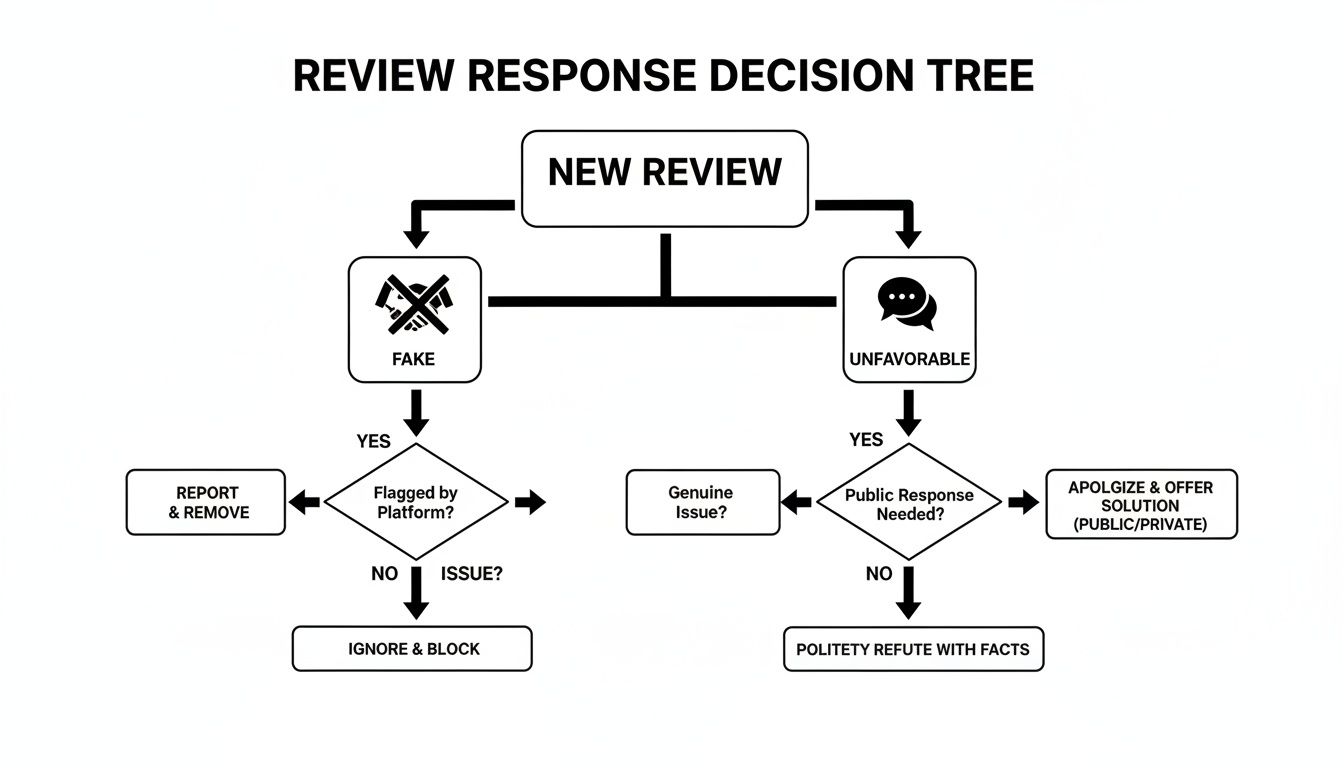
As you can see, your immediate next steps depend entirely on whether the review is fraudulent or just an unhappy customer, which sets the strategy from the very start.
The Importance of Documentation
Good documentation can be the difference between a denied request and a successful removal. It's also worth remembering that Google's moderation can be a bit of a black box. The system has become so aggressive that it sometimes ends up wiping out legitimate reviews, too.
In fact, a recent analysis found that around 73% of reviews deleted by Google were actually five-star ratings, which turns the idea that only bad reviews get removed on its head. One business owner watched their review count drop from 260 to just 88 overnight—a shocking 66% loss with no explanation.
This volatility is exactly why solid documentation is your best friend. You can read more about Google's aggressive review moderation to get the full picture. Strong evidence gives a human reviewer the justification they need to overturn an automated decision, protecting your reputation from both malicious attacks and an overzealous algorithm.
After you submit your appeal, you can track its progress right from the GBP Help portal, so you'll always know where things stand.
When to Call in the Reputation Management Pros
Let's be honest—trying to get a bogus Google review taken down can feel like a full-time job you never signed up for. While flagging a one-off weird review is one thing, some situations are just too big or too complex to handle on your own. Knowing when to wave the white flag and call for backup is a crucial part of protecting your brand.
It's one thing to deal with a single disgruntled customer. It's another thing entirely when you wake up to a sudden flood of dozens of one-star reviews from people you've never even met. This is a coordinated attack, and it's a clear signal to bring in the experts.
The same goes for reviews that cross the line into legally defamatory or libelous territory. These situations demand a careful, persistent approach that goes far beyond just clicking the "flag as inappropriate" button.
When Professional Help Is a Smart Investment
The biggest resource you'll lose in this fight? Time. The endless cycle of documenting evidence, escalating tickets, and following up with Google Support can swallow your entire week, pulling you away from what you should be doing: running your business. A professional service takes that entire mess off your hands.
It's probably time to hire an expert when:
- You simply don't have the hours to dedicate to the relentless follow-up that escalations require.
- A review contains serious, potentially illegal claims that could cause real damage.
- You're being targeted by a large-scale, coordinated negative campaign (often called "review bombing").
A professional team does more than just flag reviews. They build a rock-solid case file for each one, often have direct lines of communication with platform support teams, and they manage the entire back-and-forth until there's a resolution. Your odds of success go up dramatically.
At the end of the day, these services exist for a reason—the review dispute process can be incredibly frustrating and slow. You can dig deeper into how dedicated online reputation management services work to see if it’s the right call for your business. It frees you up to focus on your customers while the experts focus on defending your reputation.
A Few Common Questions About Disputing Google Reviews
When you're trying to get a bogus Google review taken down, a lot of the same questions tend to pop up. Let's get you some quick, straight-to-the-point answers based on what we see every day.
How Long Does a Review Dispute Actually Take?
Honestly, there's no set timeline, and it can be a bit of a waiting game. When you first flag a review, Google's automated systems might catch it and make a decision within a few hours. More often, though, you're looking at a wait of up to five business days for that initial verdict.
If your first attempt gets denied and you have to escalate it to a real person at Google Support, the clock resets. This next phase can drag on for several weeks. The key here is persistent, professional follow-up to make sure your case doesn't fall through the cracks. It's frustrating, but patience is a must.
Can I Actually Sue Someone Over a Fake Review?
Technically, yes, you can pursue legal action for defamation. But I'll be blunt: it's an incredibly difficult, expensive, and time-consuming road to go down. You don't just have to prove the review's claims are false; you have to prove they caused real, measurable financial damage to your business.
On top of that, you have the major hurdle of unmasking an anonymous reviewer, which usually involves getting lawyers and subpoenas involved. For the vast majority of businesses, it makes far more sense to exhaust every single one of Google's internal options first.
What if Google Keeps Saying No to My Dispute?
This is the tough one. If you flag a review and Google rejects it, you can appeal that decision through the Google Business Profile help section. But if that appeal also gets denied, you've pretty much hit a wall with Google's process.
You can't just keep flagging the same review over and over for the same reason—it won't work. At this point, your strategy has to pivot from removal to mitigation. Your best move is to focus all your energy on crafting a killer public response and, if the review is truly toxic, it might be time to bring in a professional reputation management service.