


While you can't just delete negative reviews you don't like, you absolutely can fight to get illegitimate ones taken down. The secret isn't an emotional outburst, but a cool-headed, methodical approach. It's all about proving the review breaks a platform's rules, not just that you disagree with the opinion.
Your First Moves After Getting a Negative Review

That one-star review pops up and your gut reaction is probably one of two things: fire back a heated public reply or frantically look for a non-existent "delete" button. Resist both urges. The smartest thing you can do right now is nothing at all—at least not publicly.
Just pause. Take a breath. This moment is crucial for shifting from a defensive mindset to a strategic one.
This pause gives you the space to look at the review objectively. Is this a real, though unhappy, customer with a legitimate gripe? Or does something about it feel... off? Your first goal isn't to draft a reply; it's to figure out if you have a case for removal based on the platform's specific terms of service.
Document Everything Immediately
Before you even think about clicking that "report" button, you need to become a detective and build your case file. This documentation is the evidence you'll need to present. If the reviewer suddenly edits the post or the platform removes it before your case is reviewed, you'll be left with nothing.
Start grabbing evidence right away:
- Full-page screenshots: Don't just snip the review. Capture the entire browser window showing the date, time, and the URL. This provides crucial context.
- Reviewer's profile: Click through to the reviewer's profile and screenshot that too. Pay attention to their name, photo, and especially their review history. A profile that has only ever left one-star rants can be a huge red flag.
- The content itself: Copy the full text of the review and paste it into a separate document for your records.
Pro Tip: I always tell clients to create a dedicated folder for each problematic review. Name your files clearly, like "Jane_Smith_Yelp_Review_Screenshot_Nov-15-2023.png." Trust me, when you're trying to escalate a case, having organized evidence makes all the difference.
Verify the Customer Interaction
With your evidence secured, it's time to look inward. Dig through your own records to see if this story checks out. Cross-reference the reviewer's name and the details of their complaint with your:
- CRM or customer database
- Payment processing system
- Appointment logs
- Email and message history
Can you find any trace of this person ever doing business with you? If you can't find a matching record, you've just found a powerful piece of evidence suggesting the review is fake.
This isn't just about pride; it's about protecting your bottom line. A single negative review can slash purchase intent by around 51.4%, and it can take a mountain of positive feedback to counteract that damage. The financial stakes are real, which is why a well-documented removal process is a non-negotiable business practice. You can learn more about this in a detailed report on the impact of negative feedback.
Figuring Out Which Reviews You Can Actually Get Rid of
It's a common myth that you can get a review taken down just because it's negative or you disagree with it. Let's be clear: platforms like Google and Yelp see themselves as neutral ground. They don’t care about hurt feelings; they care about their own rules.
Your only path to getting a review removed is to prove, without a doubt, that it breaks a specific policy. This means you have to start thinking like a platform moderator. What looks like a simple bad review to you might be a clear case of "Conflict of Interest" to them. Your job is to find that violation and build your case around it.
Learning the Platform Playbooks
Every platform has its own rulebook, but thankfully, they all tend to prohibit the same general kinds of behavior. Instead of trying to memorize pages of legal-speak, focus on spotting the big, universal red flags.
Here are the most common violations you'll run into.
- Conflict of Interest: This is a huge one. The reviewer can't have a vested interest in your business's failure or a competitor's success. Think reviews from disgruntled ex-employees, your direct competitor down the street, or even their family members.
- Off-Topic Rants: The review must be about a customer's experience with your business. If it veers into a rant about your personal politics, social commentary, or a complaint about a completely different company, it's off-topic and a prime target for removal.
- Spam & Fakes: This is a broad category. It covers everything from reviews posted by bots and blatant gibberish to the same negative review spammed across multiple fake accounts. If it doesn't read like it came from a real person, it's probably removable.
Here's a powerful mental shift: when you flag a review, you're not just complaining. You're acting as an informant, pointing to a specific user and telling the platform, "This person is breaking your rule 7.3b, and here is my evidence." Framing it this way makes a world of difference.
The Low-Hanging Fruit: Spotting Obvious Violations
Beyond the usual suspects, some violations are so serious that platforms act on them immediately. When you see one of these, your chances of a quick and successful removal skyrocket.
These are the "bright-line" rules that platforms are highly motivated to enforce for legal and ethical reasons.
- Hate Speech & Harassment: Content attacking people based on race, religion, gender, disability, or other protected classes is a non-starter. This also includes direct threats, personal insults, and clear bullying.
- Private & Confidential Information: A review can never, ever include private data. This means no full names of non-managerial staff (like a specific cashier), no personal phone numbers, no home addresses, and no email addresses. It's a major privacy breach.
- Illegal Content: This is an automatic red flag for any platform. Reviews can't be used to promote illegal acts, sell restricted products like firearms or drugs, or contain sexually explicit material.
Interestingly, we've found that longer rants can actually be easier to remove. Our analysis shows that 53.07% of deleted negative reviews were over 51 words long. Why? The more someone writes, the higher the chance they slip up and break a rule. You can see more trends from our analysis of 50,000 removed reviews for more on this.
A Quick Guide to Common Violations
To make this easier, I've put together a table that shows you the most common removable offenses across the big platforms. Think of it as your cheat sheet for identifying takedown opportunities.
| Violation Type | Google Business Profile | Yelp | Trustpilot | Amazon |
|---|---|---|---|---|
| Hate Speech/Harassment | Yes | Yes | Yes | Yes |
| Spam/Fake Engagement | Yes | Yes | Yes | Yes |
| Conflict of Interest | Yes (employees, competitors) | Yes | Yes | Yes |
| Off-Topic Content | Yes | Yes | Yes | No (focused on product) |
| Private Information | Yes | Yes | Yes | Yes |
| Profanity/Obscenity | Yes | Yes | Yes | Yes |
| Illegal Content | Yes | Yes | Yes | Yes |
This isn't an exhaustive list, but it covers the vast majority of cases you'll encounter. Always double-check the platform's specific guidelines, but start by looking for these clear-cut violations.
Real-World Examples & Platform Quirks
Applying these rules takes a bit of practice. For instance, a review saying, "The manager, Bob Smith, was rude" is probably staying up. But if it says, "Bob Smith, who lives at 123 Main Street, is rude," it's now sharing private information and can be removed.
A review on Google from a former employee complaining about why they were fired is a textbook "conflict of interest" and one of the easiest types to get taken down. We cover these specific scenarios in much more detail in our guide on how to get a review removed from Google.
You also need to be aware of each platform’s unique personality. Yelp, for example, is incredibly strict about review solicitation; you can sometimes use this to challenge a sudden flood of similar-sounding negative reviews. Trustpilot, on the other hand, is laser-focused on verifying a "genuine service or buying experience."
Your goal is to become a matchmaker: connect the content of the bad review to a specific violation on that specific platform. A generic complaint will get you nowhere. A precise report citing the exact policy they broke is how you win.
How to Build a Takedown Request That Actually Works
Once you've spotted a clear policy violation, you're no longer on the defensive. It's time to build a removal request that a platform moderator simply can't ignore. Firing off a vague, emotional complaint is the fastest way to get your request denied. What works? A structured, evidence-backed case that does the moderator's job for them.
Think of it like you're presenting a clear-cut case to a judge. Your goal is to make it incredibly easy for the platform's review team to see the violation, agree with you, and take it down. That means being organized, sticking to the facts, and leaving no room for interpretation.
Assemble Your Evidence Dossier First
Before you even think about clicking that "report" button, get all your proof in one place. A well-organized file shows you're serious and makes your claim instantly credible. Remember, moderators are swamped. Hand them everything they need on a silver platter.
Here’s what your evidence checklist should look like:
- Pristine Screenshots: Don't just crop the review. Capture the entire browser window showing the review itself, the reviewer's name, the date, and the URL. If their profile page tells a story (like they've only ever left one-star reviews for your competitors), grab a shot of that too.
- A Direct Link to the Reviewer’s Profile: A picture is good, but a link is better. This lets the moderator do their own internal digging, which can often seal the deal.
- Your Internal Records (This is Your Secret Weapon): This is where most cases are won or lost. If you have absolutely no record of the reviewer being a customer, state it plainly. Back it up with screenshots from your CRM, booking software, or payment system showing a search for their name turns up nothing.
- Any Relevant Context: Did the reviewer threaten you in an email before posting? Do you have security footage that directly contradicts their story? Any piece of documentation that dismantles their claims is pure gold.
This simple flow chart breaks down some of the most common—and easiest to prove—violations you'll run into.
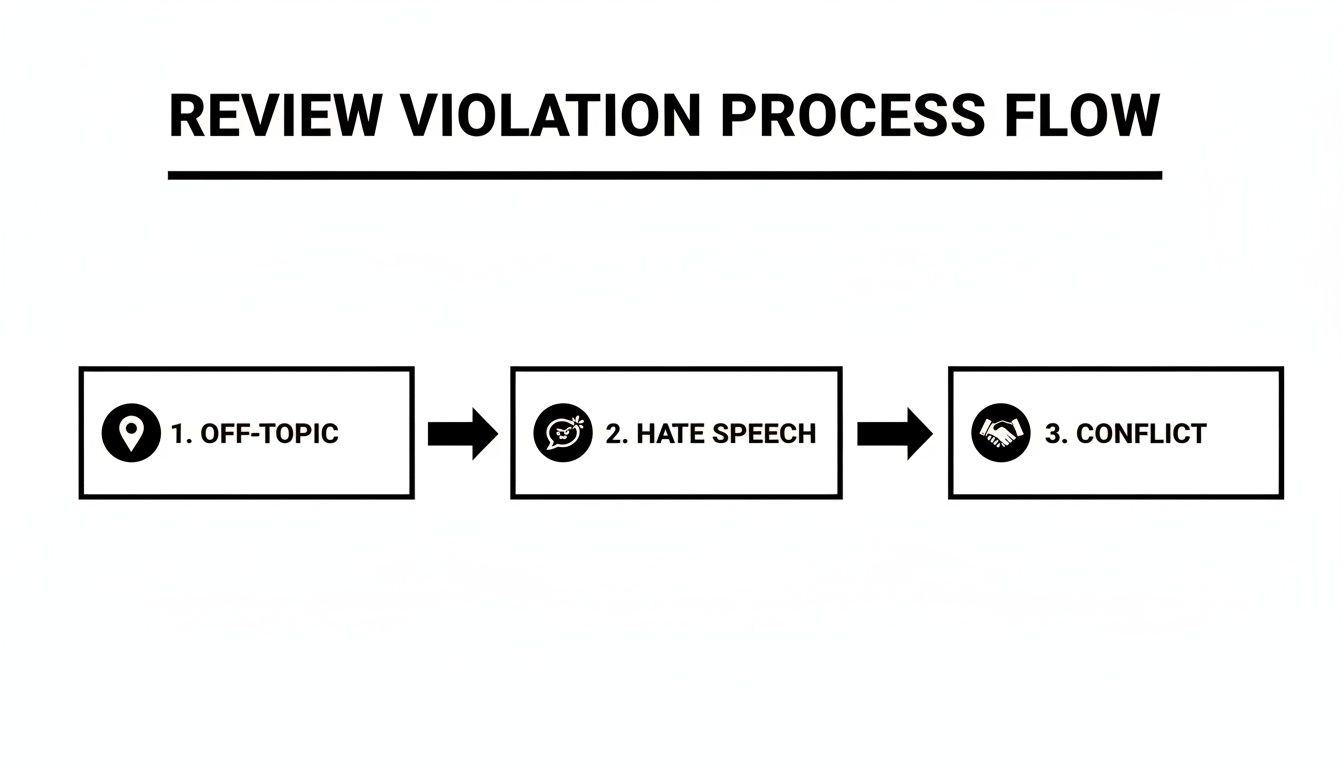
These pathways—off-topic rants, hate speech, and conflicts of interest—are the slam dunks. Platforms are almost always quick to act on these when you provide solid proof.
Craft a Short, Sharp, and Factual Report
When you write the report, get straight to the point. Moderators are sorting through hundreds of these a day. They don't have time to read a novel about how the review hurt your feelings. Brevity and clarity are your best friends.
Your report only needs to do four things:
- Identify the Review: Lead with a direct link. No confusion.
- State the Specific Violation: Name the exact policy the review violates. Don't say "this is unfair." Say, "this review violates your Conflict of Interest policy."
- Present the Proof: Briefly explain what your evidence shows. For example, "This was posted by a former employee we terminated on [Date]. We've attached their termination paperwork." Or even better, "We have no record of a customer named [Reviewer's Name] in our system, as shown in the attached CRM screenshot."
- Make a Clear Request: End with a simple, direct call to action. "We request the immediate removal of this review based on the violation of your [Specific Policy Name]."
Here’s a real-world example: We worked with a dental clinic that got a one-star review claiming a botched procedure. A quick check of their records proved the reviewer had never even been a patient. Our report was dead simple: "This review violates the policy against fake engagement. We have searched our patient database and have no record of this individual, as documented in the attached CRM screenshot." Because the evidence was undeniable, the review was gone in 48 hours.
Finding the Right Reporting Channel
Each platform has its own maze for reporting reviews. It's critical to use their official channels. Trying to find a secret email or back-door contact almost never works and can actually hurt your case.
Here’s where to start on the biggest platforms:
- Google Business Profile: Go to your GBP dashboard, find the review, click the three-dot menu, and hit "Report review." Pick the violation that fits best. You can even track your request's status in Google's Review Management Tool.
- Yelp for Business: Log in to your business account, go to the "Reviews" tab, find the offending review, click the three-dot icon, and select "Report Review." Just be warned, Yelp's process is notoriously tough, so your evidence needs to be absolutely airtight.
A Reporting Template to Get You Started
While every case is unique, this template gives you a solid, professional framework. It's designed to be direct, evidence-based, and easy for a moderator to process quickly.
Subject: Reporting Policy Violation for Review by [Reviewer's Name]
To the [Platform Name] Support Team,
I am writing to report a review that violates your platform's content policies.
Reviewer Name: [Reviewer's Name]
Date of Review: [Date]
Direct Link to Review: [Paste URL of the review]
This review violates the following policy: [State the specific policy, e.g., "Conflict of Interest," "Hate Speech," "Spam"].
The content is in violation because [Explain in 1-2 sentences how the review breaks the rule]. For example, "The reviewer is a former employee who was terminated for cause on [Date]."
As evidence, we have attached the following:
- A screenshot of the review.
- Documentation from our CRM showing this individual has never been a customer.
- [List any other evidence you have].
Based on this clear violation, we request that you remove this review from our profile.
Thank you for your time and attention to this matter.
Sincerely,
[Your Name]
[Your Business Name]
By following a structured approach like this, you dramatically boost your odds of success. You're no longer just asking to delete negative reviews—you're handing the platform an open-and-shut case that makes their decision easy.
What to Do When Your Removal Request Is Denied
So, you got that dreaded email. The one with the generic, “We’ve reviewed your request and found this content does not violate our policies” line. It’s incredibly frustrating, I know. A lot of business owners see that initial rejection and just throw in the towel, thinking the case is closed for good.
But here’s something I’ve learned from years of dealing with this: that first denial is rarely the final word. More often than not, it’s just a checkpoint. Your report was likely scanned by an algorithm or given a 10-second glance by a low-level moderator who missed the context.
This is where your persistence really starts to matter. Don't think of it as a rejection; think of it as an invitation to build a stronger, undeniable case.
Why Your First Request Probably Failed
Let's be honest, the initial denial usually happens for a few simple reasons. Your first report might have been a bit too vague ("This review is fake!"), you didn't have your evidence lined up, or an AI simply failed to grasp the nuance of the violation.
Instead of getting discouraged, use this as a chance to refine your approach. Ask yourself:
- Did I pinpoint the single most specific policy violation, or did I cast a wide net?
- Was my proof absolutely rock-solid, or could it have been interpreted in another way?
- Did I make it dead simple for a moderator to see the problem in under 30 seconds?
Often, a successful appeal comes down to framing your original evidence with more clarity or adding that one extra piece of proof you didn't include the first time. Getting your case in front of a senior specialist can make all the difference.
Finding the Right Appeal Channel (Hint: It's Not the 'Report' Button)
Whatever you do, don't just go back to the review and hit "report" again, hoping for a different result. That's a great way to get ignored. You need to find the platform's designated appeals channel, which is often tucked away.
H3: Google’s “Hidden” Appeal Process
For your Google Business Profile, the standard reporting tool is just the beginning. Once you get a denial, you can—and should—appeal it. Head back to the same Review Management Tool you used to check the status. If the review is eligible, you'll see an option to “Appeal eligible reviews.”
This is your shot to provide more detail. You get a text box to explain precisely why the review violates their policies. This is where you bring in all that extra evidence you’ve gathered.
My Pro Tip: When you appeal on Google, always reference your original case ID if you have one. Start your appeal with something direct like, "This is an appeal of the decision for review [Review ID]. The initial check missed a clear conflict of interest, as demonstrated by the attached employee records showing the reviewer works for our direct competitor."
H3: Getting a Second Look From Yelp
Yelp is notoriously tough, but a denial isn't always a dead end. After a report is denied, Yelp sometimes gives you the option to re-report it. Only do this if you have new, compelling evidence. Flagging the same review repeatedly without new information won't just fail; it can actually damage your account's credibility with their moderators.
For more serious situations, like a coordinated review bomb or clear defamation, you'll need to bypass the standard flagging system and open a support case directly through your business portal. Come prepared with a meticulously documented case file.
Building an Airtight Case for Your Appeal
An appeal isn't just asking for a do-over. It's your opportunity to present an argument so compelling that a human moderator can't possibly miss the violation.
Here’s how to strengthen your case the second time around:
- Try a Different Angle. A review can break multiple rules. If your "spam" report was denied, re-frame the appeal as a "conflict of interest" if you now have proof the reviewer works for a competitor.
- Bring in New Proof. Did you find the reviewer's public LinkedIn profile? Uncover an email where they threatened a bad review unless they got a full refund? New evidence dramatically increases your chances.
- Be Incredibly Direct. Stop using fuzzy language. Replace "This review seems fake" with "We have no record of a transaction with a person of this name in our point-of-sale system. Attached is our sales log from the date of their alleged visit."
The Power of Polite, Persistent Escalation
Sometimes, even the official appeals channel comes up short. If you have an airtight case for a blatant policy violation—especially for something serious like hate speech, threats, or posting private information—don't be afraid to take it a step further.
On Google, this might mean contacting Google Business Profile support directly through their help center. This will usually open a chat or email thread with a support agent. While these agents don't have the final say, they can escalate your ticket internally to a specialized policy team.
I won't lie, this process takes patience. It can involve several follow-ups over a few weeks. But for a review that is genuinely damaging and unequivocally against the rules, this level of persistence is what it takes to finally delete negative reviews that should have been removed from the start.
Your job is to stay polite, be professional, and keep presenting your undeniable evidence until it lands in front of someone who can make the right call.
What to Do With Negative Reviews You Can't Get Removed
Sometimes, the review just isn't going anywhere. You’ve done your homework, checked the platform policies, and the simple truth is the review is legitimate enough to stay. It doesn't violate any rules.
This might feel like a defeat, but it’s actually a golden opportunity. Your public response becomes the final word, a powerful signal to every potential customer who stumbles upon that review.
A thoughtful reply can do more than just damage control; it builds trust. Think about it: 94% of consumers admit a bad review has convinced them to avoid a business. But a professional, solutions-oriented response can completely flip that narrative. It shows you’re accountable, responsive, and genuinely care about your customers.
At this point, your goal is no longer to get the review taken down. It’s to showcase your stellar customer service for all to see.
The Acknowledge, Propose, Act Framework
The absolute worst thing you can do is get defensive. Arguing with a customer online is a race to the bottom that you’ll never win. Instead, lean on a simple, effective framework that keeps you professional and focused on a resolution.
- Acknowledge: Start by thanking them for their feedback, even if it’s harsh. You don't have to admit fault, but you must acknowledge their frustration. Something as simple as, "Thank you for bringing this to our attention. We're sorry to hear your experience with our delivery time didn't meet your expectations," shows you're listening.
- Propose: Offer a clear path to take the conversation offline. The goal is to move out of the public spotlight. This doesn't always mean a refund. A simple proposal like, "We'd like to look into this for you. Could you please email our support manager, Sarah, at [email address] so we can get a few more details?" works perfectly.
- Act: End on a positive, action-oriented note. This final sentence is for all the future readers. Reiterate your commitment to quality service, showing everyone that you take these issues seriously and work hard to resolve them.
This framework transforms a public complaint into a live demonstration of your excellent customer service.
Crafting the Perfect Public Reply
With that structure in mind, the key is to be prompt, professional, and brief. You never want to get into a long back-and-forth debate. The public reply is just for acknowledging the issue and moving it to a private channel.
Here’s a quick checklist to run through before you hit "post":
- Keep it short and sweet. Three or four sentences is plenty.
- Never use the customer's name or any other personal info.
- Don't offer discounts or freebies publicly. This can invite a flood of fake complaints from people looking for a handout.
- Stay cool and professional. Read your draft out loud to catch any hint of a defensive tone.
Here's the key takeaway: Your reply isn't really for the unhappy customer. It's for every other potential customer who will read it. They are your true audience, and they're watching to see how you handle problems.
Imagine a customer complains about receiving a faulty product. A great response would be: "We're very sorry to hear the product you received wasn't up to our standards. We want to make this right. Please contact our support team at [phone number] with your order number, and we'll arrange for a replacement immediately."
It’s perfect. It acknowledges the problem, offers a direct solution, takes the conversation private, and shows other shoppers you stand by what you sell. For more specific examples and tactics, our guide on how to respond to negative Google reviews is a great resource. Mastering this skill is a non-negotiable part of managing your reputation today.
When Should You Call in a Reputation Management Pro?
Trying to get illegitimate negative reviews taken down can feel like a full-time job you never signed up for. You’re already stretched thin running your business—handling sales, managing your team, and keeping customers happy. When you have to stop all that to spend hours documenting a fake review, filing a report, and then fighting a denial, it pulls you away from what actually matters.
Eventually, you hit a point where the time, stress, and frustration just aren't worth it anymore.
This is a common crossroads for business owners. Taking care of a single unfair review here and there is one thing. But some situations require a level of skill, persistence, and inside knowledge that most companies just don't have. Knowing when you’ve reached your limit is the key to protecting your brand without completely burning yourself out.
It’s not about admitting defeat. It’s about making a strategic move to bring in a specialist who does this all day, every day.
You're Under a High-Volume or Coordinated Attack
A sudden flood of one-star reviews is a massive red flag. This isn't just an unhappy customer—it's an organized assault. These attacks can be launched by a shady competitor, an angry group, or even automated bots.
You’ll start to see some tell-tale signs:
- A bunch of one-star reviews pop up in a very short window of time.
- The language or complaints across the reviews sound suspiciously similar.
- The "reviewers" have brand new profiles with zero other activity.
Trying to flag these one by one is like playing whack-a-mole. You’ll never keep up. A reputation management service like LevelField knows how to spot these patterns immediately. They'll bundle all the evidence into a single, comprehensive case that proves to the platform that you're the victim of a coordinated, policy-violating attack. That approach is infinitely more effective than sending a dozen scattered reports.
The Review Involves Complex or Legally Sensitive Issues
Sometimes, a review goes way beyond simple criticism and veers into dangerous territory. We're talking about defamatory statements, false accusations that could be considered libel, or the exposure of private information about you or your employees. When that happens, the stakes get a lot higher.
Handling these situations requires a careful, methodical approach. One wrong move in your response or report could actually make the legal risk worse. Experts are trained to navigate these high-stakes cases by focusing strictly on the platform's policy violations, building an objective, evidence-based argument that doesn't add fuel to the fire.
This is particularly true for professionals in fields like law or medicine, where a baseless accusation can do serious, lasting damage to someone’s career. A specialist knows exactly how to frame the issue for platform moderators, highlighting the breach of rules without getting dragged into a messy legal back-and-forth.
You Simply Don’t Have the Time or Resources
Honestly, the most common reason people bring in an expert is that they're just out of bandwidth. Getting a review removed is rarely a quick fix. It’s often a long game of persistent follow-ups, appeals, and obsessive documentation.
And the platforms themselves have changed the game. They've ramped up their use of automated systems to police reviews, removing millions at a time. This trend, which you can read more about in these platform enforcement reports from Search Engine Land, means that successful removals are almost always the result of perfectly documented cases submitted through official channels. The system now favors those with deep expertise.
Hiring a service hands this entire headache over to someone else so you can get back to running your business. They take care of everything:
- Investigation: They dig in to find the specific rule the review breaks.
- Documentation: They build the complete evidence file with screenshots, records, and context.
- Submission: They file the takedown request using the proper channels for that platform.
- Persistent Follow-Up: They chase it down, managing every appeal and escalation until there's a final answer.
At the end of the day, a reputation expert doesn't just save you time. They bring a much higher success rate because they live and breathe the platforms' rules, turning a chaotic fight into a managed, professional process.