


Let's get right to it. That stinging one-star review just landed on your Google Business Profile, and your first instinct is to make it disappear. But can you just hit a delete button? The short answer is no—but that's not the whole story.
While you can't remove a review just because it’s unflattering, you absolutely can get negative reviews removed if they break Google’s rules. The entire process hinges on one thing: proving a clear policy violation.
The Real Deal on Removing Negative Google Reviews
Think of Google Reviews less like your own website's comment section and more like a moderated public square. A moderator wouldn't silence someone for having an unpopular opinion, but they would step in to remove graffiti, spam, or personal attacks. Google acts the same way.
A customer sharing their honest, albeit negative, experience is protected speech in Google's eyes. Your feelings about the review—whether you think it's unfair, exaggerated, or just plain mean—don't factor into their decision. The only question Google cares about is: Does this review violate one of our specific content policies?
Everything else is noise. This is the single most important concept to understand before you even think about flagging a review.
This simple flowchart breaks down the logic. It’s the exact mental model you should use when a bad review comes in.
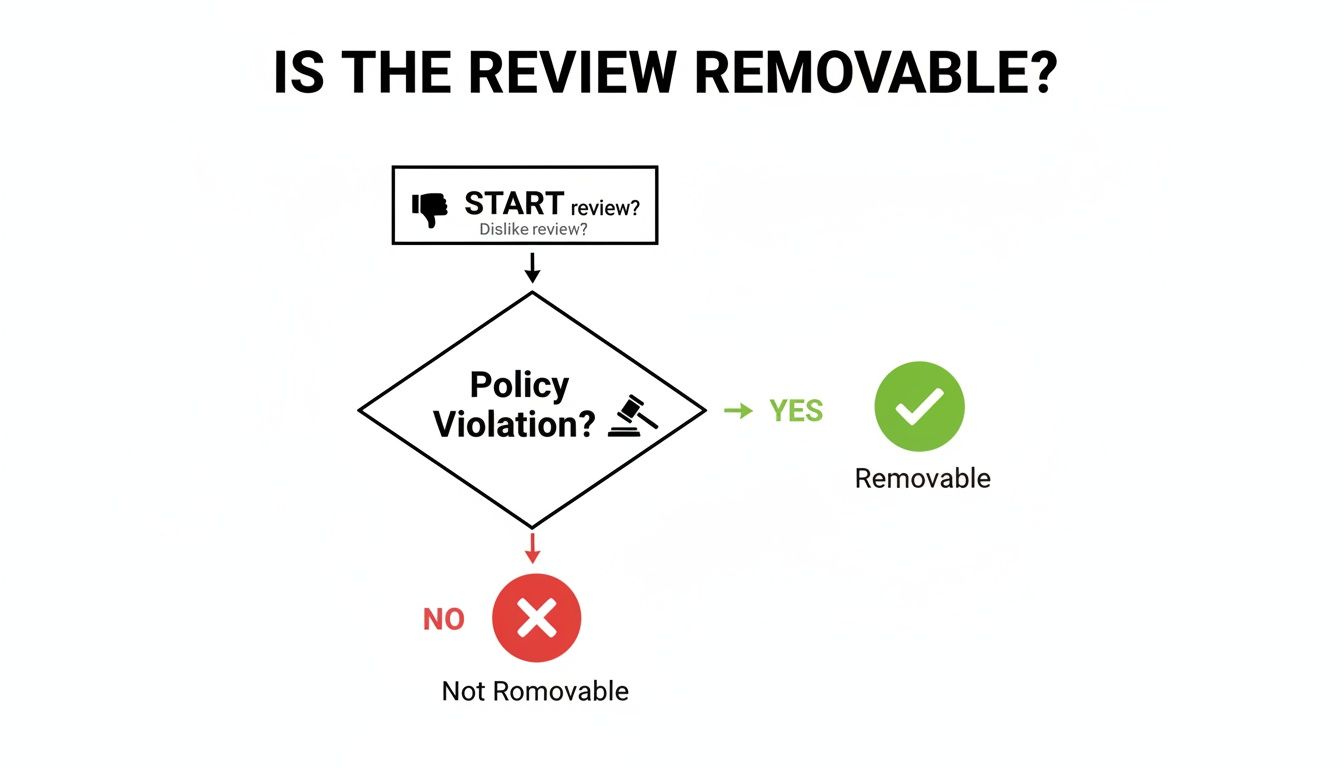
As you can see, the path to getting a review taken down only opens up if you can pinpoint a specific rule that's been broken.
What You Can Remove vs. What You're Stuck With
To make this crystal clear, let's look at some real-world examples. Knowing the difference between a removable offense and a simple bad opinion will save you a ton of time and frustration.
This quick guide should help you immediately spot whether you have a legitimate case for removal.
Quick Guide to Google Review Removal
| Review Type | Can It Be Removed? | Reason |
|---|---|---|
| Spam or Fake Content | Yes | The review is from a bot, a fake account, or is clearly just an ad for something else. |
| A Genuinely Bad Experience | No | The customer had a legitimate, poor experience and is sharing their honest opinion. |
| Off-Topic Rants | Yes | The content is a personal attack, a political diatribe, or has nothing to do with their customer experience. |
| Harsh but Fair Criticism | No | The reviewer points out real service flaws, even if their language is brutally honest. |
| Conflict of Interest | Yes | The review was posted by a competitor, a disgruntled ex-employee, or someone you can prove was paid to post it. |
Getting a feel for these categories is the first step. The good news is that Google is getting more aggressive in its enforcement. In fact, data shows that review takedowns hit record highs in 2023, with analysis suggesting Google is cracking down hard on fake content to protect the platform's integrity. You can find more insights in this analysis of Google's review moderation trends and see how it might work in your favor.
Understanding Google’s Review Policies

If you want any chance of getting a negative Google review taken down, you have to start thinking like Google. That means putting your frustration aside and learning to speak their language. And their language is all about one thing: their Prohibited and Restricted Content policies.
These rules aren't about whether a review is fair, or if the customer was right or wrong. They are a rigid set of guidelines built to keep the platform functional and safe.
Think of Google as the referee in a game. If a review breaks a specific rule in their playbook, you can flag it, and the ref might pull it down. But if the review doesn't technically violate any of those rules—no matter how much you disagree with it—it’s going to stay up.
Common Policy Violations You Can Actually Use
While Google’s full policy document is long and detailed, most of the reviews that actually get removed violate one of just a few key rules. Focusing on these will save you a ton of time and energy.
Here are the most common violations that give you a real shot at removal:
- Conflict of Interest: This is a big one. A review is forbidden if it’s posted by someone with an obvious bias. This includes current or former employees, competitors pretending to be customers, or anyone who was paid to leave a fake review.
- Spam and Fake Content: This is your catch-all for reviews posted by bots, from fake accounts, or that are just blatant advertising. If a supposed "customer" review is just a link to their own business, that’s a textbook violation.
- Off-Topic Content: A review is supposed to be about a customer's experience with your business, period. Rants about politics, general complaints about the neighborhood, or personal attacks on an employee's private life are all considered off-topic and can be removed.
- Harassment or Hate Speech: This is a zero-tolerance area for Google. Any content that bullies, threatens, or uses discriminatory language against people or protected groups is strictly prohibited and usually gets taken down quickly once reported.
Key Takeaway: Your success hinges on matching the review's content to a specific policy violation. A vague complaint like "this review is unfair" will get you nowhere. A precise claim like "this review is off-topic because it only discusses the reviewer's political beliefs" gives Google a concrete reason to take action.
The Nuance of Google’s Enforcement
It's also important to understand that Google's moderation can feel a bit unpredictable. They rely heavily on automated systems to do the initial filtering, and sometimes those systems get it wrong.
For example, data shows that restaurants have a huge number of reviews deleted—both positive and negative. Why? Their high volume of daily customers can sometimes trigger AI flags for suspicious activity, even when the reviews are completely legitimate. You can read more about how restaurants are uniquely affected on Hospitality Today.
This is exactly why building a clear, evidence-based case is so important. You’re not just trying to convince a person; you often have to get past an algorithm first. By mastering Google's rules, you can frame your request in a way that both their automated systems and their human moderators can understand and act on. That's how you remove a negative Google review the right way.
A Step-by-Step Guide to Flagging an Inappropriate Review
Alright, so you've found a review that pretty clearly crosses the line and breaks one of Google’s policies. What now? It’s time to flag it. This is your official first step in asking Google to take it down.
Think of flagging as raising your hand and telling the hall monitor—in this case, Google's moderation team—that something's wrong. You're pointing out the problem and asking them to step in. The more accurate you are with your report, the better your odds of getting that review removed.
You have two main ways to do this: directly from Google Maps or through your Google Business Profile (GBP) dashboard. Both get the job done, but I generally recommend using your GBP dashboard because it keeps the report tied to your official business account.
How to Flag a Review from Google Maps
This is the fastest way to flag a review, and what’s interesting is that anyone can do it, not just the business owner.
- Find the Review: Pull up your business on Google Maps and find the review you need to report.
- Access the Menu: Look for the three little dots right next to the reviewer’s name and give them a click.
- Select 'Report review': A pop-up will ask you to pick the reason you're reporting the review.
Choosing the right violation is critical here. For instance, if a disgruntled ex-employee is venting, you'd choose "Conflict of interest." If the review is full of profanity or threats, "Hate speech or harassment" is the one you want. Be specific.
Reporting from Your Google Business Profile
This is the method I recommend for business owners. It officially logs the complaint from your verified profile, which can sometimes carry more weight.
- Log In: Just sign in to your Google Business Profile account.
- Navigate to 'Reviews': In the menu on the left, you'll see a "Reviews" tab. Click it.
- Find and Flag: Scroll down to the offending review, click the three-dot menu next to it, and hit "Report review."
The process is the same as on Maps—you'll need to select the specific policy that's being violated. Don't just guess; pick the one that truly fits the situation.
What Happens Next? Once you hit submit, your report goes into Google’s moderation queue. You'll get an automated email saying they received it, and then... you wait. This can take anywhere from a few days to a week or even longer. Google is sifting through millions of these, so a little patience goes a long way.
If Google sides with you, the review will just vanish one day. If they don't agree that it's a violation, it stays up. You can keep an eye on the status of your reports right inside your GBP dashboard.
For a more detailed look at the process, our guide on how to report fake Google reviews breaks it down even further with screenshots and extra tips. Ultimately, flagging is your first and most direct line of defense against reviews that go from being simple opinions to actual policy violations.
What to Do When Your Removal Request Is Denied
So, you got the email. That dreaded, "we will not be taking any action" message from Google. It’s easy to feel like you’ve hit a brick wall, but I can tell you from experience, this is rarely the end of the road. A denial often just means your first report didn’t have enough clear-cut evidence for the initial reviewer to make a call.
Think of it this way: your first flag was just a headline. Now, it’s time to write the full story. This is your chance to escalate the issue and build a much stronger case.

The next step isn't just trying again; it's about shifting your strategy from a simple report to a well-documented appeal.
Building a Stronger Case for Appeal
When you appeal a denied request, you get a second shot to really explain why the review breaks a specific rule. This is where you need to connect the dots for the moderation team with cold, hard evidence. Just saying the same thing again won't cut it.
Your mission is to make the violation so obvious they can't possibly ignore it. Start gathering proof.
- Screenshots: Grab anything you can find—text messages, social media posts, or internal records—that prove a conflict of interest or show someone is faking their identity.
- Timestamps: Pull up dates and times from your CRM, POS system, or appointment calendar that directly contradict the reviewer’s claims.
- Documentation: If you suspect an ex-employee is behind the review, have their employment dates handy to clearly show a conflict of interest violation.
The trick is to lay it all out logically. Don’t make the moderator guess. Spell out the context and explain exactly how your evidence proves the policy violation.
When to Consider Legal Options
Every so often, a review goes beyond just being negative and veers into illegal territory. If your appeal gets shot down but the review contains defamatory lies, impersonates someone, or leaks private information, it might be time to think about legal action.
Important Distinction: There's a huge difference between opinion and defamation. "The service was slow" is an opinion. But "The owner stole my credit card information" is a false statement of fact that could seriously damage your reputation. That’s where the line is crossed.
Your first move should be to talk to a lawyer specializing in internet law or defamation. They can tell you if you have a solid case for a court order, which you can then take to Google to force the removal. It's definitely a more expensive and complicated path, but for reviews causing real, measurable harm, it can be a lifesaver.
Partnering with Reputation Management Professionals
Look, if this whole process sounds like a massive headache, or if you're dealing with an onslaught of fake reviews, calling in the pros is a smart move. Reputation management services live and breathe this stuff. They know Google’s policies inside and out and understand exactly how to frame an appeal with evidence that gets results.
Companies like LevelField can take the entire process off your plate, from digging into the violation and collecting the proof to handling all the back-and-forth with Google. It frees you up to actually run your business and dramatically boosts your odds of getting the review taken down, especially in tricky situations like coordinated attacks. While you focus on your customers, they focus on cleaning up your online reputation.
Beyond Deletion: Proactive Reputation Management Strategies
Trying to get a negative review removed is important, but if that’s your only strategy, you're playing pure defense. Think of it like a soccer team that only has a goalie—it's a recipe for getting scored on. The best businesses go on the offense by building such a strong, positive reputation that the occasional bad review barely makes a dent.
This is a fundamental shift from damage control to brand building. The goal is to create an online presence so overwhelmingly positive that one person’s bad day doesn’t define you. Instead of living in fear of criticism, you build a system that constantly showcases what you do best.
At its core, the strategy is simple: drown out the negative with a flood of authentic, positive feedback. This doesn’t happen by magic. It’s the result of a deliberate, consistent effort to encourage your happiest customers to share their stories.
Turning Happy Customers Into Vocal Advocates
Your most satisfied customers are often your quietest ones. They had a great experience, paid their bill, and went on with their lives. It's your job to give them a gentle nudge to share that positive experience where it really counts—on your Google Business Profile.
Here are a few proven ways to get more positive reviews without being pushy:
- Email Follow-Ups: A few days after a purchase or service, send a short, polite email asking for their thoughts. A direct link to your Google review page makes it a one-click process for them.
- Text Message Requests: Especially for service-based businesses, a quick text message can feel personal and gets a surprisingly high response rate. "Hey, how did we do? Mind leaving a quick review?"
- QR Codes in Your Business: Put a QR code on receipts, menus, or at the front counter. When a customer is feeling good about their experience, you want to make it dead simple for them to act on that feeling.
The key is to make it effortless. The less friction, the more likely you are to get that 5-star review, building a powerful buffer against any negativity that comes your way.
Responding to Negative Reviews The Right Way
Even with the best service in the world, bad reviews are going to happen. It's inevitable. But how you respond can completely transform the situation. In fact, research shows that 71% of consumers read a business's response to reviews, which means your reply often carries more weight than the original complaint. A calm, professional response shows you're accountable and serious about customer service.
When you respond to a negative review, you aren't just talking to one unhappy customer. You are speaking to every potential customer who reads that review in the future.
Your response is a public demonstration of your company's character. If you want to master this skill, our guide on how to respond to negative Google reviews offers templates and real-world advice. Simply put, responding shows you care, and that builds trust.
Comparing Reputation Management Strategies
Choosing the right approach depends on the situation. Do you try to delete, respond, or just bury the negative review with positive ones? Here's a quick breakdown to help you decide.
| Strategy | Pros | Cons | Best For |
|---|---|---|---|
| Review Removal | Permanently gets rid of the problem. | Low success rate; only works for policy violations. | Clearly fake, spammy, or defamatory reviews that violate Google's terms. |
| Public Response | Shows accountability; lets you tell your side. | Can draw more attention to the review; requires a careful, non-defensive tone. | Legitimate (but negative) customer experiences where you can solve a problem or clarify a misunderstanding. |
| Review Suppression | Builds a stronger, more accurate online reputation over time. | Takes consistent effort; doesn't remove the existing negative review. | All businesses as a long-term, ongoing strategy to build a resilient brand reputation. |
As you can see, a well-rounded strategy is your best bet. Deletion is for clear violations, responding is for genuine feedback, and suppression is the foundation you should always be building.
Ultimately, managing your online reputation goes beyond just handling reviews. It’s about building a resilient brand that can weather any storm. For more great ideas on this, check out these 8 Simple Online Reputation Management Tips. By combining proactive review generation with masterful responses, you take back control and ensure your online image truly reflects the quality of your business.
It's Time to Take Back Your Online Reputation

While you can't just wave a magic wand and make every negative review vanish, you’re definitely not powerless. Knowing that you can remove negative reviews on Google when they cross the line into policy violations is a powerful first line of defense.
Throughout this guide, we've covered the practical steps—from spotting a review that breaks the rules to flagging it and even pushing back if your initial request is denied. But the strongest businesses I’ve seen don't just play defense; they build an amazing offense.
Here's the bottom line: your long-term success isn't about scrubbing every bad review from existence. It's about building such a strong foundation of positive feedback that the negative ones barely make a dent.
When you make it a habit to encourage happy customers to share their experiences and you respond to criticism with professionalism, you create an authentic and resilient online presence. A random one-star review then looks like an outlier, not the norm.
It’s time to shift from reacting to your reputation to actively building it. You now have the playbook and the tools. Go out there and create a brand that can weather any storm, proudly displays its strengths, and earns the trust of every person who finds you online. It's your story to tell.
Frequently Asked Questions
When you're trying to figure out how to handle negative Google reviews, a lot of questions pop up. Let's get straight to the point and answer some of the most common ones we hear from business owners.
How Long Does Google Take to Review a Flagged Review?
There’s no magic number here. Once you flag a review, it enters Google's queue, and the review process can take anywhere from a few days to a week, sometimes even longer.
The hardest part is the waiting game, as Google usually won't send you an email letting you know if they took it down or not. Your best bet is to simply keep an eye on your profile to see if the review disappears.
What Is the Success Rate for Getting a Review Removed?
This really comes down to how strong your case is. If you've got a slam-dunk violation—like a review filled with hate speech, spam links, or it’s obviously from a disgruntled ex-employee—your chances are actually pretty good.
But if the review is just a scathing account of a genuine customer experience, it's almost certainly staying put. Success isn't about whether you think the review is unfair; it’s about whether you can point to the specific rule that was broken.
The biggest mistake we see? Businesses flag reviews simply because they're "not true." Without proving a specific policy violation like 'Conflict of Interest' or 'Off-Topic,' your request will get tossed out almost immediately.
Can I Pay Someone to Remove a Negative Google Review?
Be incredibly wary of any company that guarantees they can get a negative review removed for a fee. It’s a huge red flag.
Legitimate reputation management firms can absolutely help. They know how to build a solid case and navigate the appeals process, which boosts your chances. But no one can ethically promise removal, because the final call is always Google's. Services that do make those guarantees often use shady tactics that could get your entire Google Business Profile suspended. A professional helps you build a better argument; they don't have a secret backdoor.