


Yes, you can remove bad Google reviews, but there's a huge catch: the review must violate one of Google's specific policies. You can't just get rid of a review because it's negative, factually incorrect in your opinion, or because you simply disagree with it. The entire game is about proving the review is illegitimate, not just unflattering.
The Hard Truth About Removing Bad Google Reviews

Look, every business owner feels that punch in the gut when a one-star review pops up. It's personal. But it’s critical to step back and separate genuine, albeit painful, customer feedback from reviews that are actually against the rules.
Google’s platform is built to protect authentic consumer opinions, even the harsh ones. That means a review from a genuinely unhappy customer detailing their bad experience is almost certainly going to stay up. Your best move in that situation is always a calm, professional, and public response.
However, things change dramatically when a review crosses a line. Google has a very clear set of content policies, and if you can pinpoint the violation and build a case, you have a real shot at getting it taken down.
A Tale of Two Bad Reviews
To see what I mean, imagine a local café gets two different one-star reviews on the same day.
- Review #1: "The coffee was lukewarm, and the barista was rude. Waited 15 minutes for a simple latte. I won't be back." This review stings, but it’s a classic example of a customer’s personal experience. It doesn't break any rules, so it’s not removable.
- Review #2: "This place is a front for illegal activity! The owner is a criminal. AVOID AT ALL COSTS!!!" This is a whole different beast. It’s not an opinion on the coffee; it’s a serious, unsubstantiated accusation. This review is a prime candidate for removal because it likely violates policies against dangerous and derogatory content.
Getting a handle on this distinction is the single most important part of the process. Your success hinges entirely on your ability to connect the review to a specific policy violation.
The core principle is simple: Google removes reviews based on how something is said, not what is said. A customer can express their dissatisfaction, but they can't use hate speech, impersonation, or spam to do it.
To help you quickly figure out if you have a case, I've put together a quick-reference table. Use this as your first check before you even think about hitting the "report" button. It’ll help you focus your time and energy where it actually matters—on the reviews Google will actually consider taking down.
Removable vs. Non-Removable Reviews
| Scenario | Likely Removable? | Why? |
|---|---|---|
| A former employee leaves a bitter, one-star review. | Yes | This is a clear conflict of interest. |
| A customer complains about high prices. | No | This is a subjective opinion about value. |
| The review contains profanity or slurs. | Yes | This violates the hate speech and offensive content policy. |
| A competitor leaves a fake negative review. | Yes | This is deceptive content and a conflict of interest. |
As you can see, the theme is clear. Reviews based on legitimate customer experience (even if you disagree) are here to stay. Reviews based on deception, harassment, or a conflict of interest are the ones you can and should fight.
Pinpointing Which Reviews Actually Break Google's Rules
Getting a negative Google review taken down isn't about whether you agree with it. It's about proving it violates a specific Google policy. You have to put on your detective hat and connect the dots between the review's content and Google's official rulebook. Your feelings about the review, unfortunately, don't carry much weight—it’s all about a clear-cut policy breach.
Google’s job isn’t to play referee in a he-said-she-said battle. Their focus is on protecting the integrity of their platform, which means weeding out content that's deceptive, harmful, or just plain irrelevant. If someone had a genuinely bad experience and left a harsh but honest opinion, Google considers that protected speech, and it's almost certain to stay up.
Spotting Spam and Fake Content
This is probably the most common reason for removal and, thankfully, one of the easiest to prove. Spam isn't just someone trying to sell you something; it's any review that's inauthentic or posted just to manipulate your rating. Google's algorithms are getting smarter about this, but plenty still slips through.
Here’s what to look out for:
- Gibberish: Reviews that are just a jumble of random letters or nonsense phrases.
- Duplicate Content: Seeing the exact same review pop up multiple times from different accounts.
- Promotional Links: A one-star review that mysteriously contains a link to your direct competitor.
- Paid-for Praise (or Pans): Content from users who were clearly incentivized. You can often spot these by their generic language or a pattern of similar reviews across different business profiles.
A classic example is seeing a sudden flood of one-star reviews from brand-new profiles that have never reviewed anything else. That’s a massive red flag for a coordinated attack, and documenting that pattern is crucial for your removal request.
Identifying Conflicts of Interest
This violation is all about who is leaving the review. Google’s rules are clear: you can't review a business if you have a vested interest, because your feedback simply can't be impartial.
Think about these common scenarios:
- Disgruntled Ex-Employees: Someone you let go last month suddenly leaves a scathing review detailing internal company drama. That’s not a customer experience.
- Competitors: The owner of the shop down the street posing as a customer to tank your rating. It happens more than you'd think.
- Your Own Team: A well-meaning manager encouraging (or pressuring) current employees to leave five-star reviews to inflate the company's score.
The review has to come from a genuine customer. If you can find evidence linking the reviewer's profile to their real-world identity—say, their LinkedIn profile shows they work for your competitor—your case for removal becomes incredibly strong.
Unmasking Harassment and Hate Speech
Google takes a very hard line on this, and for good reason. Reviews that attack, threaten, or harass people are prime candidates for removal. This isn't just about an angry customer—it's about language that is explicitly hateful, discriminatory, or dangerous.
Any review targeting someone based on their race, religion, disability, gender, or sexual orientation is a severe and immediate policy violation. Google tends to act very quickly on these reports because they represent a direct threat to user safety.
This category also covers personal attacks, like doxxing (posting private info like a home address) or making credible threats. Even if a review starts with a complaint that seems legitimate, the moment it crosses into hate speech or harassment, the entire review becomes removable.
Off-Topic and Irrelevant Rants
At the end of the day, a review has to be about the customer's experience with your business. When it spirals into a rant about something completely unrelated, it violates the off-topic policy.
Imagine a restaurant customer leaving a one-star review to complain about the city’s parking situation or to air their political grievances. That has absolutely nothing to do with the food, the service, or their experience at your establishment.
While not as severe as hate speech, it's still a clear violation. And Google is getting more aggressive here. In 2023 alone, they removed or blocked over 170 million reviews for policy violations, a number that keeps growing. This shows their commitment to relevance, which is why building a case around off-topic content can be a surprisingly effective strategy. You can learn more about Google's review filtering updates on Brainspikemarketing.com.
How to Report a Fake or Unfair Google Review
So you’ve found a review that you're pretty sure breaks Google's rules. What now? Just letting it sit there and hoping it goes away on its own isn't a strategy. The goal is to build a clear, concise case for Google's moderation team so they can quickly see the violation and take it down.
You’ve got two main ways to report a review. The first is through Google Maps—it’s fast and easy. The second, and the one I almost always recommend for business owners, is through your Google Business Profile. It just gives you more control and visibility.
The Quick Flag: Reporting on Google Maps
This is the most straightforward route. Anyone, even a customer, can flag a review they see on Maps.
It's simple: find your business profile on Google Maps, locate the review in question, and click the three little dots next to the reviewer's name. From there, hit "Report review" and pick the violation that fits best—like "Spam" or "Conflict of interest."
The downside? It's a bit like sending a message in a bottle. You report it and then... you wait. There's no way to track what happens next. It’s a decent first step, but not the most powerful one.
The Business Owner's Method: Using Your Google Business Profile
This is where you get serious. Reporting through your Google Business Profile (GBP) dashboard is the far better option. It gives you a dedicated tool to manage and track your removal requests.
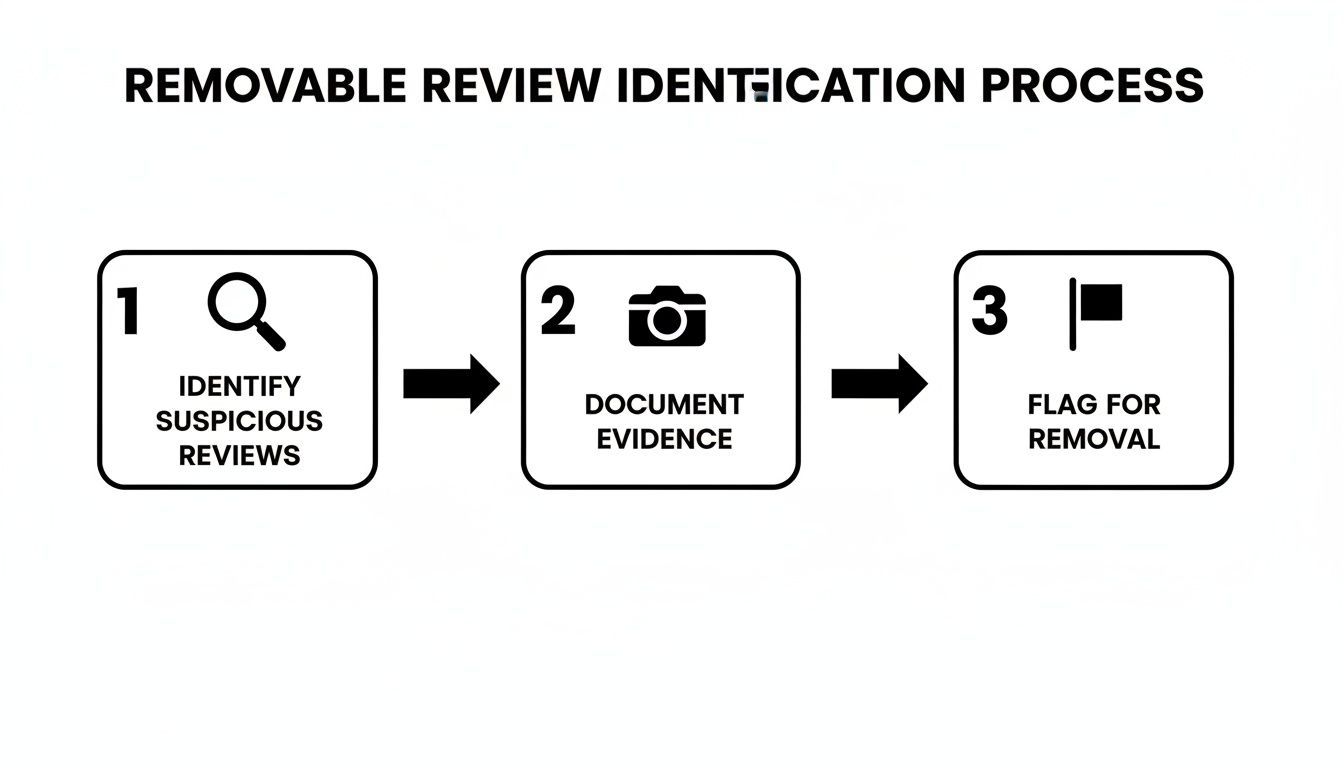
The process starts with identifying the violation, then gathering your proof, and finally, flagging it. You can't just jump to the last step and expect results.
To do this, log into your GBP, head to the "Reviews" section, find that pesky review, and use the three-dot menu to report it. The magic here is that this creates a trackable case inside Google's system. You can actually check on its status. For a complete walkthrough, check out our in-depth guide to get a review removed from Google.
Building a Rock-Solid Case with Evidence
When you submit your report, especially for nuanced violations like a conflict of interest, the short description you provide is your entire argument. You have to connect the dots for the moderator, linking the review's content directly to a specific policy.
Here’s what your evidence checklist should look like:
- Screenshot the Review: Get a full-screen grab of the review itself, making sure the reviewer's name and the date are clearly visible.
- Investigate the Reviewer's Profile: Click on their name and screenshot their profile page. Are all their other reviews 1-star rants or 5-star raves? Do they review businesses in completely random, disconnected locations? These are often red flags for a fake or paid account.
- Dig for External Proof: This is crucial for conflict-of-interest claims. If you suspect a disgruntled ex-employee, find their LinkedIn profile or a social media post that confirms their past employment. If you think it’s a competitor, a screenshot from their company website or directory can be powerful proof.
When you write your report, keep it brief and stick to the facts. No emotion, just evidence.
Pro Tip: Speak Google's language. Don't just say, "This person is a liar and never came here!" Instead, frame it in policy terms: "This review violates the policy on Misinformation. The events described did not take place, and we have no record of this individual in our customer database." This approach shows you understand the rules and makes it much easier for the moderator to justify removing it.
It’s a gut punch. You’ve reported a review you know is fake or breaks the rules, only to get that generic, automated email from Google: "we will not be taking any action." It feels final, but trust me, it’s often just the beginning.
Don’t throw in the towel. That initial rejection is usually the result of a quick scan by an algorithm. It didn't see an obvious, clear-cut violation on the first pass. Your job now is to get your evidence in front of a real person who can understand the context and nuance of the situation. This is where all that documentation you gathered really starts to matter.
How to Appeal a Denied Removal Request
After that first denial, Google gives you one shot at an appeal through the Google Business Profile Help Center. This is your chance to make a much stronger case than the simple "flag as inappropriate" option allowed. You're no longer just picking a category; you're explaining why the review is a violation, in your own words.
When you write your appeal, be methodical and stick to the facts.
- Provide Your Original Case ID: Lead with this. It immediately connects your appeal to the initial report and saves the support agent a ton of time.
- Beef Up Your Evidence: Have you found something new? Maybe you dug up a social media post proving the reviewer lives in a different country and has never been a customer. Now is the time to add it.
- Frame Your Argument Like a Pro: Don't just repeat what you said the first time. Point to the specific policy the review violates. For example, you could write, "This review is a clear violation of the 'Conflict of Interest' policy. The user was a disgruntled employee we had to let go on [Date]. We have attached a redacted copy of their termination record as proof."
Think of your appeal as a short, compelling case file for a busy investigator. A human agent isn't interested in how the review made you feel; they need to see a clear, undeniable policy violation backed by solid proof.
What If Google Still Says No?
Let's be real—sometimes, even a perfectly crafted appeal gets denied. This is common when a review, while incredibly negative and maybe even unfair, toes the line without technically breaking a specific rule. It's a gray area. When you hit this wall, you're left with two main paths: legal action or calling in the experts.
Taking the legal route means exploring things like a cease-and-desist letter or, in more extreme cases, a defamation lawsuit. These are serious, expensive, and time-consuming steps. To even have a shot at a defamation claim, you have to prove the statements are factually false and that they caused real, measurable damage to your business. This is a high bar, so you should absolutely talk to a lawyer before heading down this road.
Bringing in Professional Help
If you've exhausted Google's appeal process and legal action seems like overkill, it’s time to consider a reputation management service like LevelField. This is our specialty. We know how to navigate the often-frustrating backchannels of platform support because we do it every day.
We understand the specific evidence and language that gets a denied case reopened and seriously re-evaluated. Our team handles the entire process for you, from compiling the strongest possible evidence to persistent follow-up. For businesses being hammered by damaging fake reviews, that focused expertise can be the difference-maker in getting them taken down for good.
Playing Offense: A Proactive Approach to Reputation Management

While it's crucial to know how to fight fake or policy-violating reviews, the best defense is a great offense. The ultimate long-term strategy is to build a reputation so strong that one or two bad reviews barely make a dent. This means shifting your focus from reactive damage control to proactively building a constant stream of authentic, positive feedback.
The secret isn't a secret at all: you need to encourage your happy customers to share their experiences. The catch? You can't incentivize them with discounts or freebies—that’s a fast track to a policy violation from Google. But you absolutely can, and should, make it ridiculously simple for people to leave a review when they're feeling good about your business.
How to Cultivate Authentic Positive Feedback
Timing is everything here. The golden moment to ask for a review is immediately following a positive experience. Think about it: a roofer sends a follow-up email with a review link a week after a perfect installation, or a restaurant includes a small card with a QR code next to the bill.
Keep the ask simple and direct. You don't need a fancy script.
- In-Person: "We're so glad you enjoyed your meal! If you have a moment, we'd appreciate you sharing your experience on Google. It really helps other folks find us."
- Email: "Thank you for your recent purchase! Your feedback means a lot to us. Would you be willing to leave us a review on Google? [Link to Google Business Profile]"
By consistently making these low-pressure requests, you build a foundation of genuine customer sentiment that drowns out the occasional negative comment. This is a cornerstone of managing your online reputation effectively.
The Overlooked Power of Responding to Every Review
Replying to reviews—both the glowing and the critical—is one of the most powerful and underrated tools in your arsenal. It sends a clear signal to potential customers that you are engaged, you care, and you’re committed to their satisfaction. A well-crafted, professional response to a negative review can completely neutralize its sting.
A thoughtful reply shows that even when things don't go perfectly, you're dedicated to making things right. This builds incredible trust with people who are still on the fence about choosing your business.
Interestingly, it seems Google's algorithms may also pay attention to your engagement. Recent data revealed that a staggering 73.7% of removed reviews had no reply from the business owner. While correlation isn't causation, this suggests that actively managing your profile might signal legitimacy to Google. You can read more about this study on review deletions on SERoundtable.com.
Ultimately, a proactive strategy ensures that even if you can’t get a bad review removed, it becomes just a small blip in an otherwise stellar online reputation.
Frequently Asked Questions About Removing Bad Google Reviews
Even with a solid plan, you're bound to have questions about what to expect when you're trying to get a review taken down. Let's tackle some of the most common ones I hear from business owners about timelines, legal options, and those tricky reviews that aren't quite fake, but aren't quite right either.
How Long Does Google Take to Remove a Flagged Review?
Honestly, the timeline is all over the place. Sometimes, Google’s automated filters catch a blatant violation and zap the review within hours. But if it needs a human to look at it, you could be waiting anywhere from a few days to a couple of weeks.
If you have to escalate your request, that adds more time to the clock. The best advice I can give is to be patient but persistent. Make sure you document everything—the date you flagged it, the case ID Google gives you, and any correspondence. You'll be glad you have that paper trail if you need to follow up.
Can I Sue Someone for a Bad Google Review?
Technically, yes, you can sue for a defamatory review. But I need to be frank: it’s a grueling, expensive, and long road. You have to prove the review contains statements that are factually false (not just an opinion you disagree with) and that those false statements caused your business real, measurable financial damage.
Before you even think about calling a lawyer, exhaust every single one of Google's reporting and appeals processes. The legal bar for defamation is incredibly high, and litigation should always be your absolute last resort.
Will Responding to a Negative Review Make It More Visible?
I get this question a lot. People worry that by replying, they're bumping the negative review to the top. While responding does create "activity" on the post, the positive impact of a professional reply blows any minor visibility change out of the water.
Seeing a business owner thoughtfully address criticism shows potential customers that you're engaged and committed to good service. A smart response can completely defuse a bad review's power. Ignoring it, on the other hand, lets the negative comment stand unchallenged, which almost always looks worse.
What If a Real Customer Leaves a Factually Incorrect Review?
This is a tough one. Let's say a customer leaves a 1-star review complaining about something that's factually wrong—maybe they misunderstood your return policy. Because it's a real customer's opinion and doesn't violate a clear policy like hate speech or spam, Google is very unlikely to remove it. They tend to side with the consumer's right to voice their experience, even if it's based on a misunderstanding.
Your best move here is a public reply. Your goal is to correct the record for future readers, politely and professionally.
- Here's an example of how you might handle that: "We're sorry to hear about your frustration with the return. Just to clarify for anyone else reading, our policy for final sale items is printed on the receipt. We'd welcome a chance to connect with you directly to see if there's another way we can help."
This strategy lets you correct the misinformation without getting into an argument, showing everyone else that you're a reasonable and helpful business owner.