

Yes, you can remove a Yelp review, but there’s a major catch: it has to violate one of Yelp’s Content Guidelines. This isn't about scrubbing away every bad opinion. It's about taking targeted action against reviews that are fraudulent, defamatory, or just plain inappropriate.
Getting this distinction right is the single most important part of managing your reputation on the platform.
The Reality of Removing a Yelp Review
When an unfair or fabricated review hits your Yelp page, it's easy to feel helpless. The first question I always hear from clients is, "Can I get this taken down?" The answer is a conditional yes, and it’s crucial to set realistic expectations right away. Yelp is built on user opinions, and they fiercely protect legitimate negative feedback, no matter how harsh it might feel.
Your job isn't to silence every unhappy customer. It's to become an expert at spotting reviews that cross the line from opinion into a clear policy violation. Think of yourself as an enforcer of Yelp's rules, not a censor. This is the only approach that actually works.
Removable vs. Non-Removable Reviews at a Glance
The heart of the removal process is knowing the difference between a protected opinion and a rule-breaking review. Yelp won't remove a review just because you disagree with it. They will, however, take action on content that violates their terms.
Use this quick reference to see if a negative review might qualify for removal based on Yelp's policies.
| Violation Type (Potentially Removable) | Protected Opinion (Likely Not Removable) | Why It Matters for Your Business |
|---|---|---|
| Hate speech, threats, or harassment. | "The owner was rude and unhelpful." | Protects your staff and business from dangerous or abusive language. |
| Not based on a firsthand experience. | "My steak was overcooked and the service was slow." | Ensures feedback is from actual customers, not hearsay or online mobs. |
| Conflict of interest (competitor, ex-employee). | "I felt the prices were too high for the quality." | Prevents competitors or disgruntled staff from weaponizing reviews. |
| Spam, promotional, or irrelevant content. | "The decor felt dated and the music was too loud." | Keeps your page focused on genuine consumer feedback, not advertising. |
This table isn't exhaustive, but it covers the most common scenarios. Successful removals always hinge on identifying a specific, documented violation—not just general frustration with the review's content.
Understanding Yelp’s Stance on Authenticity
Here's the good news: Yelp actually invests a lot in maintaining the integrity of its platform. This works in your favor when you're dealing with a truly illegitimate review.
They aren't just a passive host; they actively moderate their platform. For example, as part of their efforts to combat manipulation, Yelp took action to remove over 47,900 inappropriate reviews and closed more than 551,200 user accounts for violations. You can get more details from Yelp's Trust & Safety reports.
The biggest mistake I see business owners make is reporting a review out of pure emotion. To win, you have to approach it like building a legal case: stay calm, gather clear evidence, and point to the exact policy that was broken.
By learning to spot and report these violations correctly, you can use Yelp's own system to protect your business from the kind of content that has no business being there in the first place.
Spotting Removable Violations in Yelp Reviews
Before you can even think about getting a Yelp review removed, you have to put on your detective hat. It’s a common frustration, but simply disagreeing with a review or feeling it's unfair won't get you anywhere. The only path to removal is proving the review breaks one of Yelp’s Content Guidelines.
Approaching this with a cool head is crucial. Emotional responses are understandable, but they cloud your judgment. Think of Yelp's guidelines as the rulebook—your job is to find the exact rule the reviewer broke. This shift from "this is unfair" to "this violates policy X" is the single biggest factor in successfully removing a bad review.
Opinion vs. Violation: Know the Difference
Yelp gives users a lot of leeway to share their opinions, even if those opinions are harsh. A customer saying, "The service was slow and my steak was overcooked," is sharing their personal experience. It stings, but it’s a valid opinion and isn’t coming down.
What you're looking for is content that crosses a line into a specific, prohibited behavior. When a review does that, you have a solid case.
The "Big Three" Removable Offenses
Most removable reviews fall into one of three main categories. If you can confidently place a negative review into one of these buckets, your odds of getting it taken down skyrocket.
1. Conflicts of Interest
At its core, Yelp is supposed to be a platform for unbiased consumer feedback. Any review written by someone with a clear bias is a direct violation of that principle and a prime candidate for removal.
This is a big one. Keep an eye out for:
- Disgruntled Ex-Employees: This is a classic. A former staff member leaving a scathing review about internal drama or management is a blatant conflict of interest.
- Reviews from Competitors: The owner of the shop down the street suddenly leaving a one-star review? That’s a direct violation and needs to be flagged immediately.
- Vendors or Business Affiliates: Anyone with a financial stake in your business who isn't a typical customer can't leave a review.
Real-World Scenario: Let's say you run a dental practice. You get a one-star review tearing into your "disorganized billing department." You check the name and realize it’s the administrative assistant you had to let go two months ago. That’s a textbook conflict of interest. Report it.
2. No Firsthand Experience
Yelp reviews are required to be about a personal, firsthand consumer experience. This rule is in place to stop people from flooding a business's page based on hearsay, news articles, or activism.
Watch for reviews that mention:
- Secondhand Stories: Anything starting with "My friend told me..." or "I heard that..." isn't a valid personal experience.
- Political or Social Rants: If a review ignores your actual service and instead goes on a tirade about your company’s supposed political views, it violates the relevance guideline.
- Never a Customer: The reviewer's name doesn't show up in your point-of-sale system, appointment book, or client database. This one can be trickier to prove to Yelp, but having no record of them is a powerful piece of your argument.
Real-World Scenario: A local coffee shop gets hit with a dozen one-star reviews after a local news story mentions the owner's personal political donation. The reviews don't talk about the coffee or the service; they just attack the owner. These reviews aren't based on a customer experience and are removable.
3. Inappropriate and Harmful Content
This is the most straightforward category. Yelp has a zero-tolerance policy for content that is threatening, harassing, or hateful. These types of reviews are often the easiest and fastest to get removed.
This includes:
- Threats or Hate Speech: Any language threatening violence, using racial slurs, or promoting discrimination is a severe violation.
- Harassment: This can mean personal attacks on a specific employee (e.g., "The server, Sarah, is an idiot"), relentless name-calling, or other forms of bullying.
- Private Information: A review that posts an employee's full name, personal phone number, home address, or other private data is a major privacy breach and will be taken down quickly.
The key takeaway: You must match the review's content to a specific policy. A vague complaint to Yelp won’t cut it. Your report needs to be precise: "This review violates the 'Conflict of Interest' guideline because the user is a former employee we terminated on [Date]."
This evidence-based approach is everything. Yelp’s content moderators are dealing with a massive volume of reports. Their own data reveals that about 9% of all submitted reviews are eventually removed for violations, which shows just how seriously they enforce these rules.
You can dig into Yelp's content moderation statistics for more insight. By presenting a clear, factual case tied to a specific rule, you make it easy for the moderator to see the violation and make the right call.
A Step-By-Step Workflow for Reporting Reviews
So, you’ve found a review that crosses the line and clearly violates Yelp’s policies. What now? Just being angry won't make it disappear. To get a review taken down, you have to follow Yelp’s process to the letter, and your success hinges on presenting a professional, well-documented case.
The entire goal is to make it incredibly easy for a Yelp moderator to see things your way. This means doing a bit of homework before you even think about hitting that "report" button. One of the biggest mistakes business owners make is firing off a report in the heat of the moment with zero evidence, which almost always results in a quick rejection.
Think of it as a three-part mission: analyze the review, pinpoint the exact violation, and then gather your proof.
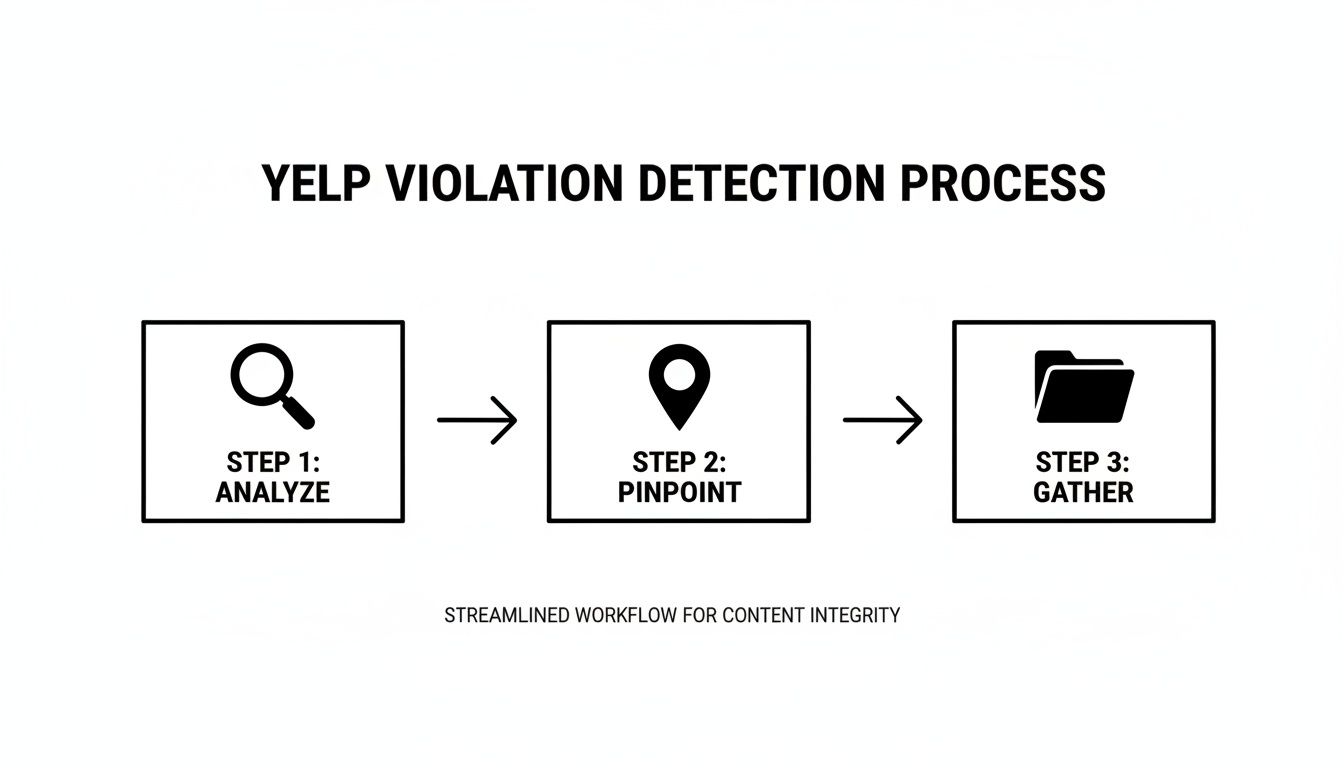
This prep work is what separates a successful removal request from one that gets ignored.
Before You Flag: Build Your Case File
Your report is only as good as the proof you bring to the table. Before logging into your Yelp for Business account, take a few minutes to get your ducks in a row. You need to think less like a frustrated business owner and more like an investigator building a case.
Here’s a quick checklist of what you should gather:
- Screenshots: Grab a clean screenshot of the full review. Make sure it includes the reviewer's username and the date it was posted. This is your insurance in case the user tries to edit or delete it later.
- Customer Records: Dig into your CRM, appointment book, or sales system. Can you find anyone matching the reviewer’s name or details? If you find them, note any relevant history. If you can't find them, that's your golden ticket. A lack of records is powerful evidence for a "not a real customer" claim.
- Internal Communications: Do you have any emails, DMs, or text messages related to the incident? For instance, if you suspect an ex-employee left the review, having an HR record of their termination date is crucial evidence.
- The Specific Policy Violation: Don't just say the review is "unfair." Pinpoint the exact rule in Yelp's Content Guidelines it breaks. Be specific: "This violates the policy on conflicts of interest," or "This review contains prohibited hate speech."
Having this documentation ready elevates your report from a simple complaint to a compelling, evidence-backed request that moderators have to take seriously.
Navigating The Reporting Process
With your evidence organized, it's time to submit the report. Yelp’s interface is pretty straightforward, but the words and options you choose here are critical.
First, log in to your Yelp for Business account. Head to the "Reviews" tab and find the review you need to report. Look for the three small dots next to it—click them to open up a menu of options. From that menu, select "Report Review."
This is where your prep work really pays off. Yelp will ask you to choose a reason for the report from a list of categories.
Here are the most common ones and when to use them:
- It contains false information: Perfect for provably false claims, like a reviewer saying you're closed on a day you are open.
- It's from someone with a conflict of interest: This is your go-to for reviews from competitors, disgruntled ex-employees, or anyone else with a clear axe to grind.
- It doesn't describe a personal consumer experience: Use this for secondhand stories ("my friend said...") or rants that have nothing to do with your business.
- It includes threats, hate speech, or harassment: For any review that is abusive, threatening, or discriminatory.
- It's spam: This one is for obvious promotional content, gibberish, or completely irrelevant posts.
Pro Tip: Keep your comments concise and factual. No emotion, no drama. Stick to the evidence and calmly state which policy was violated. A professional, direct tone will always get you further than an angry rant.
Crafting a Report That Gets Results
After you pick a category, Yelp gives you a text box to add more detail. This is your moment to present your case. Don't waste it by venting. A moderator is sorting through hundreds of these; they’re looking for facts, not feelings.
Use this simple structure for your comment:
- State the Violation: Start with a clear opening line. "This review violates Yelp's Content Guidelines regarding Conflict of Interest."
- Present Your Evidence: Briefly lay out your proof. "The reviewer, 'JohnD123,' is a former employee terminated on May 15, 2024. We have HR records to verify this." Or, "We have no record of a customer by this name or matching these details in our system for the past 12 months."
- Make the Ask: End with a direct request. "Please remove this review, as it does not reflect a legitimate customer experience and violates your policies."
This approach is professional, ties everything back to Yelp's own rules, and gives the moderation team exactly what they need to make a decision in your favor. This strategy of building an evidence-based case is effective on other platforms, too. For example, the same principles apply when you report fake Google reviews. Follow these steps, and you’ll dramatically increase your odds of getting that damaging review removed.
What to Do When Yelp Denies Your Removal Request
Getting that email from Yelp saying your removal request was denied is a punch to the gut. It’s frustrating, and it’s easy to feel like you’ve hit a dead end. But here’s the thing I’ve learned from years of dealing with this: a denial is rarely the final word.
More often than not, it just means your first report didn't hand the moderator a clear-cut, open-and-shut case. So, don't throw in the towel. This is your chance to regroup, build a stronger argument, and go back in with a strategy that works.
Reassessing Your Initial Report
First things first, take a breath and look at what you sent them. Why didn't it work? Yelp moderators are human, but they're also busy. They need to see a direct, obvious violation of their content guidelines. If they have to connect too many dots, they'll likely move on.
A denial usually boils down to one of a few common missteps:
- You picked the wrong fight. You might have flagged a review as "false" when the real violation was a "conflict of interest." The evidence you sent didn't line up with the reason you chose.
- Your proof was too thin. Just saying "this person was never a customer" is an empty claim. You need to show your work. Something like, "We've searched our POS system and appointment records from January 1st to today for the name 'Jane S.' and found no matches" is infinitely more powerful.
- The emotion got in the way. It’s personal, I get it. But a report dripping with frustration or anger makes it hard for a moderator to see the facts. They need a clear, professional summary, not a heated rant.
Try to see it from their perspective. Was the violation crystal clear in your first report? If not, you know exactly where you need to improve for round two.
Refining Your Evidence and Resubmitting
Okay, you've pinpointed the weak spot in your first attempt. Now it's time to build a rock-solid case. This isn't about just hitting the "report" button again with the same info. It's about escalating your request with better, more compelling documentation.
Think about what else you can provide. For instance, if you're certain a competitor is behind the review, a little bit of online sleuthing can go a long way. Can you find a public connection on a site like LinkedIn between the reviewer's profile and the business you suspect? A screenshot of that connection is exactly the kind of concrete evidence that can turn a "no" into a "yes."
When you're ready to submit again, your new report needs to be sharp and to the point. I always recommend leading by acknowledging the previous denial and immediately introducing your new proof.
"We are re-reporting this review as we have gathered additional evidence that it violates Yelp’s conflict of interest policy. The reviewer's public LinkedIn profile lists them as the marketing manager for [Competitor Business Name], located two blocks from us."
This approach does two things: it shows the moderator you're serious, and it gives them a fact-based argument that’s much tougher to dismiss. You’re no longer just complaining—you’re providing the exact proof they need to justify taking action.
Exploring Legal Takedown Options
Sometimes, a review crosses a line from just being negative into the territory of defamation. This isn't a term to throw around lightly. Legally, defamation is a false statement of fact—not an opinion—that causes provable financial harm to your business.
A harsh opinion like "the food was terrible" is protected speech. But a specific, untrue claim like "the restaurant's kitchen is infested with rats" (when your health inspections are clean) could be defamatory.
This is a serious step and isn't the right path for every negative review. It can be expensive and time-consuming, so it should be reserved for the most damaging, blatantly false statements.
You'll absolutely need an attorney for this. They can help you draft a formal legal takedown request. While Yelp isn't obligated to remove a review just because a lawyer asks, they do take well-documented claims of defamation seriously. The key is having undeniable proof that the statement is false and that it has caused real, tangible damage to your business.
Navigating these waters can get complicated fast. For those really stubborn or high-stakes reviews, it can be a smart move to bring in a specialist service like LevelField. Their team lives and breathes this stuff—they know the platform policies and legal hoops inside and out, and they can manage the whole process for you.
Building a Proactive Reputation Management Strategy

Trying to hunt down and remove every single bad Yelp review is a draining, defensive game. While it’s a crucial skill to have in your back pocket, a truly resilient brand isn't built by erasing the bad stuff. It's built by creating so many positive experiences that the occasional negative review becomes a mere blip on the radar.
This means shifting your mindset from constant damage control to consistently delighting customers. A proactive approach is all about creating an environment where glowing feedback happens on its own. It's less about begging for reviews—which Yelp’s policies strictly forbid—and more about delivering an experience so great that people want to talk about it.
Master the Art of the Public Response
Every review on your page, good or bad, is a public stage. How you handle the feedback is often more telling to potential customers than the original review itself.
Responding to a negative review isn't about winning an argument; it's about demonstrating grace under fire. A calm, professional, and genuinely helpful reply can completely neutralize the sting of a one-star comment. It shows everyone watching that you take accountability and are serious about customer satisfaction, which builds a massive amount of trust.
And don't just focus on the bad stuff! Acknowledging your five-star reviews with a simple, personalized "Thank you, we're so glad you enjoyed..." shows you appreciate your best customers and helps foster a loyal community.
Best Practices for Responding to All Reviews
- Acknowledge and Validate: Always start by thanking them for their feedback, even if it’s harsh. "Thanks for sharing your experience with us" is a simple but effective start.
- Keep It Professional, Not Personal: Never get defensive, make excuses, or get into a public back-and-forth. Address the specific issues raised calmly and stick to the facts.
- Take the Conversation Offline: For negative reviews, offer a direct line to resolve the problem. "We're sorry to hear we missed the mark. Please contact our manager at [email/phone] so we can make this right." This shows you're proactive without airing all the details publicly.
- Be Prompt: Try to respond to all new reviews within 24-48 hours. This shows you’re actively engaged and listening.
Here's a powerful motivator: One study found that 70% of consumers are more likely to leave a review if they see a business owner actively responds to others. Your engagement directly fuels more engagement.
This simple act is a cornerstone of a healthy online presence. To dive deeper into the tactics involved, you can explore our complete guide to managing your online reputation.
Dilute Negativity by Encouraging Positive Feedback
The most powerful way to deal with a negative review you can't get removed is to bury it in a sea of positivity. When your Yelp page is full of fresh, four and five-star reviews, that one outlier just doesn't carry the same weight. But since you can't ask for Yelp reviews, how do you make it happen?
You do it by focusing relentlessly on an exceptional customer experience. It's worth remembering that nearly 70% of all Yelp reviews are four or five stars—people genuinely enjoy sharing good news. Your only job is to give them something to talk about.
Think about the small things that create a "wow" moment. A handwritten thank-you note, a quick follow-up call to ensure everything was perfect, or simply remembering a regular's order can be the very thing that inspires them to pull out their phone and write a glowing review.
Setting Up a Monitoring System
You can't respond to reviews you don't know exist. A proactive strategy requires you to be the first to know when a new review goes live. Letting a negative comment sit for a week can do serious damage to your reputation.
The easiest way to stay on top of this is by setting up alerts in your Yelp for Business account. This will send an email notification for every new review, allowing you to respond quickly, de-escalate negative situations, and thank happy customers while the experience is still fresh.
To truly understand what people are saying, it's wise to continuously monitor public feedback. Tools like a comments analyzer can offer powerful insights into customer sentiment across different platforms. This level of awareness keeps you in the driver's seat of your brand's story. Ultimately, while knowing if you can remove a Yelp review is a vital skill, building a reputation strong enough to withstand criticism is the real long-term victory.
Your Top Yelp Removal Questions, Answered
When a bad review hits, it's natural to have questions. The whole process can feel like a black box, and frankly, there's a lot of bad advice floating around. Let's cut through the noise and get straight to the answers you actually need.
Knowing how the system really works helps you set realistic expectations and put your effort where it will count.
How Long Does Yelp Take to Review a Flagged Post?
Once you hit "report," the waiting begins. In my experience, Yelp's moderators are pretty quick with obvious violations—things like hate speech or direct threats. You’ll often see those disappear within 24 to 48 hours.
But what about the trickier stuff? If you’re arguing a conflict of interest or claiming the person was never a customer, it takes more digging on their end. Those cases can easily stretch to a week or more. The single biggest factor that speeds things up is your evidence. A clear, well-documented report gets you to the front of the line.
If you haven’t heard anything back in five to seven business days, it’s a safe bet your first report didn't make the cut. That's your cue to start thinking about the next move.
Does Paying for Yelp Ads Help Remove Bad Reviews?
Let's put this one to bed for good: No. Absolutely not. Your advertising dollars have zero influence on how review flags are handled.
Yelp keeps its content moderation team completely separate from its sales department. An advertiser's report goes into the same queue as everyone else's and is judged by the exact same Content Guidelines. There's no secret backdoor or special treatment for paying customers.
Key Takeaway: Don't waste your time or money thinking ads will solve your review problems. Your only path to removal is building a solid, evidence-based case that a review clearly violates Yelp's policies.
Can I Sue Someone for a Negative Yelp Review?
Technically, yes, you can sue a reviewer for defamation. But should you? For most businesses, it’s an uphill, expensive, and very public battle you’re unlikely to win.
The legal standard for defamation is incredibly high. You have to prove that the review contains verifiably false statements of fact—not just opinions—and that those false statements caused you real financial damage.
Here's the difference:
- Opinion (Protected Speech): "The service was slow and the owner was a jerk."
- Potentially Defamatory Statement of Fact: "The owner charged my credit card twice for the meal."
The first is just a bad experience. The second is a factual claim you could disprove with transaction records.
Before you even think about calling a lawyer, you need rock-solid proof that the claims are completely fabricated. For the vast majority of businesses, the time, stress, and legal fees make suing over a single bad review an impractical and often counterproductive strategy. It should always be your absolute last resort.