


So, can you just delete a bad Google review? Let's get straight to it: no, there isn't a magic "delete" button for business owners. But that doesn't mean you're powerless. You absolutely can get illegitimate reviews removed if they break Google's rules, and I'm going to walk you through exactly how to do it.
The Truth About Getting Bad Google Reviews Removed

When a scathing one-star review pops up, it’s easy to feel like it’s a permanent stain on your record. The first thing you need to do is change your perspective. You’re not trying to "delete" an opinion you don't like; you're "reporting a violation" of Google's content policy.
This is all about identifying reviews that are flat-out illegitimate—things like spam, fake accounts, blatant conflicts of interest, or defamatory attacks. You're building an evidence-based case to show Google's moderation team that a rule has been broken.
What's Happening with Review Removals Right Now
Here’s some good news. While getting a review taken down isn't a walk in the park, Google is more active than ever in policing its platform. A recent analysis showed that review deletions shot up by an astonishing 600% between January and July 2025.
And it’s not just fake five-star reviews getting the boot. The data shows that roughly 35–38% of all deleted reviews are one- and two-star ratings. That means a carefully prepared, well-documented removal request has a better shot today than ever before.
Key Takeaway: Success isn’t about arguing with an opinion. It’s about proving a policy was broken. Your goal is to give Google's moderators a clear, undeniable reason to act.
The Role of Your Google Business Profile
Your Google Business Profile is your command center for this entire process. It’s where you’ll not only respond to customers but also flag and report violations.
Effectively managing your online reputation starts with mastering this tool. Before you even think about tackling reviews, it’s crucial that you know how to optimize your Google Business Profile for local success. A well-managed profile gives you the foundation and the tools to handle whatever comes your way.
Know the Rules: What Actually Warrants a Google Review Removal?
If you want to get a bad review taken down, you have to start thinking like a Google moderator. That means learning their rulebook—their content policies—and building your case around a specific violation.
Simply telling Google a review is "unfair" or "not true" is a dead end. That's a one-way ticket to getting your request ignored. Why? Because from Google's perspective, a customer complaining that your prices are too high isn't a violation; it's just an opinion. A painful opinion, maybe, but an opinion nonetheless.
The real trick is learning to spot the difference between a review you just don't like and one that genuinely breaks the rules. Grasping this distinction is everything. It’s the foundation for every single successful removal request I’ve ever seen.
Pinpointing the Exact Policy Violation
To build a case that Google can't ignore, you have to connect the dots between the review's content and a specific prohibited category. Let's get practical and look at what this actually looks like.
- Conflict of Interest: This is a big one. A review from a bitter ex-employee, a current staff member trying to boost your rating, or a direct competitor trying to tank it is a clear violation. For example, if you do a little digging and find that one-star review came from the owner of the shop across the street, you’ve got a slam-dunk case.
- Off-Topic Rants: The review has to be about a customer's experience with your business. Rants about your personal politics, the tough parking situation on your block, or a broader complaint about the industry don't belong. Flag them.
- Harassment & Hate Speech: This is the most serious category. Any review containing personal attacks, threats, or discriminatory language aimed at you, your team, or any protected group is a major violation. Google usually acts on these fast.
- Spam & Fake Content: Think bot-generated nonsense, reviews posted from obviously fake accounts, or the same review blasted across multiple business profiles. If it doesn't read like it came from a real person who had a real experience, it's likely spam.
Why This Is So Critical Right Now
In today's market, you can't afford to get this wrong. The numbers don't lie: 89% of people read online reviews before buying something, and a whopping 93% say those reviews directly impact their decision.
And where are they looking? Mostly Google. With 73% of all online reviews housed on its platform, a single fake or malicious review there can do an incredible amount of damage to your reputation and your bottom line. For professionals in fields like law or healthcare, where trust is everything, removing a fraudulent review isn't just nice—it's essential. This data is why the answer to "can you delete a bad Google review" is a firm yes, but only if you prove a policy was broken. You can dig deeper into how reviews influence customers by checking out the latest statistics.
A Pro's Take: The single biggest mistake I see business owners make is reporting a review for the wrong reason. They just click "spam" out of frustration. Don't do that. If it’s a conflict of interest, select that specific reason. If it contains harassment, report it as harassment. Choosing the right violation dramatically increases the odds that a human moderator will see things your way. Your evidence has to back up the specific claim you're making.
So, you’ve found a review that clearly breaks the rules. That’s the first step, but getting Google to agree and actually remove it is a whole different ballgame. The secret is to make it incredibly easy for Google’s moderators to see what you see. You need to build a clear, logical case backed by solid proof.
Let's walk through the exact process I use, starting with the simplest method and escalating from there if needed.
The whole game plan really boils down to three key actions: analyze the review, match it to a specific policy, and then—only then—report it.
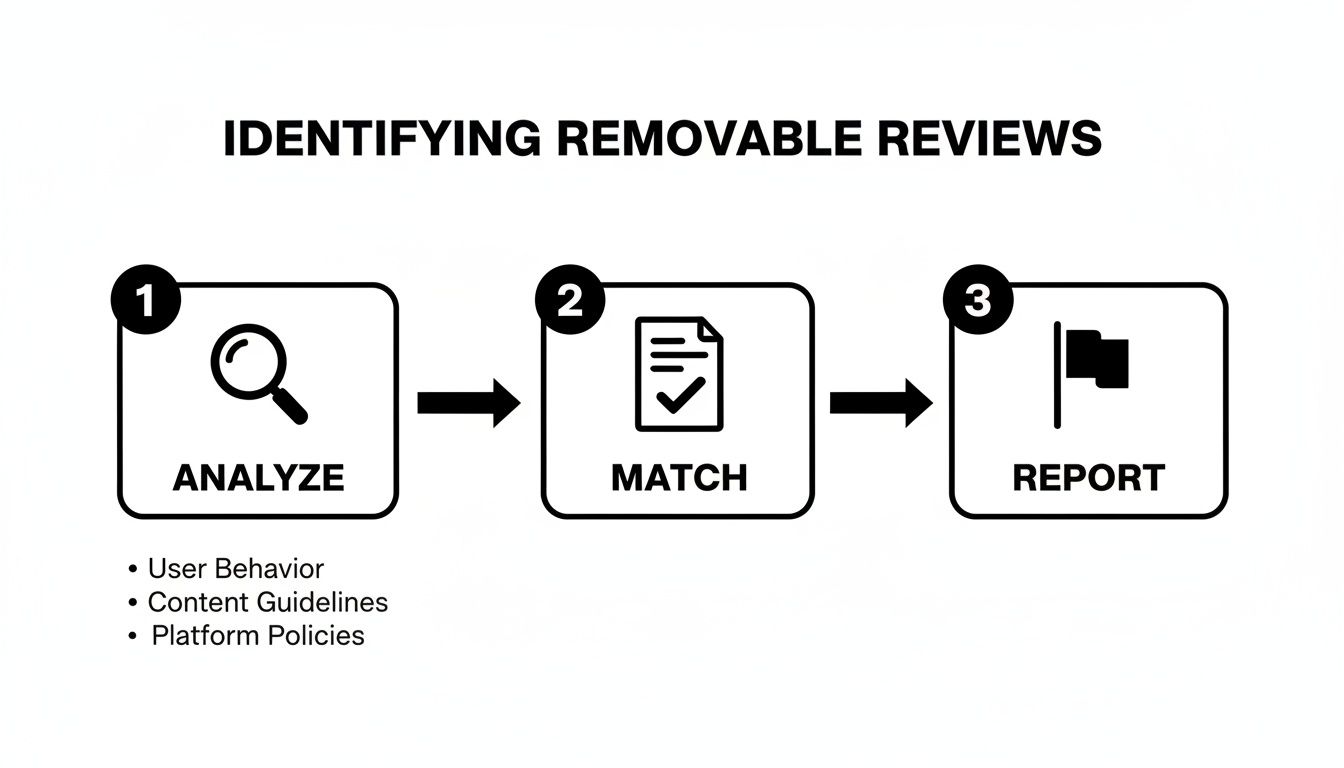
This flowchart really hits home an important point: jumping straight to the "report" button is a rookie mistake. Your success hinges on the homework you do first.
Your First Move: Flagging It in Your Business Profile
The quickest and most direct way to report a review is right from your Google Business Profile dashboard. This is your frontline defense and works best for the really obvious violations, like outright spam or hateful comments.
It's a straightforward process:
- Go to your reviews: Sign in to your Google Business Profile and head over to the “Reviews” tab.
- Find the problem review: Scroll until you find the one you’ve identified as a policy-breaker.
- Flag it: Click the three-dot menu next to the review and hit "Report review."
- Choose the right violation: This is crucial. Don’t just lazily click "Spam." If it’s a former employee, select "Conflict of interest." If it’s irrelevant, choose "Off-topic." The more specific you are, the better.
After you submit it, your report goes into Google's system. It might be scanned by an algorithm or looked at by a person. Either way, you'll get an email confirming they received it, and then the waiting begins. It can take a few days or sometimes a couple of weeks.
When to Escalate: Using Google's Support Form
What if your flag gets denied or you’re met with radio silence? It’s time to take it up a notch. Google has a more detailed takedown request form that lets you plead your case with evidence. This is where all that prep work really shines.
To build a case that a moderator can't ignore, you need proof. Vague claims get denied; documentation gets results.
Here’s what solid evidence looks like:
- No Customer Record: If you’re sure the review is fake, state that you've checked your POS system, client database, and appointment logs and have zero record of the reviewer. Be specific.
- Conflict of Interest Screenshots: Is the reviewer an ex-employee? Find their old LinkedIn profile showing they worked for you and screenshot it. If it’s a rival business, a screenshot of their own Google Business Profile is the smoking gun.
- Internal Documents: For a review left by a disgruntled former employee, a redacted HR document or internal email (respecting privacy, of course) can definitively prove the conflict of interest.
Here's a real-world example: A dental clinic got a 1-star review from someone claiming a procedure went horribly wrong. The clinic couldn't find anyone by that name in their patient records. They submitted a formal statement confirming this, along with a screenshot of the reviewer's profile—which, it turned out, had reviewed 10 other dentists in different states on the same day. The review was gone in 48 hours.
For a deeper dive into this form and how to fill it out effectively, check out our dedicated guide on how to report a review on Google.
How to Keep Tabs on Your Request
Once you submit the more detailed form, you’ll be given a case number. Guard this number! It’s your ticket to checking on the status of your request.
Now, you have to be patient. But don't be passive. If two or three weeks go by without an answer, you can follow up on that same support ticket using your case number.
Managing your online reputation effectively means knowing the tools at your disposal. Learning how to optimize Google My Business is fundamental, as it gives you a much better handle on controlling your profile and dealing with these situations when they arise.
What to Do When Your First Removal Request is Denied
It’s incredibly frustrating. You’ve gathered your evidence, flagged the review, and a few days later, you get that gut-punch email from Google: "the review doesn't violate our policies."
Don't give up. This is a common roadblock, and it's almost always an automated response or a decision from a first-level reviewer. Your job now is to get your evidence in front of an actual person.
The best way forward is to contact Google Business Profile support directly. This escalates your case. When you connect with a support agent, you can present the documentation you’ve collected—screenshots, internal records proving the person was never a customer, you name it. Be polite but firm. Reference your original case ID and clearly explain why the initial decision was a mistake.
Trying to Engage the Reviewer Directly
While you’re working the official channels with Google, you can also try a more direct approach. It's a delicate strategy, but it can work wonders.
It all starts with your public reply to the review. A calm, professional, and genuinely helpful response can sometimes be enough to make the reviewer reconsider. They might edit their comment or even delete it entirely.
Whatever you do, don't get defensive. Acknowledge their complaint (even if you know it's completely fabricated), show that you want to make things right, and give them a way to contact you offline, like an email address or phone number. This not only opens a private dialogue but also shows every other potential customer that you take feedback seriously.
Here's a real-world example: A local restaurant got a one-star review claiming a customer suffered food poisoning after a meal. Instead of arguing, the manager posted a public reply: "We take health and safety very seriously. Could you please email us at manager@restaurant.com with the date and time of your visit so our team can immediately investigate this?" The reviewer went silent, but the public saw a business that was responsive and responsible.
When to Escalate with a Legal Takedown Request
For the most serious situations, like when a review contains demonstrably false and damaging information, a legal takedown request is your final option. This is a major step and not one to be taken lightly.
This path is really only for clear cases of defamation—false statements of fact that actively harm your business's reputation. A customer saying your service was “terrible” is just their opinion. A customer falsely claiming you “stole their property” or “committed fraud” crosses the line into potential defamation.
To go this route, you'll need a lawyer to draft a formal notice to Google. The letter must clearly outline the defamatory content and provide concrete evidence proving the statements are factually untrue. Google's legal department will then review the claim. Because this involves legal fees and a high burden of proof, it's truly a last resort for businesses facing significant financial or reputational damage from a malicious review.
Responding to Negative Reviews You Cannot Remove

Let's face it: sometimes, despite your best efforts, a negative review is there to stay. The customer's complaint is legitimate, it doesn't violate any of Google's policies, and now it's a part of your public record. This isn't a dead end—it's actually a golden opportunity.
A well-crafted public response is one of the most effective tools in your reputation management arsenal. How you handle public criticism often says more about your business than a dozen glowing reviews. You're not just replying to one unhappy customer; you're showing every potential customer who reads that exchange that you're professional, accountable, and committed to getting it right.
How to Craft a Winning Response
Your reply needs to be prompt, professional, and personal. The worst thing you can do is copy and paste a generic, corporate-sounding apology. It feels insincere because it is. Instead, build your response around a simple, human framework.
First, thank the reviewer for their feedback, even if it’s tough to read. Acknowledging their effort can instantly de-escalate the tension. Then, validate their feelings and offer a genuine apology that their experience didn't meet their expectations—or yours.
Key Insight: Never, ever get into a public argument. Your response is for every future customer, not just the original reviewer. The goal is to demonstrate grace under pressure, not to win a debate.
Always offer to take the conversation offline. Providing a direct email or phone number for a manager shows you're serious about resolving the issue. This protects the customer's privacy and, just as importantly, prevents a long, drawn-out argument from unfolding on your public profile.
Real-World Examples of Effective Replies
The best response always depends on the specifics of the complaint. A vague one-star review needs a different approach than a detailed, legitimate grievance.
Here’s how you can handle a few common scenarios:
- For Legitimate Complaints: "Thank you for bringing this to our attention. We're truly sorry to hear your experience didn't meet our standards, and this isn't the level of service we strive for. Please contact our manager, Sarah, directly at [email address] so we can learn more and make this right for you."
- For Factually Inaccurate Reviews: "We appreciate you taking the time to share your feedback. We've looked into this and don't have a record of this incident as you've described it, but we take all customer concerns seriously. We would welcome the chance to discuss this with you directly to understand what happened."
- For Vague Criticism: "Thank you for the feedback. We're always looking for ways to improve and would appreciate hearing more details about your experience. Please feel free to reach out to us at [contact information] when you have a moment."
Learning to handle these situations is a critical skill. For a deeper dive, our guide on how to respond to negative Google reviews covers more advanced tactics for almost any scenario you might encounter.
When Should You Call in a Professional for Review Removal?
Let’s be honest: trying to get a bad Google review taken down can feel like a full-time job you never signed up for. It’s frustrating, time-consuming, and often feels like you're shouting into the void. This is precisely when bringing in a professional reputation service stops being a "last resort" and becomes a smart business decision.
Think of it this way: if your business is suddenly hit with a wave of fake one-star reviews overnight, or you're facing a single, incredibly damaging and false accusation, you're not just dealing with a simple complaint. You're dealing with a direct attack on your reputation. These situations demand a level of documentation, persistence, and follow-up that most business owners simply don't have the bandwidth for.
When Expertise Really Matters
A professional service isn't just flagging the review and hoping for the best. They live and breathe Google's content policies. They know exactly how to build a case file with compelling evidence and present it in a way that actually gets a human moderator at Google to pay attention.
The reality is that Google's enforcement is anything but consistent. Recent analysis of Google’s enforcement actions shows that while some industries, like restaurants, see more deletions, success is possible across the board—if you know how to argue your case. Getting older reviews removed, for instance, often requires a fresh legal argument or pointing out a new pattern of abuse that Google's automated systems missed.
This is where an expert, policy-based appeal shines. They can spot the violations that a standard flagging attempt misses, turning a likely "no" from Google into a successful takedown.
Hiring an expert isn’t about finding a magic button to delete bad reviews. It’s about applying specialized knowledge and relentless persistence to navigate a complex system, which dramatically increases the odds of getting your good name back.
Common Questions About Getting Reviews Removed
You know the process, but let's be honest, real-world questions always pop up. Here are some quick, no-nonsense answers to the things business owners are really wondering when a bad Google review hits their profile.
How Long Does It Take to Remove a Review?
This is the million-dollar question, and the answer is… it depends. If you’ve been hit with something obvious like spam or hate speech, Google's automated systems might catch it and pull it down within 24 to 72 hours of you flagging it.
But for anything that requires a human to look at it—especially if you've escalated the case with evidence—you need to be patient. I've seen these more complex cases take anywhere from a week to a full month for Google's team to investigate and give you a final answer.
The hardest part is waiting. Trust me, spamming them with the same request won't speed things up; it can actually clog the system and delay a decision.
Expert Tip: If you've escalated a case and haven't heard a peep after three weeks, it's fair game to send a polite follow-up. Just reply to your original support email and reference your case ID to ask for a status update.
Can I Actually Sue Someone Over a Bad Review?
Technically, yes, you can pursue a defamation lawsuit. But I'm going to tell you right now: this should be your absolute last resort. Think of it as the nuclear option.
Legal action is incredibly expensive, drags on forever, and the burden of proof is all on you. You have to prove the review contains verifiably false statements of fact (not just opinions you disagree with) and that those false statements caused measurable financial damage to your business. That's a very high bar to clear.
Before you even think about calling a lawyer, make sure you have tried every single one of Google's own reporting and appeals channels first.
Will Replying to the Review Hurt My Chances of Removal?
Not at all. In fact, you absolutely should reply while you wait for Google's decision. A calm, professional, and helpful public response shows potential customers that you're engaged and accountable. It’s your chance to control the narrative.
Just stick to the high road. Don't get dragged into a public argument or an emotional back-and-forth. Keep your reply brief, professional, and focused on a solution. It protects your reputation, regardless of whether the review ultimately stays or goes.