

Trademark infringement on Amazon isn't just a nuisance; it's a direct assault on your business that can gut your revenue and cripple your brand's reputation. We're talking about everything from blatant counterfeit products showing up on your listings to shady sellers hijacking your brand name to trick customers. To fight back, you need more than just generic advice. You need a real, in-the-trenches playbook for navigating Amazon's complex and often frustrating enforcement systems.
Why You Can't Afford to Ignore Trademark Infringement on Amazon

For sellers, Amazon is a land of incredible opportunity. But let's be honest—it's also a battlefield where your intellectual property is under constant attack. Turning a blind eye to infringement is the fastest way to lose sales, destroy customer trust, and tarnish a brand image you’ve spent years building. Bad actors count on the platform's massive scale and anonymity to get away with it, making a proactive defense absolutely essential.
The problem has exploded. Trademark infringement on Amazon has surged by a staggering 62% year-over-year, turning the marketplace into a free-for-all for some legitimate brands. This chaos translates into real money lost—over $120 billion globally—as fake listings and hijacked product pages siphon away revenue, hitting sellers in the US and Europe especially hard. You can get a deeper look at this trend and find tips for building a 2025 enforcement strategy at frankleholawyer.com.
The Many Faces of Infringement
The first step to regaining control is knowing what you're up against. Infringement isn't always as obvious as a cheap knockoff. Scammers use subtle tactics to slowly eat away at your market share and credibility. You have to be on the lookout.
These violations directly hit your bottom line and what customers think of you. Here’s what to watch for:
- Counterfeit Products: This is the most blatant attack. A third party sells fake versions of your product, often attaching themselves directly to your own listing.
- Listing Hijacking: An unauthorized seller latches onto your official ASIN with their own inferior or completely different product. They steal the Buy Box and cash in on your hard-earned reviews.
- Brand Name Misuse: A competitor stuffs your registered trademark into their product titles, descriptions, or backend keywords to poach your traffic.
- Image and Logo Theft: Scammers lift your copyrighted product photos or brand logos and slap them on their own listings to fake authenticity and fool buyers.
I see too many sellers underestimate the damage a single hijacker can do. They don't just steal a few sales. By selling a shoddy item on your listing, they rack up negative reviews that get permanently stuck to your product, sabotaging its reputation long after the hijacker is gone.
This guide is designed to give you a practical framework for spotting, documenting, and shutting down these threats. We're skipping the theory and getting straight to the specific tools and strategies you need to protect your brand inside Amazon's ecosystem.
Your First Line of Defense: Unlocking Amazon Brand Registry
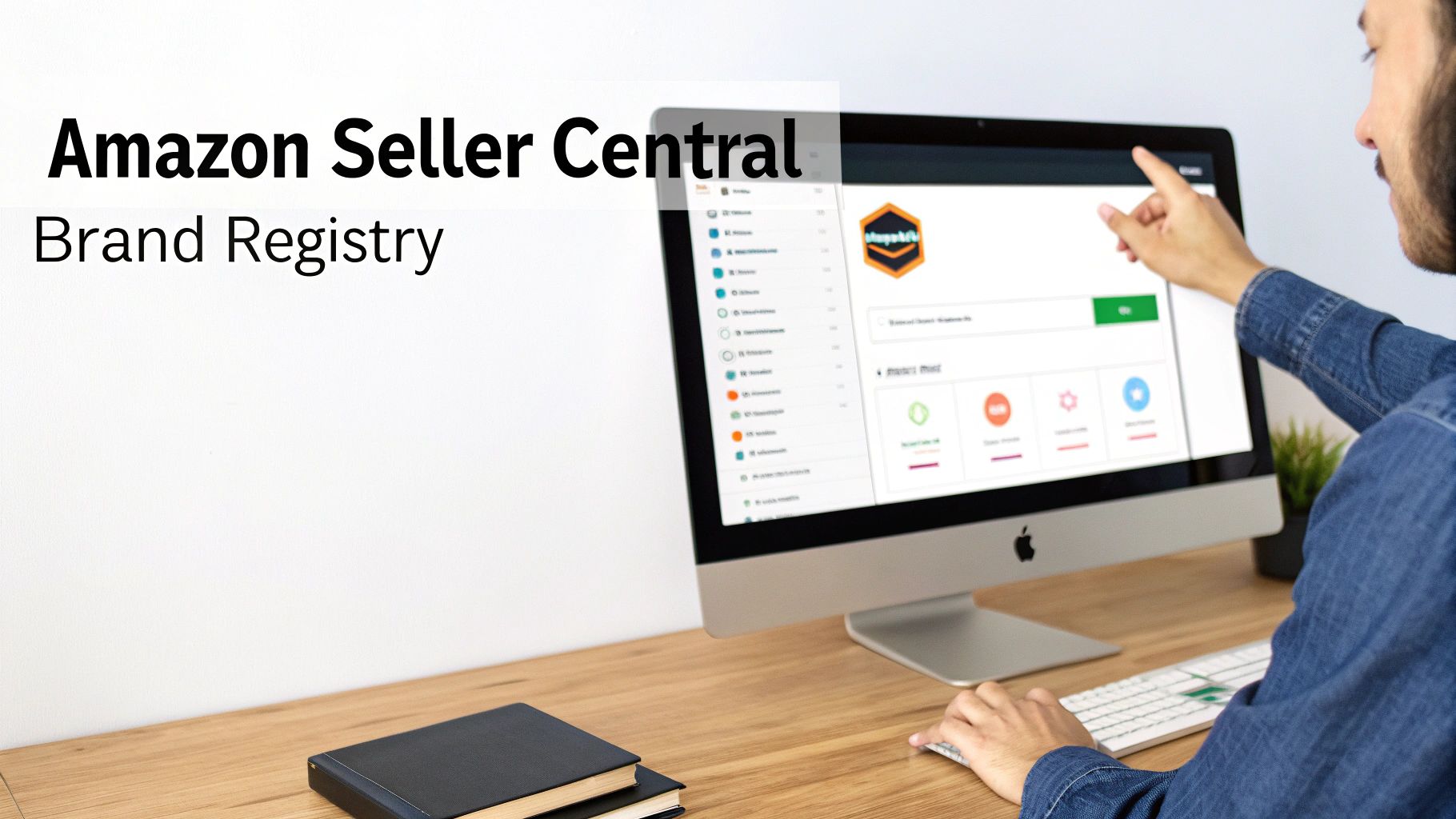
Think of Amazon Brand Registry as your command center for fighting trademark infringement. It's not just some registration form you fill out and forget; it’s a whole suite of powerful tools designed to give you real control over your brand on the platform. Honestly, trying to deal with hijackers and counterfeiters without it is like fighting with one hand tied behind your back.
Once you're enrolled, you get access to a much more effective enforcement system. Instead of getting stuck with generic public forms, you can use the dedicated ‘Report a Violation’ tool. This is your direct line to Amazon's internal teams, giving your reports more weight and getting you much faster results.
To really get the most out of it, understanding the comprehensive Amazon Brand Registry benefits is key to protecting your intellectual property. The program is the single best way to maintain the integrity of your product pages.
Gaining Control Over Your Listings
One of the first things you'll notice is how much more control you have over your own ASINs. Before Brand Registry, any random seller could suggest changes to your product titles, images, or bullet points. This can lead to absolute chaos, and it’s a favorite tactic of hijackers who change your details to match their cheap knockoffs, which confuses customers and tanks your reputation.
With Brand Registry, you become the official source of truth for your products. This authority helps lock down your content and stops unauthorized changes in their tracks. For example, say a hijacker changes your title from "Genuine Leather Dog Collar" to "Faux-Leather Pet Collar" to sell their junk. Brand Registry gives you the power to instantly revert those changes and block that seller from messing with your listing again.
The system is built around protection and growth—because Amazon knows you can't grow your brand if you can't protect it first.
Proactive Protection That Works Around the Clock
Here’s where Brand Registry has really become a game-changer: it’s moved from being reactive to proactive. Amazon now uses automated, machine-learning scans to find and remove potential infringements before you even know they exist. For anyone who has spent countless hours manually hunting for violations, this is a massive relief.
And these automated protections are incredibly good. Amazon's own data shows its systems now proactively block 99% of suspected infringements before a brand ever has to file a report. This works through a few key mechanisms:
- Automated Scans: The system constantly scours the marketplace for listings that are misusing your brand name or swiping your images.
- Predictive Analysis: It learns from past infringement reports to spot and stop bad actors before they can even get their new attacks off the ground.
- Listing Creation Blocks: It prevents unauthorized sellers from creating new ASINs using your trademarked brand name in the first place.
The true value of Brand Registry isn't just about making it easier to report problems. It’s about drastically reducing the number of reports you have to file at all. This frees you up to focus on growing your business instead of constantly playing defense.
How to Document Infringement and Build an Airtight Case
When you’re facing a trademark violation on Amazon, how you build your case is everything. Simply firing off an angry report without hard evidence is a fast track to getting ignored. Your success depends entirely on the quality and clarity of the proof you provide.
Think of yourself as a detective building a case file. You need to gather undeniable proof that another seller is misusing your intellectual property. The goal is to present Amazon’s enforcement team with such a clear, objective, and well-documented claim that they have no choice but to take action. This requires a meticulous approach.
Capturing the Initial Evidence
The second you spot a potential infringement, your first move is to document everything. Listings can vanish or be edited in a flash, so don’t wait.
Start by taking high-resolution, unedited screenshots of the entire product detail page. Make sure you capture these key elements:
- The full product title, especially where it misuses your trademarked name.
- The seller's name and a link to their storefront. This is essential for attribution.
- The ASIN of the infringing product.
- Any of your brand’s images, logos, or marketing copy they've stolen.
- Customer reviews are gold—especially any that mention the product is a fake or of poor quality.
This collection of screenshots acts as a snapshot in time, proving the violation existed exactly as you found it.
The Power of the Test Buy
While screenshots are a great start, a test buy is often the knockout punch. It elevates your claim from a suspicion of infringement to confirmed counterfeit activity. By ordering the product yourself, you get your hands on the physical proof that what they're selling isn't genuine.
Once the package arrives, the documentation continues.
- Photograph Everything: Get clear photos of the shipping package, the product packaging, and the item itself from every angle.
- Side-by-Side Comparisons: This is where you create your most powerful evidence. Place your authentic product right next to the counterfeit one and photograph them together. Zoom in on the differences—the shoddy logo, the cheap materials, the flimsy packaging, the flawed stitching. Make the contrast impossible to miss.
- Note the Order ID: That Amazon Order ID from your test buy is crucial. It creates an unbroken chain of evidence that directly links the fake product in your hands to that specific seller and that specific ASIN.
This simple process is the foundation of a winning claim.
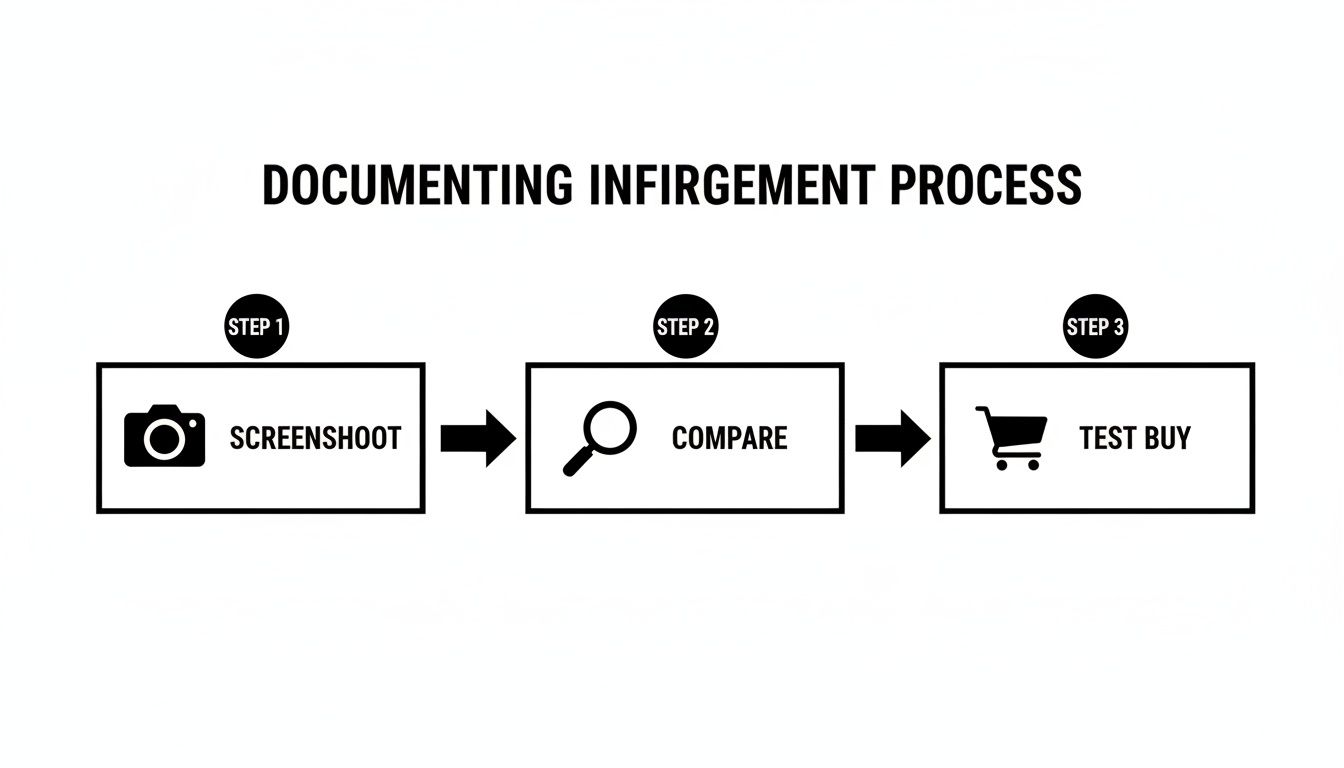
From digital screen grabs to a physical side-by-side comparison, this flow gives Amazon’s team everything they need to see the violation for themselves.
Your Evidence Checklist for Amazon
Gathering the evidence is only half the battle; organizing it is just as important. When you’re ready to submit your case using the Report a Violation tool in Amazon Brand Registry, you need to have all your ducks in a row. A messy, incomplete submission is an easy excuse for Amazon to delay or deny your claim.
I've found that using a clear checklist ensures you have everything needed for a strong report. This approach makes it easy for Amazon’s investigators to quickly see the facts and validate your claim.
Evidence Checklist for Amazon Trademark Infringement Claims
| Evidence Type | Description & Purpose | Where to Find It |
|---|---|---|
| Trademark Registration | This is your proof of ownership. It establishes your legal right to file the complaint in the first place. | Your official trademark registration certificate, including the registration number. |
| Infringing Listing URL/ASIN | The direct link to the product detail page where the violation is happening. | Copy the URL from the browser's address bar or find the ASIN under the "Product details" section on the listing. |
| Seller/Storefront Name | The name of the third-party seller you are reporting. | Displayed on the product page, usually in the Buy Box area or near the "Add to Cart" button. |
| Screenshots of Listing | Visual proof of how your trademark is being misused in titles, descriptions, bullet points, or images. | Take full-page screenshots of the entire product detail page. |
| Test Buy Order ID | The Amazon order number from your purchase of the counterfeit item. This connects the physical product to the seller. | Find this in the "Your Orders" section of your Amazon account after you complete the purchase. |
| Side-by-Side Photos | A direct, visual comparison of your genuine product next to the counterfeit from the test buy. | Take these yourself once the test buy item arrives. Focus on clear, well-lit shots. |
Pro Tip: Don't make the investigator hunt for the proof in your photos. When creating your side-by-side comparisons, use a simple image editor to add arrows or circles that explicitly point out the differences. Guide their eyes directly to the evidence.
By methodically gathering and organizing these specific pieces of evidence, you’re no longer just filing a complaint—you’re submitting a professional, well-documented case file. This level of detail and professionalism drastically increases your chances of a swift and successful takedown.
Alright, you’ve done the detective work and have your evidence locked and loaded. Now it's time to actually get the infringing listings taken down. This is where you'll use Amazon's 'Report a Violation' tool inside Brand Registry.
Think of this as presenting your case to a judge. The clearer and more direct you are, the better your chances of a quick, favorable verdict. You need to make it incredibly easy for Amazon's internal teams to see the problem and take action.
Getting Around the Report a Violation Tool
Once you log into Brand Registry, the reporting tool is front and center. It’s essentially a search engine for Amazon's massive catalog. You can hunt for the bad listings using ASINs, product names, or even by uploading an image.
One of the best features here is the ability to report up to 50 ASINs at a time. This is a huge time-saver when you're dealing with one hijacker who has latched onto a dozen of your products.
After you've flagged the infringing listings, you have to tell Amazon what kind of infringement it is. This choice is crucial.
- Trademark Infringement: This is your bread and butter for counterfeiters, hijackers using your brand name, or anyone else misusing your registered mark in their listing titles, bullet points, or backend keywords.
- Copyright Infringement: Pick this if someone has ripped off your product photos, your A+ content, or the unique copy you wrote for your listing.
- Patent Infringement: Use this option only if another product is a direct copy of an invention you have a utility patent for.
Getting this right is half the battle. If you report a trademark issue as a copyright claim, it just goes to the wrong team and creates delays. I've seen simple takedowns get stuck in limbo for weeks because of this simple mistake.
Writing a Report That Actually Works
This is the moment of truth, and frankly, where most sellers mess up. They write angry, novel-length rants filled with frustration. Remember, the person reading your report is looking at hundreds of these a day. They don't have time for your life story.
Be clinical. Be factual. Be direct.
What Not to Do: "This seller is a scammer who has been stealing my sales for weeks! Their product is cheap garbage and is ruining my brand's good name. You need to shut them down immediately before more customers get ripped off!"
This is just noise. It’s emotional and doesn't point to specific evidence.
A Much Better Approach: "The seller 'GlobalDeals4U' is selling counterfeit versions of our trademarked product 'GripMaster Pro' (Reg. #9876543) on ASIN B09XYZ123. A test buy (Order ID: 111-2222333-4444555) confirms the product lacks our official logo and is made of inferior materials, as shown in the attached side-by-side photos."
See the difference? It’s objective and packed with facts: the trademark number, the order ID from the test buy, and a direct reference to the photo evidence. This is the kind of report that gets results. If you want to get even more granular on this, we've got a whole guide on how to report counterfeit products.
So, What Happens After You Hit 'Submit'?
Don't sit there hitting refresh. You can track the status of your report right in the Brand Registry dashboard, but it's not instantaneous. I’ve seen resolutions come back in a few hours, and I've seen them take the better part of a week. It all depends on the case's complexity and how swamped the review team is.
You're going to get one of three answers:
- Accepted: Success! Amazon agrees with you and has taken action, which usually means yanking the listing or booting the seller.
- Rejected: This stings, but it's not the end. Amazon will give you a reason, which almost always boils down to "not enough evidence" or "the infringement isn't clear."
- More Information Needed: The review team might have a question or need a clearer photo. Respond quickly and professionally.
If you get rejected, take a breath. Read the feedback carefully, see where the hole in your case was, and patch it. Maybe your photos were blurry, or your explanation wasn't specific enough. A denial is just a signal to strengthen your argument and try again. When it comes to protecting your brand from trademark infringement on Amazon, persistence backed by solid proof always wins.
Knowing When and How to Escalate Legally
While Amazon's internal tools are powerful, they aren't always the final word. Sometimes, you'll run into a bad actor who is so persistent or causes such significant damage that you have to take the fight off the platform and into the legal arena. Recognizing this tipping point is crucial.
So, when is it time to call in the lawyers? You should seriously consider it after you've exhausted Amazon's reporting tools with little to no success. This is a common scenario with sophisticated counterfeiters who are masters at playing whack-a-mole—they operate multiple accounts, ignore takedown notices, and pop right back up under a new storefront moments after being shut down.
If your revenue has taken a nosedive or your brand's reputation is being systematically destroyed by a flood of negative reviews on fake products, that’s a massive red flag. It's a clear signal that platform enforcement just isn't cutting it.
The First Step Beyond Amazon: A Cease and Desist Letter
Before jumping into a full-blown lawsuit, the standard first move is sending a formal Cease and Desist letter. Think of it as a legal shot across the bow. This document, almost always drafted by an attorney, officially puts the infringer on notice. It clearly lays out your trademark rights, details exactly how they’re breaking the law, and demands they stop—immediately.
This letter actually serves two key purposes:
- It can solve the problem fast. A lot of smaller infringers, or even those who genuinely didn't realize they were doing anything wrong, will comply right away to dodge legal trouble.
- It builds your legal case. If they ignore it, the letter becomes Exhibit A, proving to a court that you made a good-faith effort to resolve the issue before things got serious. This really strengthens your position down the road.
Honestly, a strongly-worded letter on a law firm's letterhead carries a lot of weight. It shows you mean business and is a pretty cost-effective way to escalate the matter without committing to the time and expense of a lawsuit right off the bat.
The legal ground is shifting here. Courts are taking a closer look at how involved platforms like Amazon are in sales. Recent decisions, like the one in the Louboutin v. Amazon case, hint that marketplaces could be held liable if their actions make them look more like an active seller than just a neutral venue.
When a Lawsuit Becomes Necessary
What if the Cease and Desist letter gets ignored and the trademark infringement on Amazon just keeps going? At that point, filing a lawsuit might be your only real option. This is a big step, usually reserved for the most serious cases where you can prove you've suffered significant financial harm.
The goal of a lawsuit isn't just to stop the infringer for good; it’s also about potentially recovering lost profits and other damages they’ve caused.
Working with an experienced intellectual property attorney is non-negotiable at this stage. They’ll be your guide through the entire complex process, from filing the initial complaint all the way through discovery and potential settlement talks. It can feel daunting, but sometimes, legal action is the only way to permanently shut down a determined counterfeiter and send a powerful message that your brand is not an easy target.
Proactive Strategies to Prevent Future Infringement
Putting out fires all day is exhausting. If you're constantly fighting trademark infringement on Amazon, you're stuck in a reactive loop that drains your time and resources. The real win comes from shifting your mindset from reactive takedowns to proactive prevention. Your goal is to make your brand a much less appealing target for counterfeiters in the first place.
This means getting ahead of the problem. Instead of just playing whack-a-mole with bad listings, you need to build a defensive wall that stops infringers before they can even make a single sale.
Fortifying Your Brand with Amazon’s Tools
Amazon has some seriously powerful, invitation-only programs that can act as a digital fortress for your brand. Getting enrolled in these is one of the smartest moves you can make.
- Amazon Project Zero: Imagine being able to remove counterfeit listings yourself, instantly, without waiting for Amazon's team to investigate. That’s Project Zero. It also uses machine learning that gets smarter every time you flag a fake, proactively blocking similar listings.
- Amazon Transparency: Think of this as a unique fingerprint for every single item you produce. You get unique Transparency codes to stick on every unit. Amazon scans this code before shipping anything to a customer. If the code is missing or invalid, the product is stopped dead in its tracks.
When you use a program like Transparency, you're essentially putting a bouncer at the door of Amazon's fulfillment centers. A counterfeiter can't get their fake product in because they can't generate the unique, scannable code.
Making Your Products Harder to Copy
Beyond Amazon's own tools, your physical product and packaging can be a huge deterrent. Let's be honest, a generic brown box is an open invitation for a counterfeiter.
Start thinking about how you can incorporate unique, hard-to-replicate features into your design. This could be anything from holographic stickers and custom embossing to intricate logos that are just too expensive and difficult for a fly-by-night operation to copy well. For a deeper look at building this kind of multi-layered defense, check out our full guide to online brand protection.
If you're looking for expert help to manage your IP and handle the complexities of Amazon's policies, exploring specialized solutions for brands can provide a much-needed layer of defense.
And one last thing: don't forget to register your trademarks in all the key international markets where you sell. It’s a simple step, but it prevents an infringer from just hopping over to another country's Amazon marketplace where you'd otherwise have no legal power to stop them.
Questions We Hear All the Time About Protecting Your Brand on Amazon
Let's be honest, figuring out the ins and outs of trademark protection on Amazon can feel like a full-time job. You're not alone in having questions. We've compiled some of the most common ones we get from sellers and laid out the straight-up answers you need.
What's the Real Difference Between Trademark and Copyright Infringement?
It’s easy to mix these up, but using the right term in your Amazon report is crucial. If you get it wrong, Amazon will likely reject your claim, and you’ll have to start all over.
Trademark infringement is all about protecting your brand identity. Think of your brand name, your logo, your tagline—anything that tells a customer, "This is from us." Infringement happens when another seller uses your marks in a way that tricks or confuses shoppers. The classic example is a counterfeiter slapping your logo on a knock-off product or another seller cramming your brand name into their keywords to steal your traffic.
Copyright infringement, on the other hand, is about protecting your creative assets. This is what happens when someone lifts your professionally shot product photos, rips off your entire A+ Content layout, or just copy-pastes the product description you spent hours writing.
How Long Until Amazon Actually Does Something About My Claim?
There's no magic number, but things have gotten much faster. After you file a claim using the Report a Violation tool in Brand Registry, you’ll typically see some movement within 24 to 72 hours.
But here's the reality: the quality of your evidence is everything. If you provide a crystal-clear report with a test buy receipt, side-by-side photos showing the fake product next to your real one, and a concise explanation, you could see the infringing listing taken down in a matter of hours. A fuzzy claim with weak proof? That could drag on for a week or more while Amazon's team tries to sort it out.
Pro Tip: Don't freak out if you don't get an instant response. As long as you've submitted a solid, well-documented case, it's in the queue. You can always check its progress under "Submission History" in your Brand Registry dashboard.
Can I Fight Infringement Without a Registered Trademark?
You can try, but it's an uphill battle. Amazon has a public-facing infringement report form where you can file a claim based on "common law" rights. These are rights you've earned just by using your brand name in the market.
However, these claims are far less powerful and rarely succeed. Amazon gives priority—and the best enforcement tools—to brands with federally registered trademarks. Without one, you're locked out of Amazon Brand Registry, which is hands-down the most effective weapon against trademark infringement on Amazon. Getting your trademark registered and enrolling in Brand Registry should be at the very top of your to-do list.