


When you first see a negative post about your business on Ripoff Report, it's easy to feel powerless. Their infamous 'no removal' policy is legendary for a reason—simply asking them to take something down almost never works. So, what do you do? The key is to stop thinking about deletion and start thinking about invisibility. Your real goal is to get the report de-indexed from search engines or bury it with positive content.
Understanding the Ripoff Report Problem

Finding your company's name on Ripoff Report feels like a punch to the gut. Unlike most review sites that have some sort of dispute process, this platform was built on the principle that once a report goes up, it stays up. For years, this has been a source of incredible frustration for businesses blindsided by false or misleading posts.
The site, founded back in 1998 by Ed Magedson, positions itself as a bastion of free speech and consumer advocacy. Because of this, they've historically refused to remove reports, even when proven false. This rigid stance led to a flood of lawsuits.
Interestingly, the game changed in late 2018 when search engines cracked down on "gripe sites." Ripoff Report’s organic search traffic cratered by a staggering 82% in just one month. While that was a huge blow to their visibility, the reports themselves didn't disappear. They're still live and can inflict serious damage if someone stumbles upon them.
The Real Impact of a Negative Report
Even if the report doesn't get much traffic on Ripoff Report itself, it can still pop up on the first page of Google when someone searches for your brand. That’s where the real danger lies. Every potential customer, investor, or new hire is just one search away from seeing it.
The fallout can be swift and painful:
- Loss of Trust and Credibility: A prominent negative link can undo years of hard work building a solid reputation.
- Reduced Sales and Revenue: Why would a customer choose you when a search result screams "scam"?
- Recruitment Challenges: The best people want to work for companies with a clean reputation. A Ripoff Report can be a major red flag.
It's crucial to understand that other online threats can erode your brand's integrity, such as the dangers of typosquatting, which redirects your potential customers elsewhere. A Ripoff Report works in a similar way by hijacking your brand's narrative and poisoning the well.
The core problem isn't the post itself, but its high visibility in search engines. Your entire strategy needs to revolve around controlling what people find when they look you up.
With a clear understanding of the challenge, we can explore the available strategies. The table below provides a high-level overview of your primary options, each tailored to different circumstances.
Initial Ripoff Report Response Strategy Comparison
| Strategy | Primary Goal | Best For |
|---|---|---|
| Do Nothing | Monitor the situation, avoid escalation. | Low-visibility reports with factual inaccuracies that are easy to disprove if needed. |
| Respond Publicly | Present your side of the story directly on the report. | Situations where you have clear, concise evidence to counter the claims professionally. |
| Legal De-indexing | Get a court order to force Google to remove the report from search results. | Defamatory, false, or libelous content where you can prove damages. |
| Reputation Suppression | Push the negative report down in search results by creating positive content. | Cases where legal action isn't viable or as a long-term protective measure. |
Each path has its own costs, timelines, and chances of success. Since direct removal is off the table, the best approach is always the one that most effectively reduces the report's visibility and neutralizes its impact on your business.
Sizing Up the Damage and Arming Yourself with Proof
When a negative Ripoff Report hits, the first instinct is to get angry or defensive. That’s human. But to beat it, you need to channel that energy into a cold, hard analysis. You’ve got to put on your detective hat and pick apart the report, looking for weaknesses you can exploit.
Start by deconstructing every single claim. Don't read it as one big attack; break it down sentence by sentence. Is this statement a flat-out lie? Is it a wild exaggeration? Or is it an opinion, however nasty? This process pulls you out of the emotional spiral and puts you in control, letting you see the report for what it is: a collection of assertions that can be challenged.
Finding the Cracks in Their Story
Not everything that’s negative is illegal. Someone saying they had a "terrible experience" is usually just an opinion. What you're looking for are the specific violations that give you legal or procedural leverage to get the report taken down or, more realistically, de-indexed from Google.
Keep an eye out for these specific types of content—they are your best ammunition:
- Factual Inaccuracies: Hunt for anything that is demonstrably false. We're not talking about subjective complaints, but claims you can disprove with hard evidence.
- Defamatory Language: This is a step beyond just being false. It’s a false statement of fact that actively harms your reputation and causes real-world damage.
- Copyright Infringement: This is a surprisingly common mistake people make. Did they steal your company logo, product photos, or even a professional headshot from your website to use in their post? That's a clear violation and gives you a powerful angle via a DMCA takedown notice.
- Impersonation: Does the post pretend to be from someone it’s not? Maybe they're posing as a disgruntled ex-employee or creating a fake customer persona to make their story sound more believable.
When you start sorting the claims into these buckets, you’re no longer just staring at a complaint. You’re building a case file. This is the first real step in any effective ripoff report remove strategy.
Building Your Arsenal of Evidence
Once you've dissected the report, it’s time to gather the proof that shuts down each false claim. It’s not enough to know they’re lying; you have to be able to prove it to a third party, whether that's an attorney, an arbitrator, or Google's legal team. Documentation is your best friend here.
Get on this immediately. Don't wait. Online content can change, so you need to preserve the evidence as it exists right now.
Your Evidence Checklist:
- Timestamped Screenshots: Grab screenshots of the entire report. Make sure your computer's date and time are visible, or use a tool that automatically adds a timestamp.
- Webpage Archives: Use a service like the Wayback Machine or Archive.today to create a permanent, verifiable record of the page. This is undeniable proof of what was published and when.
- Internal Records: This is where you fight back with facts. Pull together every internal document that contradicts their claims.
Here’s a real-world scenario: A report claims you took their money and never shipped the product. Your counter-evidence would be a saved PDF of the FedEx delivery confirmation with a signature, the email chain where you addressed their concerns, and the transaction record from your payment processor showing you issued a refund. Game over.
By systematically collecting this proof, you shift from being a victim to being an adversary. This evidence file is the bedrock of everything that comes next, whether you're talking to a lawyer, filing for arbitration, or bringing in a professional to handle the fight for you.
Pathways to Making a Report Invisible
Let's get one thing straight: Ripoff Report is notorious for its "no removal" policy. Once something is posted, it stays posted. So, forget about trying to delete the report from their website. The real goal, the one that actually matters, is making it disappear from Google.
This is where your customers, investors, and even future employees are looking you up. If they can't find the negative report in a search, it might as well not exist. The good news? There are proven, powerful ways to make that happen. Your strategy will fall into one of two camps: using the legal system to force search engines to delist the report, or using smart online reputation management to bury it.
Using the Law to De-Index a Report
One of the most decisive ways to neutralize a Ripoff Report is through legal de-indexing. This doesn't magically erase the report from Ripoff Report’s own servers, but it does something equally effective: it gets a court to order Google and other search engines to remove the link from their results.
This approach is your best bet when the report contains outright lies and defamatory statements. If you can prove in court that the claims are false and have caused real, tangible harm to your reputation or business, a judge can issue a court order that specifically names the URL of the Ripoff Report page.
That court order is your golden ticket. You submit it directly to Google's legal department, and they are legally required to comply.
A Quick Reality Check: Securing a court order for de-indexing isn't a walk in the park. It demands a strong legal case, backed by solid proof of falsehoods and damages. But when you win, it's a permanent fix to your visibility problem.
Getting that order means filing a lawsuit against the person who wrote the report. This can get tricky, especially if they posted anonymously. However, experienced internet law attorneys deal with this all the time and know how to navigate the process to get a binding order that search engines have to respect.
The Power of Search Engine Suppression
What if a lawsuit doesn't make sense for you? Maybe the report is more opinion-based than factually false, or perhaps the time and expense of litigation are just too much right now. In these cases, your most effective strategy is what we call search engine suppression, sometimes known as reverse SEO.
This chart lays out the very first decision you need to make when you discover a negative report.
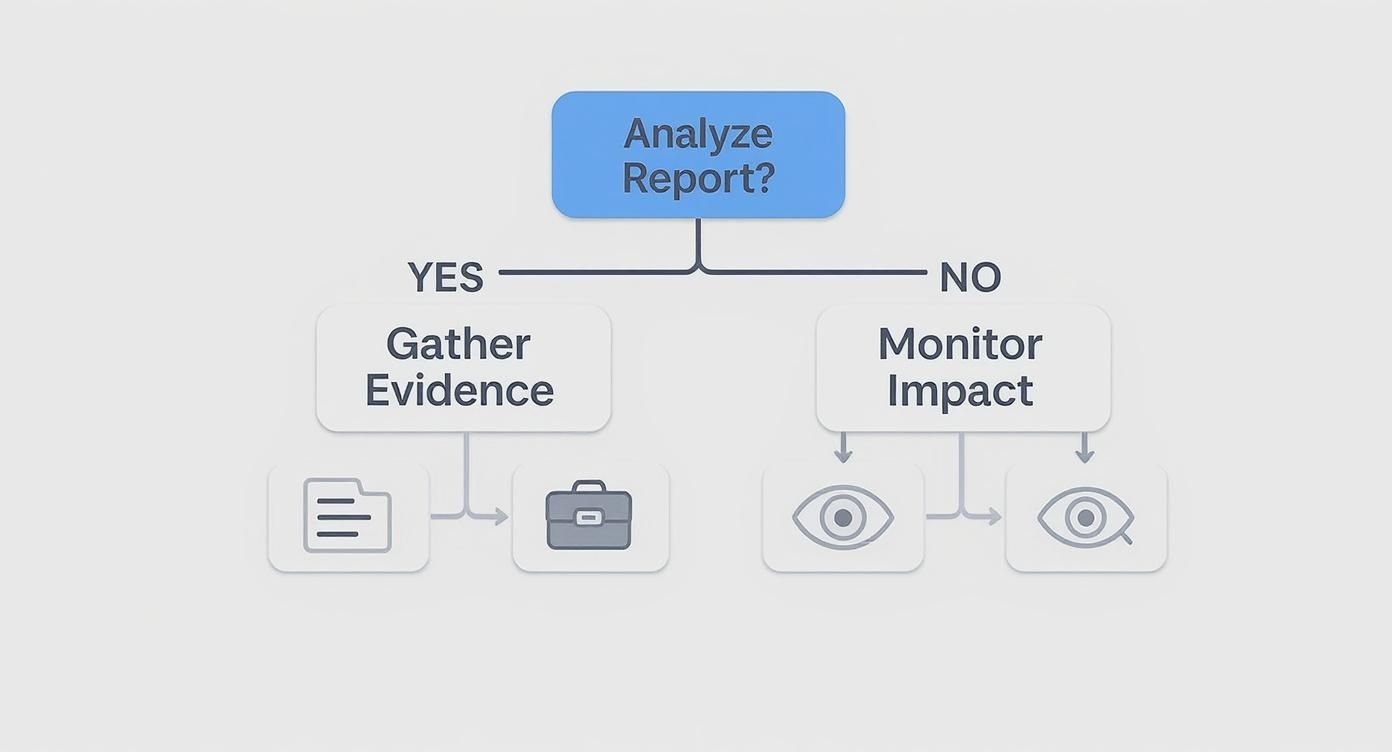
As you can see, a clear-eyed assessment is the critical first step, whether you decide to take immediate action or just keep an eye on things for now.
The logic behind suppression is beautifully simple: if you can't remove the negative, you bury it. You achieve this by creating a whole ecosystem of positive, high-quality online content about you or your company and optimizing it to outrank the Ripoff Report. Given that the overwhelming majority of people never click past the first page of Google, pushing the negative link to page two or three renders it effectively invisible.
This isn’t about just churning out a bunch of spammy articles. A real suppression campaign is about building and promoting authoritative digital assets.
Pillars of an Effective Suppression Campaign:
- Owned Websites and Blogs: Your own well-optimized corporate or personal website is your single most powerful tool. By consistently publishing good content, you establish it as the definitive source of information about you.
- High-Authority Profiles: Creating and actively using profiles on respected platforms like LinkedIn, Crunchbase, and key industry directories helps build out a strong, positive digital footprint.
- Positive Media Mentions: Getting featured, interviewed, or even publishing a guest article on reputable news sites or industry blogs creates the kind of powerful, positive search results that Google’s algorithm loves.
Pulling off a successful suppression campaign requires a real understanding of search engine optimization (SEO). You’re essentially taking back control of the narrative. For a deeper look, our guide on how to remove negative search results covers more advanced tactics. It’s a proactive and potent way to build a digital fortress around your brand.
Comparing Your Two Main Options
So, which path do you choose? The answer depends on your budget, how quickly you need results, and the specific nature of the report. Neither legal de-indexing nor suppression is a one-size-fits-all solution.
Because Ripoff Report won't budge, these two strategies are the industry-standard tools for defending your reputation. A court order forces Google's hand, but the legal system moves slowly. Even after you get an order, Google can take up to 8 weeks to fully process it.
In contrast, a well-executed suppression campaign can start showing results much faster, often pushing the negative report down in the rankings within 30 to 90 days. This speed is critical when you consider that over 90% of clicks go to first-page results.
Let’s break it down side-by-side.
| Factor | Legal De-Indexing | Search Engine Suppression |
|---|---|---|
| Effectiveness | Highly effective; a permanent removal from search results. | Effective at killing visibility; requires ongoing effort to maintain top rankings. |
| Cost | Can be high due to legal fees, but it's typically a one-time expense. | Varies widely; often an ongoing monthly investment in content and SEO. |
| Timeline | Slower to start, as it's tied to the court system (can take many months). | Faster to show initial results, often within the first 1-3 months. |
| Best For | Reports that are clearly defamatory, false, or libelous and can be proven with evidence. | Opinion-based reports, situations where a lawsuit isn't feasible, or as part of a long-term reputation-building strategy. |
In the end, the goal is to reclaim your online reputation. Whether you go the legal route to erase the link from search or build a wall of positive content to bury it, you have solid, viable options for neutralizing the threat a Ripoff Report poses to your name.
What About Ripoff Report's Own Programs?
So, you've realized asking for a ripoff report remove is a non-starter. It's at this point that most businesses stumble upon the platform's own internal "solutions." Ripoff Report offers a couple of paid programs that promise to address your complaint, but let's be crystal clear: they do not offer deletion.
What you're really looking at are expensive options to amend a report, not erase it. It’s absolutely critical to go into this with your eyes wide open, understanding what you're actually paying for and the very real limitations involved.
Ripoff Report's main offerings are the Corporate Advocacy Program (CAP) and the VIP Arbitration Program. Both demand a hefty financial commitment and come with zero guarantees of a positive result. When you engage with these, you're playing their game on their turf.
Before you even think about spending a dime, your first move should be to post a public rebuttal. A calm, professional, and fact-based response right on the report itself won’t make it go away, but it’s your best shot at providing context for anyone who stumbles upon it. This is your chance to tell your side of the story.
A Closer Look at the Corporate Advocacy Program
The Corporate Advocacy Program, or CAP, is usually the first stop. Essentially, you pay Ripoff Report to "investigate" the complaint against you. If they decide in your favor, they’ll add a positive update or an editor's note to the top of the report.
But here’s the catch, and it's a big one: the original negative report remains untouched. The damaging title, the angry accusations, and all the original text are still there for the world to see. All you get for your money is a little preamble saying the issue was resolved. While that’s certainly better than nothing, it’s a long way from the clean slate you were hoping for.
The price tag for this program is not small, often running into the thousands of dollars, and the "investigation" is entirely at their discretion. You are, in effect, paying the very platform hosting the damaging content to be the judge and jury—a situation many rightly see as a major conflict of interest.
Opting for the CAP is a strategic gamble. You're betting that a positive editor's note is worth the high cost, all while accepting that the original complaint will never truly disappear.
Is the VIP Arbitration Program a Better Bet?
For those looking for a more formal process, there's the VIP Arbitration Program. This is a legally binding route that involves an independent, third-party arbitrator reviewing evidence from both your business and the person who wrote the report. The entire goal is to determine if the claims made are factually true.
If the arbitrator rules that certain statements in the report are false, Ripoff Report will agree to redact only those specific false statements. They will not take down the report.
Let's imagine a real-world scenario. Say a report lists ten different complaints about your service. After you go through the expensive arbitration process, the arbitrator finds that three of those claims are verifiably false. Ripoff Report would then just black out those three sentences, leaving the other seven negative claims perfectly intact for everyone to read.
There are some serious things to consider here:
- Serious Cost: Arbitration is expensive. You're not just paying for the program; you're also paying the arbitrator's fees, which can push the total cost well past what the CAP costs.
- No Deletion, Ever: A complete win in arbitration still doesn't get the report removed. You end up with redactions, but the negative title and URL live on.
- The Risk of Losing: You might not even win. If the arbitrator sides with the report's author, you've just spent thousands of dollars to have a third party officially legitimize the negative content.
Ripoff Report Internal Program Analysis
To make sense of these options, it helps to see them side-by-side. The table below breaks down what you're really getting into with each program.
| Program | Estimated Cost | Potential Outcome | Key Consideration |
|---|---|---|---|
| Corporate Advocacy (CAP) | Typically starts at $2,000+ per report | A positive editor's note is added to the top of the original report. | The original negative content remains fully visible, and the outcome is decided by Ripoff Report itself. |
| VIP Arbitration Program | Often $5,000 to $15,000+ | Redaction of specific statements proven to be false; the report and its title stay live. | Legally binding process with a third-party arbitrator, but with a high cost and no guarantee of a favorable outcome. |
Ultimately, Ripoff Report's internal programs are designed to manage a problem, not solve it. They can offer a small measure of relief in very specific cases, but they are costly and will never give you the fresh start you’re looking for. For many businesses, investing that same money and effort into a court-ordered de-indexing or a strategic online suppression campaign delivers a much better, and more permanent, return.
When to Hire Reputation Management Experts

Let's be honest: trying to tackle a Ripoff Report by yourself is an uphill battle. It's a frustrating, complicated, and often emotionally draining process. While the DIY route might seem like a way to save money, there are definite red flags that signal it’s time to bring in the pros.
The decision to hire an expert often boils down to a simple cost-benefit analysis. Is the damage from this report costing you more than a professional solution would? If you're losing customers, top talent is turning down job offers, or your brand's credibility is in the gutter, the answer is almost certainly yes.
Identifying the Need for Professional Help
Some situations are just too complex to handle alone. In these cases, going it alone can backfire, wasting precious time and money, and sometimes even making the problem worse.
You should seriously consider bringing in experts if any of these sound familiar:
- The Report Haunts Your First Page: If that negative link is one of the first things people see when they Google your name, the damage is happening in real-time. Professionals have the SEO firepower and technical know-how to launch a suppression campaign strong enough to push it down and out of sight.
- The Content is Clearly Defamatory: Proving defamation isn't just about being right; it's about navigating a tricky legal system. You'll need an attorney who specializes in internet law to build a case that can actually secure a court order for de-indexing. You can learn more about this approach at https://levelfield.io/defamation-removal.
- You Just Don't Have the Time or Resources: A serious ripoff report remove strategy is a massive undertaking. Most business owners are already stretched thin, and they simply don't have the bandwidth to run a full-scale legal or SEO campaign on the side.
Understanding the Cost and ROI
Professional help isn't cheap, but it’s an investment in the survival of your business. The financial and emotional cost of a lingering negative report can be immense. Depending on the complexity, legal and reputation management fees can range from $5,500 to over $100,000.
With some studies suggesting that by 2025, over 30% of online reviews could be fake, professional intervention is becoming more critical than ever to separate fact from fiction.
Investing in reputation management isn't just about making a bad link disappear. It’s about reclaiming your story, protecting future revenue, and restoring the trust you worked so hard to build. The ROI becomes crystal clear when the phone starts ringing again and you can get back to growing your business with confidence.
Choosing the Right Partner
Not all reputation management firms are the same. When you're vetting potential partners, look for transparency, a proven track record, and a strategy that makes sense. Be wary of anyone promising a "guaranteed removal" from Ripoff Report itself—that's a promise they simply can't keep.
A reputable firm will always:
- Perform a deep-dive analysis of the situation before recommending a specific, customized plan.
- Clearly explain their methods, whether it's pursuing a legal de-indexing, a search engine suppression campaign, or a mix of both.
- Provide transparent pricing and realistic timelines so you know exactly what you're paying for and when to expect results.
This isn't just about damage control; it's about securing your business's future. For a wider view on protecting your brand online, a comprehensive online reputation management guide can offer valuable perspective. Ultimately, hiring the right experts means you stop being a victim of an online attack and become the one in control of your reputation again.
Common Questions About Ripoff Report Removal
When you're staring down a negative report, a flood of questions is inevitable. Your reputation is on the line, and you need straight answers from people who've been in the trenches. Here are the most common concerns we hear from businesses facing this exact challenge, answered from our real-world experience.
How Much Does It Cost to Address a Ripoff Report?
This is almost always the first question, and the honest answer is: it depends. There’s no flat fee for making a Ripoff Report problem go away because every situation is different. The cost really boils down to the strategy you choose.
Going the Legal Route (De-indexing): This is usually the most expensive path upfront. You should budget anywhere from $5,500 to over $25,000 for the legal work required to get a court order. It's a hefty investment, but it's the most permanent fix for getting the link out of Google's search results.
Search Engine Suppression: This strategy typically involves a monthly retainer with an online reputation management (ORM) firm. Costs can range from $1,500 to $10,000 a month, depending on how competitive your search results are and how much firepower is needed to bury the report.
Ripoff Report’s In-House Programs: Don't forget their own options, like the CAP or Arbitration programs. These are also quite expensive, often starting at several thousand dollars, and come with no guarantee that you'll be happy with the outcome.
The real question isn't what a solution costs, but what inaction is costing you. How much business are you losing every single month that report sits on page one? More often than not, the investment in a professional fix pays for itself surprisingly fast.
What Is a Realistic Timeline for Results?
I know you want this fixed yesterday, but patience is part of the game. The timeline depends entirely on the road you take.
Getting a court order for de-indexing is a marathon, not a sprint. The legal system moves at its own pace, so expect the process to take anywhere from six months to over a year. And even after you have the order in hand, it can take Google a few more weeks to process it.
Suppression, on the other hand, can offer much quicker relief. A well-run campaign can start pushing that negative report down in the rankings within the first 30 to 90 days. While it might take a few more months to push it off the first page completely, seeing it drop provides an immediate morale boost and reduces the damage.
Can I Really Get a Report Removed Successfully?
Let's be crystal clear about what "success" means here. It doesn't mean deleting the page from Ripoff Report's website—they’ve made that nearly impossible. Success means making it invisible to the public by getting it removed from search engine results.
And yes, your chances of achieving that are actually very high if you pick the right strategy.
With Legal De-indexing: If you have a rock-solid, evidence-based defamation case, your odds of getting a court order are excellent. The entire thing hinges on having undeniable proof that the statements are false and causing you harm.
With Suppression: Here, success is a function of expertise, consistency, and resources. When a skilled ORM team is creating and promoting high-quality, positive content about you, it's almost a given that you can push the negative link off the first page of Google. Executed properly over time, this method has a near-guaranteed success rate.
So, while you can't force Ripoff Report to take down the post, you have incredibly effective ways to control what your potential customers see. By focusing on either de-indexing or suppression, you can absolutely neutralize the threat and take back control of your online story.