



Finding something negative about yourself online is a gut-punch. But the worst thing you can do is react emotionally. To get bad search results removed, you have to be strategic, methodical, and a little detached. The very first thing is to take a deep breath and start a thorough audit. Let's get organized.
Your First Moves Against Negative Search Results
When that negative result pops up, your first instinct might be to fire off an angry email or post a rebuttal. Don't. Seriously, just don't. Your initial moves are critical, and a calm, calculated approach will serve you far better than a panicked one. The goal here is to shift from defense to offense by gathering intelligence and building a solid game plan.
This whole process kicks off with a complete audit. I don't just mean a quick glance at the first page of Google. You need to dig. Search your name, your company's name, and any common variations. Your mission is to find and document every single piece of unwanted content out there.
Catalog Every Negative Link
Grab a spreadsheet. This simple document is about to become your command center for this entire operation. It's where you'll track every removal request, suppression effort, and any potential legal action. Keeping everything in one place is non-negotiable.
Your spreadsheet should have columns for:
- URL: The exact link to the damaging content.
- Screenshot: A picture of the page as it is now. This is gold if the content gets changed or deleted later.
- Content Type: Is it a bad review? A news article? A forum post? A social media rant?
- Platform: Where is it hosted? Google, Yelp, Facebook, a local news blog?
- Notes: A quick summary of the problem and why it's a big deal.
This isn't just busywork. It transforms a chaotic mess into a project you can actually manage. You'll see the full picture and won't forget a single damaging link.
Categorize and Prioritize the Damage
Okay, now you have a list. But not all negative results carry the same weight. Some are just annoying, while others can actively torpedo your career or business. You need to triage them. A false, defamatory post on page one is a five-alarm fire. A grumpy comment on page four? Not so much.
The same goes for personal information. If you find your details on a data broker site, that's an immediate, high-priority problem. For a step-by-step walkthrough on that specific issue, our guide on the FastPeopleSearch opt-out process is a great resource.
The workflow below breaks down these crucial first steps.
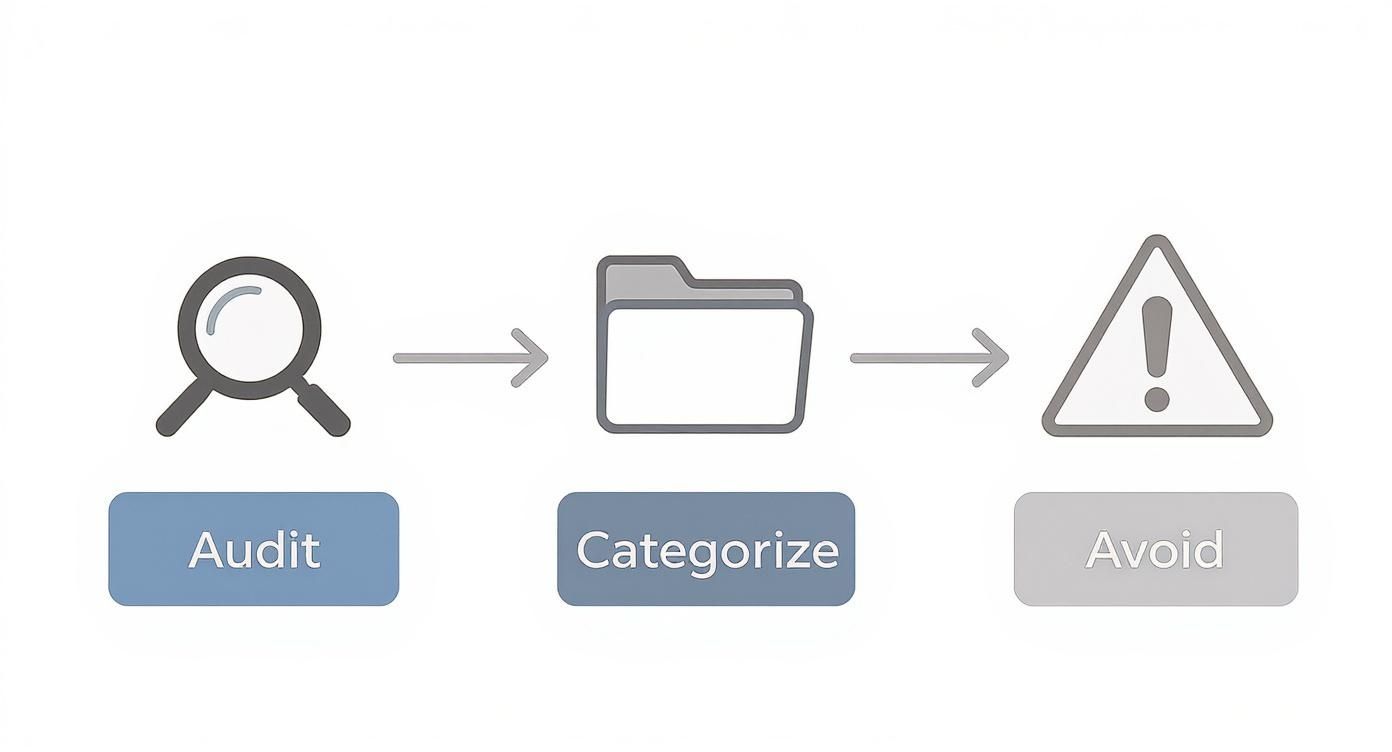
As you can see, it's a disciplined process: audit everything, categorize the threats, and—most importantly—avoid making things worse by engaging.
To help with this, I use a simple matrix to quickly sort and prioritize what I'm looking at.
Bad Search Result Triage Matrix
Use this matrix to categorize negative search results and determine the best initial action for each type of content.
| Content Type | Platform | Initial Action | Urgency |
|---|---|---|---|
| Defamatory Blog Post | Independent Blog/News Site | Legal Counsel Consultation | Very High |
| Negative Customer Review | Yelp, Google Maps, Trustpilot | Platform Removal Request | High |
| Personal Info Leak | Data Broker (e.g., Spokeo) | Immediate Opt-Out/Removal | Very High |
| Outdated News Article | News Outlet | Platform Removal Request | Medium |
| Negative Forum Comment | Reddit, Niche Forums | Moderator/Platform Request | Medium |
| Unflattering Social Media | Facebook, Instagram, Twitter | Platform Reporting | Low-High |
| Impersonation Account | Social Networks, Forums | Platform Impersonation Report | Very High |
This kind of framework helps you focus your energy where it will have the most impact first, rather than trying to fight every battle at once.
Critical Mistake to Avoid: Whatever you do, do not engage with the negative content directly. Replying to that bad review or commenting on that blog post is like pouring gasoline on a fire. Even just clicking the link over and over can signal to search engines that the page is relevant, potentially boosting its rank and making your problem much, much worse.
By starting with this disciplined audit, you're building a strong foundation. You'll have a clear, prioritized list of targets and all the evidence you need to take action—whether that’s a simple platform report, a legal notice, or a full-blown SEO campaign to suppress the result. This initial, deliberate work is the single most important thing you can do to take back control of your story online.
Playing by Their Rules: Using Platform Policies to Your Advantage
Every platform out there—from Google to Yelp, all the way to Reddit—has its own rulebook. Think of their terms of service and content policies as your secret weapon for getting unwanted content taken down. Blindly smashing the 'report' button and hoping for the best is a losing game. The real strategy is to build a case that points directly to a specific policy violation.
You have to shift the conversation. It's not about your feelings or whether you "like" a post. It's about showing a platform moderator exactly how a piece of content breaks their rules. This transforms your complaint from a subjective plea into an objective policy breach, giving them a clear, justifiable reason to take action on your behalf.
How to Navigate Google’s Removal Tools
For most people, Google is the main event. The search giant has very specific policies, and knowing which one applies to your situation is the key to any effort to remove bad search results. While they won't pull down a page just because it’s negative, they draw a hard line on things like doxxing, harassment, and non-consensual explicit content.
One of the best tools Google offers is the "Results About You" dashboard. This feature was built specifically to help you find and request the removal of search results that expose personal details like your phone number, home address, or email.
This is the kind of personal information Google is prepared to remove directly through their own support channels.

The image above highlights Google's official stance on removing personally identifiable information (PII), such as confidential ID numbers and financial details. This isn't a gray area; for these kinds of privacy violations, you have a direct path to getting them removed.
Of course, Google's algorithms and human raters are constantly working to demote harmful content based on signals like expertise, authoritativeness, and trustworthiness (what SEOs call E-A-T). But the system isn't perfect. That’s why tools like "Results About You" exist—to fill the gaps and give you more direct control over your information, a point driven home by a recent analysis of data removal services.
Crafting Removal Requests That Actually Work
Once you move beyond Google, you'll find every major platform has a reporting process. Your mission is to pinpoint the exact violation and build your case around it. A vague report is an ignored report.
Here’s how to think about some of the most common platforms:
- Review Sites (Yelp, Glassdoor, Trustpilot): These sites are on the lookout for conflicts of interest (like reviews from disgruntled ex-employees), hate speech, and personal attacks. If a review starts naming specific employees in a harassing way, don’t just report it as "inaccurate." Report it for violating the platform’s anti-harassment policy.
- Social Media (Facebook, X, Instagram): Impersonation is a huge red flag on social media. If someone sets up a fake profile for you or your business, use the platform's dedicated impersonation reporting tool. The key here is to provide a link to your real profile as proof of ownership.
- Forums (Reddit): Reddit has sitewide rules against harassment and posting private info (often called "doxxing"). But the real power often lies with the moderators of individual subreddits, who have their own specific rules. Always start by reporting the post to the subreddit moderators, citing both a sitewide and a subreddit rule if you can.
Pro Tip: Never submit a removal request without taking a screenshot of the confirmation page. If your first attempt is ignored or denied, this screenshot becomes critical evidence for your appeal. File it away in that master spreadsheet you created during your audit.
A Template for Reporting a Fake Review
Let's walk through a real-world scenario. You get a scathing one-star review on Google Maps, but you're positive it’s from a competitor, not a real customer. A generic report will go nowhere. You need to present evidence.
Here’s a simple framework for your report:
- State the Violation: "This review violates the policy against Fake Engagement and Conflict of Interest."
- Present Your Evidence: "We have no customer records matching the reviewer's name or any details in their comment. The reviewer's profile was created today and has only left this one review, which is a common pattern for fake accounts created to harm a business."
- Explain the Impact: "This fake review is clearly intended to manipulate our business's rating and mislead potential customers."
- Make a Clear Request: "We request that this review be investigated and removed immediately in accordance with your content policies."
This approach does the heavy lifting for the platform's support team. You’ve handed them a clear, actionable case by connecting the dots between the offending content and their own rulebook. Getting good at this is fundamental to taking back control of your online reputation.
When Legal Action Is Your Only Move Left
Sometimes, you do everything right. You file the reports, you reach out directly, you follow the platform's rules to the letter... and the damaging content stays up. It’s frustrating, but it’s not the end of the road. This is the point where you have to shift your thinking from platform moderation to legal enforcement.
Taking legal action is a serious step. It means the situation has moved beyond a simple complaint and into the realm of actual, provable harm. You're no longer just asking a platform to take something down; you're using the power of the law to remove bad search results that are illegally damaging your reputation.

Defamation: When Lies Cause Real Harm
"Defamation" is a word that gets tossed around casually, but it has a very specific legal meaning. It’s not just an insult or a bad review. Defamation is a false statement of fact that injures someone's reputation.
It generally comes in two forms:
- Libel: This is the written form. Think of a fake review, a malicious blog post, or a defamatory social media comment that’s presented as fact.
- Slander: This is spoken defamation. An example would be false accusations made in a YouTube video or a podcast interview.
To have a real case, you usually need to prove a few things: the statement was verifiably false, it was shared with others, and it caused you measurable damage. That last part is key—you need to show you lost business, a job opportunity, or suffered some other tangible harm because of the lie.
It's easy to confuse opinion with defamation. "This contractor did a terrible job" is an opinion. But "This contractor stole materials from my home" is a statement of fact. If it's false, it could be libel.
Using the DMCA for Stolen Content
What if the problem isn’t a lie, but outright theft of your work? Maybe someone has copied your blog posts, used your professional photography without permission, or re-uploaded your videos as their own. This is a clear-cut case for the Digital Millennium Copyright Act (DMCA).
A DMCA takedown is a formal notice you send to the service provider hosting the stolen content (like Google, a web host, or a social media site). You’re essentially telling them, "I own the copyright to this, it's being used illegally, and you need to remove it." Web hosts and platforms take these notices very seriously because they can face liability if they ignore them.
For instance, if a competitor copies and pastes your service descriptions onto their own website, a DMCA notice to their hosting provider is often the quickest way to get it taken down. It’s a direct and powerful tool that often sidesteps the need for a full-blown lawsuit. If you're dealing with this kind of issue, you can learn more about how to address false and damaging online articles here: https://levelfield.io/blog/how-to-remove-google-articles.
Tackling Impersonation and Privacy Invasions
Legal channels are also critical when you’re facing impersonation or serious privacy violations. If someone has created a fake social media account in your name or published your private information online (a practice known as "doxxing"), you should start with the platform's reporting tools. But if they fail to act, legal help is your next step.
An attorney can help you send a formal cease and desist letter or, in more severe cases, file a lawsuit to unmask an anonymous harasser and hold them accountable. When you’re navigating these complex issues, consulting a litigation law practice can give you a clear understanding of your rights and options.
This isn’t just a niche problem; it's a growing global trend. Since 2020, Google has seen a huge jump in content removal requests from courts and government agencies. They’ve received nearly 330,000 such requests from almost 150 countries, and that number has been growing by an average of 34% every year. It’s clear that using formal legal channels to force content removal is becoming more and more common.
How to Bury Negative Results with SEO
Sometimes, you'll hit a wall trying to get a negative result deleted. It's frustrating, but it doesn't mean you're out of options. When you can't get something removed, you have to switch from defense to offense. The new goal? Make that negative result irrelevant by burying it so deep in the search results that no one ever finds it.
This strategy is what we in the industry call online reputation management (ORM). It’s all about taking back control of your narrative. You do this by creating a wave of positive, high-quality content that you own and promoting it until it outranks the bad stuff. Think of it as building a digital fortress of positive assets that stand in front of the negative content.

Building Your Digital Portfolio
First things first, you need to create an online portfolio of properties that are entirely under your control. These will be the foundation of your SEO push. The aim here is to have multiple high-quality web pages all competing to rank for your name or your company’s name.
Some of the most effective assets you can create are:
- A Personal or Company Website: This is your home base online. A website with your name in the domain (like
yourname.com) has a great shot at ranking #1. Here, you have total control to tell your story exactly the way you want it told. - Optimized Social Media Profiles: Don't underestimate the power of social media in search results. Google sees platforms like LinkedIn, X (formerly Twitter), and Facebook as authoritative. Fully built-out, professional, and active profiles can rank surprisingly well.
- Third-Party Contributions: Look for opportunities to write guest posts for respected blogs in your field or participate in interviews. Getting a positive article or interview published on a high-authority website can become a powerful asset that ranks for your name.
Each one of these properties is another chance to claim a spot on the first page of Google, pushing the negative result further down.
Creating High-Authority Content
Once your digital properties are in place, the real work begins. You need to get into a rhythm of publishing genuinely useful, keyword-rich content that paints you as an authority. This isn't about churning out content for the sake of it; it's about creating things that search engines recognize as valuable.
Let's say you're a real estate agent trying to bury a bad review. You could start a blog on your personal website and post articles about local market trends, tips for first-time homebuyers, or in-depth neighborhood guides. This is exactly the kind of expert content Google loves to show its users.
A huge part of this is actively building quality backlinks to your positive content. In Google's eyes, every high-quality link from another website is like a vote of confidence, signaling that your content is trustworthy and deserves a higher ranking.
Key Insight: Don't just create content; create content that deserves to rank. Your focus should be on providing real value, answering the questions people are asking, and showcasing your expertise. That's what builds lasting authority and successfully pushes down the stuff you don't want people to see.
Comparison of Removal vs Suppression Strategies
Before diving deeper into a suppression campaign, it's helpful to understand how it stacks up against direct removal. Each approach has its place, and knowing the differences will help you decide where to focus your resources.
| Strategy | Best For | Cost | Timeframe | Success Rate |
|---|---|---|---|---|
| Removal | Clear policy violations (defamation, copyright, PII) on specific platforms. | Low to High | Days to Months | Varies (Low to High) |
| Suppression (SEO) | Content that can't be removed, like negative opinions, old news, or posts on uncooperative sites. | Medium to High | 6-18+ Months | High (with sustained effort) |
Ultimately, while removal offers a permanent fix, suppression is the more reliable strategy for content that doesn't violate any clear rules.
The Long Game of SEO Suppression
Be prepared: SEO is a marathon, not a sprint. It’s not a quick fix. While you might see some positive shifts in a few months, it can easily take six months to a year—or even longer—to successfully bury a stubborn negative result. Consistency is everything.
Here’s a practical checklist to keep your suppression campaign on track:
- Identify Your Assets: Take stock of all the positive and neutral search results already ranking below the negative one. These are your best candidates for an immediate optimization boost.
- On-Page SEO: Go through your owned properties (your website, profiles) and optimize the title tags, headings, and content to include your target keywords, like your name or your company's name.
- Set a Content Calendar: Commit to a regular publishing schedule. Whether it's one blog post a week or a few social media updates a day, consistency shows search engines that your sites are active and relevant.
- Focus on Link Building: Proactively look for opportunities to get your positive content linked to from other reputable websites. This is one of the most powerful ranking signals you can influence.
At the end of the day, the best way to deal with bad search results that simply won't disappear is to drown them in a sea of positive, authoritative content that you control. It demands patience and consistent effort, but it's the most effective long-term play for reclaiming your online story.
Knowing When to Call in a Reputation Management Pro
Let's be realistic. You can handle a lot of this on your own, especially if it’s a one-off bad review or an annoying forum post. But there’s a definite ceiling to DIY reputation management. When you find yourself in a genuine firefight—facing a coordinated negative campaign or a sticky legal mess—you’re no longer just managing your reputation. You're in a specialized battle that requires experience, the right tools, and a deep playbook for how search engines and legal systems work.
Knowing when to hand the reins over to a professional isn't admitting defeat. It's a smart, strategic move. If you're sinking hours into this every week and getting nowhere, or worse, you can see the negative content actively hurting your sales, it's time to get a professional opinion. The tipping point is usually when the problem gets too big, too complex, or just too nasty for one person to handle.
Signs You Need an Expert
Some situations are just too big to tackle alone. These aren't minor annoyances; they're serious threats that demand a professional, multi-faceted strategy to successfully remove bad search results or push them so far down they become invisible.
It’s probably time to call in the pros if you’re dealing with any of these scenarios:
- A Coordinated Attack: This isn't just one negative review. It’s a sudden flood of negative posts, articles, and comments popping up across multiple sites at once. This smells like a deliberate campaign, often from a competitor or a very determined detractor.
- Complex Legal Issues: The content is defamatory, infringes on your copyright, or involves someone impersonating you, but the platform's standard reporting tools aren't working. A good ORM firm, especially one with legal chops, knows exactly how to navigate these channels.
- High-Authority Negative Press: A hit piece on a major news outlet is a whole different beast. These sites have massive domain authority, and trying to outrank them with a few blog posts is like bringing a knife to a gunfight. It requires a serious, resource-heavy suppression campaign.
- Direct Hit to Your Bottom Line: You can draw a straight line from the bad search result to lost customers and a tanking star rating. When it’s costing you real money, the investment in a professional pays for itself.
A reputable ORM firm does more than just send takedown requests. They deploy a full arsenal of strategies: advanced SEO suppression, creating a buffer of positive content, digital PR, and working with legal teams to clean up your search results for good.
What a Reputable Firm Actually Does
Think of a legitimate online reputation management (ORM) agency as your strategic partner. They’ll start with a deep-dive audit—similar to the one you did, but with more powerful software to find threats you might have missed. From there, they build a custom game plan. That might involve direct negotiation with site owners, legal escalation, and a long-term SEO suppression campaign designed to build a firewall of positive content around your name.
These issues are only getting more complicated. In the first half of 2024, government and court requests for Google to remove content hit an all-time high. While Russia led the pack with over 26,000 requests, countries like South Korea and India also filed thousands. This global trend, which you can explore in the data on government content removal requests, just shows how complex the removal landscape has become. It’s an environment that professionals are built to navigate.
Red Flags to Watch Out For
Unfortunately, the reputation management industry has its share of snake oil salesmen. As you vet potential partners, you need to be on high alert for anyone making promises that sound too good to be true.
Here are some massive red flags:
- "Guaranteed" Removals: This is the biggest one. No one can guarantee the removal of content from a site they don't own. Ethical firms talk about high success rates and proven strategies, not impossible certainties.
- Vague or "Secret" Methods: A trustworthy firm should be able to walk you through their process. If they can’t clearly explain their strategy (like SEO suppression, content creation, or legal notices) and instead use buzzwords, run.
- No Case Studies or References: A solid track record is everything. They should be able to provide anonymized case studies or connect you with past clients. If they can't, it's a bad sign.
- Black Hat SEO Tactics: If anyone mentions creating fake positive reviews, using spammy link-building schemes, or other shady tactics, end the conversation immediately. These methods can backfire and make your reputation even worse.
Choosing the right firm is crucial. You’re looking for a partner with a transparent process, realistic goals, and a portfolio of real, tangible successes.
Questions We Hear All The Time
When you're trying to get rid of negative search results, a lot of questions pop up. Let's tackle some of the most common ones I've heard over the years, giving you the straightforward answers you need.
How Long Does This Actually Take?
Honestly, it depends entirely on the path you take. If you've found a clear-cut policy violation—like someone posting your private information or engaging in blatant harassment—a direct removal request with the platform can be surprisingly fast. I've seen these resolved in just a few days, though a few weeks is more typical.
On the other hand, going the legal route with a court order is a marathon, not a sprint. Expect that process to take many months. And if you're using SEO suppression to bury the bad result, you're playing the long game. You might see some encouraging signs in 2-3 months, but it often takes a solid 6-12 months of consistent effort to shove a stubborn result off the first page for good.
Can You Really Delete Something from the Internet Forever?
The short answer is no. True, permanent erasure is a myth. Once something is out there, it can be copied, screenshotted, and reposted on countless other sites or archived by services like the Wayback Machine.
The real goal here isn't total annihilation; it's about control. A successful campaign means getting the original post taken down and then using SEO to push any remaining copies so far down the search results that they become invisible. For over 90% of people who never click past the first page, that's as good as gone.
What Is the Streisand Effect, and How Do I Avoid It?
The Streisand Effect is what happens when you try to hide something and, in doing so, make it a thousand times more famous. The name comes from Barbra Streisand's 2003 lawsuit to remove photos of her house from the internet, which, of course, made everyone want to see the photos.
Steering clear of it is crucial. Here’s how:
- Don't feed the trolls. Never, ever get into a public argument or post emotional rebuttals. You're just adding fuel to the fire.
- Use the backchannels. Stick to official reporting tools, quiet legal notices, and behind-the-scenes professional help.
- Keep it quiet. The goal is to solve the problem, not to create a new story about how you're trying to solve the problem.
What's the Price Tag for Hiring a Reputation Management Pro?
The cost can be all over the map, and it really hinges on the problem you're facing. A single, straightforward removal for an obvious violation might run you a few hundred to a couple of thousand dollars. It’s a one-and-done project.
But if you're up against something more serious, like a negative news article on a major site, you're looking at a full-blown suppression campaign. These are retainer-based projects, and the investment reflects that. Costs can range anywhere from $1,000 to over $10,000 per month, depending on how deep the damage goes and how much work is needed to fix it.