


Imagine your business has a storefront. But instead of being on a physical street, it's on the vast, bustling main street of the internet. That's your online reputation. It's the first thing people see, cobbled together from Google reviews, social media chatter, news mentions, and blog posts. Online reputation management for businesses isn't a one-off task; it's the day-in, day-out work of keeping that digital storefront looking its best to build trust and bring people in.
Why Your Digital Reputation Is Your Most Critical Asset
Let's be clear: for most potential customers, your online presence is your business. Before they ever step through your door or click "add to cart," they're going to Google you. What pops up in those first few results instantly becomes their reality of who you are and what you stand for.
That first impression is everything. A search page filled with glowing reviews, helpful articles, and active social media profiles creates instant confidence. On the flip side, just one unanswered complaint or a prominent negative article can plant a seed of doubt, sending a potential customer clicking away to your competition.
It’s Not Just About Damage Control
Too many businesses think of reputation management as a digital fire extinguisher, only to be used when a crisis is raging. While handling crises is certainly part of the job, a modern ORM strategy is all about playing offense, not just defense. It's less about frantically cleaning up messes and more about building a strong, positive presence that can easily absorb the occasional negative comment.
A proactive approach is built on a few key pillars.
The Core Pillars of Online Reputation Management
To truly manage your reputation, you need a strategy that covers all the bases. It’s a mix of listening, building, and protecting. Think of it like this:
| Pillar | Core Objective | Key Activities |
|---|---|---|
| Monitoring | To know what's being said about you, where, and by whom. | Setting up brand mention alerts, tracking review sites, social media listening. |
| Building | To create and promote a positive narrative that you control. | Publishing valuable content, encouraging positive reviews, securing positive press. |
| Responding | To engage in the conversation and show you're listening. | Replying to both positive and negative reviews, engaging on social media. |
| Repairing | To mitigate and remove damaging, false, or misleading content. | Reporting policy violations, suppressing negative search results, legal takedowns. |
By consistently working on these four areas, you create a robust and authentic online presence that isn't easily shaken.
The Real-World Financial Impact
Make no mistake, your reputation is a hard asset with a direct line to your bank account. A stellar reputation doesn't just win over customers; it attracts top talent and opens doors with investors. In fact, a company’s reputation can be responsible for up to 63% of its total market value.
Consider this: it takes an average of 40 positive customer experiences to undo the damage of a single negative review. The math speaks for itself.
A strong online reputation acts like a protective shield. When built correctly, it ensures that your brand’s own voice is the loudest and most authoritative one in any conversation about your business, insulating you from the inevitable bumps in the road.
This is all about taking control of your story before someone else writes it for you. For a specialized look at how these principles apply in a high-stakes field, this guide on Reputation Management for Attorneys offers some fantastic, industry-specific insights.
Building Your Proactive Reputation Strategy

Truly effective online reputation management for businesses isn't about frantically putting out fires. It's much more like landscape architecture. Instead of scrambling when a crisis hits, the smart move is to proactively build and own your digital presence. The aim is to create such a strong, positive footprint that a random negative comment seems like a tiny weed in an otherwise immaculate garden.
This approach ensures that when people look you up, they find an online world you've deliberately built—one filled with authoritative, positive, and trustworthy content that you control.
Cultivating Positive Customer Reviews
It's a strange truth that your happiest customers are often your quietest. A proactive strategy is all about giving them a megaphone. You can't just sit back and hope for good reviews to trickle in; you have to create a dead-simple, frictionless way for satisfied clients to share their feedback.
So many businesses see a huge jump in positive reviews just by setting up automated, well-timed requests. This isn't about being annoying. It's about making it effortless for people who already like you to say so publicly.
Here are a few proven ways to do it:
- Email Automation: A few days after a successful purchase or service, send a polite email asking for a review.
- Point-of-Sale Prompts: Put QR codes on receipts or signs in your store that link straight to your preferred review site.
- SMS Nudges: A simple text message asking for feedback can work wonders, especially for service-based businesses.
The trick is to catch them while the great experience is still fresh in their mind.
Constructing Your Content Fortress
Beyond reviews, your most powerful reputation tools are the content you create and publish yourself. This is how you establish authority, answer your customers' questions before they ask, and, most importantly, control what shows up in search results for your brand. Think of every blog post or case study as another brick in your brand's digital fortress.
High-quality, positive content has a natural tendency to rank well in search engines, which pushes any undesirable results further down the page. When someone Googles you, you want them to be met with a library of helpful, professional resources that instantly build trust.
Proactive content creation isn't just marketing—it's reputation insurance. By dominating the first page of search results with assets you own, you make your brand resilient to future negative attacks.
This strategy puts you back in the driver's seat of your own narrative.
Essential Content Types for a Strong Reputation
To build this fortress, you need to focus on creating things that offer real value to your audience while framing your brand in a positive light. The goal is to become the number one source of information about your own business.
Here are the heavy hitters when it comes to content for proactive reputation building:
- Insightful Blog Posts: Write articles that genuinely solve your customers' problems. When you answer common questions, you position yourself as the go-to expert.
- Detailed Case Studies: Nothing works like a real-world success story. Case studies offer powerful social proof and show exactly what you can do for a client.
- Positive Press Coverage: Actively look for mentions in industry news or local media. A press release about a company milestone or a new hire can generate incredible third-party credibility.
- Official Company Profiles: Make sure your profiles on places like LinkedIn, Google Business Profile, and industry-specific directories are complete, professional, and consistent across the board.
By consistently creating and promoting this type of content, you're building a powerful buffer. This deliberate "digital real estate development" is the cornerstone of any modern ORM strategy and ensures your voice is the loudest and most trusted one out there.
Monitoring Your Digital Footprint Like a Pro
You can't manage a conversation you don't even know is happening. That’s the core of it, really. Strong online reputation management for businesses all starts with listening—setting up a kind of digital radar that scans the entire web for mentions of your brand. This isn't about ego-surfing; it's about systematically tracking the health of your brand's perception as it unfolds in real time.
Think of it as the central nervous system of your reputation strategy. Without that constant flow of information, you're just flying blind. A single negative article can do serious damage; in fact, research shows that companies risk losing about 22% of potential customers if damaging content shows up on the first page of Google.
This kind of proactive listening helps you catch sparks before they turn into fires. It also lets you find and amplify positive feedback and gives you invaluable intelligence on what your market is thinking. It’s the only way to get a true 360-degree view of how people see you.
Identifying the Critical Signals to Monitor
To build a radar system that actually works, you need to know what signals to tune into. A solid approach goes way beyond just tracking your company's name. It means setting up alerts for a whole spectrum of keywords across social media, forums, news sites, and, of course, review platforms.
Your digital radar should be calibrated to pick up on these key signals:
- Direct Brand Mentions: This is the obvious one. You need to know every time your company name is mentioned, whether they tag you or not.
- Executive Names: Your key leaders are often the face of the company. Monitoring their names can tip you off to PR opportunities or personal reputation issues that might spill over and affect the business.
- Product and Service Names: Tracking conversations around your specific offerings is a goldmine for real-time feedback. You can spot bugs, find glowing testimonials, and see how people are actually using your stuff.
- Competitor Buzz: Listening to what people are saying about your competitors gives you a huge advantage. You’ll learn their strengths, their weaknesses, and get a front-row seat to their marketing strategies.
- Industry Keywords: Keeping an ear to the ground for broader industry terms helps you spot trends, jump into relevant conversations, and position your brand as an authority.
When you're actively monitoring your digital footprint, it's also crucial to have a plan for collecting customer feedback on LinkedIn, since this is where so many important B2B conversations happen.
Choosing Your Reputation Monitoring Toolkit
Once you know what you're listening for, you need the right tools to do the listening. The market is full of options, from simple, free alerts to highly sophisticated paid platforms. The right choice really comes down to your budget, your company’s size, and how deep you need to go with your analysis.
An effective monitoring tool does more than just find mentions. It helps you analyze sentiment, identify key trends, and pinpoint influential voices in your industry, turning raw data into actionable intelligence.
This isn't a one-size-fits-all situation. For a lot of small businesses, starting with free tools is a perfectly good first step. As your needs get more complex, you can graduate to more powerful paid platforms that offer deeper analytics and wider coverage. Our detailed breakdown of the best online reputation management software can help you compare the top options out there.
To help you get a feel for what's available, here’s a quick look at a few popular choices.
Choosing Your Reputation Monitoring Toolkit
A practical comparison of popular ORM tools to help you select the right platform for your business needs.
| Tool | Best For | Core Features | Typical Price Point |
|---|---|---|---|
| Google Alerts | Startups and small businesses on a tight budget. | Monitors the web for new content matching keywords. Delivers results via email. | Free |
| Brand24 | Businesses needing comprehensive social media and web monitoring. | Real-time mention tracking, sentiment analysis, influence scoring. | Paid (Subscription) |
| Mention | Companies focused on brand tracking and competitor analysis. | Wide platform coverage, custom reports, API access for integration. | Paid (Subscription) |
Ultimately, the goal is to pick a tool that gives you a clear, consolidated view of all the conversations that matter. This is what turns monitoring from a soul-crushing manual task into an efficient, automated process that empowers you to protect and grow your brand's reputation with confidence.
5. Responding to Negative Feedback and Managing a Crisis
Let's be realistic: even with the best products and services, negative feedback is going to happen. A shipment gets delayed, a new employee has an off day, or a simple misunderstanding occurs. The real test of your online reputation management for businesses isn't about achieving a perfect, complaint-free record—it's about how you handle the heat when it arrives.
Think of your response plan as a digital fire department. When a small fire starts, a practiced, calm, and efficient response can put it out before it turns into a full-blown crisis.
How you handle these moments can truly define your brand. A quick, empathetic, and transparent reply doesn't just fix one customer's problem. It's a public demonstration to every other potential customer that you listen, you care, and you’re committed to making things right. This is your opportunity to turn a frustrated customer into a loyal advocate.
The decision tree below offers a simple way to think about which tools you might need, from basic monitoring to full-scale crisis management.
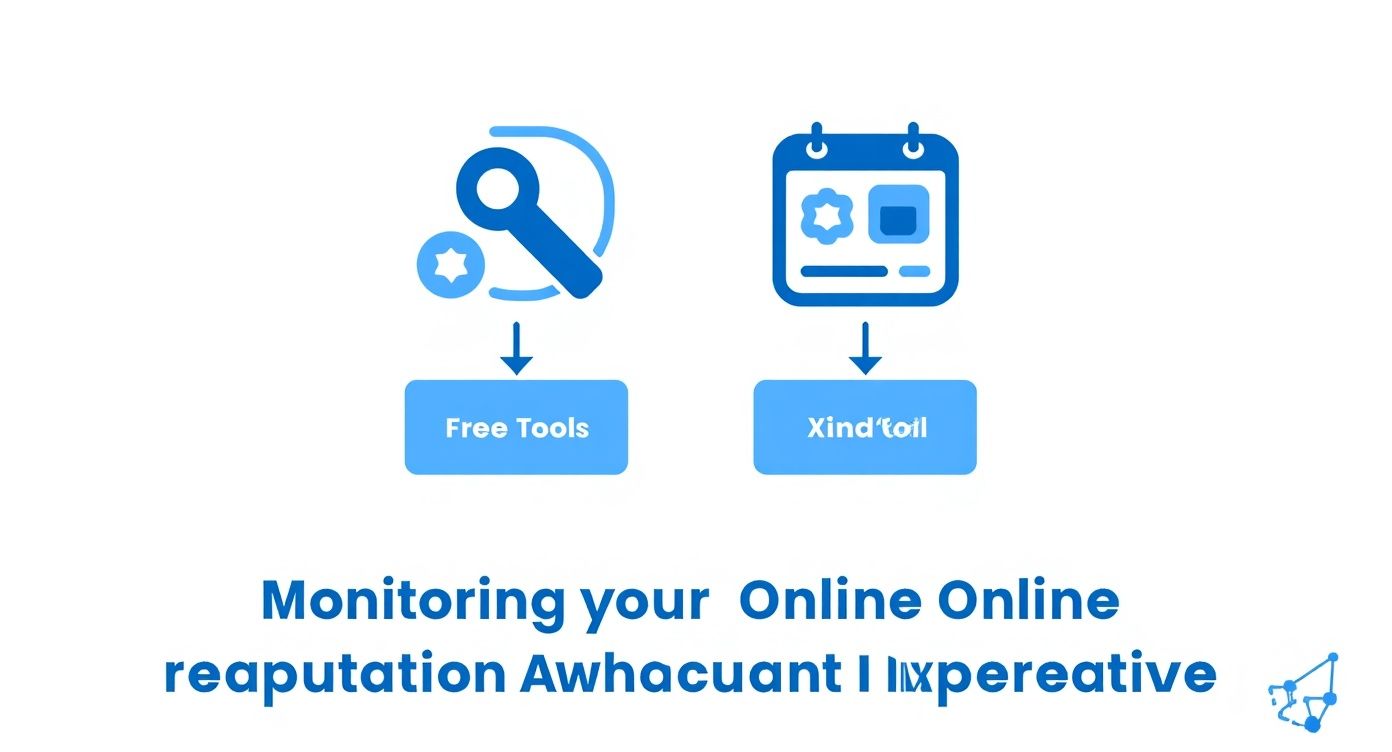
This graphic lays out the journey from starting with free tools to see what people are saying, all the way to using advanced paid platforms for deep analytics when the stakes are high.
The Acknowledge, Empathize, and Act Protocol
When that negative review pops up, your first instinct might be to panic or get defensive. Resist that urge. The best approach is to follow a structured protocol that keeps your responses professional, constructive, and on-brand. Rushing in to argue is like throwing gasoline on that small fire.
A simple but incredibly effective framework is "Acknowledge, Empathize, and Act." This three-step approach is designed to de-escalate tension and steer the conversation toward a positive outcome.
Here’s how to put it into practice:
- Acknowledge the Issue: Always start by thanking them for their feedback and mention their specific complaint. This simple step shows you've actually read what they wrote and aren't just firing off a canned response. It validates their feelings right away.
- Empathize Sincerely: Use phrases that show you get it. "I can definitely see how frustrating that would be," or "We're so sorry your experience didn't meet your expectations." Genuine empathy is a powerful tool for disarming anger.
- Act by Offering a Solution: This is where you take control. State exactly what you'll do to help, and—most importantly—provide a clear way to take the conversation offline. Directing them to a specific email or phone number gets sensitive details out of the public eye and moves you closer to a real resolution.
This protocol makes sure your public-facing response is a masterclass in customer service, while the nitty-gritty of fixing the problem happens privately. For a deeper dive into crafting the perfect replies, check out our guide on how to respond to negative Google reviews.
Handling Illegitimate and Defamatory Attacks
Of course, not all negative feedback is legitimate. Sometimes, you'll face reviews that are just plain false, defamatory, or violate a platform's rules. These often come from disgruntled ex-employees, shady competitors, or people who just want to cause trouble.
For these kinds of attacks, your strategy has to be different. Responding publicly can actually give them the attention they crave and make their false claims look more credible. Your first move isn't to engage; it's to document everything. Take screenshots of the review, noting the username, the date, and the exact text.
Your primary goal with illegitimate feedback is removal, not engagement. Arguing with a bad-faith actor in public rarely ends well and can amplify their false claims in search algorithms.
Once you have your evidence, it's time to work through the platform's official reporting system. Major sites like Google, Yelp, and Trustpilot all have policies against fake or malicious content.
Here are the steps to follow:
- Review the Platform's Policies: Get familiar with what counts as a violation. This usually includes things like hate speech, impersonation, conflicts of interest (like a review from a former employee), and content that isn't based on a real customer experience.
- Flag the Review: Use the built-in "Report" or "Flag as inappropriate" function. When you file your report, be specific about which rule the review breaks. The more detail, the better.
- Escalate If Necessary: If your first flag gets denied, don't just give up. Many platforms have a secondary review or escalation process. This is where that documentation you gathered becomes crucial for making your case.
If the content is causing serious harm to your business and the platform won't act, it might be time to talk to a lawyer to explore your other options.
Turning Reputation Insights into Business Growth
A lot of businesses see online reputation management as a defensive game—something you do to put out fires. But that’s a huge missed opportunity. The truth is, it’s one of the most powerful engines for growth you have. Think about it: every review, social media comment, and forum post is raw, unfiltered feedback. It's like having a direct line to your customers' thoughts.
When you stop just reacting to comments and start analyzing them, you’re basically conducting market research in real-time. This feedback is pure gold. It can help you tweak your products, sharpen your marketing, and massively improve your customer experience. It flips ORM from a reactive chore into a proactive business intelligence tool.
From Feedback to Innovation
The real magic happens when you connect the dots. Are you seeing the same complaint pop up over and over? That’s not just a problem to solve; it's a giant, flashing neon sign pointing to a flaw in your product or a gap in your service.
On the flip side, what are people consistently praising? If customers can't stop talking about your lightning-fast shipping, that’s a core strength you should be shouting about on your homepage. It’s a proven selling point, handed to you on a silver platter.
Online feedback is the voice of the market speaking directly to you. Listening to that voice allows you to innovate faster, solve real problems, and build things people genuinely want and need.
Suddenly, that one-star review about your confusing app interface isn't just an attack. It's a free usability test that tells you exactly what to fix in the next update.
Using Insights to Guide Business Strategy
Digging into your reputation data gives you a direct line into what your customers are thinking, and it often uncovers opportunities you’d never have seen otherwise. It helps you answer tough business questions and make real improvements across the entire company.
Here’s how you can turn those insights into action:
- Refine Product Development: If you see a dozen reviews mentioning a specific feature is clunky, that feedback goes straight to your product team. It’s a clear mandate for what to improve, based on what real users are experiencing—not just what you think they want.
- Sharpen Marketing Messaging: Pay attention to the exact words and phrases customers use when they rave about you. Weaving their language into your ad copy and website makes your marketing feel way more authentic and hit home much harder.
- Improve Customer Service Training: Are people constantly complaining about slow response times? That data gives you concrete examples to bring into your next training session, helping you fix the root cause of the problem.
- Identify New Opportunities: Sometimes, a customer will mention an off-label way they use your product. This can spark ideas for new features, or even point you toward entirely new markets you hadn’t considered.
This strategic mindset is catching on. The global market for ORM software is expected to balloon from $5.2 billion in 2024 to $14.02 billion by 2031. That kind of investment tells you one thing: smart companies know that managing their online presence is non-negotiable for growth. You can dig deeper into these numbers in this analysis of ORM statistics.
By treating your online reputation as a wellspring of business intelligence, you create a powerful feedback loop. You listen, you improve, and that, in turn, earns you more positive feedback. This cycle doesn't just protect your brand; it builds a stronger, more customer-focused, and ultimately more profitable business.
How to Measure Your Reputation Management ROI
So, you’ve put in the work to build a stellar online reputation. How do you prove it’s actually making a difference to the business? To keep the budget and support flowing, you have to show stakeholders how your efforts are hitting the bottom line, not just generating feel-good comments.
Measuring the Return on Investment (ROI) for your reputation work isn't about fuzzy feelings; it's about connecting the dots between specific performance indicators (KPIs) and real business growth. It’s how you tell the story of a stronger reputation leading to a healthier company.
Key Metrics for Tracking Reputation Health
Before you can tie reputation to revenue, you need to get your hands on the core data. These metrics are the vital signs of your brand’s digital health and the foundation for making your case to leadership.
Start by consistently tracking these data points:
- Average Star Ratings: Keep a close eye on your aggregate rating across crucial platforms like Google, Yelp, and any industry-specific review sites. A rising average is one of the clearest signs you're on the right track.
- Sentiment Analysis: What’s the ratio of positive, neutral, and negative mentions of your brand online? The goal here is simple: a steady, measurable increase in positive sentiment over time.
- Brand Search Rankings: Go ahead, Google your own brand name. What shows up on that first page? Your work should be pushing positive, brand-controlled websites and articles to the top of those results.
This is the raw data you'll need to build a compelling ROI argument.
A strong reputation isn't just a "nice-to-have"—it's a powerful customer acquisition tool. The data is clear: star ratings directly influence whether a customer will even consider doing business with you, making this a critical metric for calculating ROI.
Think about it from the customer's perspective. By 2025, it’s estimated that 92% of people won't even consider a business unless it has at least a four-star rating. That's an incredibly high bar. It also means a single bad review could scare away as many as 30 potential customers. That's a direct, material hit to your revenue. You can dig into more of these numbers in this reputation management overview.
Connecting ORM Metrics to Business Outcomes
Once you have a handle on your core reputation data, the next step is linking it to the financial metrics your leadership team actually cares about. This is where you transform reputation management from a perceived cost center into a proven revenue-driver.
Here’s how to connect your efforts to real-world business results:
- Correlate Star Ratings with Sales: Map out your average star rating against your monthly or quarterly sales figures. You'll often find a clear pattern where an uptick in your ratings is followed by a lift in sales conversions.
- Analyze Lead Quality: A great reputation doesn't just bring in more leads; it brings in better leads. Compare the conversion rates of leads that came in during a period of high positive sentiment versus those from a time when negative press was circulating.
- Measure Customer Lifetime Value (CLTV): Happy customers stick around. Businesses with solid reputations naturally build more loyalty. See if customers who found you after your reputation initiatives kicked off have a higher CLTV than those who came on board before.
When you build reports that show these direct connections, you’re no longer just talking about managing reviews. You're proving that investing in your online reputation is one of the smartest financial moves a business can make.
Your Top ORM Questions, Answered
Even with a solid plan in place, it's natural to have questions about how online reputation management for businesses actually works in practice. Let’s tackle a few of the most common ones that come up.
How Long Until I See a Real Difference?
This is the big question, and the honest answer is: it depends entirely on where you're starting.
If you’re building a positive reputation from scratch, you can start seeing encouraging signs—like new positive reviews and fresh content ranking well—in as little as 30 to 90 days.
On the flip side, if you're in repair mode and trying to push damaging search results down, you need to be in it for the long haul. It often takes a dedicated effort of six months to a year, sometimes more, to successfully bury negative content from Google's first page. This isn't a quick fix; it’s a marathon.
Can't I Just Delete That Awful Review?
If only it were that simple. The short answer is no, you usually can't just hit a delete button on a review someone else left. The only exception is when the review is a clear violation of the platform's own rules. Think hate speech, outright spam, or a review from a disgruntled ex-employee (a clear conflict of interest).
Your first move should always be to flag and report reviews that break the rules. Don't get into a public argument with a fake reviewer—it just bumps their comment to the top. The goal is quiet removal, not a loud debate.
For legitimate negative feedback, your best strategy is two-pronged: respond politely and professionally, then launch a campaign to earn a wave of new, positive reviews from your happy customers to effectively bury the negative one.
What's the Real Cost of Managing My Reputation?
The investment in ORM can swing dramatically. If you're a small business owner DIY-ing it with free tools like Google Alerts and focusing on asking customers for reviews, your main cost is your own time and effort.
However, for serious issues like a full-blown crisis or battling a negative article that’s stuck to the top of search results, you'll likely need professional help. In these cases, costs can run anywhere from a few hundred to several thousand dollars per month, depending on the scope and intensity of the work.
Remember, a strong reputation impacts every corner of your business, including hiring. A staggering 70% of recruiters admit to checking a candidate's online presence. Your digital footprint matters more than you think, and you can find more stats on how a digital reputation impacts hiring to see the full picture.