


It's not enough to just flag a bad review and cross your fingers. If you want to successfully remove a fake Google review, you have to do your homework first. It starts with pinpointing the exact Google policy the review breaks, then gathering solid proof, and finally, submitting a crystal-clear report through your Google Business Profile. This deliberate, methodical process is your best weapon against these kinds of attacks on your reputation.
Why Fake Google Reviews Demand Your Immediate Attention

It’s a feeling every business owner dreads—that gut-punch of seeing a one-star review pop up from a name you don't recognize. This isn't just a small frustration; it's a direct hit on the trust you've spent years building. One fake review can drag down your overall star rating, sinking your business profile in local search results where visibility is everything.
Let's be honest, people lean on reviews to decide where to spend their money. A bogus negative review is like a digital roadblock, steering potential customers away before they even think about clicking on your website or walking through your door. The damage isn't just about the immediate lost sale; it's about the seed of doubt that gets planted in people's minds.
The Real-World Impact on Your Business
This isn't just a theoretical problem. The culprits can be anyone from a bitter ex-employee out for revenge to a shady competitor trying to get a leg up. Sometimes, it's not even a person but an automated bot campaign—a "review bomb"—designed to torpedo your rating in a matter of hours. The "why" doesn't matter as much as the result: a damaged reputation that hurts your bottom line.
The problem is massive, and Google knows it. In 2023, they blocked or removed an incredible 170 million reviews that violated their policies. That's a 45% jump from the year before. They also took down 12 million fake business profiles. These figures, which you can read more about in these fake review statistics, show just how rampant this issue has become.
"A fake review is more than just negative feedback. It's a calculated attempt to mislead consumers and unfairly damage a business. Addressing it quickly and correctly is not optional—it's essential for survival."
Taking Control of Your Online Narrative
You can't just ignore these attacks and hope they go away. Learning how to properly remove fake Google reviews has become a non-negotiable skill for anyone running a business today. It's about protecting what you've built and making sure your online presence is a true reflection of your work.
This guide will give you a proven game plan to:
- Spot the Fakes: Learn to recognize the tell-tale signs that separate genuine customer feedback from a fabricated attack.
- Build a Rock-Solid Case: Find out exactly what kind of evidence the Google team needs to see to take your report seriously.
- Master the Removal Process: Follow a straightforward, step-by-step method for reporting reviews and escalating them if necessary.
By taking these steps, you can push back against dishonest tactics and take back control of your business's story.
Building Your Case: How to Spot and Document Fake Reviews
Before you even think about how to remove a fake Google review, you need to switch gears. Forget being the angry business owner for a moment and become a detective. Google doesn't care about your gut feelings or he-said-she-said arguments. They respond to cold, hard evidence that clearly violates their policies. Your mission is to build such a rock-solid case that their moderators have no choice but to agree with you and take the review down.
It all starts with learning to spot the subtle—and sometimes not-so-subtle—red flags that separate a genuinely upset customer from a bad actor. You have to move past the initial sting of the bad review and start looking for patterns.
First Impressions: The Telltale Signs of a Fake
Some fakes are so clumsy they're almost comical. Others are more sophisticated, designed to look just legitimate enough to hurt your reputation. The more you look, the better you'll get at telling them apart.
A great place to start is the reviewer's profile. Just click on their name. Does it look suspicious? Maybe it’s a generic name like "John Smith," or maybe they have no profile picture. The real smoking gun is often their review history. Have they only ever left one review—for you? Or, on the flip side, have they carpet-bombed other local businesses with one-star ratings? These "empty" or overly aggressive profiles are often a dead giveaway.
The review's content is also a treasure trove of clues.
- Painfully Vague: The review screams about "terrible service" or a "horrible experience" but offers zero specifics. No mention of what happened, when, or who was involved.
- Factually Wrong: They might complain about an employee who doesn't work for you or a product you've never sold. This kind of mistake is gold for your takedown request.
- Over-the-Top Language: The tone is often wildly emotional or aggressive, using language that feels completely out of proportion for a normal customer complaint.
- Suspicious Timing: Did a handful of one-star reviews pop up all at once? This could be a "review bombing" campaign, a classic move by a competitor or a disgruntled ex-employee.
One of the easiest wins is when a review mentions a competitor by name, either praising them or telling people to go there instead. This is a direct violation of Google's conflict of interest policy and is usually a slam dunk for removal.
This initial detective work is what sets the stage for a successful report.
To help you get started, I've put together a quick-reference table that breaks down the most common red flags. Keep this handy as you vet suspicious reviews.
Red Flags for Spotting Fake Google Reviews
A quick-reference guide to help you identify the common characteristics of fraudulent reviews.
| Red Flag Category | Specific Signs to Look For | Why It Raises Suspicion |
|---|---|---|
| Reviewer Profile | Generic name, no profile picture, brand new account. | Legitimate users often have established profiles. New or empty accounts are common for one-off attacks. |
| Review History | Only one review (yours), or a spree of 1-star reviews for competitors. | This suggests the account was created solely to harm your business or is part of a negative campaign. |
| Review Content | Lacks specific details, uses extreme or emotional language. | Real customers usually describe their actual experience. Vague complaints are hard to verify and often fake. |
| Factual Inaccuracies | Mentions products/services you don't offer or staff who don't work for you. | This is concrete proof the person never interacted with your business. |
| Promotes a Competitor | Explicitly names and recommends another business. | A clear violation of Google's conflict of interest policy. |
| Timing & Patterns | A sudden wave of negative reviews in a short period. | This points to a coordinated "review bombing" attack, not a random influx of unhappy customers. |
Think of this table as your initial checklist. If a review ticks a few of these boxes, it's time to start gathering your evidence.
Gathering Your Evidence: A Step-by-Step Documentation Process
Once you've flagged a review as suspicious, it's time to build your case file. Don't just hit the "report" button and cross your fingers. You need to meticulously document everything to present a compelling argument to Google.
First, grab a full-page screenshot of the review. Make sure it clearly shows the reviewer's name, the date, the rating, and all the text. Don't crop it—the full context matters. On a desktop, the Print Screen key or a browser extension works perfectly.
Next, click through to the reviewer's profile and take another complete screenshot. You want to capture their review history (or the lack of it), their name, and their photo. If their history shows a pattern—like only reviewing dentists in five different states—it strongly suggests they're a "reviewer for hire."
With that done, it's time to turn inward and check your own records.
Cross-Referencing with Your Internal Records
This is often the nail in the coffin. Your goal is to prove to Google that the reviewer was never a real customer. That means you need to search every record you have for their name, email, or any other detail you can find.
Dig through your:
- Customer Relationship Management (CRM) system
- Email archives and support tickets
- Billing and payment platforms
- Appointment books or reservation logs
If you search high and low and find zero trace of them, you have your most powerful piece of evidence. Your claim is no longer, "I think this is fake." It becomes, "We have searched our records and can confirm this person has never been a customer."
Pull everything together into a dedicated folder: the review screenshot, the profile screenshot, and a simple statement confirming they aren't in your customer database. Now you’re ready to submit a report based on facts, not frustration. This level of prep work drastically improves your odds of getting the review removed on the first try.
The Playbook for Reporting Fake Reviews to Google
Okay, you've done the hard work of gathering your evidence and building a solid case. Now it's time to take that information to Google and formally request the takedown.
This part is all about precision. You need to know exactly how and where to submit your report, and more importantly, which specific policy the fake review breaks. This isn't the time for a long-winded, emotional story about how unfair the review is. Think of yourself as a surgeon: be direct, efficient, and focus only on the facts that prove a policy violation. Google’s moderators are sifting through thousands of reports every day, so yours needs to be crystal clear to get noticed.
This flowchart gives you a good visual breakdown of the initial steps, taking you from suspicion to documentation.
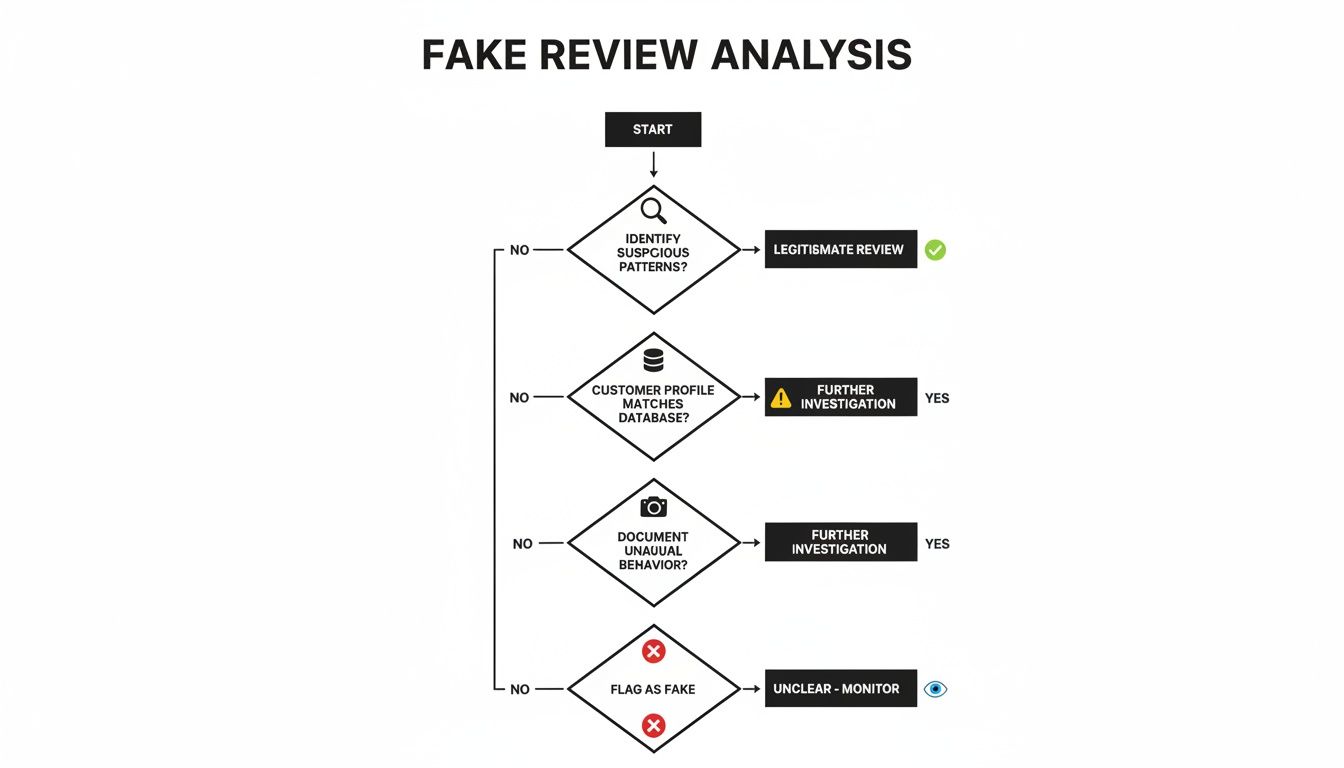
As you can see, the path is straightforward: spot something fishy, confirm if the person was ever a customer, and document everything. Following this structured approach is your best bet for a successful removal.
Method 1: Flagging the Review Directly
This is your first line of defense—the fastest and most common way to report a bogus review. It’s built for clear-cut violations and takes just a few clicks right from your Google Business Profile or on Google Maps.
Here’s the quick rundown:
- Find the review in question on your profile.
- Click the three vertical dots next to the reviewer's name.
- Choose 'Report review' from the menu that pops up.
This will bring up a window asking why you're flagging it. This is where all that detective work you did earlier comes into play. You’ll see a list of potential policy violations, and you absolutely must select the one that best fits your situation.
Choosing the Right Policy Violation
This is the most critical step of the whole process. Don't just guess. You need to match the evidence you’ve collected to one of Google's specific rules.
These are the violations you'll run into most often:
- Conflict of Interest: This is your go-to for reviews left by competitors, disgruntled former employees, or anyone else with an obvious bias. If they praise a competing business by name, it's a slam dunk.
- Off-Topic: The review has nothing to do with a real customer experience. Maybe it’s a political rant, a personal jab at the owner, or just random nonsense.
- Harassment: The review contains threats, bullying, or abusive language aimed at you or your staff. This is for content that goes way beyond simple criticism and becomes a personal attack.
- Spam and Fake Content: This is a broad category for anything that’s clearly not genuine. Think reviews from bots, fake accounts, or a cluster of reviews that all look like they're part of a coordinated attack.
Pro Tip: Keep your report short and to the point. Google moderators don't have time for a novel. A simple, factual statement like, "This violates the 'Conflict of Interest' policy. The reviewer is an employee of our direct competitor, [Competitor's Business Name]," is way more powerful than an emotional plea.
After you submit, Google will send you an email confirmation. The review process usually takes 3 to 7 business days, though it can sometimes drag on longer. Be patient. Whatever you do, don't flag the same review over and over, as that can just gum up the works.
Method 2: Using Google’s Review Removal Form
What if flagging the review directly doesn't work? Or what if you're dealing with a more complicated situation, like a flood of fake reviews all at once? The next step is to use Google's dedicated takedown form.
This tool lets you submit a much more detailed report and actually track the status of your request. It's a bit more involved, but it gives you a higher level of oversight.
It's especially handy if you're the victim of "review bombing." The form lets you manage and monitor all your takedown requests from a single dashboard, which is a lifesaver when you're under a large-scale attack. For a deeper look at this approach, you can learn more about how to report fake Google reviews and what to expect from the process.
Here's how to use it:
- Navigate to the Google Business Profile support workflow for managing reviews.
- Confirm which business profile you're working on.
- Choose the option to report a new review for removal.
- From there, you can pick the specific reviews you want to report and provide a more detailed explanation for each.
The best part? This tool gives you a Case ID for every request. That ID is crucial if you end up needing to escalate the issue down the road. By approaching this with organized evidence and a clear head, you dramatically improve your odds of getting those fake reviews wiped from your profile.
What to Do When Google Rejects Your Removal Request

It’s one of the most frustrating emails a business owner can get. The subject line reads, “Your request about a review was not escalated,” and your stomach just drops. You spotted the fake, put together your evidence, and reported it, only to get a generic rejection. It feels like a dead end, but I can tell you from experience: this is rarely the final word.
Think of that initial rejection as Google's automated gatekeeper. The system is designed to catch only the most obvious, clear-cut violations. It almost always misses the nuances that a real person would spot immediately. So, your new mission is to get your carefully documented case past the algorithm and in front of human eyes. This is where your prep work really starts to matter.
Appealing Directly Through Google Business Profile Support
When that first flag gets denied, your next move is to file a formal appeal through Google Business Profile (GBP) support. This is a completely different channel that puts you in a much more direct line of communication with a support team. While the first flag was like a quick triage, the appeal is the full examination.
Before you jump in, get all your ducks in a row. Pull up the evidence you gathered earlier. The single most important piece of information you'll need is your Case ID from the original removal request—you'll find it in the confirmation email Google sent. Without it, you're essentially starting from square one.
Here’s what you need to have ready for your appeal:
- The original Case ID to link back to your denied request.
- A direct URL to the specific review on your profile.
- All your evidence: screenshots of the review, the suspicious reviewer profile, and any internal records (like CRM searches) that prove this person was never a customer.
When you contact support, lay out your case calmly and factually. Don't just say it's fake; point directly to the policy violation you believe has occurred.
For example: “We are appealing the decision on Case ID [your number]. This review violates the ‘Conflict of Interest’ policy. We have confirmed this individual has never been a client, and their review history exclusively targets our direct competitors with 1-star reviews.”
A word of advice: be prepared to wait. Some appeals are handled in a few days, but it’s not uncommon for it to take several weeks. Don't be afraid to follow up politely every 7-10 business days on the same email thread. Persistence is often the key to getting it reviewed.
Understanding When to Pursue Legal Action
In some rare and extreme situations, a fake review crosses the line from a simple policy violation into outright defamation. This isn't just a negative opinion; it's a false statement of fact that causes real, measurable harm to your business. Think of someone falsely claiming your restaurant caused a food poisoning outbreak or your accounting firm committed fraud.
When you're dealing with this level of malicious content and Google’s own appeals process has failed, a legal removal request becomes a viable, though serious, option. This is a significant escalation with a much higher bar for evidence. You can't just feel a review is defamatory; you have to be able to prove it in a court of law.
The Legal Removal Request Process
Taking the legal route isn’t about convincing a support agent—it’s about presenting Google with a legal directive they are obligated to follow. The goal here is to obtain a court order that officially declares the review's content to be unlawful.
Here's what that process typically looks like:
- Consult with an attorney. You need someone who specializes in defamation or internet law. They’ll give you a realistic assessment of your case and whether you have a legitimate claim.
- File a lawsuit. This is usually filed against the reviewer (who might be identified as "John Doe" if their identity is unknown) to prove the statements are factually false and have caused tangible damages.
- Obtain a court order. If successful, the court will issue an order that explicitly identifies the defamatory review and mandates its removal.
Once you have that court order in hand, you can submit it to Google through their legal troubleshooter form. This gives them the legal justification they need to take down the content, completely bypassing their standard content policies. It's an expensive and lengthy path, but for a business facing severe reputational damage from malicious lies, it's often the most powerful and effective final option.
When It's Time to Call in the Reputation Pros
Trying to get fake Google reviews removed on your own can be a maddening experience. You meticulously follow the steps, build a solid case, and hit "submit," only to get an automated rejection or, even worse, complete silence. While you can often handle the occasional oddball negative review yourself, there are times when the fight just isn't worth the time, energy, and stress.
That's when you bring in a specialist. Hiring a professional reputation service isn't admitting defeat—it's a smart business decision. You're recognizing that your time is far more valuable spent running your company than it is battling an often-impenetrable system built for massive scale, not individual attention.
The Tipping Point: When the Volume Becomes Unmanageable
The most obvious sign you need help is sheer volume. One or two bogus reviews a month? A small business owner can usually tackle that. But what about when a dozen pop up in a single week?
This is a classic sign of a coordinated "review-bombing" attack. Often, it's a competitor or some other bad actor deliberately trying to tank your rating. Trying to document, report, and appeal every single one turns into a full-time, soul-crushing job. You're stuck playing a game of whack-a-mole that pulls you away from what actually grows your business.
A professional service is built to handle this kind of onslaught. They already have the workflows in place to process a high volume of takedown requests at once, making sure every case is perfectly documented and tracked without draining your own resources.
This ability to scale is a game-changer. Instead of you spending countless hours taking screenshots and chasing down follow-ups, an expert team takes over the entire frustrating process, from the initial detective work to the final confirmation of removal.
When the Attacks Get Vicious and Complicated
Not all fake reviews are simple one-star rants. Some are easy to spot and debunk. Others are far more sophisticated, cleverly written to fly just under the radar of Google's automated policies. These are the ones that are nearly impossible to remove through the standard flagging process.
You might be up against something more serious, like:
- Persistent Harassment: An angry ex-employee or a disgruntled customer keeps creating new accounts to post defamatory content, even after you get a review taken down.
- Legally Dangerous Claims: The reviews include serious accusations that could have legal consequences, like false claims of malpractice or illegal activity. These require a precise and careful response.
- Cross-Platform Campaigns: The attack isn't limited to Google. The same lies are popping up on Yelp, Trustpilot, and social media, forcing you to fight a war on multiple fronts.
In these messy situations, you need more than just a simple "flag as inappropriate." You need someone who has a deep, almost instinctual, understanding of platform policies and the hidden escalation paths. Professionals know the specific evidence and language that actually gets a human moderator’s attention when the first attempt fails. For these broader, more complex issues, looking into reputation management consulting can help you build a comprehensive defense strategy.
The Strategic Edge of Bringing in an Expert
At the end of the day, hiring an expert is about ROI. Just think about the cost of your own time and the very real revenue you lose every day your star rating is damaged. When a service can point to a 95% success rate for removals, that's not just a vanity metric—it translates directly into protected revenue and restored customer trust.
Partnering with a service like LevelField means you can hand off the entire burden to a team whose only job is to master these systems. They take care of the documentation, the constant communication, and the relentless follow-up needed to get a resolution. This frees you up to get back to what you're good at: serving your customers and running your business, knowing your online reputation is in good hands.
Got Questions About Fake Google Reviews? Let's Get Them Answered
Working to get a fake Google review taken down can feel like a maze. Even when you know the basic steps for spotting, documenting, and reporting bad-faith content, you’re bound to run into some specific head-scratchers along the way. Think of this section as your personal cheat sheet for tackling the most common hurdles business owners face.
How Long Does It Take for Google to Remove a Fake Review?
This is the big one, isn't it? The honest answer is: it really depends.
Once you flag a review, you can usually expect Google’s first look to take anywhere from three to seven business days. This initial check is often handled by an automated system or a frontline moderator looking for clear, obvious policy violations.
But what if your first attempt gets denied? That's when you move to the appeal process, and the clock resets. An appeal triggers a much deeper, human-led investigation, which can easily take several weeks. You have to be patient, but don't wait forever. If a couple of weeks go by with no word, it's time to follow up on your case directly through your Google Business Profile support portal.
Here’s a pro tip: Don't fall into the trap of flagging a review over and over again, thinking it will speed things up. It won't. In fact, it can gum up the works and actually slow down the process. Submit your report once, save your Case ID, and stick to the official appeals process if your first request is denied.
Can I Actually Sue Someone for a Fake Google Review?
Technically, yes, you can sue for defamation. But this path is a steep, expensive, and often frustrating climb, so it should always be your absolute last resort.
To even have a shot, the review can't just be someone's negative opinion. It must contain false statements of fact that you can prove have caused real, measurable financial damage to your business. A classic example would be someone falsely accusing your restaurant of a health code violation that never happened.
The burden of proof is incredibly high. You need to show the statements are false, that they caused harm, and—the hardest part—you have to unmask the anonymous reviewer. This can involve costly legal maneuvers like subpoenas. Given the time, money, and energy involved, legal action is really only practical for the most damaging and clear-cut cases after you've already tried every other option with Google. Before you even consider it, talk to a lawyer who specializes in internet law.
Should I Respond to a Fake Review?
This is a tough call, and the right answer really depends on the situation.
As a general rule, if you are 100% certain a review is a malicious fake—maybe from a known competitor or a disgruntled ex-employee—the best move is often to say nothing at all. Why? Because responding can signal to Google’s algorithm that the interaction is genuine, which can ironically make the review more visible and harder to get removed.
But there are gray areas. What if you suspect it's fake, but can't be sure it isn't just a mistaken customer? In that case, a carefully worded, professional response can do wonders for your reputation with real customers who are watching how you handle things.
Try something like this:
- "We take feedback like this very seriously, but we can't seem to find any record of your visit in our system. We would appreciate the chance to learn more. Could you please contact our manager directly at [email address or phone number] so we can sort this out?"
This approach is perfect because it shows you’re responsive and proactive without actually validating the fake claim. It moves the conversation offline and signals to everyone else that you care about getting things right.
What Is Review Bombing and How Do I Deal with It?
Review bombing is a nightmare scenario: a sudden, coordinated flood of negative reviews posted in a very short amount of time. It's usually orchestrated on social media or forums by people who have never set foot in your business.
When this happens, your first instinct might be to frantically flag every single review. Don't do it. That’s the least effective strategy.
Instead, you need to contact Google Business Profile support directly and report that your business is under a coordinated attack. Build a clear case for them by providing evidence like:
- Proof of the sudden, unnatural spike in one-star reviews.
- Screenshots of any social media posts or forum threads where the attack was organized.
- Any details that show the reviewers aren't actual customers (e.g., they're all from another country, they all use similar language).
Google has specific policies against this kind of malicious, coordinated behavior. They are much more likely to step in and remove the reviews in bulk when you present them with a clear, well-documented case of a targeted campaign.