


Seeing a negative or inaccurate article pop up in your search results is a gut-wrenching feeling. I've been there, and I've helped countless others navigate this exact problem. The good news is you have more power than you think. You can absolutely get that article removed from Google, but it's not about one magic button. It's a process.
Fundamentally, you have two main lines of attack: go to the source and ask the website owner to take it down, or go to Google and ask them to stop showing it. Which path you choose first depends entirely on your specific situation.
Your Playbook for Getting an Article Removed From Google
When you first discover a damaging article, the natural reaction is to panic. Don't. The best thing you can do is take a deep breath and switch from reacting emotionally to thinking strategically. This isn't a single fight; it's a campaign. Each step requires a different approach, a different timeline, and has its own chance of success. Your job is to pick the right tool for the right moment.
The first step is always to analyze the article itself. Is it just factually wrong? Is the information embarrassingly old? Or does it cross a serious line into defamation, harassment, or a major privacy breach? The answer to that question sets your entire strategy in motion. A simple correction might just take a polite email to the editor, but a serious legal violation means you'll probably need to go straight to Google's legal team with your evidence in hand.
First, Understand Your Options
Before you start firing off emails, let's get a clear picture of the tools in your arsenal. Each one is designed for a different scenario.
- Go Straight to the Publisher: This should almost always be your first move. Getting the website owner or editor to remove or amend the article cuts the problem off at the root. It’s the cleanest, most permanent fix.
- Use Google's Removal Tools: What if the publisher ignores you, or they actually do take the article down but a ghost of it still haunts Google's search results? This is where Google's own tools come in. They won't delete the article from the website, but they can make it disappear from Google Search.
- Legal & Policy Takedowns: For the really serious stuff—content that breaks the law (like copyright theft or defamation) or violates Google's policies (like doxxing or non-consensual explicit images)—you can file formal takedown requests. This path requires more work and solid evidence, but it's incredibly powerful when you have a strong case.
This simple flowchart breaks down that initial decision perfectly.
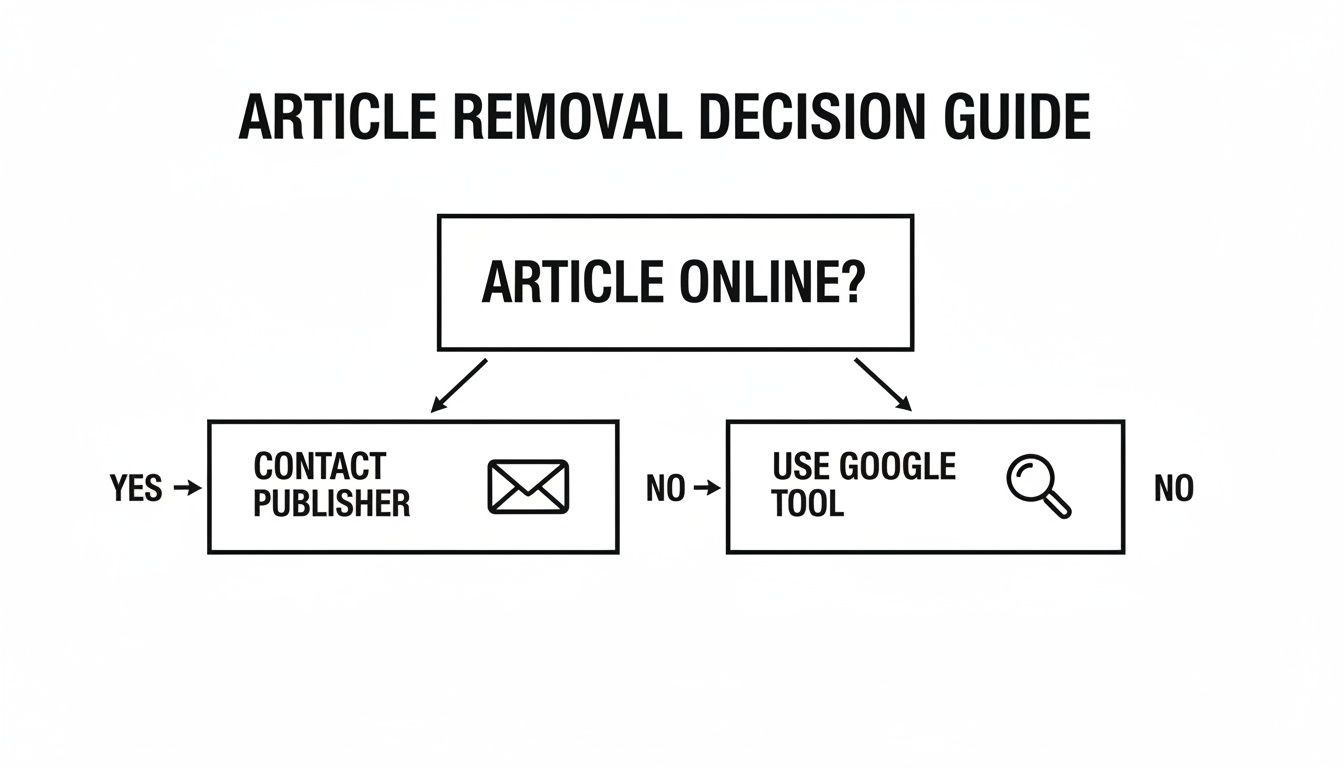
As you can see, the core question is simple: is the article still online? If yes, start with the publisher. If no, go to Google.
To help you decide which path makes the most sense, I've put together a quick comparison table. It breaks down the main strategies so you can see at a glance which one fits your needs.
Comparing Your Article Removal Options
| Removal Method | Best For | Success Probability | Estimated Timeline |
|---|---|---|---|
| Publisher Request | Factual errors, outdated information, or when you have a good relationship with the site. | Medium | Days to Weeks |
| Google's Outdated Content Tool | Articles that have been removed or changed but still show up in search results. | High (if criteria are met) | 24-48 hours |
| Legal/Policy Takedown | Defamation, copyright infringement, doxxing, or severe privacy violations. | Varies (High with strong evidence) | Weeks to Months |
| Hiring a Reputation Firm | Complex cases, multiple negative articles, or when you need professional firepower. | High (with the right firm) | Months |
This table should give you a solid starting point. Remember, these are just estimates, and every case is unique.
A Quick Reality Check
Be prepared: this isn't an overnight fix. A friendly publisher might take down an article in a few days. A formal legal request with Google, on the other hand, could easily take weeks or even months to get reviewed. Success is never a sure thing, which is why a methodical, documented approach is your best friend. For instance, understanding the detailed processes behind strategies for reinstating a suspended account on platforms like Amazon can offer great insight into how large tech companies handle policy violations and appeals.
The most important advice I can give you is this: be persistent, be professional, and document everything. Save every email, screenshot every form you submit, and organize all your evidence. This paper trail is the most valuable thing you'll have if things get complicated and you need to escalate your case.
Go Straight to the Source: Contacting the Publisher
Your first move should almost always be to contact the publisher directly. Think of it this way: asking Google to de-index a page is like asking a librarian to hide a book. Contacting the publisher is like asking the author to un-publish it entirely. It's the cleanest, most permanent solution.
Going to the source cuts the problem off at the root. Once the page is gone from their website, it’s gone for good. It can’t be found through Google, Bing, or even a direct link someone saved.
You’d be surprised how often a polite, well-reasoned request works. Most site owners, whether they’re running a small personal blog or a major news outlet, don't want outdated or just plain wrong information on their site.
Finding the Right Person to Email
Here's where a little detective work pays off. Firing off an email to a generic info@ or contact@ address is like throwing a message in a bottle—it’ll probably never reach the person who can actually help you.
You need to find someone with the keys to the content. Start your search on the website's "About Us," "Team," or "Contact" pages. Look for titles like:
- Editor-in-Chief or Managing Editor: These are your best bets for news sites, online magazines, and high-quality blogs. They own the content.
- Webmaster or Site Administrator: For smaller sites or forums, this person handles the technical side and usually has the power to remove pages.
- The Author: If the article has a byline, reaching out to the writer directly can be incredibly effective. They have a personal stake in the accuracy of their work and might be your biggest advocate for getting a correction or update pushed through.
Can't find a direct email? Don't give up. Tools like Hunter.io are great for sniffing out email addresses. You can also search for the person on LinkedIn and see if they have contact information listed or send them a polite message there.
My Two Cents: Your goal here is to make it incredibly easy for them to say "yes." When you put a clear, professional request in front of the right person, you remove all the friction. It shows them you're serious and you've done your homework.
How to Craft a Request That Actually Gets Read
The tone of your email is everything. You're asking for help, not demanding action. Even if the article is causing you a world of frustration, keep your communication calm, professional, and respectful. An angry, threatening email is a one-way ticket to the trash folder.
Keep it simple and direct. Your email needs to give them everything they need to make a decision without a lot of back-and-forth.
Make sure your email includes these four things:
- A Clear Subject Line: Get straight to the point. "Request for Correction Regarding Article [Article Title]" or "Content Removal Request" works perfectly.
- The Exact URL: Don't make them hunt for it. Copy and paste the full link to the page right at the top of your email.
- Your Reason: In plain language, explain why the content should be removed or changed. Stick to the facts and avoid emotional appeals.
- Proof: This is non-negotiable. If you’re claiming something is factually incorrect, provide documentation to back it up. If it's a privacy issue, briefly explain the specific harm it's causing.
For instance, imagine a business publication got your company's numbers wrong. You could write something like this:
"The article states our company's annual revenue is $500,000. This is incorrect. As you can see from our attached official financial summary, our revenue for that fiscal year was $1.2 million. We would be grateful if you could correct this error to ensure your reporting is accurate."
See? It's objective, helpful, and backed by evidence. You're not accusing them; you're helping them improve their content.
The Gentle Art of the Follow-Up
People are busy. Inboxes are a disaster. It’s entirely possible your well-crafted email simply got missed. If you don’t hear anything back after about a week, sending a polite follow-up is completely fine.
Just reply to your original message with a simple note like, "Just wanted to gently follow up on my email below. Any help would be greatly appreciated."
Don't spam them. One polite nudge every 7-10 business days is more than enough. If you've sent two or three follow-ups with no response, that’s your answer. It's time to accept this route is a dead end and move on to the next steps, knowing you gave it a fair shot.
Turning to Google’s Official Removal Tools
So, you've tried contacting the publisher directly and either got no response or a flat-out "no." Don't lose hope. Your next move is to go straight to the source: Google itself.
Now, let's be crystal clear about what this means. Google can't march onto someone else's website and delete their article. That power belongs solely to the publisher. What Google can do is de-index the page, effectively making it invisible in their search results. For most people, if it's not on Google, it might as well not exist. This is a powerful alternative.
To do this, you have to play by Google's rules and use their official channels. Each tool is designed for a very specific scenario, so success hinges on picking the right one and building a solid case.

For Content That's Already Gone: The Outdated Content Tool
This is probably the most common tool people use, but it's also the most misunderstood. The Remove Outdated Content tool has one, and only one, purpose: to remove search results for pages that have already been changed or deleted by the website owner.
Think of Google's search index as a massive library catalog. If a publisher removes a book (the article) from their shelf, the catalog might not get updated right away. This tool is your way of telling the librarian, "Hey, this card points to a book that isn't there anymore. Please remove it."
It's a fantastic way to speed things up if the publisher already did their part. But I have to stress this: if the article is still live and unchanged, this tool will not work. Your request will be instantly and automatically denied.
For Legal and Policy Violations
When you're dealing with something more serious than just an outdated page, you need to escalate. Google provides specific legal forms for content that violates the law or its own strict policies. These requests are manually reviewed by specialized teams, so your evidence has to be airtight.
This is where you move from "this is incorrect" to "this is illegal or harmful." Filing the right type of claim is the most important first step.
The most common takedown requests fall into a few key categories:
- Copyright Infringement (DMCA): This is your go-to when someone has stolen your original work—a blog post you wrote, a photo you took, a video you produced—and posted it without permission. You’ll need to provide URLs to both the stolen copy and your original content to prove ownership.
- Privacy Violations: This covers the malicious publication of sensitive, private information, a practice often called "doxxing." We're talking about things like your private phone number, home address, financial details, or medical records. This policy also covers non-consensual explicit imagery.
- Defamation: This is, by far, the toughest nut to crack. Simply telling Google that an article contains lies about you isn't enough. In nearly all cases, you'll need an official court order declaring the content legally defamatory. Without that legal document, Google is highly unlikely to intervene in what it sees as a personal dispute.
Google sees itself as a neutral party. It's not a judge or jury. For serious legal claims like defamation, they need a ruling from an actual court before they'll step in and remove content from their search results.
How to Build a Winning Removal Request
No matter which form you use, the quality of your submission is everything. A lazy, vague request is a guaranteed denial. You need to present a clear, concise, and evidence-backed case that makes it easy for the Google reviewer to say "yes."
Here’s how to give your request the best shot at success:
- Be Hyper-Specific with URLs: Don't just give them the website's homepage. Provide the exact, full URL of the specific page with the problematic content.
- Explain It Clearly: In the description box, be calm and factual. Explain exactly which policy is being violated. Quote the specific sentences or passages from the article that are the problem.
- Provide Proof: This is non-negotiable. If it's a DMCA claim, link to your original work. For a privacy violation, take clear screenshots. For defamation, attach the signed court order.
Submitting the request is just the start. If you're dealing with a particularly stubborn or complex issue, our comprehensive guide to Google content removal strategies dives into more advanced tactics. The goal is always the same: build an undeniable case that leaves the reviewer with no other choice but to approve it.
Handling Defamation and Privacy Takedowns

Sometimes an article crosses a line. It's no longer just negative or inaccurate—it's actively harmful. We're talking about content that's defamatory, harassing, or a major invasion of your privacy. In these situations, a polite email to the publisher just won't cut it. You need to shift your strategy to a formal, evidence-based takedown.
This is when you escalate the fight using legal frameworks and Google's own policies against harmful content. It’s a different game entirely. Unlike asking for a simple correction, this path forces you to prove the content violates specific laws or platform rules. The burden of proof is high, but getting the content removed for good is worth the effort.
This approach is becoming more common. Content related to privacy, security, defamation, and fraud consistently rank as top reasons for removal demands. We saw defamation spike in 2020, privacy and security dominate from 2021-2022, and fraud take the lead in 2023. This trend shows why treating article removal as a formal process is often necessary.
What Counts as Defamation and Privacy Violations Online?
Before you can build a case, you have to know what you're fighting. Vague complaints are easily dismissed. You need to anchor your request in a specific, recognized violation.
Defamation (Libel): This is a false statement, presented as fact, that damages your reputation. The key here is that it must be provably false. An opinion, no matter how nasty, isn't defamation. "This contractor did a bad job" is an opinion. But, "This contractor stole materials from my home," if untrue, is a different story—that could be libel.
Privacy Violations: This usually means someone has exposed sensitive personal information without your permission, a practice often called "doxxing." Think financial data, medical records, or intimate personal details that have no business being public.
Harassment: This isn't just criticism; it's content that is threatening, abusive, or designed to incite hatred against you. For Google to act, it typically has to be severe and targeted.
Let's be clear: Google is extremely hesitant to remove content, especially when freedom of speech is involved. For defamation, that means you can't just tell them an article is false. You have to prove it.
Gathering Your Evidence for a Legal Takedown
A successful takedown request is built on a mountain of solid, undeniable evidence. Your job is to hand Google a file so compelling they have no choice but to act.
Start by meticulously documenting everything. Keep your evidence organized and crystal clear, so the reviewer can understand the situation immediately.
Here’s what you should have in your evidence file:
- Timestamped Screenshots: Get clear screenshots of the full article, the URL, and any social media posts sharing it. Make sure the date and time are visible.
- Proof of Falsity: If the claims are defamatory, find documents that directly contradict them. If an article says your business is unlicensed, include a copy of your official business license.
- Witness Statements: If other people can confirm that the statements are false or that you've suffered harm, a signed and dated statement can add serious weight to your claim.
The single strongest piece of evidence for a defamation claim is a court order. Nothing beats a legal document from a judge declaring the content defamatory. It's the gold standard and dramatically boosts your chances of getting the article pulled from Google.
When to Bring in Legal Professionals
Navigating defamation and privacy law is tricky. You can submit initial requests yourself, but there are clear signals that it's time to call in the experts. If the publisher is ignoring you or becomes hostile, or if the article is causing serious financial or personal damage, you need legal counsel.
For most people, a good first step is consulting a civil litigation lawyer. They can assess the strength of your case and map out a legal strategy.
Legal pros are essential for securing that all-important court order or for drafting a cease-and-desist letter that has real teeth. If your reputation is under a serious attack, our team also offers expert guidance through the entire https://levelfield.io/defamation-removal, handling the complex details so you can get back to what matters.
When to Hire a Professional Reputation Management Service
Trying to get an unwanted article off Google by yourself is a great starting point. But sometimes, you're just outgunned. Certain situations are too complex, too aggressive, or have spread too far for one person to handle.
When you hit that wall, calling in a professional reputation management service isn't admitting defeat—it's a smart tactical move. These pros are the special forces of content removal. They have the experience, the tools, and the connections to fight battles you simply can't win on your own.
Think of it this way: you might be able to fix a leaky faucet, but for a burst pipe flooding your basement, you call a plumber. Immediately. It's the same principle here.
Recognizing When You're In Over Your Head
Knowing when to ask for help is half the battle. If you spend months fighting a losing war, the negative content can become even more entrenched, making it exponentially harder to clean up later.
If any of these situations sound familiar, it's a clear sign you need to bring in the experts.
- You're Facing a Coordinated Attack: One bad article is annoying. A dozen showing up at once is a full-blown crisis. If you see multiple negative articles, a flood of fake reviews, and hostile social media posts all appearing in a short period, you're almost certainly the target of a deliberate smear campaign. A pro team can spot the patterns and dismantle the attack from multiple angles.
- The Publisher is a Ghost: What happens when the website has no contact form, no email, no author name? What if they're hiding behind proxy services? Reputation firms have sophisticated tools and investigation methods to unmask anonymous publishers, a feat that's next to impossible for the average person.
- The Legal Issues Get Complicated: The problem might involve tricky international defamation laws or require a deep understanding of how platform policies differ from country to country. Specialized firms either have legal experts on staff or work hand-in-hand with law firms that live and breathe this stuff.
The real secret sauce of a good reputation service isn't just that they send takedown notices. It's their deep, institutional knowledge of how search engines and review platforms really work. They know the unwritten rules and have direct contacts, allowing them to frame a removal case in a way that gets it in front of the right person who can actually make a decision.
How to Choose the Right Reputation Firm
Picking the right partner is absolutely critical. Let's be honest—the online reputation industry has its share of shady operators who make big promises and deliver nothing. You need a firm that is transparent about its methods, operates ethically, and plays by the rules.
When you're vetting a company, don't be shy. Ask the hard questions. Their answers will tell you everything.
Your Vetting Checklist:
- "Walk me through your exact process." They should be able to explain their entire methodology, from the initial analysis to the final report. Vague, hand-wavy answers are a huge red flag.
- "Can I see some case studies or speak with a reference?" A legitimate firm will have success stories and testimonials to back up their claims, even while protecting client confidentiality.
- "How do you define and report on success?" Get specific. Does success mean the URL is de-indexed, the article is gone for good, or something else entirely? Make sure your goals are perfectly aligned.
- "What's your fee structure?" You want total transparency. Run from any company that uses high-pressure sales tactics or offers unrealistic guarantees, like a 100% success rate. It's just not possible.
- "Do you follow platform terms of service?" This is a deal-breaker. Using "black hat" tactics can backfire spectacularly, potentially getting you penalized by Google and making the problem far worse.
Ultimately, hiring a professional service is an investment in your digital footprint and your peace of mind. When you’re facing a relentless online assault, having a team of seasoned pros in your corner can turn a long, stressful fight into a swift, decisive victory.
Your Top Questions About Google Removals, Answered
When you're trying to get an article taken down from Google, it's easy to feel lost. The process can seem complicated and the rules confusing. Let’s clear up some of the most common questions I hear from people, so you can move forward with a bit more confidence.
How Long Does It Take for Google to Remove an Article?
This is the big one, isn't it? The honest answer is: it really depends on which path you take. There’s no single timeline, and each removal method has its own review period. Knowing this from the start helps manage expectations during what can be a pretty stressful time.
Here’s a realistic breakdown of what you're looking at:
- Going to the Publisher Directly: This can be surprisingly fast. If you’ve got a solid reason and the publisher is responsive, the article could be gone or fixed in just a few days. But if they drag their feet or you need to follow up, it could easily stretch into weeks.
- Using Google's Outdated Content Tool: Once the publisher has actually removed or changed the page, this tool is a lifesaver. You submit the link, and Google usually processes it within 24 to 48 hours. Just remember, the content must be gone from the live site first for this to work.
- Filing Legal or Policy Takedown Requests: Settle in, because this is the long haul. These requests are reviewed by real people on specialized teams and often require a mountain of evidence. You could be waiting anywhere from several weeks to a few months for a decision, depending on how complex your case is and how swamped Google’s team is at the moment.
Will the Article Be Gone Forever Once It's Removed?
Not necessarily, and this is a crucial point that trips a lot of people up. Getting something out of Google search is not always the same as erasing it from the internet completely. The permanence of the removal depends entirely on how it was taken down.
If you successfully get the publisher to delete the article from their website, then yes, it's gone for good. You've eliminated the source. That page ceases to exist and can't be found by anyone—not through Google, other search engines, or even a direct link.
But if you only use one of Google’s removal tools to "de-index" the URL, the story is different. The article will vanish from Google's search results, making it effectively invisible. However, the page itself still lives on the original website. Anyone who has the direct link can still see it, and it might even pop up on other search engines like Bing or DuckDuckGo.
Think of it this way: A publisher removal is like recalling and destroying every copy of a book. A Google de-indexing is like removing the book's card from the library catalog—the book is still on the shelf, you just can't find it.
What if My Removal Request to Google Is Denied?
Getting that denial email from Google feels like hitting a brick wall. It’s disheartening, but it’s rarely the end of the line. A denial is usually just a signal that your first attempt didn't tick all of their very specific boxes.
Your first move should be to read their reasoning carefully. Google’s denial emails aren't typically generic; they usually point to the exact weakness in your submission.
Common reasons for a denial include:
- Not Enough Proof: You didn't provide sufficient evidence to back up your claim.
- Wrong Tool for the Job: You tried using the Outdated Content tool for a page that is still live and unchanged.
- It's Not a Policy Violation: The content might be negative, but it doesn't technically break any of Google’s specific removal rules.
If your request gets denied, you can almost always strengthen your case and try again. This means gathering more compelling evidence, framing your argument better, or making sure you’re filing under the correct policy. Frankly, a denial is often a sign that it might be time to get some professional help to build a more powerful case.
Can I Remove an Article That Is Negative But True?
This is, without a doubt, the toughest situation to be in. Getting factually accurate information removed is incredibly difficult. Google sees its mission as organizing information, and its policies are strongly tilted toward protecting free expression, even when that information is unflattering.
Generally speaking, Google will not remove an article just because it’s negative or embarrassing, as long as the facts are correct. You can't file a defamation claim, because truth is the ultimate defense against defamation.
Your best—and often only—shot here is to negotiate directly with the publisher. Your appeal can't be about the facts. Instead, you have to find another angle. You could argue the information is outdated, no longer in the public interest, or that leaving it up is causing you disproportionate harm. It’s less of a demand and more of a plea for empathy and perspective.