



Managing a doctor's online reputation means actively overseeing and shaping your digital presence. It's about more than just reviews; it's about managing patient feedback, making sure your online information is correct, and ultimately building the kind of trust that brings new patients through your door. It's a strategic effort that has a real, measurable impact on your practice's growth.
Your Digital Reputation Is Your New First Impression
Not too long ago, a doctor's reputation was built almost entirely on word-of-mouth referrals and your standing in the local community. Today, that first impression is made online, often weeks or even months before a potential patient considers booking an appointment.
Your digital footprint—everything from your Google Business Profile to your Healthgrades page—is the new referral. It's shaping how people see you and your practice on a massive scale.

The Patient Journey Has Gone Digital
The way patients find and choose a new doctor has completely changed. A recommendation from a friend is still valuable, but now it’s almost always followed by a quick search online to see what others are saying.
The numbers don't lie. A staggering 90% of patients now use online reviews to check out physicians. For 77% of them, it’s the very first thing they do. This tells us one thing loud and clear: your online reputation isn't just a "nice to have"—it's the main engine driving patient trust and new appointments.
To illustrate how critical this is, let's look at the key stages where your online presence comes into play.
The Modern Patient's Decision-Making Journey
| Stage | Patient Action | Impact of Online Reputation |
|---|---|---|
| Awareness | Experiences a symptom or receives a referral from a friend or primary care physician. | A strong online presence makes your practice visible during initial searches for specialists or local doctors. |
| Consideration | Searches online for the doctor's name or "best [specialty] near me." | This is where star ratings and review volume become critical. A low rating can immediately disqualify you. |
| Validation | Reads recent reviews on Google, Healthgrades, and Vitals. Checks the practice website and social media. | Patients look for consistent positive feedback, professional responses to negative reviews, and an up-to-date website. |
| Decision | Compares 2-3 top candidates and makes a choice based on overall online impression and logistics. | A polished, trustworthy digital footprint gives patients the confidence to pick up the phone and book. |
This online vetting process is incredibly influential. Further research shows that 84% of patients wouldn't even book an appointment with a referred doctor if they had a rating below four stars. Think about that. A handful of poor reviews can completely cancel out a glowing personal recommendation from a trusted source.
The Digital Touchpoints That Define You
Effective reputation management goes beyond just chasing five-star ratings. It’s about carefully building a professional and trustworthy image across all the places where patients are looking. A proactive approach to healthcare reputation management isn't just a good idea; it's essential for survival.
Patients are forming their opinions based on a few key areas:
- Review Sites: Platforms like Google, Healthgrades, Vitals, and even Yelp are now the front doors to your practice.
- Your Practice Website: Is it modern, easy to navigate, and professional? Does it feature authentic patient testimonials? This is your digital home base, and it needs to build instant credibility.
- Social Media: Active profiles that share useful health tips or a behind-the-scenes look at your team can create a genuine connection with potential patients.
- Search Results: What shows up on the first page of Google when someone searches for your name? That first page is your new business card.
Your online presence is a direct reflection of your practice's commitment to patient care. Every review, every listing, and every response contributes to a narrative that can either attract new patients or drive them away. Ignoring this is no longer an option for a thriving medical practice.
Getting a Real-World Look at Your Online Reputation
Before you can start building a five-star reputation, you have to see what patients see right now. A solid doctor online reputation management plan always begins with an honest, unflinching audit of your digital footprint. This isn’t just about cherry-picking the good reviews; it’s a systematic deep dive to find the good, the bad, and the completely invisible across the entire web.
The idea is to put yourself in a potential patient's shoes. They aren't just googling your practice name. They're searching for individual doctors, looking up your specialty, and even typing in their symptoms to find a local provider. To get a true picture, your audit has to mimic this real-world behavior.
How to Search Like a Patient
To see what everyone else sees, you need to use a few different search tactics. Don't just type your clinic's name into Google and call it a day. The first step is crucial: open an incognito or private browser window. This simple action prevents your personal search history from skewing the results, giving you a clean, unbiased view.
Try searching for yourself and your practice in a few different ways:
- By Practice Name:
"[Your Practice Name] reviews" - By Doctor Name:
"[Dr. [Your Name]] reviews" - By Specialty and Location:
"best [specialty] in [city]"or"[specialty] near me" - By Condition:
"[condition] doctor in [city]"
This multi-faceted approach shows you what different kinds of patients are finding. The person who was referred directly to Dr. Smith will see one set of results, while someone frantically searching for a local cardiologist will see something entirely different. You need to understand both patient journeys.
The Key Platforms You Can't Ignore
Your audit has to go way beyond a simple Google search. Patients have a handful of go-to, healthcare-specific sites they trust for vetting doctors. You absolutely have to check your profiles on each one, looking closely at your ratings, reviews, and how complete your information is.
Here’s the essential checklist:
Google Business Profile: This is your digital front door. It’s often the very first impression a patient gets. What's your star rating? How many reviews do you have? What are people saying in the most recent ones?
Healthgrades: A giant in the physician-rating world. Scour your profile here for accuracy, look at the detailed patient experience scores, and read every single comment, especially the negative ones.
Vitals: Similar to Healthgrades, Vitals gives patients a place to rate everything from your bedside manner to the average wait time.
Yelp: It might not be built for healthcare, but a huge number of patients still use Yelp to review doctors. An unclaimed or neglected profile here is a major blind spot that can really hurt you.
An incomplete or outdated profile on any of these sites is an immediate red flag for a potential patient. It can signal a lack of attention to detail—a quality nobody wants in their doctor. Your audit needs to catch these gaps right away.
Looking Beyond the Stars
A 4.5-star rating is great, but it doesn't tell the whole story. The real gold is buried in the details of the reviews themselves. As you go through each platform, document what you find. You're not just counting stars; you're looking for patterns.
Here's what to dig into:
- Recurring Themes: Are multiple people mentioning long wait times? Is your front desk staff consistently getting shout-outs for being amazing? These trends point directly to systemic strengths and weaknesses in your patient experience.
- Outdated Information: This is a big one. On every single profile, check your address, phone number, and office hours. Incorrect information is an incredibly common—and easily fixed—problem that causes immense patient frustration.
- Response (or Lack of) Patterns: Are you responding to reviews? If so, are the responses professional and, most importantly, HIPAA-compliant? Seeing a wall of reviews with zero replies can make a practice look like it just doesn't care.
- Photo Quality: Do your profiles have a professional, current headshot of you? Are there clean, well-lit photos of your office? Grainy, outdated, or nonexistent images do nothing to build trust with someone who has never met you.
Doing this level of detailed audit gives you a baseline—a starting point. It takes you from guessing what your reputation is to knowing precisely where you stand. Once you have this clear, evidence-based picture, you can finally build a targeted strategy that shores up your weaknesses and truly showcases your strengths.
Picking the Right Tools for Your Reputation Toolkit
Once you’ve taken a hard look at your online presence, it's time to get the right technology in your corner. Let's be realistic—manually keeping tabs on everything said about you online is a losing battle. A solid doctor online reputation management strategy depends on having a smart toolkit to automate the grunt work, help you respond quickly, and proactively build the positive digital footprint you want. The idea is to stop putting out fires and start fireproofing your reputation.
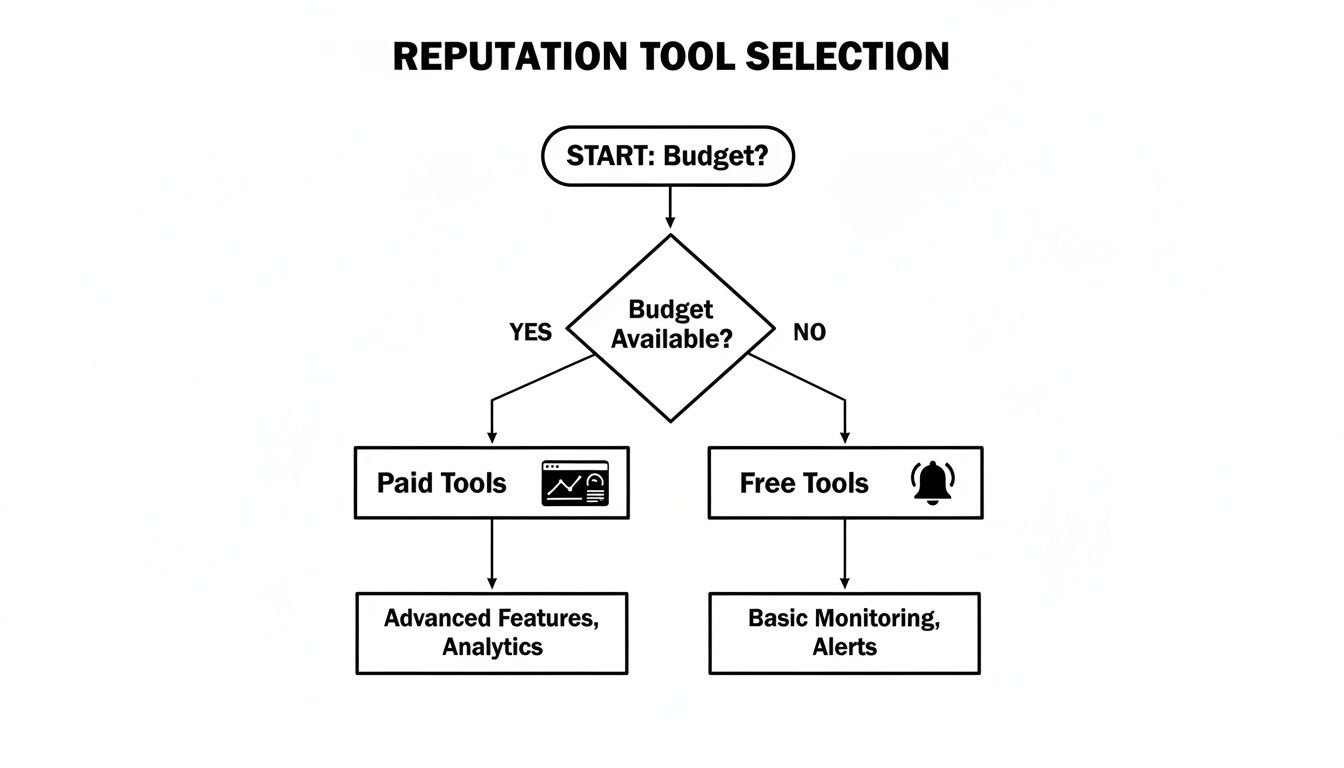
You don't need to break the bank to get started, either. The trick is to pick a tech stack that actually fits your practice's size, budget, and what you’re trying to achieve. From free alerts to powerful, all-in-one platforms, there's a good fit for everyone.
Getting Started: Free and Low-Cost Options
If you're a solo practitioner or run a small clinic, starting with free tools is a great way to build the right habits without the financial commitment. These tools give you the basic visibility you need to get going.
- Google Alerts: This is the easiest first step. Set up alerts for your name, your partners' names, and your practice name. You'll get an email anytime you're mentioned on a new web page, in the news, or on a blog. It’s simple but effective.
- Manual Checks: I know it’s not automated, but blocking out just 15 minutes a week to manually scan your profiles on Google, Healthgrades, and Vitals is non-negotiable. It’s the only way to ensure you catch new reviews right away.
These DIY methods work, but they demand consistency. The biggest downside is that nothing is connected. You'll find yourself jumping between a dozen browser tabs and emails trying to piece together the full picture of what people are saying.
When to Upgrade to a Comprehensive Platform
As your practice grows—or if you're juggling multiple doctors and locations—a dedicated reputation management platform becomes a necessity. These systems are built to save you time, keep you compliant, and give you insights that free tools just can't touch.
This isn’t just a nice-to-have anymore; it's quickly becoming standard procedure. A 2023 industry report found that a staggering 68% of healthcare practices now use some form of reputation management technology. It's a clear signal that the industry sees managing online feedback as a core business function, not just a side marketing task.
Think of these platforms as a central command center for your online reputation. They pull reviews from dozens of sites into a single dashboard so you can respond, analyze trends, and see everything in one place. The data shows feedback is heavily concentrated on a few major players: Google Business Reviews account for 37%, with Facebook at 23% and Yelp at 14%. A good platform will cover these giants while still keeping an eye on the smaller, healthcare-specific sites. You can dig into the numbers in the full report on doctor reputation management trends.
Must-Have Features for Any Healthcare Reputation Tool
When you start looking at paid software, you have to be picky. A generic tool built for restaurants or retailers won't get the unique compliance and communication challenges you face in healthcare.
Here’s what you should look for, no exceptions:
- HIPAA-Compliant Workflows: This is the absolute deal-breaker. The platform must be secure and offer features like pre-approved, HIPAA-safe response templates to prevent you from accidentally disclosing protected health information.
- Automated Review Requests: The best defense is a great offense. A system that automatically texts or emails happy patients after their appointment to ask for a review is the single most powerful way to build a five-star reputation.
- Sentiment Analysis: The smarter tools use AI to read between the lines of your reviews, flagging recurring themes. This can offer incredible operational feedback—like discovering that patients constantly complain about long wait times or consistently praise a specific front-desk staff member.
- Multi-Platform Monitoring: The software needs to pull reviews and mentions from everywhere that matters—Google, Healthgrades, Vitals, WebMD, social media—and put them all into one clean, manageable inbox.
For practices looking to take their strategy to the next level, particularly when it comes to managing tricky reviews or launching a major reputation-building campaign, partnering with professional review services can provide expert guidance that works hand-in-hand with your software.
Responding To Reviews Without Violating HIPAA
Engaging with patient feedback online is one of the most powerful things you can do for your practice's reputation, but it's also where the stakes are highest. One wrong move in a review response can trigger a serious HIPAA violation, turning a good-faith effort into a legal and financial nightmare.
The secret is learning to respond in a way that acknowledges the feedback without ever confirming that the reviewer is, or ever was, a patient of your practice. It feels unnatural at first, but it's the only safe way to operate. The Health Insurance Portability and Accountability Act (HIPAA) is incredibly strict; something as simple as acknowledging a reviewer by name or mentioning their visit is a clear disclosure of Protected Health Information (PHI).
Your responses must stay general and professional. They should focus on your practice's standards of care, not the individual's specific, personal experience.
The Golden Rule Of HIPAA-Compliant Responses
Your absolute top priority is protecting patient privacy. This means you cannot confirm, deny, or even hint that a reviewer is a patient. A simple "Thank you for your visit, Jane" is an instant violation. Instead, you need a strategy that shows you're listening while keeping the entire public conversation generic.
The core principle is simple: Acknowledge the feedback, state your practice's commitment to quality care, and move the conversation offline. This approach shows prospective patients that you take feedback seriously without putting your practice or your license at risk.
The moment you engage with the specifics of a review online, you've crossed a line. A compliant response is never about winning an argument; it's about professionally de-escalating the situation and inviting a private, secure conversation.
Here are the non-negotiables for every single review response:
- Never use the reviewer’s name. I don't care if they use their full name and a clear profile picture. Don't do it.
- Do not confirm patient status. Avoid any phrasing like, "We're sorry about your experience at our clinic."
- Do not discuss any specific details. Never mention appointments, treatments, billing, or diagnoses in your public reply.
- Always provide an offline contact method. Offer a direct phone number or email for a specific person, like a practice manager.
HIPAA-Compliant Review Response Templates
To make this easier, here are some practical, copy-and-paste templates. They're designed to be safe, effective, and adaptable for the most common review scenarios you'll encounter. Think of this table as your quick-reference guide for staying on the right side of the law.
| Review Type | Key Objective | HIPAA-Safe Response Example |
|---|---|---|
| Positive Review | Show appreciation without confirming patient status. | "Thank you for sharing your positive experience. We strive to provide excellent care and appreciate you taking the time to leave feedback." |
| Vague Negative Review | Acknowledge the issue generally and guide the conversation offline. | "We are committed to providing timely and efficient care for everyone. We take all feedback seriously and encourage you to contact our office manager directly at [phone number] to discuss your experience." |
| Detailed Negative Review | De-escalate and firmly pivot to a private channel, citing privacy rules. | "We take patient care and feedback very seriously. While we cannot discuss any specific situations online due to privacy regulations, we urge you to contact our patient advocate at [phone number] so we can address your concerns directly." |
These templates give you a solid, compliant starting point. The goal isn't to be robotic, but to have a reliable framework that protects everyone involved.
Handling The Most Upsetting Reviews
The toughest reviews are the ones filled with specific, often inaccurate, claims about a visit. The temptation to jump in and correct the record is immense. Don't. This is where your discipline is tested most.
Imagine a review that falsely details a misdiagnosis and a billing error. Your only move is to stay general and immediately pivot offline. It's not just about the law; truly understanding and responding to online reviews effectively is about knowing which battles to fight and where to fight them.
- Non-Compliant (and a huge mistake): "That's incorrect. Your diagnosis was confirmed by lab results, and your bill was for the co-pay you failed to pay at your visit."
- HIPAA-Safe (the only right answer): "We take patient care and feedback very seriously. While we cannot discuss any specific situations online due to privacy regulations, we urge you to contact our patient advocate at [phone number] so we can address your concerns directly."
This response is firm, professional, and—most importantly—compliant. It shows accountability to the public while protecting both the patient's privacy and your practice from legal jeopardy. For more detailed tactics, our guide on how to respond to negative Google reviews breaks this down even further. Mastering this skill is a cornerstone of modern reputation management for any medical professional.
Tackling Fake Reviews and Defamatory Content
Let's be honest—seeing a false or defamatory review pop up online feels like a direct hit to your professional integrity. It's easily one of the most frustrating parts of managing your reputation, but it's a battle you can absolutely win if you have a clear plan. The secret is to stay strategic and procedural, not emotional.
First things first, you have to know what you're up against. Not every negative review can be taken down. In fact, most can't. The critical distinction is between a negative opinion (which is protected speech) and a verifiably false statement of fact (which usually violates platform policies).
- This is protected opinion: "I felt the doctor was rushed and didn't listen to my concerns." It's subjective, and it's staying up.
- This is a false statement of fact: "This doctor charged me for a procedure they never performed." This is a specific, provable claim. If it's untrue, you have a solid case for removal.
This single distinction changes everything. Your success hinges entirely on proving a specific policy was broken, not just that you disagree with what was said.
How to Spot and Report Policy Violations
Every platform, from Google to Healthgrades, has its own rulebook. Your task is to get familiar with the common violations and build your case around them.
Look for reviews that clearly break the rules, such as:
- Spam and Fake Content: The review is obviously from a bot, a competitor, or someone who was never a patient.
- Conflicts of Interest: The post is from a disgruntled former employee or a rival practice down the street.
- Off-Topic Rants: The review isn't about their experience with you but is a soapbox for complaining about healthcare costs or insurance in general.
- Harassment or Hate Speech: The content contains threats, personal insults, or discriminatory language.
- Impersonation: Someone is posting reviews pretending to be you or another individual.
Once you’ve pinpointed a clear violation, it's time to report it. Gather all the evidence you have. This could be internal records (for your eyes only, never shared publicly) showing the person was never a patient, or even screenshots of the same review posted for a dozen other doctors.
When you report a review, you're not pleading your case to a judge. You're flagging it for a content moderation system. Your goal is to make it dead simple for the moderator to see the violation. Be concise, stick to the facts, and point directly to the rule that was broken.
Why Protecting Your True Reputation Matters
Pushing back against fake reviews isn't about vanity. It's about making sure patients can find truly high-quality care. The data here is surprisingly strong: physicians with higher ratings tend to have better educational credentials, follow clinical guidelines more closely, and even achieve better clinical outcomes for their patients.
This research highlights why reputation defense is so critical in healthcare. Fake reviews don't just ding a doctor's revenue; they can actively steer patients away from excellent providers and toward less-qualified ones with artificially inflated ratings. To see the data for yourself, you can explore the research on physician ratings and quality of care.
When to Bring in the Lawyers
Most of the time, you can resolve these issues through the platform's reporting channels. But in rare situations involving severe, ongoing defamation that's causing real financial damage, you might need to explore your legal options. This is a big step and shouldn't be taken lightly.
Before you even think about calling an attorney, make sure the situation clears a high bar. You'll need to show that the statements are:
- Verifiably false statements of fact, not just someone's opinion.
- Published to a third party, like a public review website.
- Caused tangible harm to your reputation or your practice's bottom line.
Document everything. Keep copies of the defamatory posts, your attempts to get them removed through the proper channels, and any evidence of the financial hit your practice has taken. Legal action is a last resort, but knowing it's in your toolkit is a key part of a strong reputation defense.
Proactively Building a Five-Star Reputation

True doctor online reputation management isn't just about damage control. The best practices I've worked with aren't playing defense; they're on offense. They systematically build a digital presence that actually reflects the high quality of care they provide every day.
It's about creating a steady, ethical flow of positive patient stories. When you do this right, that occasional negative comment gets drowned out, and you build a wall of trust that attracts new patients before they even call your office.
The secret? Your happiest patients are often your quietest. While a frustrated patient is highly motivated to vent online, someone who had a great, routine visit often needs a gentle nudge. Your job is to make it incredibly simple for them to share their positive story, turning that goodwill into a tangible asset for your practice.
Ethically Encouraging Patient Feedback
Getting more positive reviews comes down to one thing: asking for them consistently and professionally. This isn't about being aggressive or offering gift cards, which is a major red flag that violates platform policies and destroys credibility. It’s about weaving a simple, polite request into your existing patient workflow.
Timing is everything. The best moment to ask is shortly after a good appointment, while the positive experience is still fresh. This can be done through a few simple, often automated, methods that work.
- Post-Visit Messages: An email or text sent within a few hours of an appointment can be a game-changer. A simple "thank you" with a direct link to your preferred review site is incredibly effective.
- In-Office Cues: Think simple. A small sign with a QR code at the checkout desk can prompt patients to leave feedback while they're waiting.
- A Well-Trained Team: Your front-desk staff is your front line. Empower them to spot happy patients and say something as simple as, “We're so glad you had a good visit today. If you have a moment, we'd be so grateful if you shared your experience online.”
The objective isn't to cherry-pick only glowing feedback. It's about increasing the total volume of reviews. Most patient experiences are good. By encouraging more of them to speak up, you naturally pull your average rating up to a more accurate reflection of the care you provide.
Making the Review Process Frictionless
Let's be honest, your patients are busy. If leaving a review takes more than two or three taps on their phone, you've lost them. You have to remove every ounce of friction between their willingness to help and hitting "submit."
This means sending a direct link that goes exactly where it needs to. Don't just say, "Find us on Google." Give them a link that opens the Google review box for your practice directly. This one small change can make a massive difference in your conversion rate from request to published review.
Key Metrics to Measure Your Success
A proactive reputation strategy needs clear goals. After all, you can't improve what you don't measure. Tracking a handful of key performance indicators (KPIs) will tell you if your efforts are actually working and where you need to adjust course.
I recommend focusing on these essentials:
- Average Star Rating: Keep a close eye on your rating across crucial platforms like Google and Healthgrades. Your target should be a steady trend toward 4.5 stars or higher.
- Review Volume: How many new reviews are you getting each month? If this number is climbing, your feedback request system is working.
- Review Recency: Fresh reviews matter—a lot. They tell prospective patients and search engines that your rating is current and trustworthy.
- Sentiment Trends: Use your management tool to dig into what people are saying. For example, are complaints about wait times disappearing after you made a change to your scheduling? This proves your feedback loop is working.
Watching these numbers gives you a clear, data-backed view of your online health. It turns doctor online reputation management from a reactive headache into a measurable growth strategy for your practice.